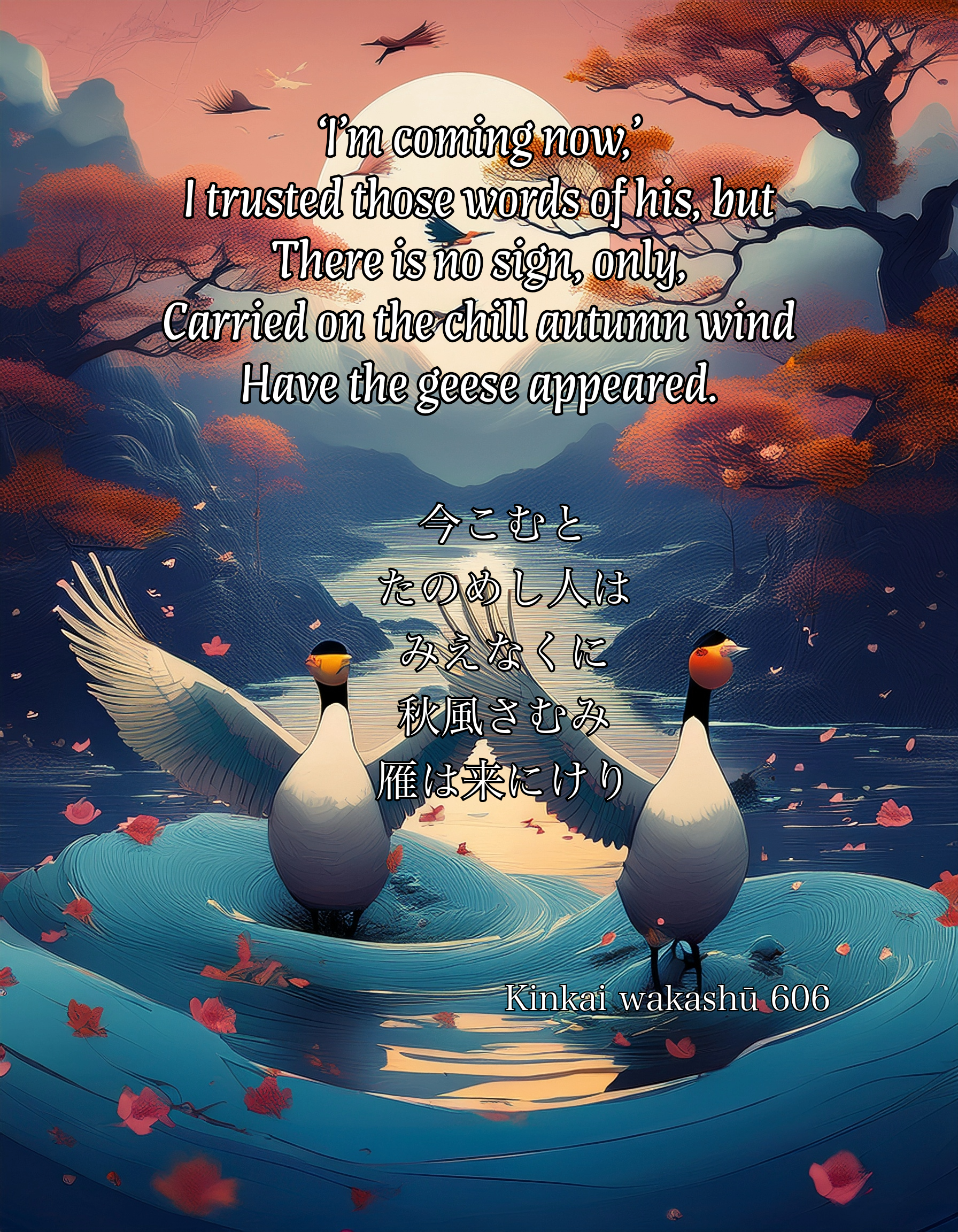
ima komu to tanomeshi hito wa mienaku ni akikaze samumi kari wa kinikeri
‘I’m coming now,’ I trusted those words of his, but There is no sign, only, Carried on the chill autumn wind Have the geese appeared.[i]
606
[i] See: Topic unknown. いまこむとたのめしことをわすれずはこのゆふぐれの月やまつらん ima komu to / tanomeshi koto o / wasurezu wa / kono yūgure no / tsuki ya matsuran ‘ “I’m coming now,” / If, that she trusted those words of mine / She has not forgotten, then / This evening / The moon might she be awaiting, too? ’ Fujiwara no Hideyoshi (Shinkokinshū XIII: 1203)
I sent this to the residence of someone, who had gone to a distant province, when they had said they’d return around the Eighth Month and there had been no sign of them by the Ninth.
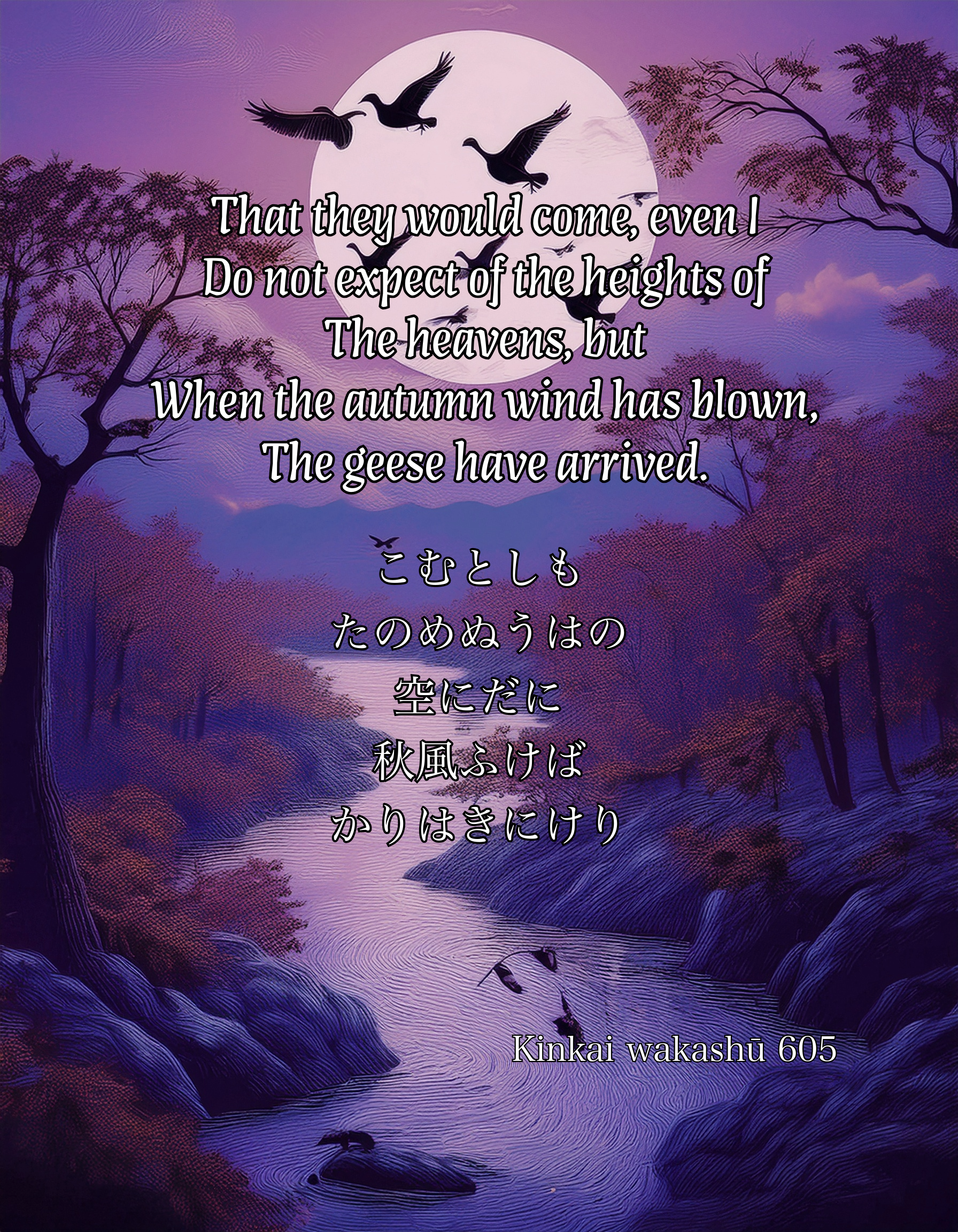
こむとしもたのめぬうはの空にだに秋風ふけばかりはきにけり
komu to shimo tanomenu uwa no sora ni dani akikaze fukeba kari wa kinikeri
That they would come, even I Do not expect of the heights of The heavens, but When the autumn wind has blown, The geese have arrived.[i]
605
[i] See: Love carried on the wind. きくやいかにうはのそらなる風だにもまつにおとするならひありとは kiku ya ika ni / uwa no sora naru / kaze dani mo / matsu ni otosuru / narai ari to wa ‘Do you hear it? Well? / From the heavens’ heights / Even the wind, / To come whispering among the pines / Has grown accustomed.’ Kunaikyō (Shinkokinshū XIII: 1199); and: A poem from the poetry competition at Prince Koresada’s house. 秋風にはつかりがねぞきこゆなるたがたまづさをかけてきつらむ akikaze ni / hatsukari ga ne zo / kikoyunaru / ta ga tamazusa o / kaketekitsuran ‘On the autumn wind / Come the first goose cries. / I hear them; / Whose letters / Do they bring, I wonder?’ Ki no Tomonori (Kokinshū IV: 207)
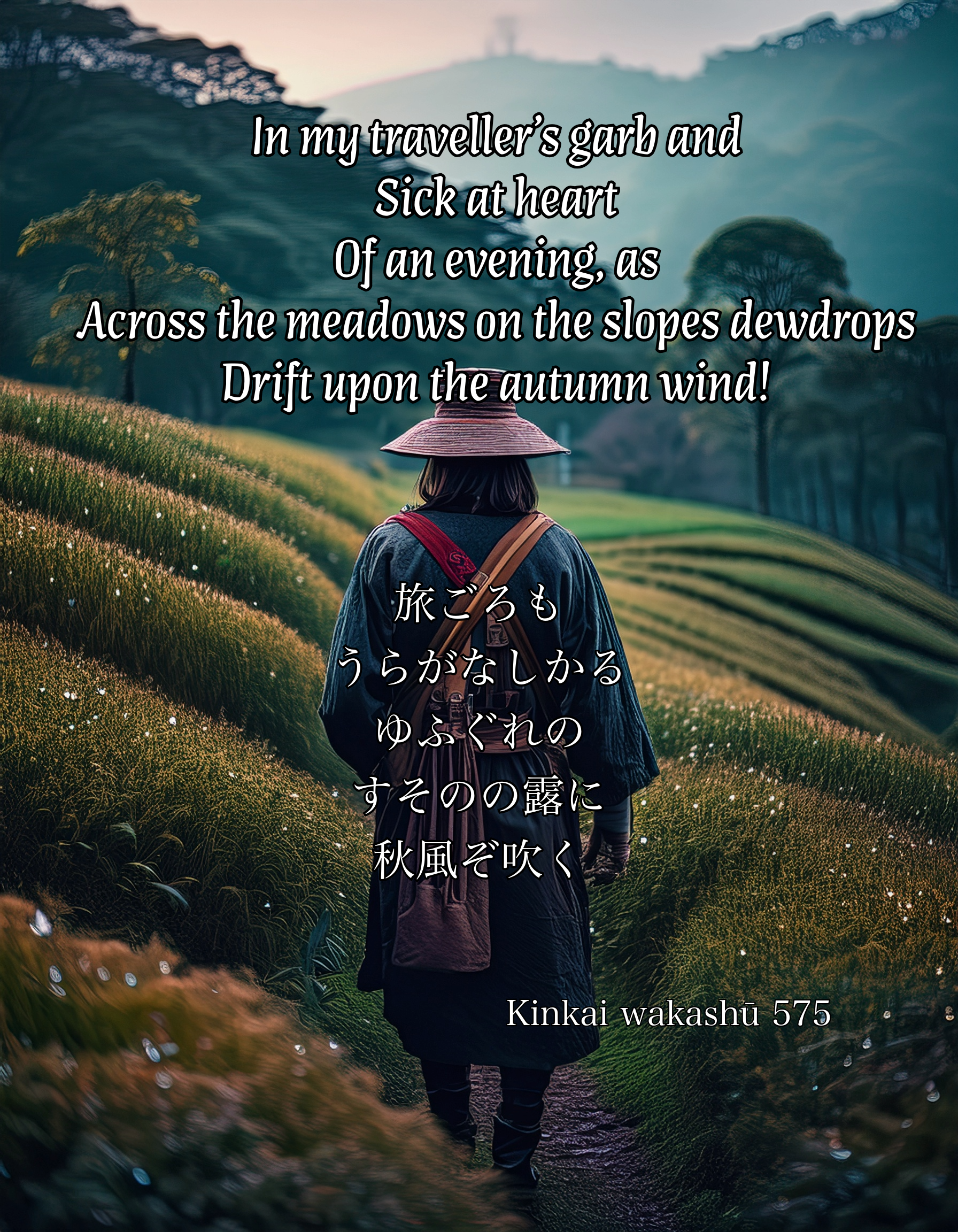
tabigoromo uraganashikaru yūgure no susono no tsuyu ni akikaze zo fuku
In my traveller’s garb and Sick at heart Of an evening, as Across the meadows on the slopes dewdrops Drift upon the autumn wind! [i]
575
[i] See: 旅ごろもうらがなしさにあかしかね草の枕は夢もむすばず tabigoromo / uraganashisa ni / akashikane / kusa no makura wa / yume mo musabazu ‘In my traveller’s garb / My heart-sickness / I cannot lift, for / My grassy pillow / Brings no dreams, at all…’ Hikaru Genji (Genji monogatari 223); and: たびごろもうらがなしかるあさぢふによはのしぐれよいかにせよとぞ tabigoromo / uraganashikaru / asajū ni / yowa no shigure yo / ika ni seyo to zo ‘In my traveller’s garb and / Sad at heart among / The clumps of cogon grass, / O, midnight shower, / Tell me, what I am I to do?’ Jakuchō (Sumiyoshi-sha uta’awase kaō ni-nen 54)
saoshika no fushido o asami fuku kaze ni yowa ni naku ne zo fukaku nariyuku
The stag’s Resting place disturbed by The gusting wind At midnight his belling cry Comes from deeper in the mountains.
Chikanari 77
Right
さらでだにね覚かなしき秋風に夜しもなどか鹿の鳴くらん
sarade dani nezame kanashiki akikaze ni yoru shimo nado ka shika no nakuran
Even were it not so, To waken is so sad With the cruel autumn wind; Why is it that above all at night The stag should cry so?
Ie’kiyo 78
The Left poem’s ‘at midnight his belling cry comes from deeper’ does not sound especially elegant. The Right poem composes ‘why is it that above all at night the stag should cry so’, sounding like it is only at night that stags bell, but stags do this all the time in autumn. The Ancient and Modern also has the composition, ‘Mud-daubers buzzing / In the autumn bush clover; / Leaving with morning’.[1] The poems of Left and Right have no merits or faults between them—they should tie.
[1] This is a quotation from: Topic unknown. すがるなく秋のはぎはらあさたちて旅行く人をいつとかまたむ sugaru naku / aki no hagiwara / asa tachite / tabi yuku hito o / itsu to ka matan ‘Mud-daubers buzzing / In the autumn bush clover; / Leaving with morning, / Away on a journey: for him, / How long must I wait?’ Anonymous (KKS VIII: 366)
mononofu mo aware to omoe azusayumi hikino no yowa no saoshika no koe
Let even a warrior Feel pity! A catalpa bow drawn On Hiki Plain at a midnight Stag’s call.
The Former Minister of the Centre 67
Right (Win)
つれもなきつまをやたのむ秋風の身にさむき夜は鹿も鳴くなり
tsure mo naki tsuma o ya tanomu akikaze no mi ni samuki yo wa shika mo nakunari
Is it his heartless Bride he seeks? The autumn wind Chills the bones at night As the stag, too, does cry.[1]
Kozaishō 68
The Left’s poem seems to have no faults worth mentioning, but the Right’s poem is composed with the poem ‘The autumn wind / Chills my bones / As cold as / The woman I hope for / In the dark, night after night’ in mind and seems particularly pleasant, so it wins.
[1] An allusive variation on: Topic unknown. 秋風の身にさむければつれもなき人をぞたのむくるる夜ごとに aki kaze no / mi ni samukereba / tsuremonaki / hito o zo tanomu / kururu yo goto ni ‘The autumn wind / Chills my bones / As cold as / The woman I hope for / In the dark, night after night.’ Dharma Master Sosei (KKS XII: 555)
uwaba fuku ashita no hara no akikaze ni onore utsurou hagi no shitazuyu
Blowing upon the upper leaves Over Ashita Plain, The autumn breeze touches, Fading all of itself The dripping dew upon the bush clover.
Tomoshige 63
Right
今よりはたが涙とか成りぬらん下葉色づく秋萩の露
ima yori wa ta ga namida to ka narinuran shitaba irozuku akihagi no tsuyu
From now on Whose tears might They become? Colouring the underleaves Are dewdrops upon the autumn bush clover…[1]
Dharma Master Zenshin 64
Left and Right are in the same style. The Right’s poem wonders ‘whose are these tears’ and has a person’s tears as the dew upon the grass, which is something one often hears. Using dew on the grass as a person’s tears is a bit vague, yet it’s not going so far as to be a definite fault. These should tie.
[1] An allusive variation on: Topic unknown. あきはぎのしたば色づく今よりやひとりある人のいねがてにする akihagi no / shitaba irozuku / ima yori ya / hitori aru hito no / inegatenisuru ‘The autumn bush clover’s / Underleaves are colouring / From this point on, / For one all alone / Will sleep be harder to find?’ Anonymous (KKS IV: 220)
takasago no susono no ma’hagi tsuyu fukashi mine no akikaze fukazu mo aranamu
On Takasago’s Slopes the fair bush clover is Deep in dew— O, that the autumn winds from the peak Would fail to blow…
The Supernumerary Major Counsellor 53
Right
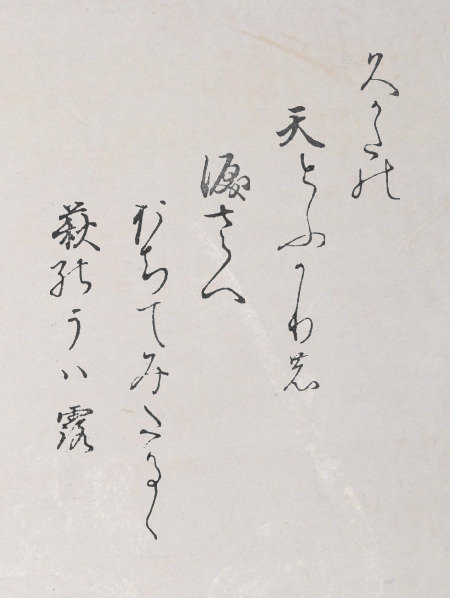
久かたの天とぶかりの涙さへおちてみだるる萩のうは露
hisakata no ama tobu kari no namida sae ochite midaruru hagi no uwazuyu
From the eternal Heavens flying, even the goose Tears Drop in confusion Overlaying the dew upon the bush clover.[1]
Nobunari 54
Both Left and Right seem particularly pleasant. Thus, they tie.
[1] An allusive variation on: Topic unknown. なきわたるかりの涙やおちつらむ物思ふやどの萩のうへのつゆ nakiwataru / kari no namida ya / ochitsuran / mono’omou yado no / hagi no ue no tsuyu ‘Calling across / Did the geese let tears / Fall? / My dwelling, lost in thought, / Has dew upon the bush clover.’ Anonymous (KKS IV: 221)