Tag Archives: ama

Eien narabō uta’awase 30

Round Two

Left (Win)

君がよはあまのいはとをいづるひのいくめぐりてふかずもしられず

kimi ga yo wa
ama no iwato o
izuru hi no
iku meguri chō
kazu mo shirarezu
My Lord’s reign:
Since from the stone door in the heavens
Emerged the sun,
‘How many circuits has she made?’, they ask—
A number quite unknown.

Lord Saburō
59

Right

みかさやまふもとのさとはあめのしたふるにおもひもあらじとぞ思ふ

mikasayama
fumoto no sato wa
ame no shita
furu ni omoi mo
araji to zo omou
At Mikasa Moutain’s
Foot, in a hamlet
‘neath the heavens
Passing time—painful thoughts
There I’d have not a one, I feel!

Ushigimi
60

The Left’s poem goes beyond the general flow of diction, containing mystery and depth. I have to say it is truly superior. While the Right’s poem has no faults to mention, it has yet to emerge from prosaic expression. Thus, the Left wins.

The ‘stone door in the heavens’ is that which the supreme sun-deity Amaterasu stood before and then entered. But when we’re talking about dawn breaking at the end of night, we say ‘gates of heaven’. Which of these two was did the poet have in mind, I wonder? If he was thinking of dawn breaking, then the usage is erroneous, but even if he did mean ‘stone door of the heavens’, then do we use this about the circuits of the sun? This is vague. In addition, the final ‘they ask’ is difficult to pronounce. As for the Right’s poem, ‘‘neath the heavens’ lacks emotion. The dual use of ‘thoughts’ and ‘feels’, as I have already remarked, is not an error, but does grate on the ears a bit.

Eien narabō uta’awase 09

Round Two

Left

をちかたやくも井の山のほととぎすあまつよそにもなきわたるかな

ochikata ya
kumoi no yama no
hototogisu
ama tsu yoso ni mo
nakiwataru kana
From the distant
Mount within the clouds
A cuckoo
In yonder heavens
Sings his song!

Lord Saburō
17

Right

ほととぎすしのだのもりのしのびねをたづねざりせばいかできかまし

hototogisu
shinoda no mori no
shinobine o
tazunezariseba
ikade kikamashi
A cuckoo
In Shinoda’s sacred grove
Lets out a hushed cry;
Had I not come to visit here,
How might I have heard it?

Ushigimi
18

In regards the poem of the Left’s ‘from the distant’ and what follows, extremely recently and colloquially, at the Nakatomi purification ceremony it seems there was a composition, ‘in the distance, below the trees so lush’. This diction is contrary to the expected style of waka and something which occurs only extremely rarely. Truly, one does not compose using such diction in a poetry match. The poem of the Right has nothing of interest about it, yet it also lack faults to mention, so it wins.

This round, neither poem appears bad. The Left has a novel style, while the Right seems cliched, but its expression is smooth. I wonder if we could see these as a tie.

Entō ōn’uta’awase 27

Round Twenty-Seven

Left (Tie)

高砂のすそ野の真萩露ふかし嶺の秋風ふかずもあらなむ

takasago no
susono no ma’hagi
tsuyu fukashi
mine no akikaze
fukazu mo aranamu
On Takasago’s
Slopes the fair bush clover is
Deep in dew—
O, that the autumn winds from the peak
Would fail to blow…

The Supernumerary Major Counsellor
53

Right

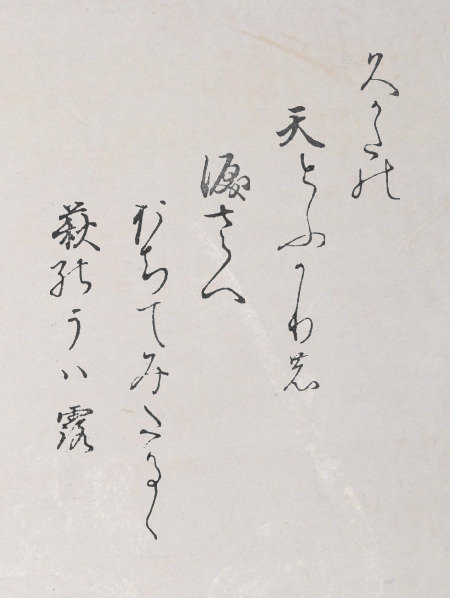
久かたの天とぶかりの涙さへおちてみだるる萩のうは露

hisakata no
ama tobu kari no
namida sae
ochite midaruru
hagi no uwazuyu
From the eternal
Heavens flying, even the goose
Tears
Drop in confusion
Overlaying the dew upon the bush clover.[1]

Nobunari
54

Both Left and Right seem particularly pleasant. Thus, they tie.


[1] An allusive variation on: Topic unknown. なきわたるかりの涙やおちつらむ物思ふやどの萩のうへのつゆ nakiwataru / kari no namida ya / ochitsuran / mono’omou yado no / hagi no ue no tsuyu ‘Calling across / Did the geese let tears / Fall? / My dwelling, lost in thought, / Has dew upon the bush clover.’ Anonymous (KKS IV: 221)

Naidaijin-ke uta’awase 31

Round Seven

Left

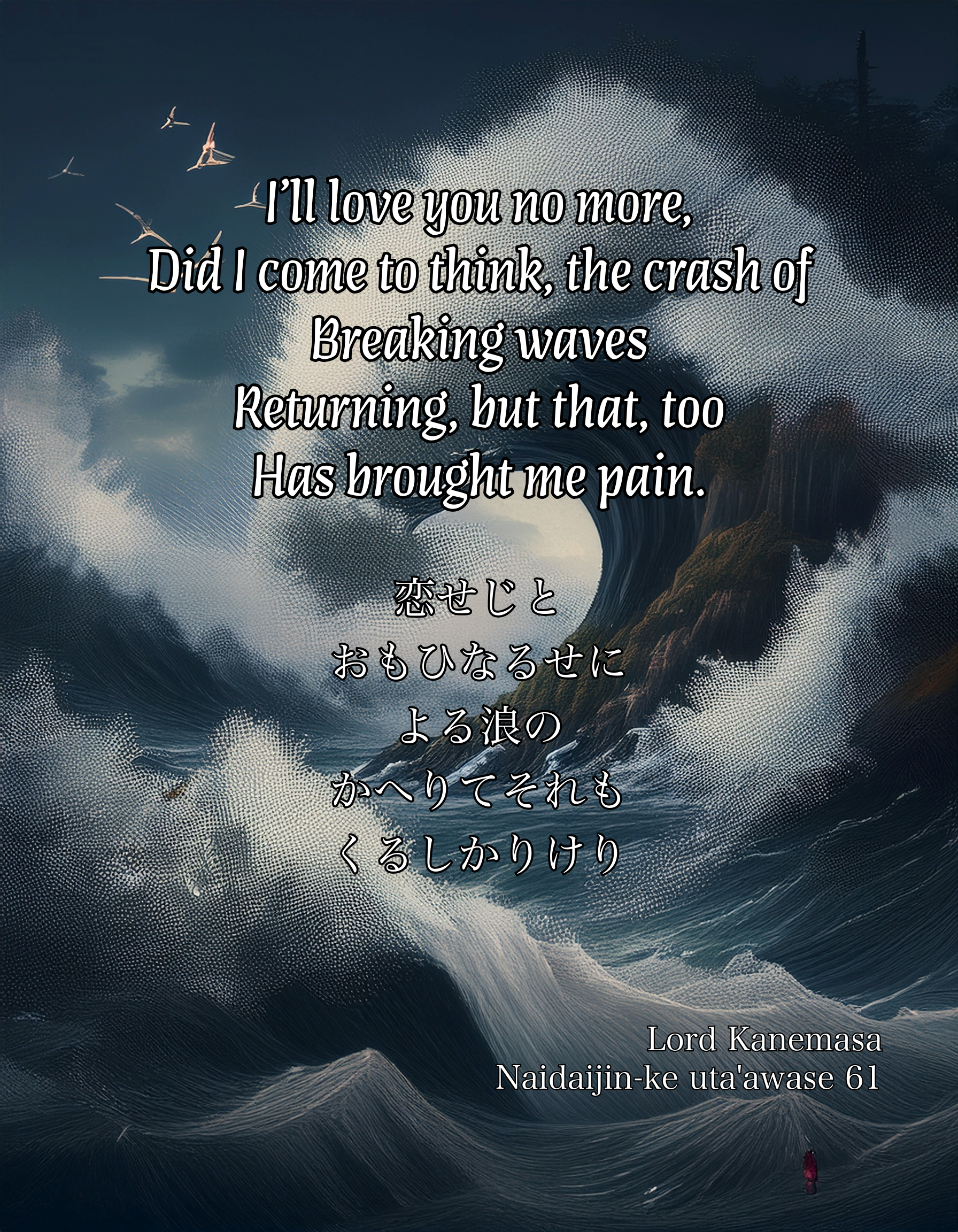
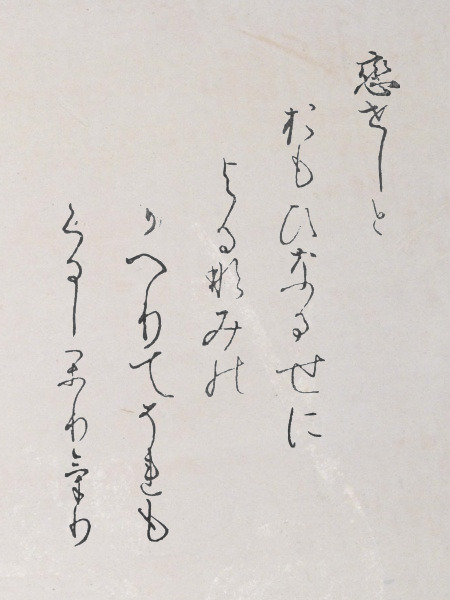
恋せじとおもひなるせによる浪のかへりてそれもくるしかりけり

koiseji to
omoinaru se ni
yoru nami no
kaerite sore mo
kurushikarikeri
I’ll love you no more,
Did I come to think, the crash of
Breaking waves
Returning, but that, too
Has brought me pain.

Lord Kanemasa
61

Right (Both Judges – Win)

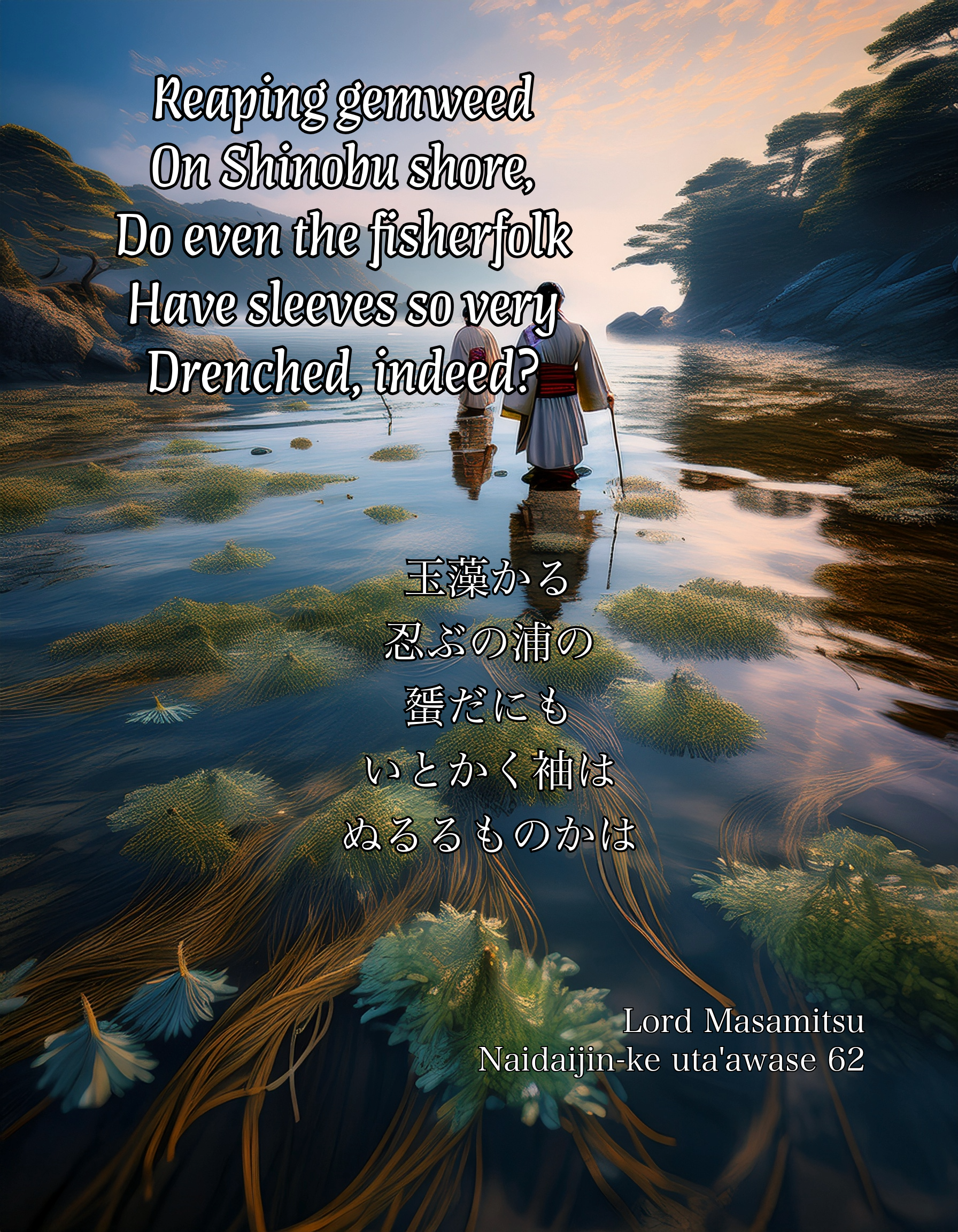
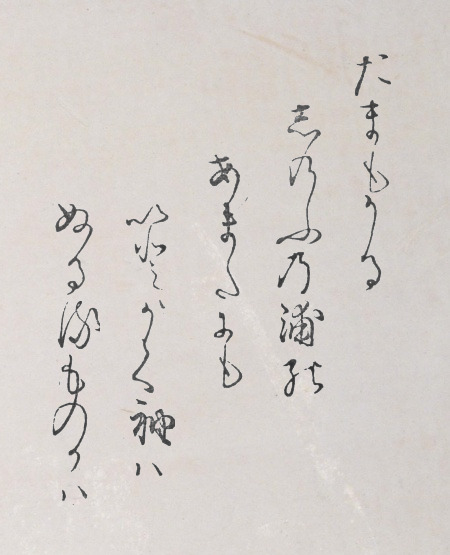
玉藻かる忍ぶの浦の蜑だにもいとかく袖はぬるるものかは

tamamo karu
shinobu no ura no
ama dani mo
ito kaku sode wa
nururu mono ka wa
Reaping gemweed
On Shinobu shore,
Do even the fisherfolk
Have sleeves so very
Drenched, indeed?

Lord Masamitsu
62

Toshiyori states: both of these are charming, however, a line from a famous poem is used for as the initial section, and in such cases the new poem should not closely evoke the source. Someone once said something similar, a long time ago. It’s a bit inferior, isn’t it.

Mototoshi states: neither of these contain any errors, yet the section following the central ‘crash of / Breaking waves’ seems intermittently painful, with sleeves damper than those of the fisherfolk on Shinobu shore. It seems a bit better at present.

SKKS XVIII: 1723

Composed when he was far from courtier’s hall.

あまつ風ふけひの浦にゐるたづのなどか雲井にかへらざるべき

ama tsu kaze
fukei no ura ni
iru tazu no
nado ka kumoi ni
kaerazarubeki
Heaven’s breezes
Blow upon the shore at Fukei, where
Rests a crane:
Why, beyond the clouds,
May he not return?

Fujiwara no Kiyotada
藤原清正[1]


[1] Fujiwara no Kiyotada 藤原清正 (?-953): one of the Thirty-Six Poetic Immortals and a minor courtier. As well as being included in Shinkokinshū, this poem is also listed in Wakan rōeishū (II: 453), Kiyotada’s personal collection, Kiyotada-shū (89) and also the personal collection of Fujiwara no Tadami 藤原忠見, Tadami-shū (143). While Wakan rōeishū simply gives the topic of the poem as ‘Cranes’, the personal collections provide more information. Tadami states that the poem was ‘Sent to the Shōni Palace Lady to present in his place when he was of about the age to be admitted to the Courtier’s Hall and had become Governor of Kii’ making the waka a plea for further advancement at court. Kiyotada himself simply says ‘When I had become Governor of Kii and had not yet been permitted to enter the Courtier’s Hall.’ Tanaka and Akase (1992, 502)  note that Kiyotada was appointed Governor of Kii while still a Chamberlain at Sixth Rank, when this was usually a post held by someone of Junior Fifth Rank, Lower Grade, the lowest rank at which a man would be permitted to enter the Courtier’s Hall (tenjō no ma 殿上間) and have direct contact with the emperor. The poem is, thus, simultaneously, an expression of gratitude for imperial favour (the ‘heavenly wind’) to him (‘the crane’) which has made him Governor of Ki – the province where Fukei is located, and a plea that he be allowed above ‘the clouds’ (into the Courtier’s Hall), which is subtly laced with resentment (‘Why haven’t I had the promotion in rank which this post would normally bring?’)!

Zōki-hōshi shū 5

I stayed by the beach at Fukiage. The moon was fair in the extreme, and the beach was a place where it was said that heavenly beings would often descend to and make merry. Truly, it was a fair place, indeed! That night, the sky was heart-rendingly moving, and as the night wore on, the breeze, brushing fallen frost from the ducks’ wing-feathers, brought loneliness to the skies, while the distant cries of cranes, calling for their comrades, was so moving, my words fail to express it. Birds other than these flocked, calling from the sandbars and even my insensitive and unfeeling self was moved beyond measure.

をとめごが天の羽衣ひきつれてむべもふけ井の浦におるらん

otomego ga
ama no hagoromo
hikitsurete
mube mo fukehi no
ura ni oruran
Heaven’s maidens’
Feathered robes,
Drawn up by
The gusts at Fukehi
Beach when they rest there.