Tag Archives: ariake

Eien narabō uta’awase 21

Round Seven

Left

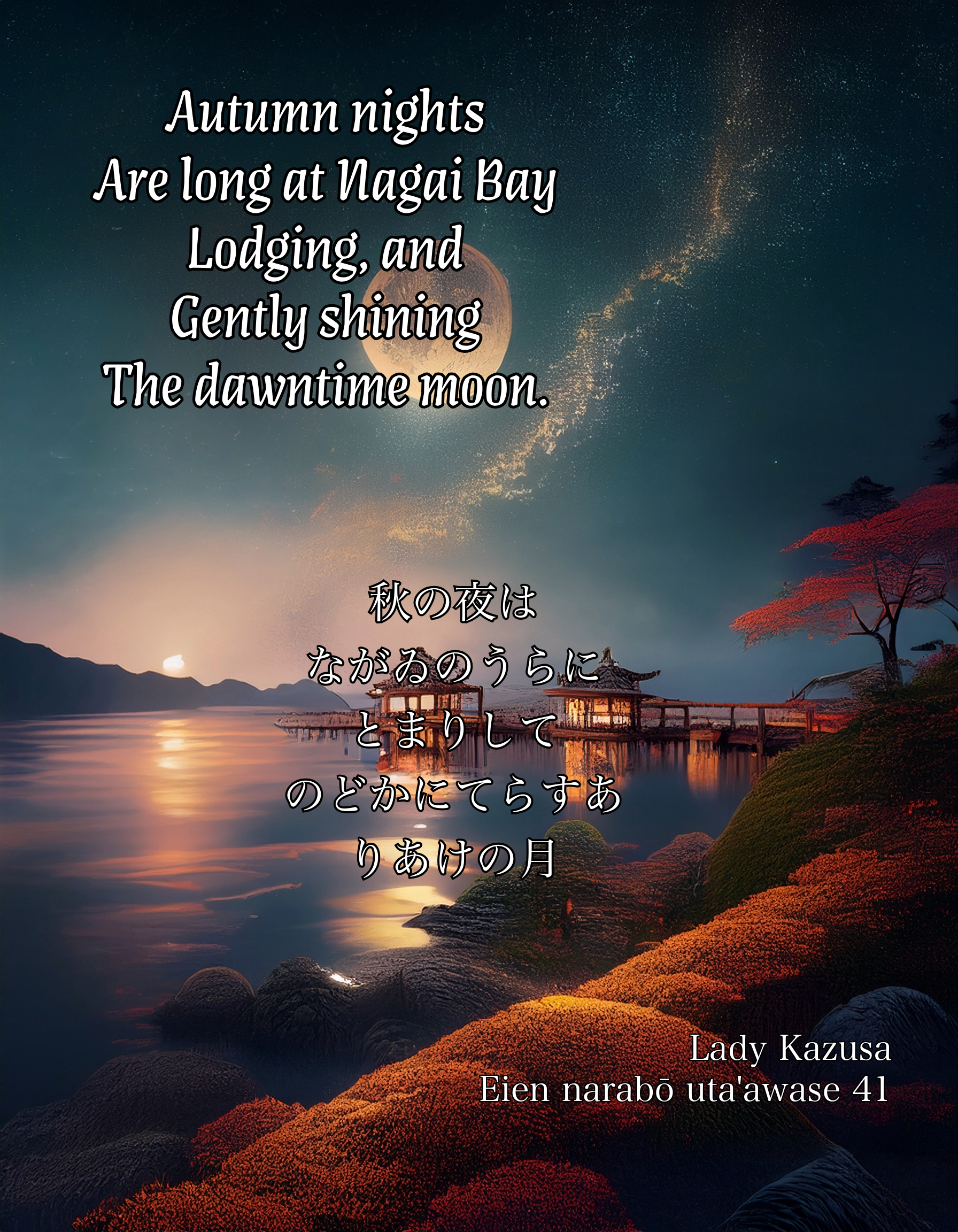
秋の夜はながゐのうらにとまりしてのどかにてらすありあけの月

aki no yo wa
nagai no ura ni
tomarishite
nodoka ni terasu
ariake no tsuki
Autumn nights
Are long at Nagai Bay
Lodging, and
Gently shining
The dawntime moon.

Lady Kazusa
41

Right (Win)

秋の夜のくもふきはらふあらしこそ月みるひとのこころなりけれ

aki no yo no
kumo fuki’harau
arashi koso
tsuki miru hito no
kokoro narikere
On an autumn night
The clouds a’blowing away,
The storm wind, truly,
As someone gazing upon the moon
Has the selfsame heart!

Lady Shikibu
42

The poem of the Left certainly imagines the scene just as it is. With that being said, however, the dawntime moon is not present long enough. The Right’s poem simply sounds like one composed by Atsutaka for the ‘Poetry Match held at the Residence of the Former Captain of the Outer Palace Guards, Left Division’.[i] Thus, it’s impossible for me to determine a winner or loser.

It’s a poem which we see in the Poetry Match at Lord Moroyori’s Residence.

冬のよの雲ふきはらふ木枯や月見る人の心なるらむ

fuyu no yo no
kumo fuki’harau
kogarashi ya
tsuki miru hito no
kokoro naruramu
On a winter’s night
The clouds a’blowing away,
The bitter wind, indeed,
As someone gazing upon the moon
The same heart seems to have![ii]

In the poem of the Left, is it the moon or the poet who is lodging at Nagai Bay? If it’s the moon, then ‘lodging’ is erroneous; if it’s the poet, then ‘gently shining’ doesn’t work. In addition to this vagueness, I do also question whether ‘dawntime’ sounds appropriate. As for the Right’s poem, ‘as someone gazing at the moon / Has the selfsame heart!’ is an elegant conception, and the diction is also smooth. It reminds me of an earlier work by someone else. Thus, it wins.

[i] This match has a several different titles, Mototoshi refers to here as both: Zen sa-hyōe no kami no ie no uta’awase 前左兵衛督家歌合 and also Moriyori-kyō no ie uta’awase 師頼卿家歌合, but it is also known as the ‘Poetry Match held by the Late Master of the of the Crown Prince’s Household’ (Ko-tōgū daibu ie uta’awase 故東宮大夫家歌合) and the ‘Poetry held by Moroyori, Captain of the Outer Palace Guards, Right Division’ (U-hyōe no kami moroyori uta’awase 右兵衛督師頼歌合): the text of this match is no longer extant, but it is known to have taken place in the winter Tennin 天仁 2 (1109). Fujiwara no Kiyosuke notes that it was judged by Toshiyori, but Mototoshi disagreed with his assessments and submitted at set of judgements of his own in appeal (Fujioka 1995, 212).

[ii] This poem is included in Shoku shikashū (VI: 293), attributed to Moroyori, with the headnote, ‘Composed on the moon in winter’.

Eien narabō uta’awase 20

Round Six

Left

あきの夜のありあけのつきはくまもなしあさくらやまもなのみこそあらめ

aki no yo no
ariake no tsuki wa
kuma mo nashi
asakurayama mo
na nomi koso arame
At an autumn night’s
Dawn, the moon
Has not a cloud before it;
The Mount of Morning Dark
May be so in name alone!

Cell of Fragrant Cloud
39

Right (Win)

秋の月あかしのうらはなびきもにすむわれからのかずも見つべし

aki no tsuki
akashi no ura wa
nabikimo ni
sumu warekara no
kazu mo mitsubeshi
The autumn moon is
Bright above Akashi Bay;
Among the trailing seaweed
Dwell tiny shrimp,
Their number now clear to my eyes.

Cell of Compassionate Light
40

The poem of the Left is an entirely tedious composition. It simply states that a cloudless autumn moon does not fit with the place name, Mount Asakura. The moon at ‘dawn’ is the same as the moon at ‘dawntime’, while Mount Asakura is used when dawn has completely finished. As for the poem of the Right, while the moon is described as bright, it doesn’t seem right to then make it a poem about trailing seaweed—this does not seem charming at all. This round, too, there’s not much more I can say than that.

As I have already mentioned, ‘moon at dawn’ in the poem of the Left is an expression which it is impossible to say is praiseworthy. Even more so, really, the concluding ‘may be so in name alone’ just says ‘is so in name alone’, doesn’t it? It’s contrary to reason to say that it’s fluent and thus, and I say this reluctantly, it’s difficult to understand. As for the Right’s poem, I don’t understand this either: it ought to be ‘their numbers, too, I have been able to see’—saying ‘their number now clear to my eyes’ implies that you haven’t previously been able to see them up to that point, and it’s vague about when you have. Even so, it’s getting light, so the light of the moon at dawn seems superior.

Eien narabō uta’awase 16

Round Two

Left (Win)

秋のよの月のひかりはかはらねどたびのそらこそあはれなりけれ

aki no yo no
tsuki no hikari wa
kawaranedo
tabi no sora koso
aware narikeri
On an autumn night
The moon’s light
Is unchanged, yet
The sky above me on my travels
Is so very sad, indeed.

Lord Saburō
31

Right

あきの夜はたのむる人もなきやどもありあけの月はなほぞまちいづる

aki no yo wa
tanomuru hito mo
naki yado mo
ariake no tsuki wa
nao zo machi’izuru
On an autumn night
With no man even expected
At my house,
It is the dawntime moon’s
Appearance that, indeed, I have awaited.

Ushigimi

32

The poem of the Left seems extremely well-trodden. It resembles a something sung as a popular song. As for the poem of the Right, ‘not…at my house’ is extraordinarily stilted, yet the poems are of the same quality, so I would say these tie.

The poem of the Left’s final ‘Is so very sad, indeed’ sounds pitiful and truly unskilled. The poem of the Right overemphasises ‘even’, and also appears to say that the dawntime moon is an element conveying a moving desolation. I wonder if this is appropriate for the topic of the ‘the moon’ in a poetry match? There needs to be a prior poem as precedent. It does say that the moon’s emergence after having waited for it is something precious, but the poem refers to the moon in the latter part of the month, after the twentieth day, doesn’t it? This would seem to be moving, for sure, but it’s something which doesn’t shed much light, so I would say that the Left wins.

Entō ōn’uta’awase 6

Left (Tie)

山のはに有明の月の残らずは霞にあくる空をみましや

yama no ha ni
ariake no tsuki no
nokorazu wa
kasumi ni akuru
sora o mimashi ya
Upon the mountains’ edge
Had the moon at dawn
Not lingered, then
On the brightening, hazy
Sky would I have turned my gaze?

Shō
11

Right

朝戸あけてながめなれたる明ぼのの霞ばかりに春を知るかな

asa to akete
nagamenaretaru
akebono no
kasumi baraki ni
haru o shiru kana
With morn, opening my door, and
Accustomed to gazing
At the dawn
The haze is all that
Tells me ‘tis spring![1]

Nagatsuna, Ranked without Office
12

The Left’s poem has ‘would I wish to see the skies brightening with haze’, which does not seem bad, but the initial line drop ‘dawn’ and the latter part ‘brightening with haze’ which is a bit dubious; the Right’s poem really has nothing special about it. The poems are comparable and tie.


[1] An allusive variation on GSS V: 249.