朝にありてわが代はつきじ天の戸や出づる月日のてらむかぎりは
| asa ni arite wa ga yo wa tsukji ama no to ya izuru tsukihi no teramu kagiri wa | In the mornings My reign will never end, I feel, While from the gates of Heaven The sun and moon emerge To shine! |
674

Garden Cherry
あさごとに我がはくやどのにはざくらはなちるほどはてもふれでみむ
| asa goto ni wa ga haku yado no niwazakura hana chiru hodo wa te mo furede mimu | Every single morning Around my house I could sweep Garden cherry Blossoms, scattered I’ll not touch them, but gaze on them, instead! |
7[i]
[i] This poem is included in Shūishū (I: 61) as an anonymous poem with the headnote ‘Among the poems from a poetry match held by the Fujitsubo Junior Consort during the reign of the Engi Emperor’, and also in Kokin rokujō (4234) with the headnote ‘Garden Cherry’.
Round Twelve
Left
霜枯に移ひ残る村菊はみる朝ごとにめづらしきかな
| shimogare ni utsuroinokoru muragiku wa miru asa goto ni mezurashiki kana | Burned by frost, Faded and lingering A cluster of chrysanthemums When I see them every morn Strikes me afresh! |
Lord Toshitaka
47
Right (Both Judges – Win)
置くしものなからましかば菊のはな移ふ色をけふみましやは
| oku shimo no nakaramashikaba kiku no hana utsurou iro o kyō mimashi ya wa | Fallen frost Were there none, then Chrysanthemum blooms Faded hues I would not see today… |
Lord Tamezane
48
Toshiyori states: the first poem has nothing remarkable about it, apart from the undesirable use of ‘clustered chrysanthemums’. The second poem’s sense could be that when the frost has fallen, the chrysanthemum won’t display faded hues, but it is a mistake to link frost fall and being able to see them. However, if we interpret is as meaning it has fallen, so we can then view them for a long time, well, I can understand that, and will make it the winner.
Mototoshi states: this poem has no faults, but it does not appear to be a poem suited to a poetry match—it’s just rather dull. The poem of the Right, too, lacks anything worth pointing out and just says that the poet wants to gaze upon faded hues today—this seems a bit cliched, but I’d say it’s superior.


Round Eight
Left (T – Win; M – Tie)
冬枯にうつろひ残る白菊はうは葉に置ける霜かとぞみる
| fuyugare ni utsuroi nokoru shiragiku wa uwaba ni okeru shimo ka to zo miru | Sere in winter, Faded and lingering A white chrysanthemum as, Fallen upon its upper leaves, Frost does appear, perhaps? |
Lord Morikata
39
Right
露じもの暁置きのあさごとに移ひまさるしらぎくの花
| tsuyujimo no akatsuki oki no asa goto ni utsuroi masaru shiragiku no hana | Frosty dewdrops With the dawn fall—arising Every morning Fading fairer become The white chrysanthemum blooms. |
Lord Michitsune
40
Toshiyori states: I have the feeling that I have never heard the expression ‘sere in winter’, and I certainly have no recollection of it being in the Collection of a Myriad Leaves. The poem of the Right is smooth and extremely charming; I’m very familiar with the expression ‘dew fallen in the morning when I arise’, and here there seems to be some reason for it, doesn’t there! Still, the first poem is better.
Mototoshi states: the expression ‘faded and lingering’ is difficult to distinguish. In addition, saying ‘Fallen upon [the flower’s] upper leaves, / Frost’ is a severe misjudgment. The poem of the Right has the tautology ‘with the dawn fall’ and then ‘every morning’. Clearly neither of these appears to win or lose, so I make this a tie.


Round Two
Left
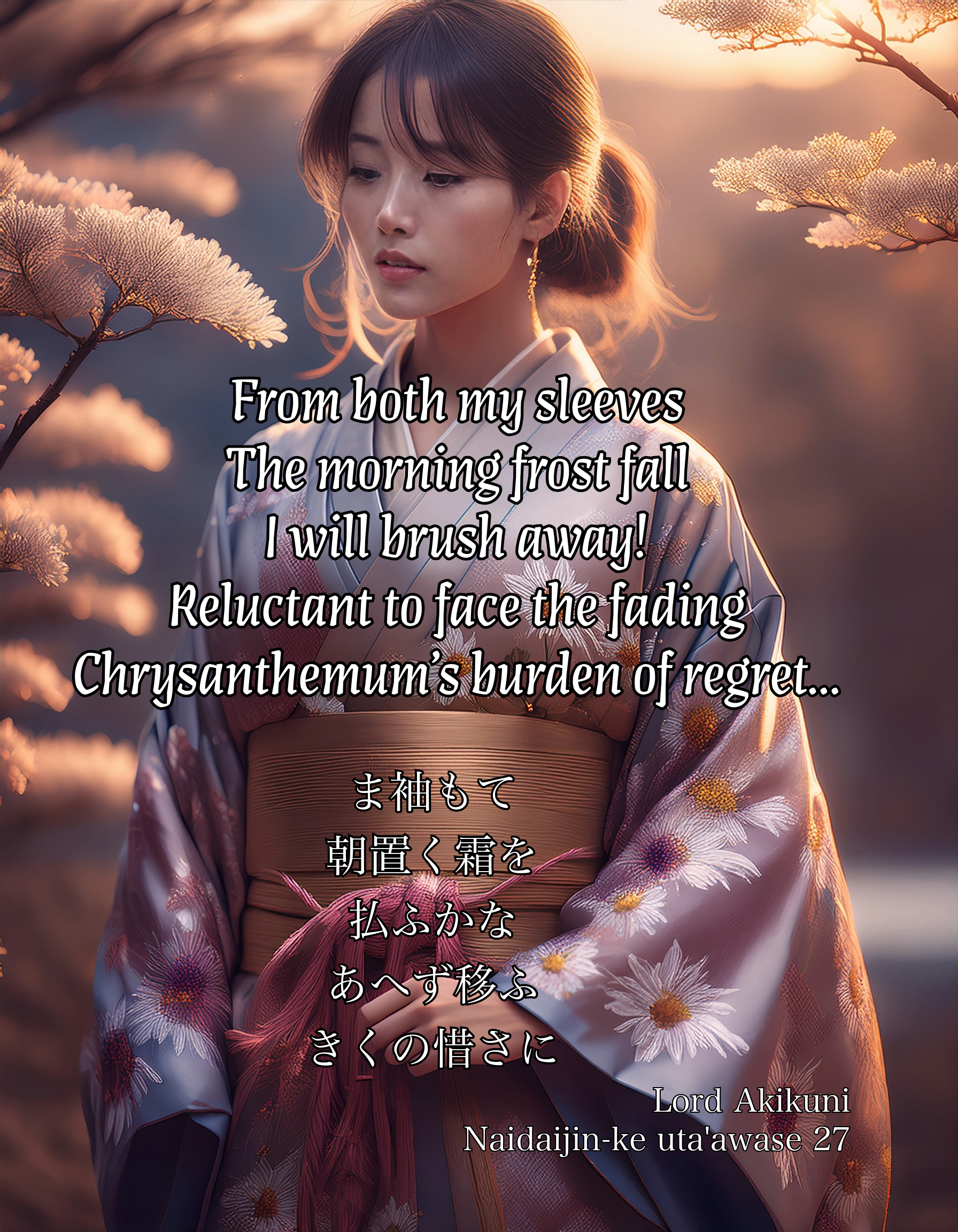
ま袖もて朝置く霜を払ふかなあへず移ふきくの惜さに
| masodemote asa oku shimo o harau kana aezu utsurou kiku no oshisa ni | From both my sleeves The morning frost fall I will brush away! Reluctant to face the fading Chrysanthemum’s burden of regret… |
Lord Akikuni
27
Right (Both Judges – Win)
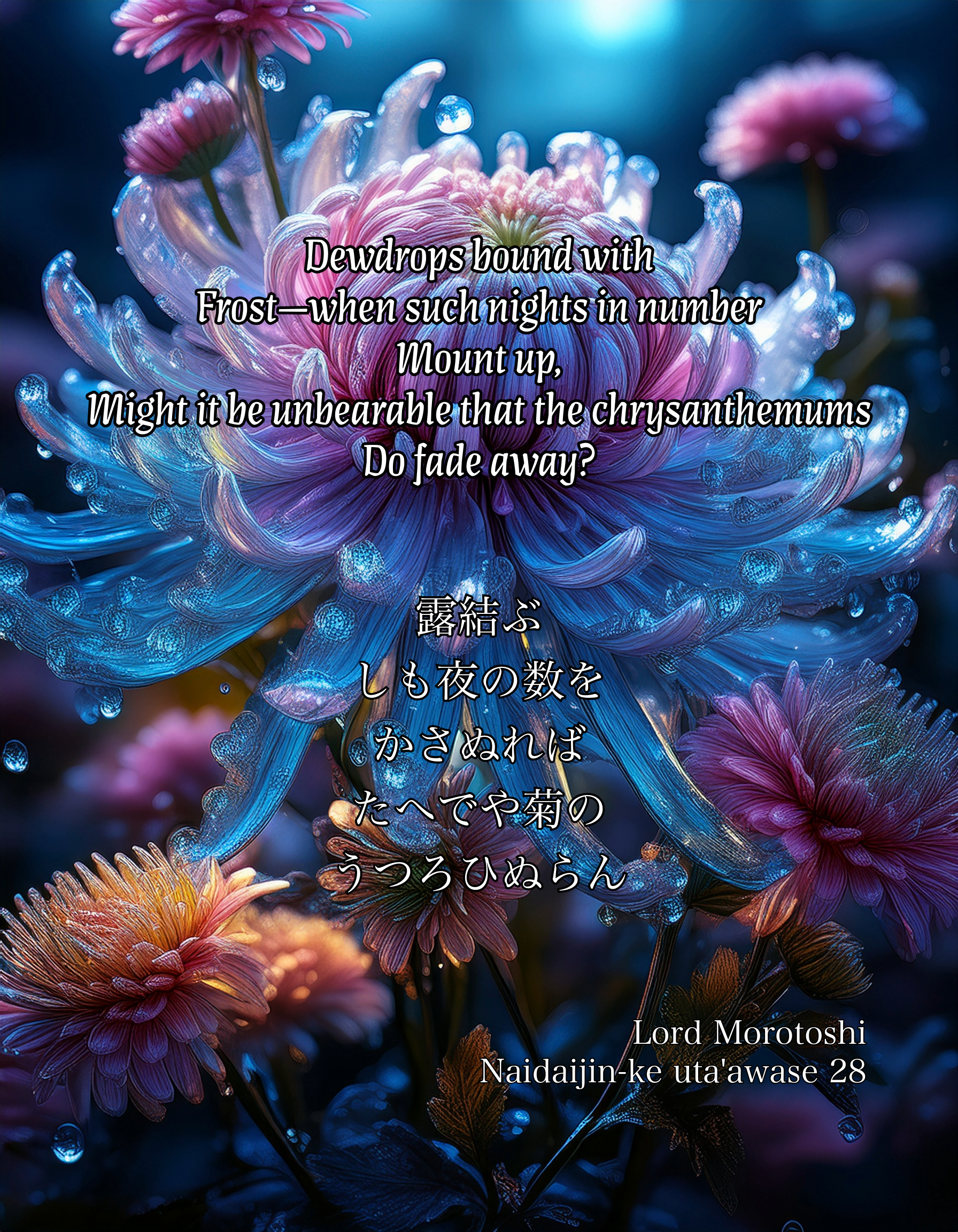
露結ぶしも夜の数をかさぬればたへでや菊のうつろひぬらん
| tsuyu musubu shimo yo no kazu o kasanureba taede ya kiku no utsuroinuran | Dewdrops bound with Frost—when such nights in number Mount up, Might it be unbearable that the chrysanthemums Do fade away? |
Lord Morotoshi
28
Toshiyori states: the first poem is extremely charming. Nevertheless, I must question the use of ‘reluctant to face the fading’ as I feel this is something I have not heard before. I can grasp the sense of diction such as ‘unable to do anything about’ or ‘without taking on autumn hues’, but did the poet mean to use the diction ‘unbearable’, perhaps? Even though this is somewhat archaic phrasing, it is used in composition. This poem’s expressions, though, I feel are somewhat unfamiliar. The conception and diction of the second poem are both extremely charming. However, this poem, too, is vague. What is going on with the initial ‘dewdrops bound’? Does it mean that the dewdrops get turned into frost? If so, then, from what is known of the calendar, this is something which only occurs on a single night, and from the following night there is only frost. It sounds as if the conception of this poem, though, is that night after night dew turns to frost, and this would be a fault. Despite this vagueness, however, its tone is elegant, so it seems superior.
Mototoshi states: the poem of the Left has a poetic configuration, but I strongly feel that it would have been preferable not to use the diction ‘both my sleeves’. It does seem as if this was used in the ancient Collection of a Myriad Leaves, but even given that was the case, in the preface to the Ancient and Modern, I recall it saying, ‘On examining the poems of ancient times, we find they use many archaic expressions. These were there not just to please the ear, but simply for moral instruction’. It appears that there are no instances of this piece of diction being used in poetry matches from the period of the Ancient and Modern, Later Selection and Gleanings, and these were all conducted for entertainment. Even in a poetry match conducted in Engi 12 [912], when the term ‘sleeve’ was used, I get the feeling that it was such a source of amusement that the poem was not recited. While the quality of the Right’s poem is not superb, the tone of ‘Dewdrops bound with / Frost—when such nights in number’ is not bad, so I feel the dew can still remain bound!
When a lady had dropped her hair-tie, I picked it up and passed it back to her.
あさねがみもとゆひそめししるしありてとけてみゆるをこころともがな
| asanegami motoyui someshi shirushi arite tokete miyuru o kokoro to mogana | That your morning bed-hair You had started to do up Is this a sign, but I would see you loosen it Together with your heart! |
Fujiwara no Sane’ie (1145-1193)

Silver grass
Left (Tie)
はなすすきほにいづるをのはしらくものあさゐるとのみあやまたれけり
| hanasusuki ho ni izuru ono wa shirakumo no asa iru to nomi ayamatarekeri | Silver grass Fronds appear upon the plains For clouds of white Spreading through the morning, simply Have I mistaken them. |
Ariwara no Suetaka
15
Right
はなすすきほのくれがたのつゆけきはうきよのなかをそよとしればか
| hanasusuki ho no kuregata no tsuyukeki wa ukiyo no naka o soyo to shireba ka | The silver grass Fronds at twilight Are dew-drenched— That this cruel world Is so, I wonder if they know? |
Fujiwara no Aritoki
16
Round Eleven
Left
しら雲の朝たつ山のからにしき枝に一むら春風ぞ吹く
| shirakumo no asa tatsu yama no karanishiki eda ni hito mura harukaze zo fuku | Clouds of white Arising with the morning on the mountain: Cathay brocade In a single bunch upon the branch Blown by the breeze of spring! [1] |
Supernumerary Major Counsellor Moto’ie
21
Right (Win)
かづらきや嶺の桜のさきしより心の空にかかるしら雲
| kazuragi ya mine no sakura no sakishi yori kokoro no sora ni kakaru shirakumo | Upon Kazuragi Peak, the cherries Have bloomed and ever since The heavens of my heart are Draped with clouds of white. |
Lord Nobunari
22
The Left’s poem has ‘Arising with the morning on the mountain: Cathay brocade in a single bunch upon the branch’ and, while it mentions spring breezes in its final section and does not fail to reflect the surface appearance of its source poem, conveys a feeling of scarlet leaves without mentioning blossom or cherry, which I have to say is something of a fault. The Right’s poem does not seem poor and lacks any faults worth mentioning, so it should win.


[1] An allusive variation on SIS IV: 220.
Round Eight
Left (Win)
朝まだきたつや霞の波まより昨日はみえし淡路島山
| asa madaki tatsu ya kasumi no namima yori kinō mieshi awajishima yama | Early in the morning, Breaking, haze From between the waves, rather than Yesterday’s sight of The mountains of Awaji Isle… |
Fujiwara no Tomoshige
15
Right
さえ残る雪げの春の朝霞かすむ名のみや空に立つらん
| saenokoru yukige no haru no asagasumi kasumu na nomi sora ni tatsuran | Do chilly remnants of Snowmelt in spring Make morning haze’s Blur in name alone Drift into the skies? |
Dharma Master Zenshin
16
The Left’s ‘Yesterday’s sight of the mountains of Awaji Isle’ sounds pleasant. The Right’s ‘Blur in name alone drift into the skies’ does not sound bad, but thinking of the conception of the topic, haze in name only is a bit inferior, isn’t it? Thus, the Left wins.


