ai’oi no sode no furenishi yado no take yoyo wa henikeri wa ga tomo toshite
Growing together, Brushing my sleeves, The bamboo at my house Has passed through the ages— My friend, it is.[i]
667
[i] See: 晋騎兵参軍王子猷 栽称此君 唐太子賓客白楽天 愛為吾友 shin no kihei sangun ōshi iu / uete kono kimi to shōsu / tō no Taishi hinkaku hakurakuten / aishite wa ga tomo to su ‘In Chin times, Administrator for Cavalry Wang Tzu-yu / Planted it and called it “This Gentleman.” / In T’ang times, Adviser to the Heir Apparent Po Lo-t’ien / loved it as being “my friend.”’ (Rimer and Chaves 1997, 132) Fujiwara no Atsumochi (Wakan rōeishū II: 432); and: When His Majesty was yet a prince and had paid a visit to the Toba Palace to converse the Hachijō’in Princess, Her Highness recited, ‘The bamboo has been my friend these many years,’ so His Majesty composed a poem [along with others present]. わが友と君がみかきのくれ竹は千代にいく世のかげをそふらん wa ga tomo to / kimi ga migaki no / kuretake wa / chiyo ni ikuyo no / kage o souran ‘As “my friend” does / My Lady see, by her fence / Black bamboo— / Its thousand knots o’er how many ages / To her will show their shape?’ Master of the Dowager Empress Household Office, Toshinari (Senzaishū X: 608).
take no ha ni furi’ōu yuki no ure o omomi shita ni mo chiyo no iro wa kakurezu
The bamboo leaves Are covered with fallen snow, Tips so heavy, but Beneath, a thousand ages Hue cannot be concealed.[i]
664
[i] See: Topic unknown. ささのはにふりつむ雪のうれをおもみ本くだちゆくわがさかりはも sasa no ha ni / furitsumu yuki no / ure o omomi / moto kudachiyuku / wa ga sakari wa mo ‘The dwarf bamboo leave are / Piled with fallen snow, / Tips so heavy that / They droop down to the roots— / So, too, my prosperity!’ Anonymous (Kokinshū XVII: 891)
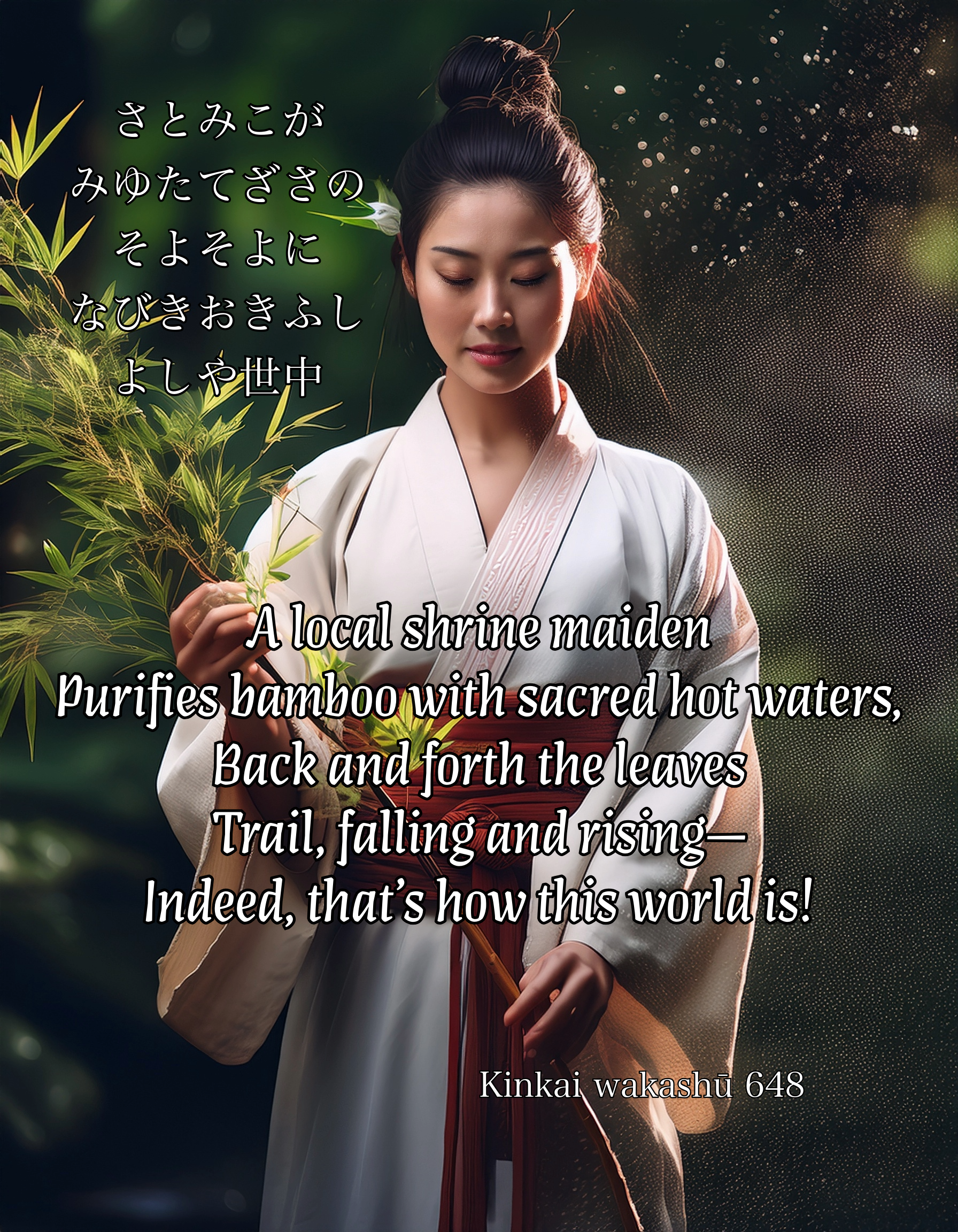
satomiko ga miyu tatezasa no soyosoyo ni nabiki okifushi yoshi ya yo no naka
A local shrine maiden Purifies bamboo with sacred hot waters, Back and forth the leaves Trail, falling and rising— Indeed, that’s how this world is![i]
648
[i] There was a shrine purification ritual whereby a shrine maiden (miko 巫女) would soak a branch of dwarf bamboo (sasa 笹) in water which she had heated, and then shake the water from the leaves, moving the branch up and down, scattering the droplets over both herself and pilgrims to the shrine. Sanetomo’s poem uses a description of this ritual as a preface (jo 序), before pivoting at the end of the fourth stanza to say that everyday life is just a sequence of both getting up and then going back to sleep (lying down) again and again (Higuchi 2016, 148).
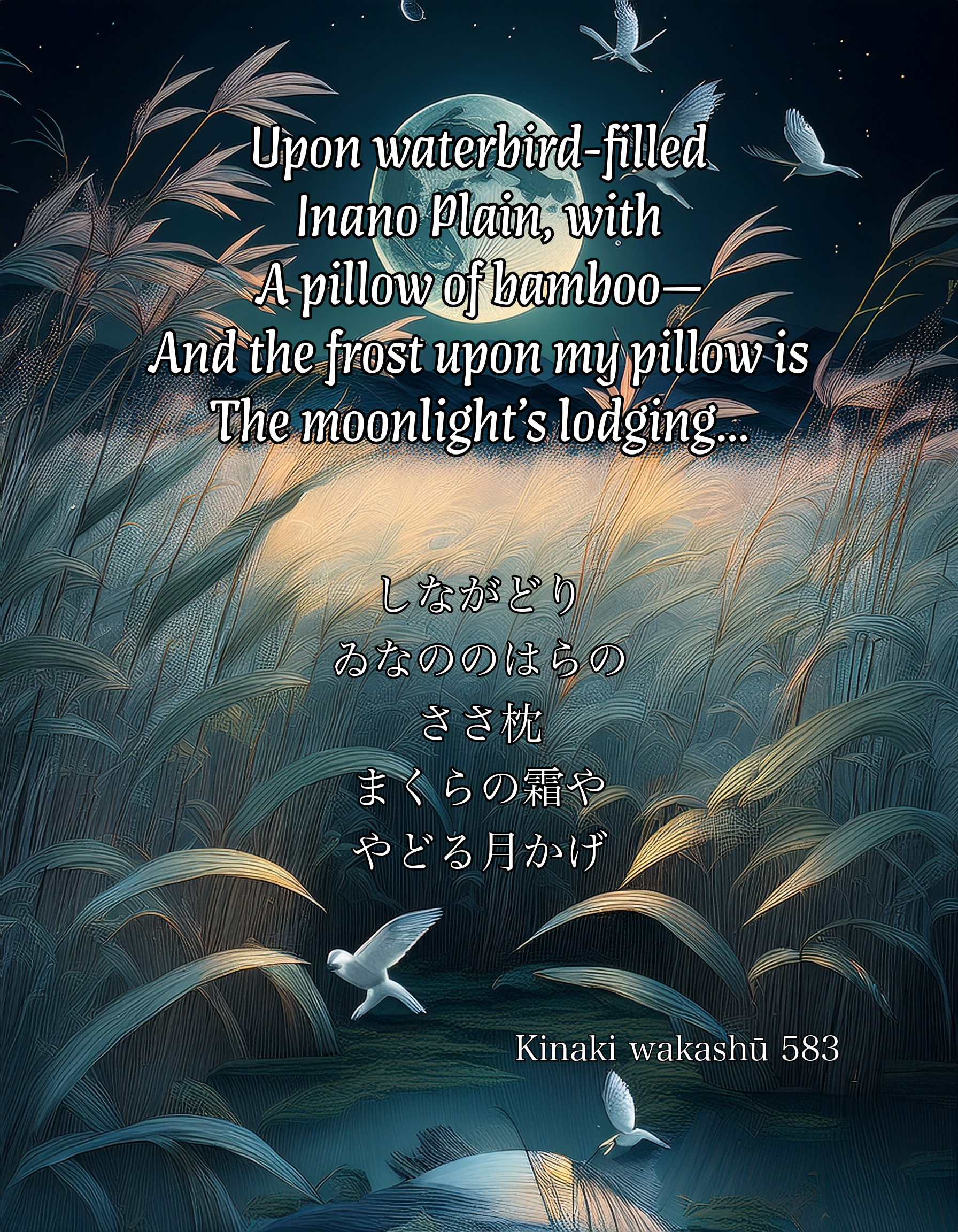
shinagadori inano no hara no sasamakura makura no shimo ya yadoru tsukikage
Upon waterbird-filled Inano Plain, with A pillow of bamboo— And the frost upon my pillow is The moonlight’s lodging…[i]
583
[i] See: Topic unknown. しながどりゐなのをゆけばありまやま夕ぎり立ちぬやどはなくして shinagadori / inano o yukeba / arimayama / yūgiri tachinu / yado wa nakushite ‘Through waterbird-filled / Inano I go, as / Upon Arima Mountain / Evening mist has risen, and / Me without a lodging…’ Anonymous (Shinkokinshū X: 910)
On a folding screen for the celebrations of the birthday of Her Majesty, the Empress in Shōhei 4.[1]
色かへぬ松と竹とのすゑの世をいづれひさしと君のみぞ見む
iro kaFenu matu to take no suwe no yo wo idure hisasi to kimi nomi zo mimu
Ever unchanging hues Have the pine and bamboo— In the ages to come Which is more eternal? My Lady, alone, will see!
The Handmaid to the Ise Virgin
Created with Soan.
[1] The empress in question was Fujiwara no Onshi (Yasuko) 藤原穏子 (885-954), the consort of Emperor Daigo. The birthday being marked was her fiftieth, with the celebrations taking place on the 26th day of the Third Month, Shōhei 承平 4 [12.5.934].