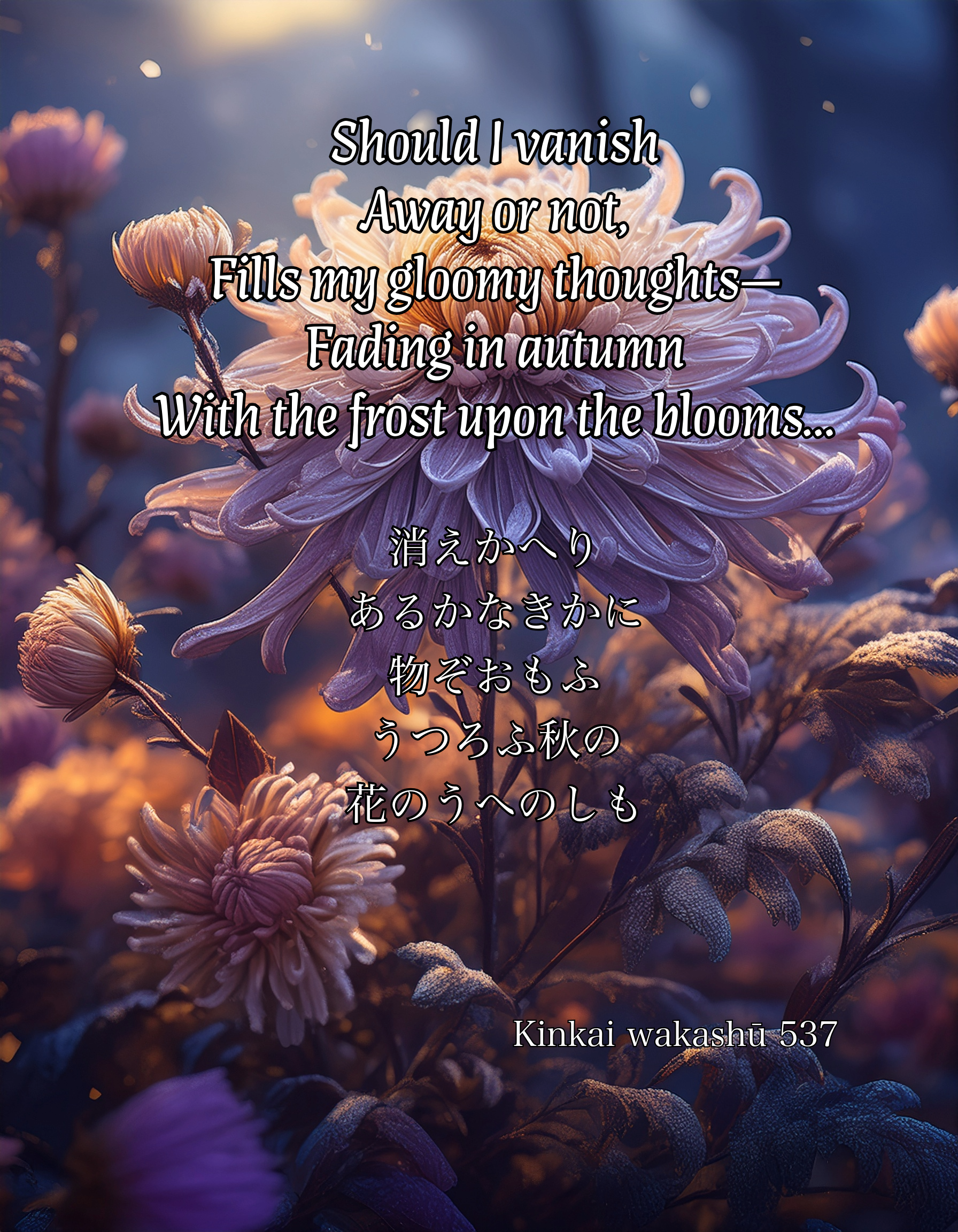
消えかへりあるかなきかに物ぞおもふうつろふ秋の花のうへのしも
| kiekaeri aru ka naki ka ni mono zo omou utsurou aki no hana no ue no shimo | Should I vanish Away or not, Fills my gloomy thoughts— Fading in autumn With the frost upon the blooms… |
537
Round Thirty
Left (Tie)
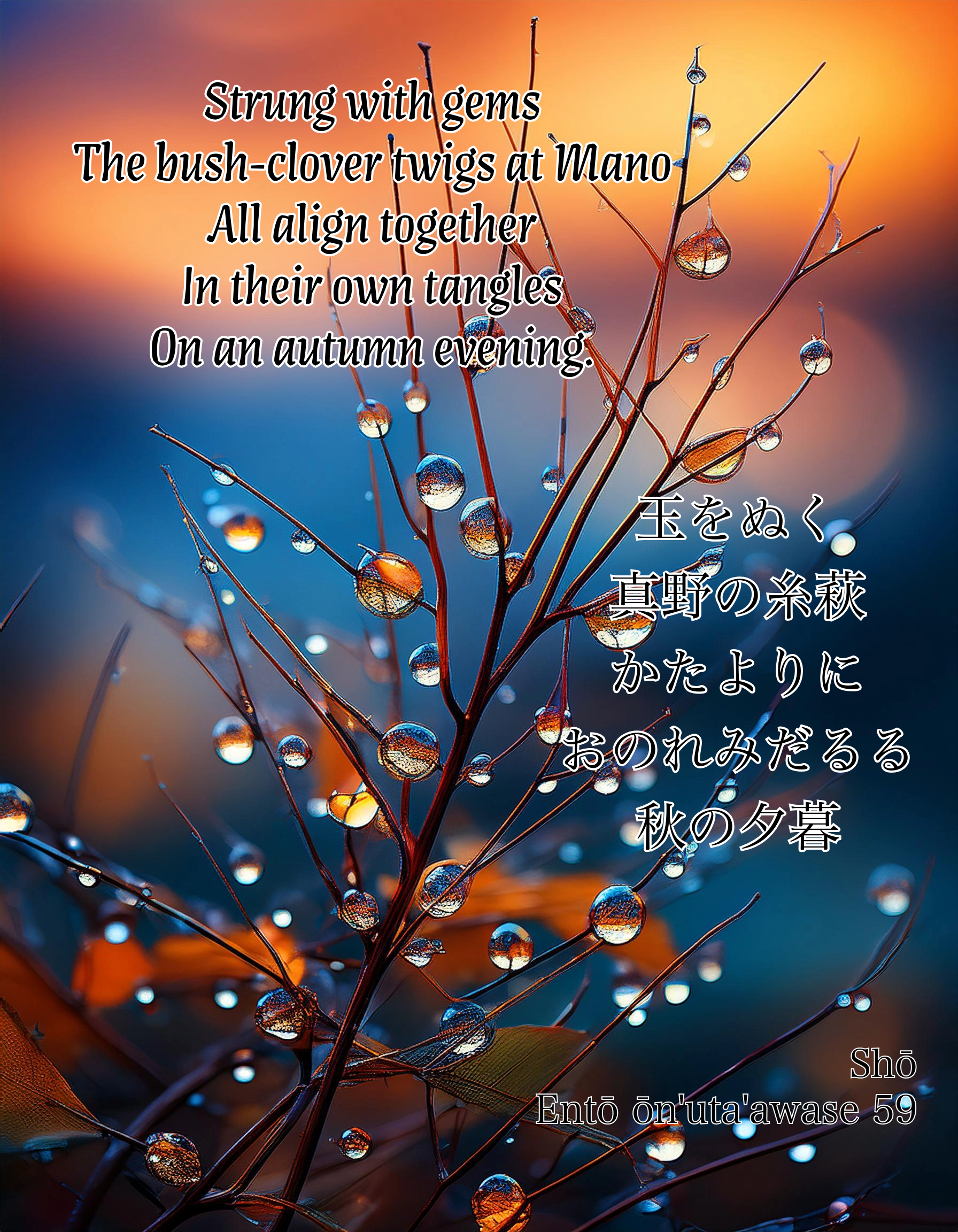
玉をぬく真野の糸萩かたよりにおのれみだるる秋の夕暮
| tama o nuku mano no itohagi katayori ni onore midaruru aki no yūgure | Strung with gems The bush-clover twigs at Mano All align together In their own tangles On an autumn evening. |
Shō
59
Right
待ちわたる時や来ぬらん白露の玉しく庭の秋はぎの花
| machiwataru toki ya konuran shiratsuyu no tama shiku niwa no akihagi no hana | Has that long-awaited Time arrived, perhaps? When silver dewdrop Pearls will spread o’er the grounds From the autumn bush clover blooms… |
Nagatsuna
60
The poems of Left and Right have different diction, but the same configuration.

Round Twenty-Nine
Left (Win)
宮城のの木下風や過ぎぬらん露におくるる秋萩の花
| miyagino no ko no shitakaze ya suginuran tsuyu ni okururu akihagi no hana | On Miyagi Plain has The breeze beneath the trees Passed by? For Missing the dewfall are The autumn bush clover blooms… |
Takasuke
57
Right
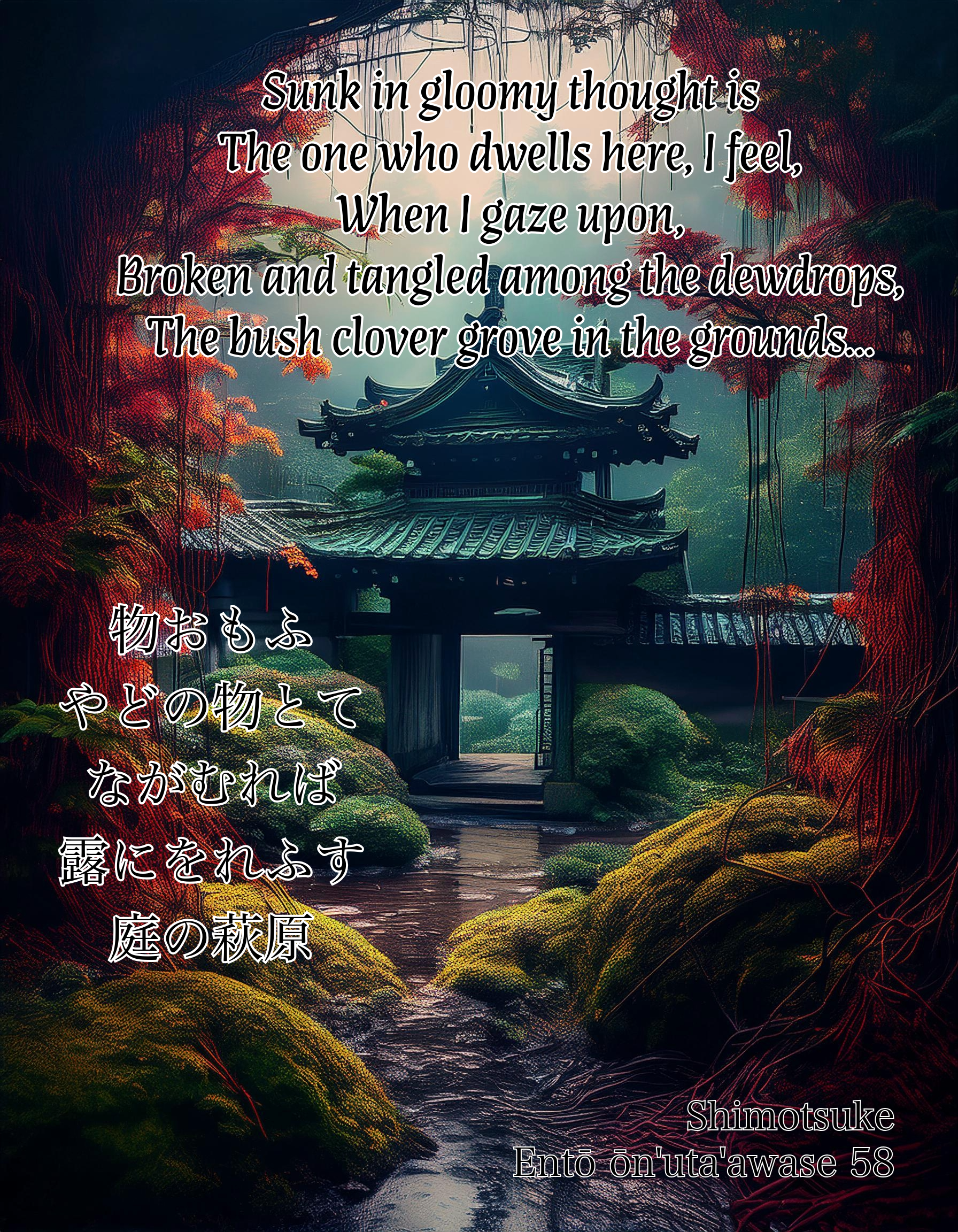
物おもふやどの物とてながむれば露にをれふす庭の萩原
| mono’omou yado no mono tote nagamureba tsuyu ni orefusu niwa no hagiwara | Sunk in gloomy thought is The one who dwells here, I feel, When I gaze upon, Broken and tangled among the dewdrops, The bush clover grove in the grounds… |
Shimotsuke
58
The Left poem’s ‘Missing the dewfall are the autumn bush clover’ sounds pleasant. The Right poem has no faults either, yet the Left should win.



Round Twenty-Five
Dew on Bush Clover
Left
下葉には色なる玉やくだくらむ風の吹きしく萩の上の露
| shitaba ni wa iro naru tama ya kudakuramu kaze no fukishiku hagi no ue no tsuyu | From the underleaves Hues have the gemlets taken In their shattering? Spread by the gusting wind Are the dewdrops on the bush clover… |
A Court Lady
49
Right (Win)
又やみむ又や見ざらん白露の玉おきしける秋萩の花
| mata ya mimu mata ya mizaran shiratsuyu no tama okishikeru akihagi no hana | Will I see again, or Will I not Silver dewdrop Pearls spread upon The autumn bush clover blooms? |
Ietaka
50
The Left’s poem does not seem to have a particularly superlative style. The Right’s poem, saying ‘will I see again, or will I not silver dewdrops’ is particularly charming and moving. Thus, it wins.


Round Twelve
Left
霜枯に移ひ残る村菊はみる朝ごとにめづらしきかな
| shimogare ni utsuroinokoru muragiku wa miru asa goto ni mezurashiki kana | Burned by frost, Faded and lingering A cluster of chrysanthemums When I see them every morn Strikes me afresh! |
Lord Toshitaka
47
Right (Both Judges – Win)
置くしものなからましかば菊のはな移ふ色をけふみましやは
| oku shimo no nakaramashikaba kiku no hana utsurou iro o kyō mimashi ya wa | Fallen frost Were there none, then Chrysanthemum blooms Faded hues I would not see today… |
Lord Tamezane
48
Toshiyori states: the first poem has nothing remarkable about it, apart from the undesirable use of ‘clustered chrysanthemums’. The second poem’s sense could be that when the frost has fallen, the chrysanthemum won’t display faded hues, but it is a mistake to link frost fall and being able to see them. However, if we interpret is as meaning it has fallen, so we can then view them for a long time, well, I can understand that, and will make it the winner.
Mototoshi states: this poem has no faults, but it does not appear to be a poem suited to a poetry match—it’s just rather dull. The poem of the Right, too, lacks anything worth pointing out and just says that the poet wants to gaze upon faded hues today—this seems a bit cliched, but I’d say it’s superior.


Round Ten
Left
植ゑしその心も置かぬ白菊はあだなる霜に移ひにけり
| ueshi sono kokoro mo okanu shiragiku wa adanaru shimo ni utsuroinikeri | I planted them, yet Unconcerned are The white chrysanthemums, For with the faithless frost Have they faded. |
Lord Munekuni
43
Right (Both Judges – Win)
菊のはな夜のまに色やかはれると霜を払ひて今朝みつるかな
| kiku no hana yo no ma ni iro ya kawareru to shimo o haraite kesa mitsuru kana | The chrysanthemum blooms Within the space of but one night their hue Will change, I thought, so Brushing away the frost Will I gaze on them this morn! |
Lord Kanemasa
44
Toshiyori states: the first poem uses ‘unconcerned’, doesn’t it. The second poem’s sequencing is undesirable, yet ‘brushing away the frost’ sounds like that really is the case. It seems superior.
Mototoshi states: one has to ask what on earth a chrysanthemum might be concerned about! As for the Right, ‘Within the space of but one night their hue’ is vague, I think, but ‘brushing away the frost and gazing’ is certainly charming—it is still lodged within my aged heart.


Round Eight
Left (T – Win; M – Tie)
冬枯にうつろひ残る白菊はうは葉に置ける霜かとぞみる
| fuyugare ni utsuroi nokoru shiragiku wa uwaba ni okeru shimo ka to zo miru | Sere in winter, Faded and lingering A white chrysanthemum as, Fallen upon its upper leaves, Frost does appear, perhaps? |
Lord Morikata
39
Right
露じもの暁置きのあさごとに移ひまさるしらぎくの花
| tsuyujimo no akatsuki oki no asa goto ni utsuroi masaru shiragiku no hana | Frosty dewdrops With the dawn fall—arising Every morning Fading fairer become The white chrysanthemum blooms. |
Lord Michitsune
40
Toshiyori states: I have the feeling that I have never heard the expression ‘sere in winter’, and I certainly have no recollection of it being in the Collection of a Myriad Leaves. The poem of the Right is smooth and extremely charming; I’m very familiar with the expression ‘dew fallen in the morning when I arise’, and here there seems to be some reason for it, doesn’t there! Still, the first poem is better.
Mototoshi states: the expression ‘faded and lingering’ is difficult to distinguish. In addition, saying ‘Fallen upon [the flower’s] upper leaves, / Frost’ is a severe misjudgment. The poem of the Right has the tautology ‘with the dawn fall’ and then ‘every morning’. Clearly neither of these appears to win or lose, so I make this a tie.


