Tag Archives: chrysanthemums

Naidaijin-ke uta’awase 24

Round Twelve

Left

霜枯に移ひ残る村菊はみる朝ごとにめづらしきかな

shimogare ni
utsuroinokoru
muragiku wa
miru asa goto ni
mezurashiki kana
Burned by frost,
Faded and lingering
A cluster of chrysanthemums
When I see them every morn
Strikes me afresh!

Lord Toshitaka
47

Right (Both Judges – Win)

置くしものなからましかば菊のはな移ふ色をけふみましやは

oku shimo no
nakaramashikaba
kiku no hana
utsurou iro o
kyō mimashi ya wa
Fallen frost
Were there none, then
Chrysanthemum blooms
Faded hues
I would not see today…

Lord Tamezane
48

Toshiyori states: the first poem has nothing remarkable about it, apart from the undesirable use of ‘clustered chrysanthemums’. The second poem’s sense could be that when the frost has fallen, the chrysanthemum won’t display faded hues, but it is a mistake to link frost fall and being able to see them. However, if we interpret is as meaning it has fallen, so we can then view them for a long time, well, I can understand that, and will make it the winner.

Mototoshi states: this poem has no faults, but it does not appear to be a poem suited to a poetry match—it’s just rather dull. The poem of the Right, too, lacks anything worth pointing out and just says that the poet wants to gaze upon faded hues today—this seems a bit cliched, but I’d say it’s superior.

Naidaijin-ke uta’awase 19

Round Seven

Left (M – Win)

霜がれの菊なかりせばいとどしく冬の籬やさびしからまし

shimogare no
kiku nakariseba
itodoshiku
fuyu no magaki ya
sabishikaramashi
Were frost-burned
Chrysanthemums there to be none, then
How much more
My brushwood fence in winter
Lonely would be…

Lord Sadanobu
37

Right (T – Win)

しも枯るるはじめをみずは白ぎくの移ふ色を惜まざらまし

shimogaruru
hajime o mizu wa
shiragiku no
utsurou iro o
osamazaramashi
Frost-burns
First sign I see not, so
The white chrysanthemum’s
Fading hues
Cause me no regret at all…

Lord Masamitsu
38

Toshiyori states: the assembled company asked how it can be possible that a brushwood fence in winter would not feel lonely after the chrysanthemums have withered, even granting that they are still there, and this is, of course, the case. In the depths of winter, one would not catch sight of any chrysanthemums. Although, it does sound as if you could could compose in this way, depending upon how early in the season it was. The second poem is of about the same quality, but I feel that I prefer it at the moment.

Mototoshi states: both poems are of the same quality, but ‘My brushwood fence in winter / Lonely would be’ really does make me realise that’s how it is.

Naidaijin-ke uta’awase 13

Lingering Chrysanthemums

Round One

Left (Both Judges – Win)

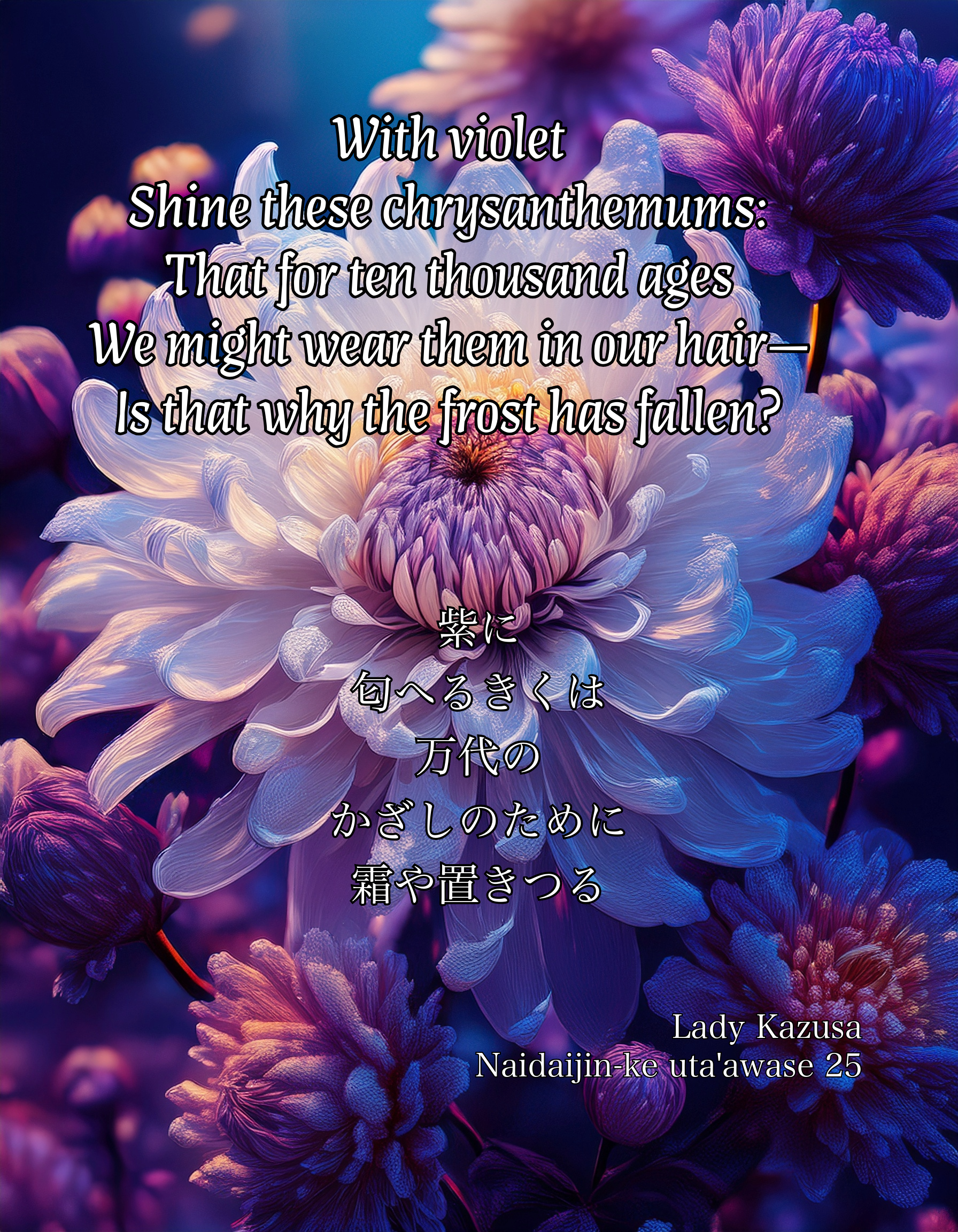
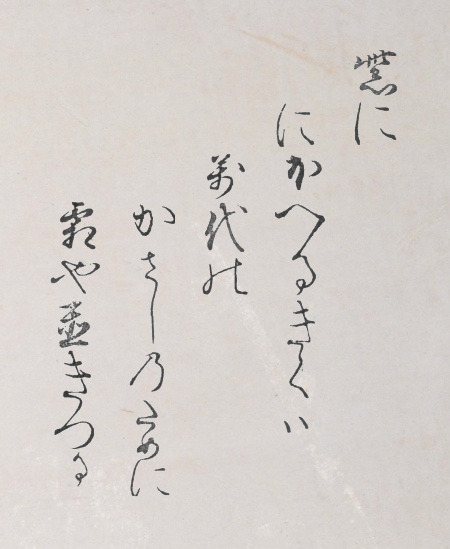
紫に匂へるきくは万代のかざしのために霜や置きつる

murasaki ni
nioeru kiku wa
yorozuyo no
kazashi no tame ni
shimo ya okitsuru
With violet
Shine these chrysanthemums:
That for ten thousand ages
We might wear them in our hair—
Is that why the frost has fallen?

Lady Kazusa
25

Right

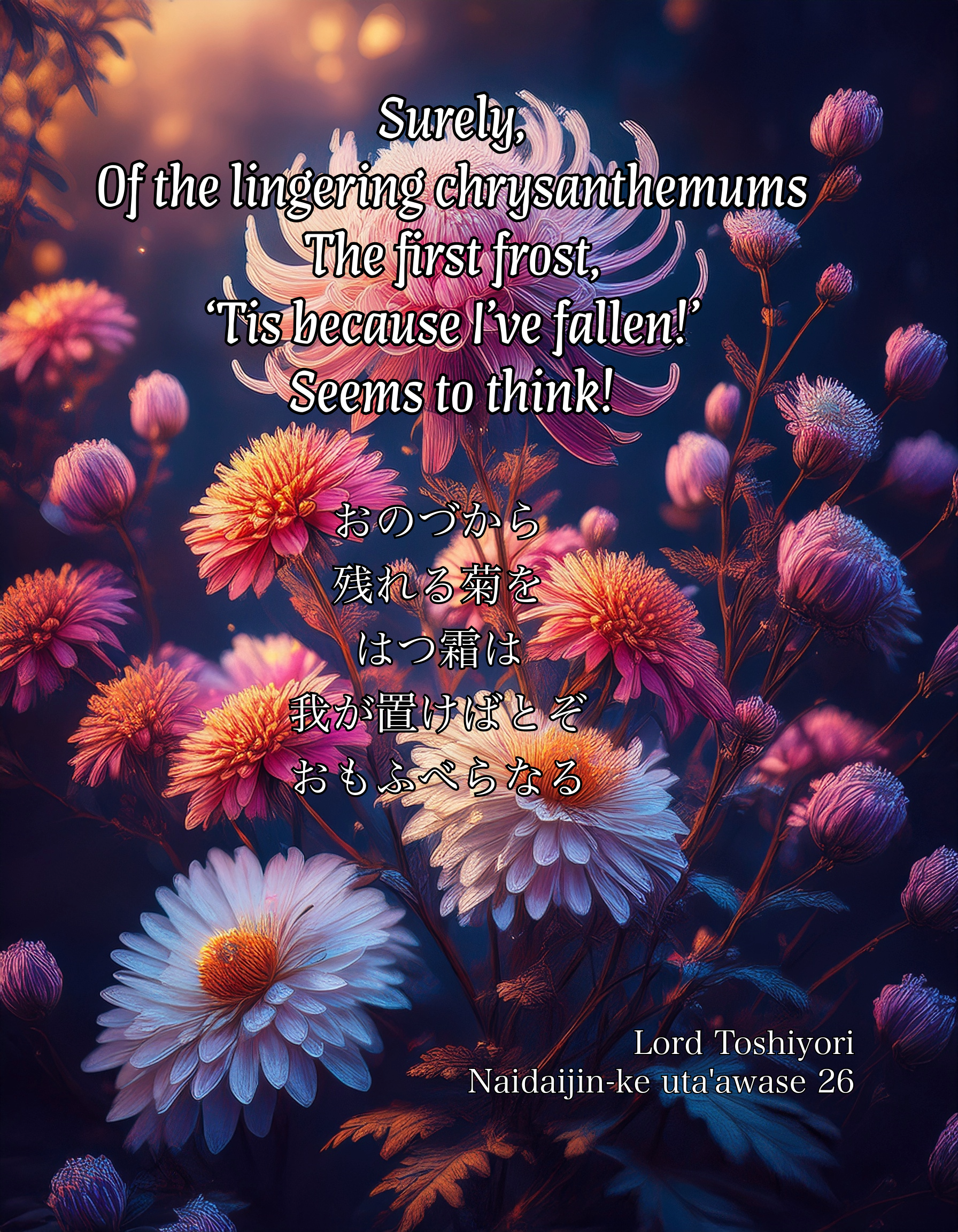
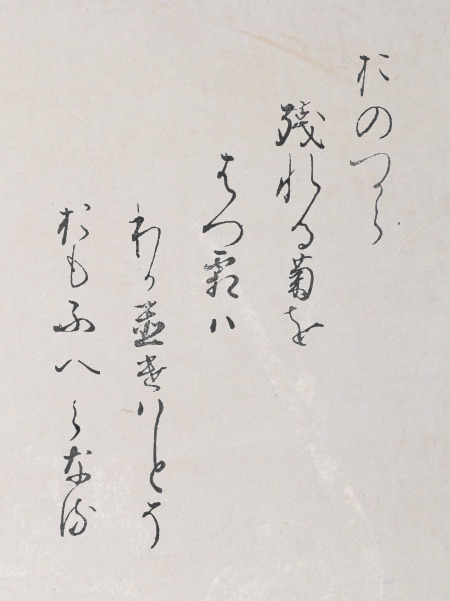
おのづから残れる菊をはつ霜は我が置けばとぞおもふべらなる

onozukara
nokoreru kiku o
hatsushimo wa
wa ga okeba to zo
omouberanaru
Surely,
Of the lingering chrysanthemums
The first frost,
‘Tis because I’ve fallen!’
Seems to think!

Lord Toshiyori
26

Toshiyori states: while the first poem is not remarkable, it does sound smooth. The concluding ‘has fallen’, though—would it be excessive to say that I feel it’s a bit grating? In the second poem, the assembled company have stated that ‘seems to’ is something that they have never heard before in their lives and given that they have said that this is what it sounds like, I make the Left the winner.

Mototoshi states: ‘With violet / Shine these chrysanthemums’ sounds appropriately poetic, but saying ‘that…we might wear them in our hair’ followed by the final ‘has fallen’ is a sequencing that is, in great part, inharmonious and lacking in gentle beauty. Nevertheless, I feel that the second poem’s ‘Surely, / Of the lingering chrysanthemums’ and the final ‘seems to’ is so unfamiliar that it makes me wonder what is going on with the sequencing there, so a single dipping in violet dye is superior and, I feel, all the sweeter!

Tōin senzai awase 09

Left – Chrysanthemums

きくをうゑて花おもほゆるけふよりはながづきをこそまちわたりけれ

kiku o uete
hana omohoyuru
kyō yori wa
nagazuki o koso
machiwatarikere
I planted chrysanthemums, and
Wondering about the blooms
From today
For the Longest Month
Will I always be awaiting.

13a

きくをうゑて花おもほゆる今よりはながづきをこそまちわたりけれ

kiku o uete
hana omohoyuru
ima yori wa
nagazuki o koso
machiwatarikere
I planted chrysanthemums, and
Wondering about the blooms
From this moment
For the Longest Month
Will I always be awaiting.

13b

Right

よにふれどおいもしられぬものなればいまよりうゑつながづきのきく 

yo ni furedo
oi mo shirarenu
mono nareba
ima yori uetsu
nagazuki no kiku
My life goes by, yet
Old age I know not
So
From this moment have I planted
Chrysanthemums in the Longest Month.

14a

よにふれどおいもしられぬものなればいまよりうつすながづきのきく

yo ni furedo
oi mo shirarenu
mono nareba
ima yori utsusu
nagazuki no kiku
My life goes by, yet
Old age I know not
So
From this moment fading are
Chrysanthemums in the Longest Month

14b

Sumiyoshi-sha uta’awase kaō ni-nen 52

Round Two

Left (Tie)

すみよしときこゆるさとにいとはずはおきどころなきみをやどさばや

sumiyoshi to
kikoyuru sato ni
itowazu wa
okidokoro naki
mi o yadosaba ya
A pleasant place to live is Sumiyoshi’s
Estate, or so I’ve heard, but
If it provide no comfort, then
My restless
Self might it attract…

Lord Kinshige
103

Right

すぎていにしあきにおくれてしもがるるきくやわがみのたぐひなるらむ

sugite inishi
aki ni okurete
shimogaruru
kiku ya wa ga mi no
tagui naruramu
Past and gone is
Autumn, but lingering,
Frost-burned
Chrysanthemums—is my sorry self
Just like them, I wonder?

Enjitsu
104

Neither the poem of the Left, nor of the Right, sound as if they have any particular faults. Nevertheless, in the case of such poems the assessment varies depending upon the speaker. While the poem of the Left is, indeed, pitiful, it also sounds a bit crude. It would be elegant, I think, if it were a woman’s poem. As for the Right’s poem, if we take it as an expression of grief over orphanhood, then in the final analysis it’s charming as it matches the conception of a scion of a noble house picturing himself as the monarch of the flowers. Then again, we do have the poem by the Enkyū Third Prince:

うゑおきしきみもなきよにとしへたる花は我が身のここちこそすれ

ueokishi
kimi mo naki yo ni
toshi hetaru
hana wa wa ga mi no
kokochi koso sure
You planted them here,
My Lord, though gone from this world,
These many years past—
The flowers and my sorry self
Both feel the same…[1]

This would seem to be in the same vein. Given that the speaker of both poems is unclear, for the moment, these tie.


[1] Composed when viewing the blossom at the Enshūji and recalling former Emperor Gosanjō (KYS IX: 518).

Daigo ōntoki kiku awase 02

霜のうへにのこれるきくのいろふかくをしむ心はなにならなくに

shimo no ue ni
nokoreru kiku no
iro fukaku
oshimu kokoro wa
nani naranaku ni
Atop the frost,
The lingering chrysanthemums’
Hues are deep, so
Regret within my heart
There should not be, yet…

Prince Iwa
3

いてしよも霜のうへなるきくのはなうつらぬほどにちよをかぞへむ

iteshi yo mo
shimo no ue naru
kiku no hana
utsuranu hodo ni
chiyo o kazoemu
On frozen nights, too,
O’er the frost
While the chrysanthemum blooms
Remain unfaded,
I would count a thousand ages.

Saimo no kami
4

Kinkai wakashū 293

Gazing at the chrysanthemums in my garden on a rainy night.

露をおもみ籬のきくのほしもあへずはるればくもる村雨の空

tsuyu o omomi
magaki no kiku no
hoshi mo aezu
harureba kumoru
murasame no sora
Weighed down with dew,
The chrysanthemums by my lattice fence
Never get a chance to dry, for
Clearing skies are clouded by
A cloudburst from above.

Dairi kiku awase 02

あきすぎてはなざかりなるきくのはないろにたぐひてあきやかへれる

aki sugite
hanazakari naru
kiku no hana
iro ni taguite
aki ya kaereru
Autumn is past and
The flowers richly blooming are
Chrysanthemums:
With their hues
Autumn does return!

Korenori
3

なみとのみうちこそみゆれすみのえのきしにのこれるしらぎくのはな

nami to nomi
uchi koso miyure
suminoe no
kishi ni nokoreru
shiragiku no hana
Simply as waves
Do they, indeed, appear!
At Suminoe
Lingering on the shore
White chrysanthemum blooms.

Korenori
4

SKKS V: 507

On the conception of chrysanthemums under the moon by a lattice fence, when she presented a hundred poem sequence.

霜をまつまがきの菊のよひの間におきまよふ色は山のはの月

shimo o matsu
magaki no kiku no
yoi no ma ni
okimayou iro wa
yama no ha no tsuki
Awaiting the frost
By my lattice fence, the chrysanthemums
In the midst of night
Are draped in puzzling hues
By the moon from off the mountains’ edge.

Kunaikyō

A kuzushiji version of the poem's text.
Created with Soan.

Tsurayuki-shū 321

On an old woman wiping her face with chrysanthemum dew on the ninth day of the Ninth Month.

けふまでに我をおもへば菊の上の露は千年の玉にざりける

kyō made ni
ware o omoeba
kiku no ue no
tsuyu wa chitose no
tama nizarikeru
Up until this day
Have you thought of me, so
Upon the chrysanthemums
These dewdrops, thousand year
Jewels do not seem to be.

Ki no Tsurayuki