yamagatsu no kakio nagara ni utsushi uete itsu to naku mimu tokonatsu no hana
Even by a woodcutter’s Brushwood fence Should they be transplanted Always would I gaze upon Bedded pinks in bloom…
6
[i] This poem is included in Fubokushō (IX: 3460), attributed to Nakatsukasa, with the headnote ‘Poetry Match held by Junior Consort Yoshiko (Hōshi) in the Fifth Month, Tenryaku 10’. In some texts of the match, there is a minor variation in the wording of the final line, having iro (‘hues’), instead of kage (‘shapes’) as here.
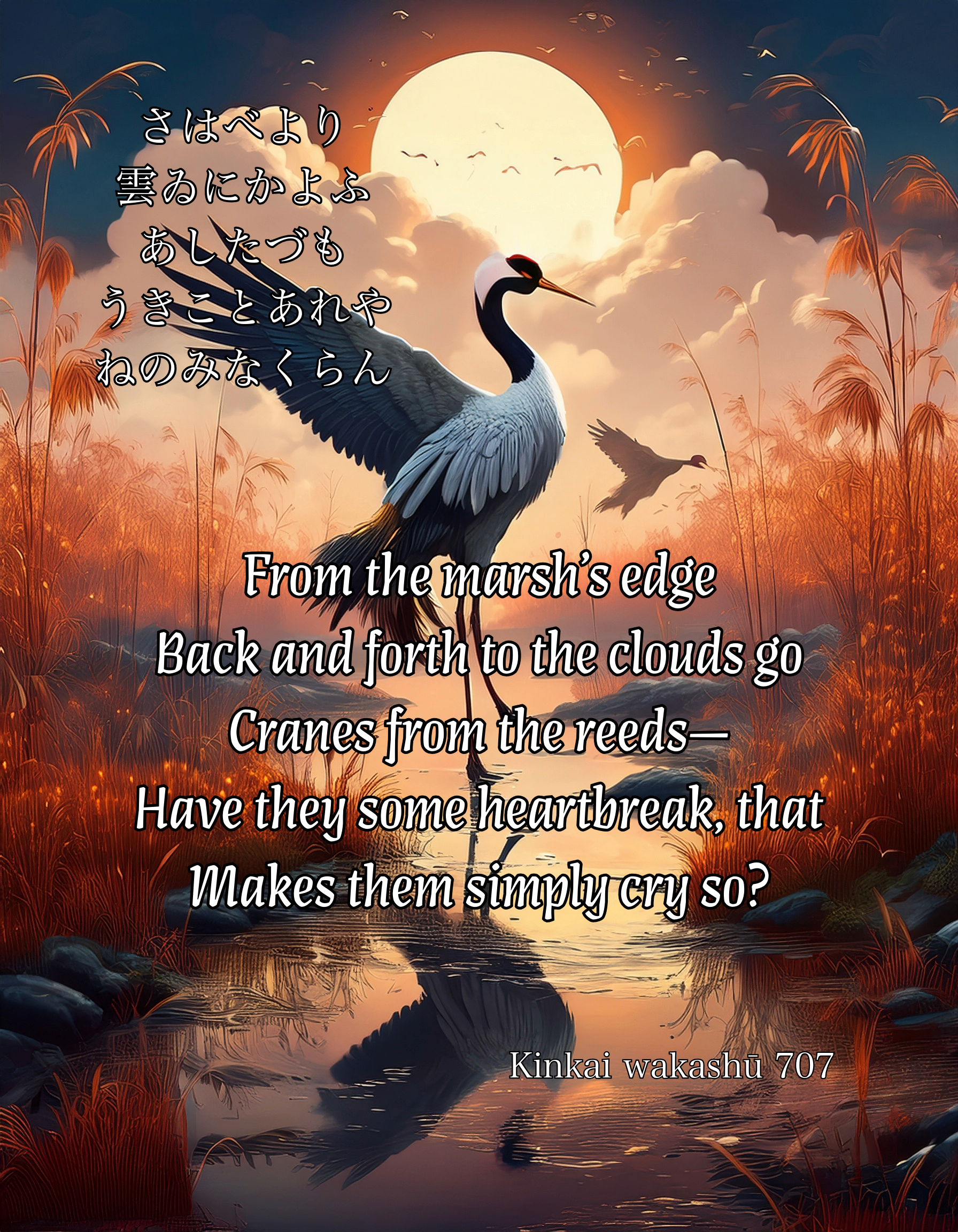
sawabe yori kumoi ni kayou ashitazu mo uki koto are ya ne nomi nakuran
From the marsh’s edge Back and forth to the clouds go Cranes from the reeds— Have they some heartbreak, that Makes them simply cry so?[i]
707
[i] See: Her reply. あしたづのくもゐにかかる心あらば世をへてさはにすまずぞあらまし ashitazu no / kumoi ni kakaru / kokoro araba / yo o hete sawa ni / sumazu zo aramashi ‘If, among the reeds, a crane / Toward the clouds / Had set his heart, then / Passing ages within the marsh, and / Dwelling there he surely would not!’ Princess Isoko (Gosenshū XI: 754)
himeshima no komatsu ga ure ni iru tazu wa chitose furedomo toshi oizukeri
Among Himeshima’s[i] Pine seedling shoots Rest cranes: A thousand year may pass, yet They’ll not age through the years.[ii]
655
[i] Himeshima 姫島 (‘Princess Isle’) was a small island which is believed to have lain in the mouth of the Yodo River where it entered the inland sea south of modern Osaka. Due to changes in topography and the river’s course since ancient times, however, its exact location is now unknown.
[ii] See: [One of] two poems composed to express his grief and sorrow by Kawabe no Miyahito when he saw the coffin of a young girl in the pine groves of Himeshima in Wadō 4 [711]. 妹之名者 千代尓将流 姫嶋之 子松之末尓 蘿生万代尓 imo ga na wa / chiyo ni nagaremu / himeshima no / komatsu ga ure ni / kokemusu made ni ‘This maiden’s name / Will drift down a thousand ages / Until Himeshima’s / Pine seedling shoots are / Choked with hanging moss.’ (Man’yōshū II: 228)
Composed and sent to the residence of the Superintendent Abbot of Tsurugaoka[i] on a morning when snow had fallen.
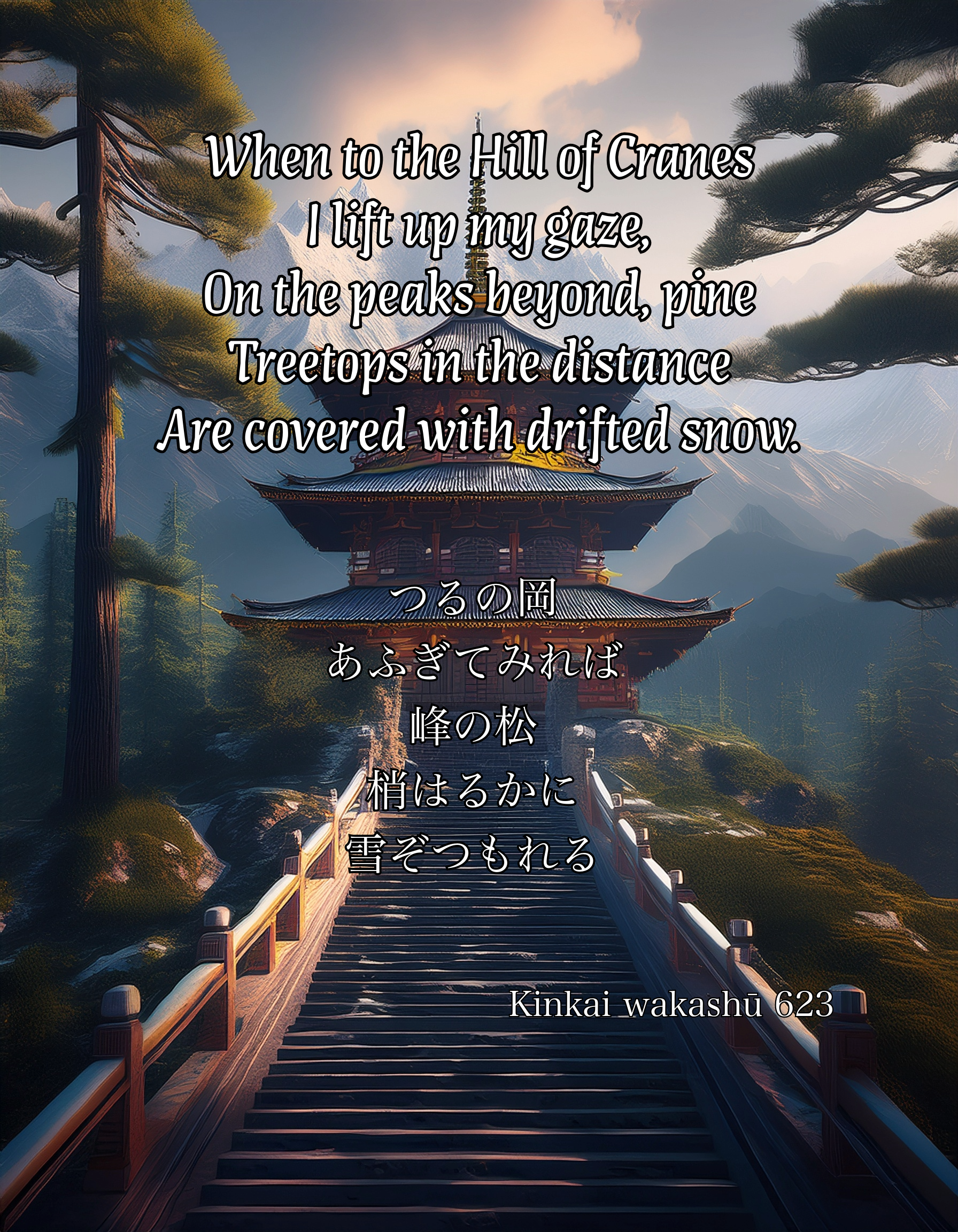
つるの岡あふぎてみれば峰の松梢はるかに雪ぞつもれる
tsuru no oka ōgite mireba mine no matsu kozue haruka ni yuki zo tsumoreru
When to the Hill of Cranes I lift up my gaze, On the peaks beyond, pine Treetops in the distance Are covered with drifted snow.
623
[i] Tsurugaoka Hachiman Shrine (Tsurugaoka hachimangū 鶴岡八幡宮) is located in Yukinoshita in Kamakura and venerated Hachiman, the deity of war and warriors as the patron of the Minamoto clan. The shrine thus was, and still is, one of the focal points of the city and where many of its most important festivals are held. It was also the location of Sanetomo’s assassination in 1219. The Superintendent Abbot (bettō sōzu 別当僧都) to whom Sanetomo sent this time was probably the shrine’s third, Teigyō 定暁 (dates unknown) (Higuchi 2016, 96).