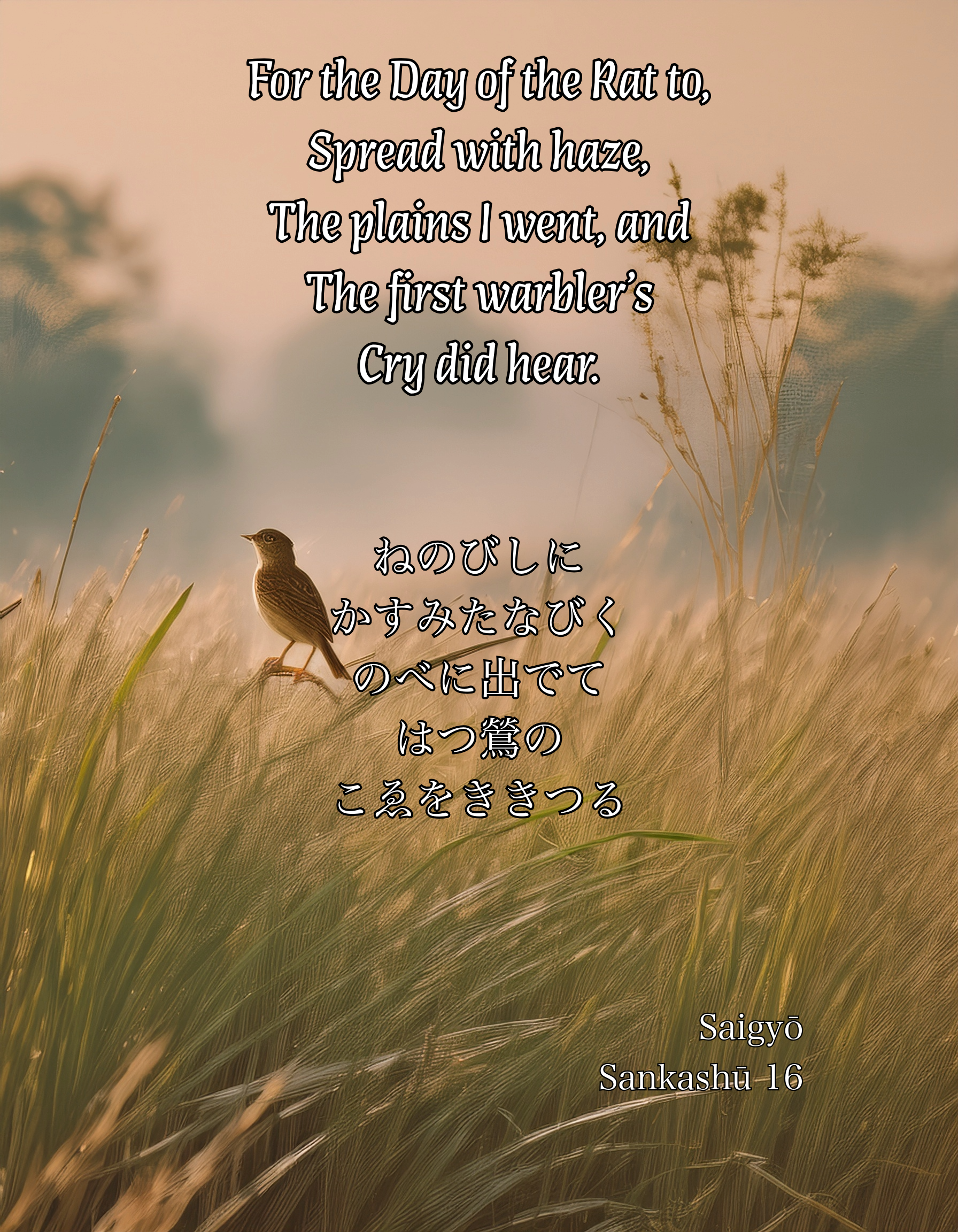
A warbler at my hermitage.
鶯のこゑぞかすみにもれてくる人めともしき春の山ざと
| uguisu no koe zo kasumi ni moretekuru hitome tomoshiki haru no yamazato | A warbler’s Cry from out the haze Does drift to, Secluded from other’s eyes, My mountain retreat in springtime. |
25

Original
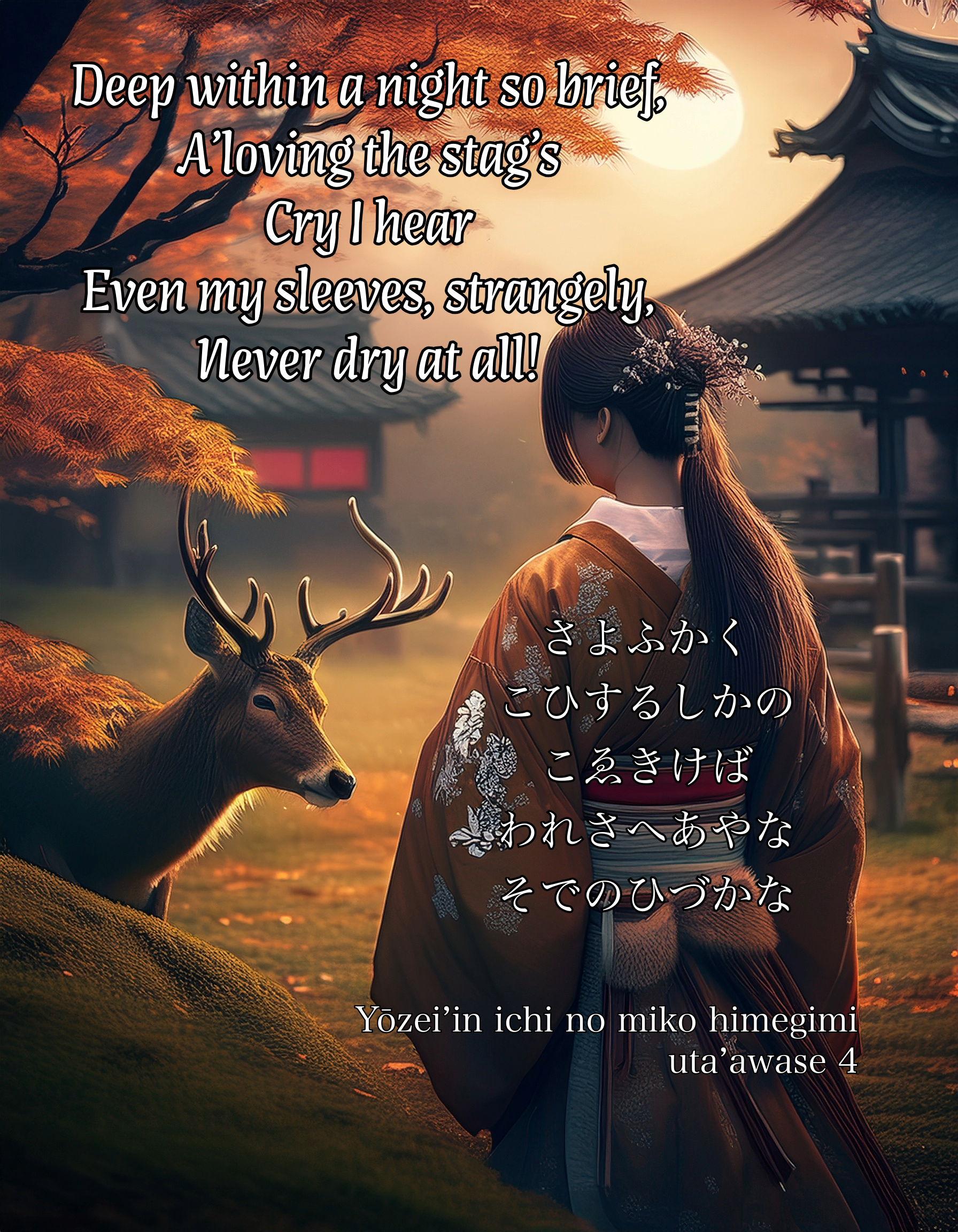
さよふかくこひするしかのこゑきけばわれさへあやなそでのひづかな
| sayo fukaku koisuru shika no koe kikeba ware sae ayana sode no hizu kana | Deep within a night so brief, A’loving, the stag’s Cry I hear Even my sleeves, strangely, Never dry at all! |
4
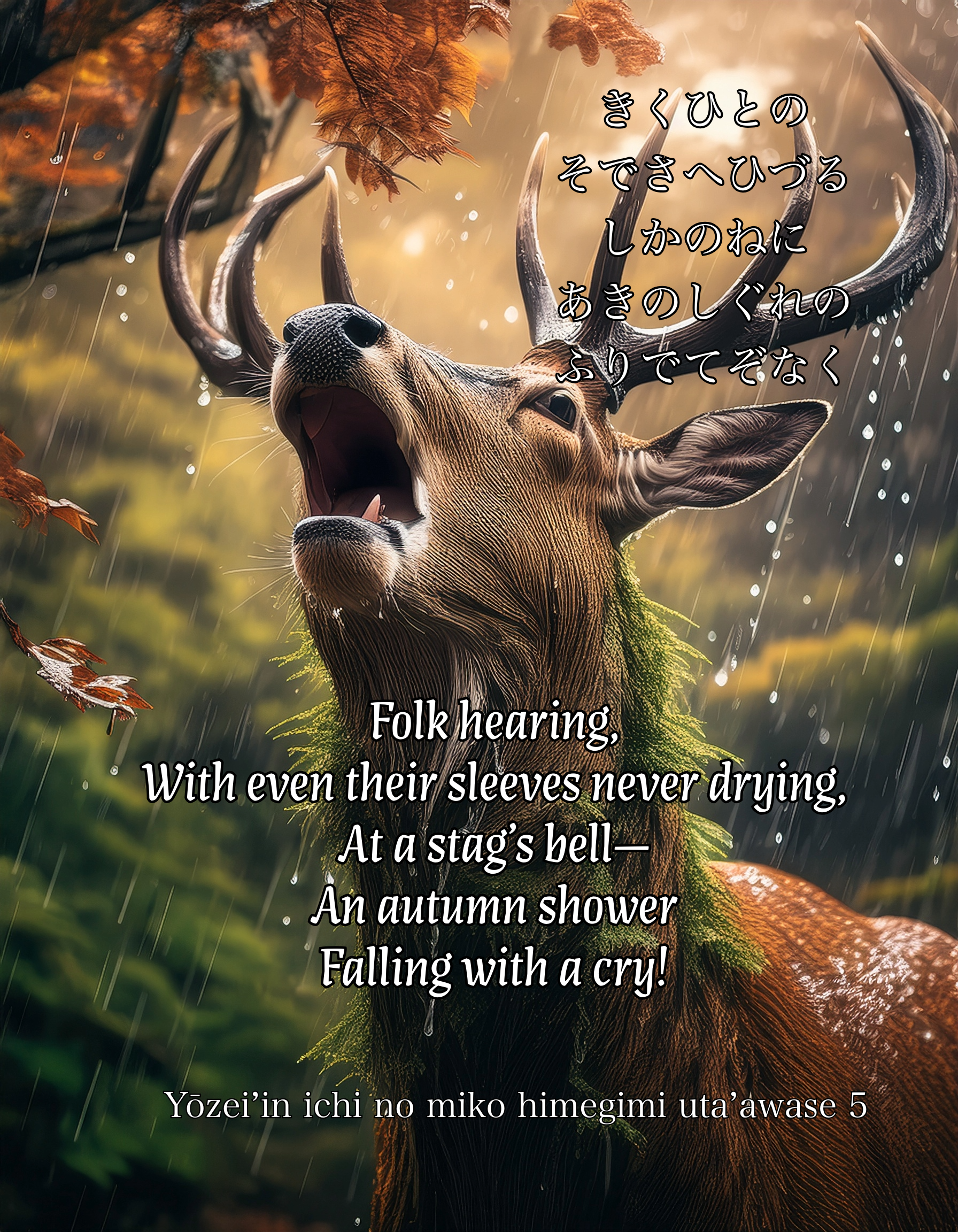
きくひとのそでさへひづるしかのねにあきのしぐれのふりでてぞなく
| kiku hito no sode sae hizuru shika no ne ni aki no shigure no furidete zo naku | Folk hearing, With even their sleeves never drying, At a stag’s bell— An autumn shower Falling with a cry! |
5
Only one poem was requested in response this round.
Composed and sent when he heard that Inspector Kinmichi had had a number of people compose poems on the bush warbler at his residence.
春霞たちへだつれど鶯の声はかくれぬものとしらずや
| harugasumi tachihedatsuredo uguisu no koe wa kakurenu mono to shirazu ya | The haze of spring Arising, interferes, yet The warbler Is unable to conceal his cry— I wonder if he know it? |
Former Consultant Tsunemori

Written on the edge of a folding screen by a painting of geese flying in the clouds, when His Majesty ordered a celebration for the Junior Principal Handmaid.
白雲の中にまがひてゆく雁もこゑはかくれぬ物にざりける
| shirakumo no naka ni magaite yuku kari mo koe wa kakurenu mono ni zarikeru | Within the clouds, so white, Entangled Goes a goose, Unable to conceal his cry With anything at all! |


Round Three
Left (Win)
さみだれにぬるともゆかむほととぎすふたこゑきなくさとはありやと
| samidare ni nuru to mo yukamu hototogisu futakoe kinaku sato wa ari ya to | By the summer showers We will be drenched, yet let’s away! For the cuckoo Has come to sing and sing again At that estate, perchance… |
Retired from the world
19
Right
さ月やみくらくはくらくほととぎすこゑはかくれぬ物にぞありける
| satsuki yami kuraku wa kuraku hototogisu koe wa kakurenu mono ni zo arikeru | In the Fifth Month’s gloomy Darkness deep, The cuckoo Is unable to conceal his cry With anything at all! |
Senior Assistant Minister Past Lecturer
20
Both Left and Right are workmanlike poems with little evidence of thought. With that being said, however, the conclusion of the Right’s poem is identical to that of a famous work by the Horikawa Minister. That poem is ‘The River Sao: / Mist rises, and from beyond / Come plover cries, / Their calls uninterrupted / By anything.’[1] And the Right here is, at the very least, extraordinarily redolent of it! Still, I feel the Left does linger in the heart.
The Left’s poem is not particularly remarkable, yet it has no faults worth mentioning. It doesn’t contain any distasteful expressions and resembles familiar compositions. The poem of the Right’s ‘darkness deep’ sounds like something said by a black-hearted scoundrel—I don’t feel it’s poetic diction at all! In addition, on the matter of the concluding ‘unable to conceal his cry’,[i] well, this appears in a range of earlier poems, as does ‘his cry uninterrupted’, so one should be hesitant about using it. I make the faultless Left the winner.


[1] Composed on plovers for a poetry competition in Eishō 4 [1050]. 佐保川の霧のあなたに鳴く千鳥聲は隔てぬ物にぞ有ける saogawa no / kiri no anata ni / naku chidori / koe wa hedatenu / mono ni zo arikeru ‘The River Sao: / Mist rises, and from beyond / Come plover cries, / Their calls uninterrupted / By anything.’ The Horikawa Minister of the Right [Fujiwara no Yorimune] (GSIS VI: 388)
[i] The only surviving example of this usage pre-dating this match is: Written on the edge of a folding screen by a painting of geese flying in the clouds, when His Majesty ordered a celebration for the Junior Principal Handmaid. 白雲の中にまがひてゆく雁もこゑはかくれぬ物にざりける shirakumo no / naka ni magaite / yuku kari mo / koe wa kakurenu / mono ni zarikeru ‘Within the clouds, so white, / Entangled / Goes a goose, / Unable to conceal his cry / With anything at all!’ Fujiwara no Kanesuke (Kanesuke-shū 48). There is also one further example in later poetry: Composed and sent when he heard that Inspector Kinmichi had had a number of people compose poems on the bush warbler at his residence. 春霞たちへだつれど鶯の声はかくれぬものとしらずや harugasumi / tachihedatsuredo / uguisu no / koe wa kakurenu / mono to shirazu ya ‘The haze of spring / Arising, interferes, yet / The warbler / Is unable to conceal his cry— / I wonder if he know it?’ Former Consultant Tsunemori (GYS I: 50)
Cuckoos
Round One
Left
ほととぎすまきのとばかりまちつれどなかであけぬる夏のしののめ
| hototogisu maki no to bakari machitsuredo nakade akenuru natsu no shinonome | O, cuckoo, Briefly by my door of cedar wood Did I await you, yet No song, at all, brightened This summer edge of dawn. |
Lord Dainagon
15
Right (Win)
ほととぎすなくうれしさをつつめどもそらにはこゑもとまらざりけり
| hototogisu naku ureshisa o tsutsumedomo sora ni wa koe mo tomarazarikeri | At the cuckoo’s Song, my joy To hold fast did I try, yet In the skies, his cry Lingered not. |
Lord Chūnagon
16
The Left’s poem, after careful consideration, has a graceful style. The diction of the Right’s poem is superb, and there is an excess of conception. Reading and reciting these leaves my aged heart at a loss. Thus, they tie.
In the Left’s poem, ‘briefly’ is an expression which means ‘just for a short time’, I think, and thus the sentiments are lacking. Saying ‘brightened…edge of dawn’ sounds as if the poet has only begun waiting at daybreak. One does see, apparently, a number of poems in prior matches where the poet has not heard the cuckoo. Nevertheless, I do wonder about whether this is appropriate, given that poems where the cuckoo has been heard are faultless. The Right’s poem is not that good, but it is poetic. Thus, it has to win.


Round Thirty-Seven
Left (Tie)
むば玉のよやふけぬらんさをしかの声すみのぼるをのの草ぶし
| mubatama no yo ya fukenuran saoshika no koe suminoboru ono no kusabushi | Might lily-seed dark Night have fallen? The stag’s Cry clearly climbs From where he lies among the meadow grasses. |
Takasuke
73
Right
秋のよはつまどふ鹿の深山出でていまだ旅なるをのの草ぶし
| aki no yo wa tsumadou shika no miyama idete imada tabi naru ono no kusabushi | On an autumn night, Seeking his bride, the stag Emerges from the mountains’ depths, And now on his travels Lies among the meadow grasses. |
Shimotsuke
74
Left and Right’s ‘lies among the meadow grasses’ have no merits or faults between them. A pleasant tie.