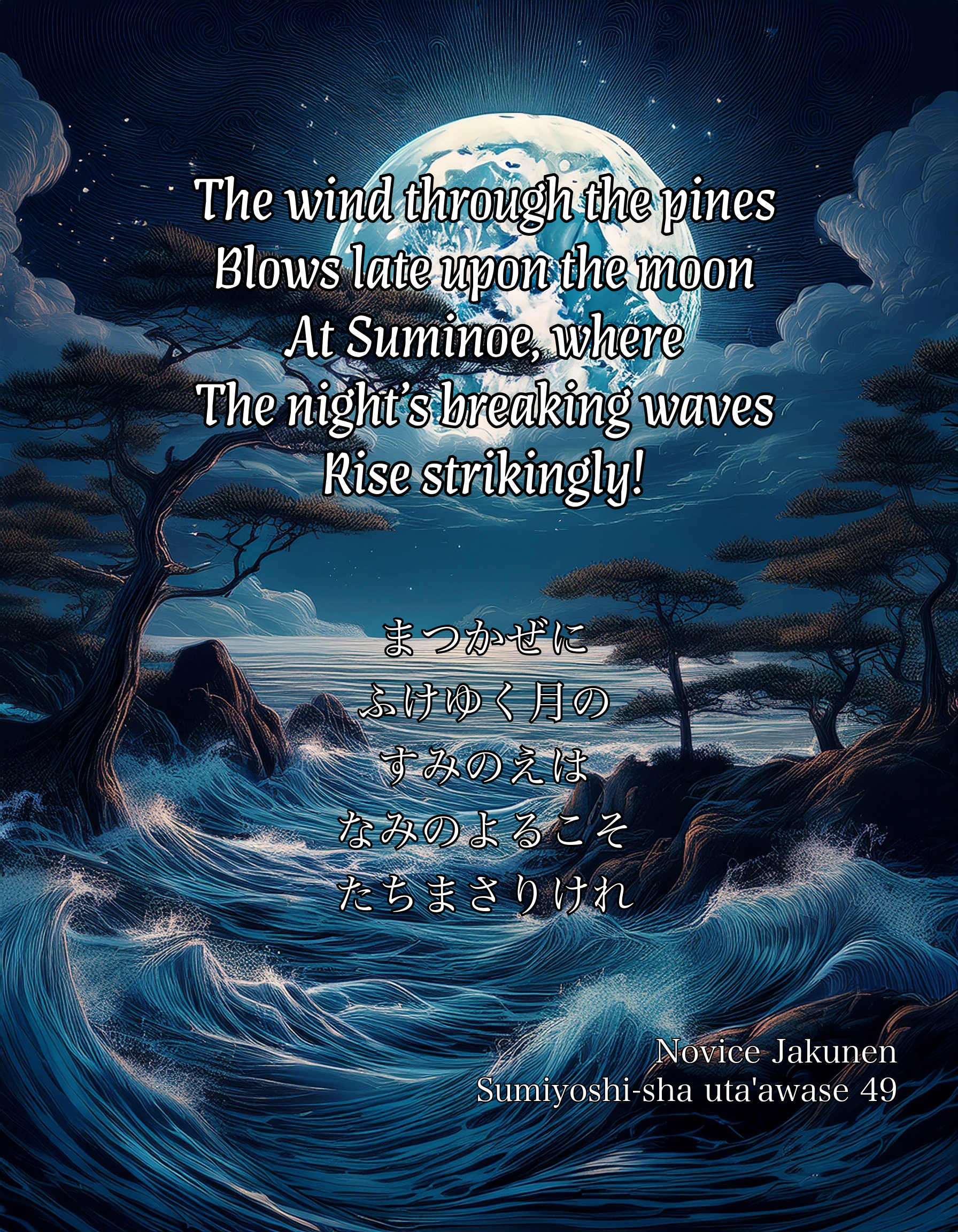
nezameshite uki yo o omoi awasureba madoromu yume ni kawarazarikeri
When I awake, with This cruel world my thoughts Occupying, The dream that filled my doze Differed not at all…
Hyōenokami 121
Right (Win)
すみのえのうきにおひたるしをれあしをなみひきたてよかみのめぐみに
suminoe no uki ni oitaru shiore’ashi o nami hikitateyo kami no megumi ni
In Suminoe’s Muddy waters grows, Languishing, a reed: O, waves, lift it upright! To receive the deity’s blessing…
Lord Michichika 122
The poem of the Left appears to have an elegant sequence, saying, ‘This cruel world my thoughts / Occupying’, but the speaker does not appear to be particularly thinking of themselves—they are simply reflecting on the transience of this world and that’s how it is. The poem of the Right begins with ‘In Suminoe’ and then has ‘Muddy waters grows’, linking the particular shore with the content. The Right should win.
yo no naka o umiwataritsutsu toshi henuru koto wa tsumori no kami ya tasukemu
In this mundane world, An endless sea of suffering, Have my years gone by; Might Tsumori’s Deity save me, I wonder?
Dharma Master Shun’e 115
Right (Win)
いへのかぜわがみのうへにすずしかれかみのしるしをあふぐとならば
ie no kaze wa ga mi no ue ni suzushikare kami no shirushi o augu to naraba
My house’s breeze of fortune To my sorry self I would bring cool, if For a sign from the God I were to seek…
Lord Sanekuni 116
The Left’s conception is charming, beginning with ‘An endless sea of suffering’ and following this with ‘Might Tsumori’s / Deity save me, I wonder?’, but ‘endless sea of suffering’ does not sound like acceptable diction. The Right’s conception of ‘For a sign from the God / I were to seek’ sounds charming, so I make it the winner.
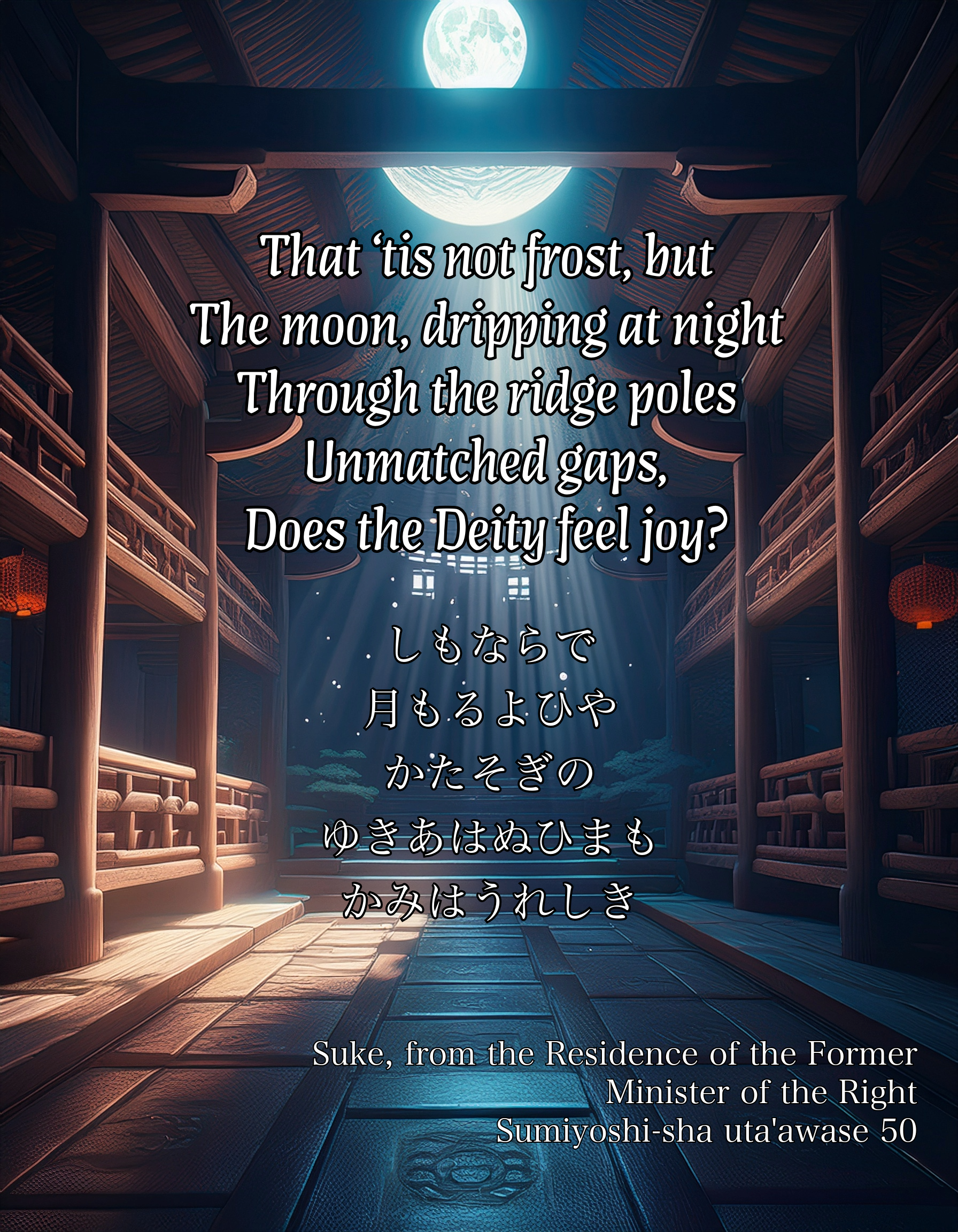
shimo narade tsuki moru yoi ya katasogi no yukiawanu hima mo kami wa ureshiki
That ‘tis not frost, but The moon, dripping at night Through the ridge poles Unmatched gaps, Does the Deity feel joy?
Suke, from the Residence of the Former Minister of the Right[2] 50
The Left poem’s ‘Blows late upon the moon / At Suminoe’ sounds pleasant, but there have been recent poems, such as ‘Brings waves–that / I would tell you!’[3] and ‘Simply with the waves / Did seem to draw near with the night’[4] and while the initial section of the poem here differs, basing a poem on this is not that unusual, I think. The tone of the Right’s poem is charming, but it does not seem likely that the Deity would feel joy simply at the moon coming through the gaps in His ridgepoles. The Deity’s power is limitless and wards eighty isles beyond Sumiyoshi—indeed, there is nowhere in Tsumori’s shore or Sumiyoshi beach, above the waves or in the shad of the pines that it does not reach. I have discussed ridgepoles earlier. Nevertheless, the configuration of the poem isn’t bad, so these should tie, I think.
[3] 人しれぬ思ひありそのはま風に浪のよるこそいはまほしけれ hito shirenuomoi ariso nohamakaze ninami no yoru kosoiwamahoshikere ‘Unknown to all / My passion burns—toward a rocky / Beach the breeze / Brings waves–that / I would tell you!’ Middle Captain Toshitada (Horikawa-in enjo awase 17/KYS (2) 468/500)
[4] Composed when he was asked by people in the capital what the moon had been like, when he had returned there, after going to Akashi to gaze upon it, at a time when it was particularly bright. 有明の月もあかしの浦風に波ばかりこそよるとみえしか ariake no tsuki mo akashi no urakaze ni nami bakari koso yoru to mieshika ‘The dawntime Moon’s brightness, with Akashi’s / Beach breezes / Simply with the waves / Did seem to draw near with the night…’ Taira no Tadamori (KYS (2) III: 216/KYS (3) III: 212)
tamagaki ni hikari sashisouru yūzukuyo kami ni tamukuru kage ni ya aruramu
The jewelled fences, Trailed with light, On an early moonlit evening: Is this to the Deity an offering Of light, I wonder?
Lord Fujiwara no Kunisuke Supernumerary Senior Secretary of the Empress Household Office Exalted Junior Fifth Rank, Lower Grade 39
Right
くもはらふあらしのみがく月にまたひかりをそふるあけのたまがき
kumo harau arashi no migaku tsuki ni mata hikari o souru ake no tamagaki
Clouds swept away By the storm wind, polish The moon, so once more Light trails across The vermillion jewelled fences.
Horikawa, from the Residence of the Former Chancellor[1] 40
The Left’s poem is extremely charming with the solicitousness it displays in the sequence ‘On an early moonlit evening: / Is this to the Deity an offering’, but it is truly regrettable that it does not use the full moon or that at the dawn. The Right’s poem focusses on ‘light trailing’ and, as I get the impression that I have heard this a lot recently, the earlier instances have said all there is to say here, so once more the overall style of the Left is superior.
tsuki no sumu naniwa no ura no keshiki ni wa kami no kokoro mo taezu ya aruramu
The moon rising above The bay of Naniwa— At the scene Even the Deity’s heart Must be unable to endure…
Lord Fujiwara no Norimori Junior Fifth Rank, Lower Grade Without Office[ii] 38
The poem of the Left appears pleasant in configuration and sequencing, but it lacks any profundity of thought and simply seems to flow easily. The Right’s poem appears to have some conception, managing to follow ‘Having a sensitive heart: / To such a one would I show / The land of Tsu’[1] and also seems to sound as if it conveys the sense of the old poem about a man finding the bay of Naniwa unbearably fine[2]. With that being said, expanding this to the Deity’s heart as well is charming. Thus, the Right wins.
[1] Sent to someone’s residence, when he was in Tsu province around the beginning of the year. こころあらむ人にみせばやつのくにのなにはわたりのはるのけしきを kokoro aramu / hito ni miseba ya / tsu no kuni no / naniwa watari no / haru no keshiki o ‘I would to a sensitive / Soul show / The land of Tsu / Around Naniwa— / Truly, the scenery of spring!’ Dharma Master Dōin (GSIS I: 43)
[2] Composed as a spring poem, when he presented a hundred-poem sequence. 心なきわが身なれども津の国の難波の春にたへずも有るかな kokoro naki / wagami naredomo / tsu no kuni no / naniwa no haru ni / taezu mo aru kana ‘Insensitive / Is my sorry self, yet / In the land of Tsu / Naniwa in springtime is / Unbearably fine!’ Fujiwara no Suemichi (SZS II: 106/Kyūan hyakushu 413)
yuki mo awanu chigi no katasogi moru tsuki o shimo to ya kami no omoimasuramu
Fail to entwine do The chiliad of trees, while from the ridge poles Drips the moon— ‘Tis frost, perhaps, does the Deity Deign to wonder?
Lord Taira no Tsunemasa Supernumerary Director of the Bureau of Horses, Left Division Governor of Awaji Exalted Fifth Rank, Lower Grade[i] 27
Right
しろたへのゆきかとみればかぜさえて月ぞしづるるすみよしのまつ
shirotae no yuki ka to mireba kaze saete tsuki zo shizururu sumiyoshi no matsu
White as mulberry cloth, I wonder, if ‘tis snow, I see— In the chill wind The moon slips from The pines of Sumiyoshi…
Lord Minamoto no Nakatsuna Governor of Oki Junior Fifth Rank, Lower Grade[ii] 28
The configuration of the Left appears elegant, but the expression ‘chiliad of trees’ was said to be impermissible by Lord Mototoshi in his judgement on a poetry competition held in a certain place. The final section, too, seems to require a bit more thought [because it’s insulting to the deity]. As for the Right, the conception of wondering if the moon’s light shining through the trees is snow slipping off them is charming, but I do wonder about the sound of ‘the moon slips’ as a piece of diction. The initial ‘white as mulberry cloth’, too, sounds like it needs further thought [because this is not used to modify ‘snow’], so these should tie.
[i]Shōgoige-gyō sauma gon-kami ken awaji no kami Taira ason Tsunemasa正五位下行左馬権頭兼淡路守平朝臣経正
[ii]Jūgoige-gyō oki no kami Minamoto ason Nakatsuna 従五位下行隠岐守源朝臣仲綱
matsu mo mina shirayū kakete sumiyoshi no tsuki no hikari mo kamisabinikeri
The pine trees, every one, Are hung with sacred streamers— At Sumiyoshi Even the moon’s light Inspires awe.
Hyōenosuke, in service to the Junior Consort (formerly Handmaid Mikawa, in service at the Nijō Palace)[1] 19
Right
かたそぎのゆきあはぬまよりもる月をさえぬしもとやかみは見るらむ
katasogi no yuki awanu ma yori moru tsuki o saenu shimo to ya kami wa miruramu
The ridge poles Fail to entwine, and from the gaps Drips moonlight— As chill-less frost, I wonder, Does the Deity regard it?
Lord Fujiwara no Naganori Supernumerary Minor Captain in the Inner Palace Guards, Left Division Exalted Senior Fourth Rank, Lower Grade[2] 20
The Left’s poem appears to have a pleasant configuration with ‘Even the moon’s light / Inspires awe’. The poem of the Right, furthermore, has a charming-sounding sequence with ‘As chill-less frost, I wonder, / Does the Deity regard it?’ but in composition one usually states that the moon is fair precisely because of its chill. Thus, when one compares it to true frost, can one say that it lacks it? While I do feel that this is somewhat vague, both the poems appear to pleasant configurations, so I make this a tie.
[1]Nȳogo no ie Hyōenosuke moto nijōin Mikawa no maishi女御家兵衛佐元二条院参河内侍
While in the Left ‘ice appears’ and ‘is not, perhaps, melted’ seem to have some kind of linkage, if we consider this as a Cathay-style poem saying ‘A chill night’s moon / Ice atop the swell’, then I would have preferred it to say ‘is, perhaps, bound’. An alternative version of this would, of course, be ‘A spring morn’s breeze / Ice on the eastern shore’ which could lead to ‘is not, perhaps, melted’, I think. The Right has ‘On the coast before the shrine / Even the pine needles’ and through this type of linkage expresses the brightness of the moon. While this type of smug-sounding expression also appeared in the round before last, the moon here does seem bright and so I can say that the Right wins.
akirakeki kami no kokoro ya taguuramu hoka yori mo ke ni sumeru tsuki kana
So bright is The Deity’s heart that, surely Close by clings More than anywhere, indeed, The moon, so clear!
Lord Fujiwara no Sanemori Supernumerary Middle Captain in the Inner Palace Guards, Right Division Exalted Senior Fourth Rank, Lower Grade[2] 14
The Left’s ‘Did He first manifest / Surely when above’ appears pleasant, but the diction of the latter part of the poem does not sound as if it does justice to the topic. The Right’s conception and diction sound as if they match the topic of the moon over the shrine, but I would have preferred a bit more technique than is in the line ‘More than anywhere, indeed’. Thus, as both contain faults the round ties once more.
mezurashiki kyō no kasuga no yaotome o kami mo koishi to shinobazarame ya
Charming, Today at Kasuga Were maidens eight— Would the deity, too, such yearning Be unable to recall?[1]
1
In reply:
Left (Tie)
やをとめをかみししのばばゆふだすきかけてぞこひむけふのくれなば
yaotome o kami shi shinobaba yūdasuki kakete zo koimu kyō no kurenaba
If maidens eight The deity does recall, then Cords of mulberry cloth Would he hang that on this beloved Day evening should not fall…
2
Right
ちはやぶるかみしゆるさばかすがのにたつやをとめのいつかたゆべき
chihayaburu kami shi yurusaba kasuga no ni tatsu yaotome no itsuka tayubeki
Should the mighty Deity permit, Upon Kasuga plain Stand maidens eight— How long would they endure?
3
[1] A variant of this poem occurs in Shūishū: Composed when officials from the provinces presented twenty-one poems on the occasion of an imperial progress to Kasuga by the former Teiji Emperor in Engi 20: めづらしきけふのかすがのやをとめを神もうれしとしのばざらめや mezurashiki / kyō no kasuga no / yaotome o / kami mo ureshi to / shinobazareme ya ‘Charming, / Today at Kasuga / Were maidens eight— / Would the deity, too, such joy / Be unable to recall?’ Fujiwara no Tadafusa (SIS X: 620)