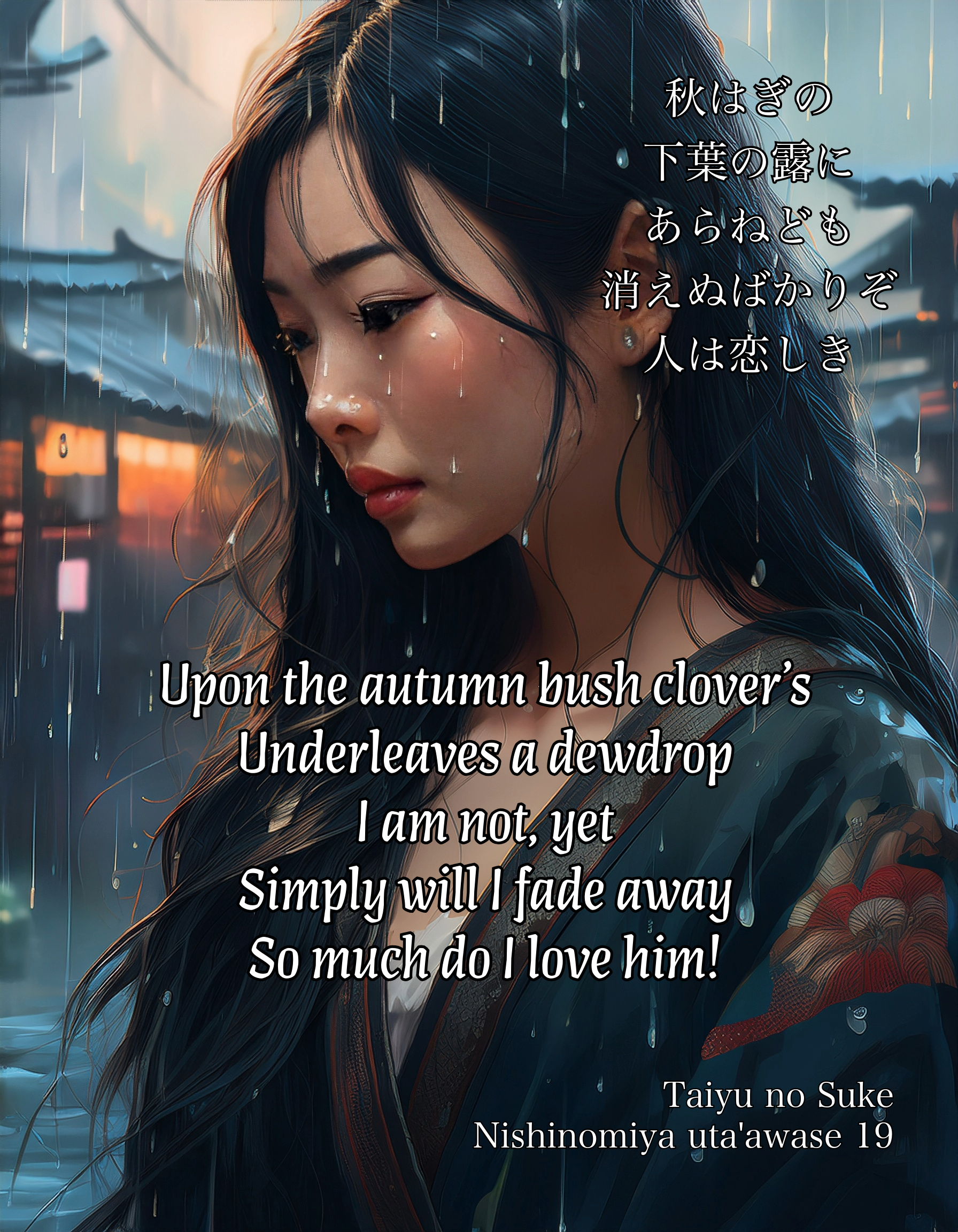
akihagi no shitaba no tsuyu ni aranedomo kienu bakari zo hito wa koishiki
Upon the autumn bush clover’s Underleaves a dewdrop I am not, yet Simply will I fade away So much do I love him!
Taiyu no Suke 19
Right
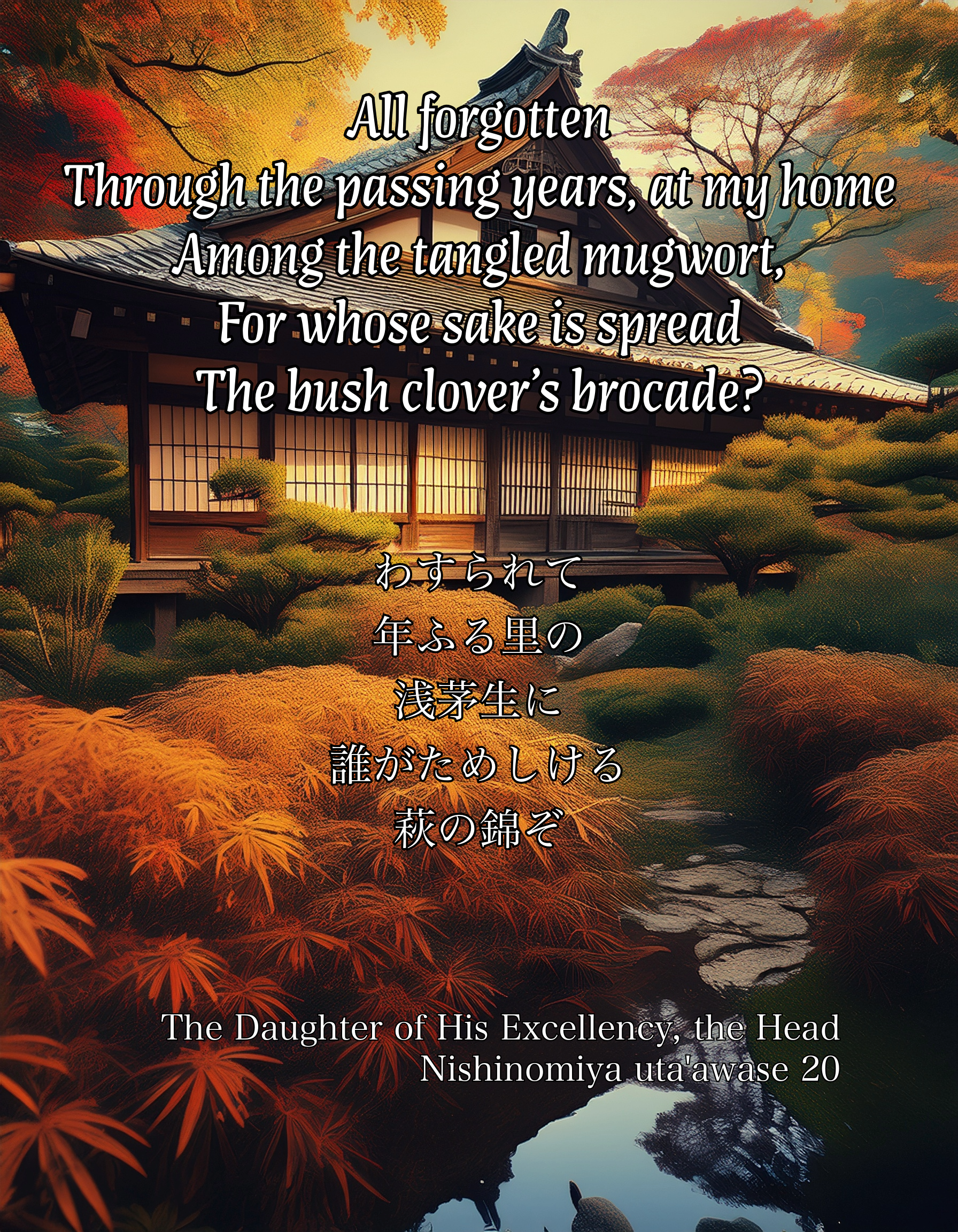
わすられて年ふる里の浅茅生に誰がためしける萩の錦ぞ
wasurarete toshi furu sato no asajū ni ta ga tame shikeru hagi no nishiki zo
All forgotten Through the passing years, at my home Among the tangled mugwort, For whose sake is spread The bush clover’s brocade?
The Daughter of His Excellency, the Head
20
I feel that the poem of the Left is conspicuously poetic, saying ‘Simply will I fade away / So much do I love him!’ while the poem of the Right’s ‘Through the passing years, at my home / Among the tangled mugwort, / For whose sake is spread / The bush clover’s brocade?’ makes me want to ask the bush clover the same question! The pull my heart in more than one direction, so here, too, I feel it’s not possible to decide on a winner or loser.
oki’akashi kumanaki tsuki o nagamureba nohara no kusa no tsuyu mo kakurezu
Lying awake ‘til dawn, and Upon the cloudless moon A’gazing— Upon the grasses o’er the plain Not a single dewdrop is concealed.
Mikawa 53
Right
月をみて心をこよひつくすかなくまなき空は又もこそあれ
tsuki o mite kokoro o koyoi tsukusu kana kumanaki sora wa mata mo koso are
Seeing the moon, Tonight, my heart Exhausts! The cloudless skies Once more are such!
Lord Kinshige 54
The Left’s ‘lying awake ‘til dawn, gazing’ suggests that the poet is at their own residence, but then it finally turns out that they are on the plain – what to make of this? It’s also the case that the moon doesn’t necessarily always appear over the plains. This poem should really have included a clearer reason for the poet’s journey. As for the Right, while it isn’t bad, the final line certainly regrettable, so this round is a tie.
[1] The kanshi in question appears in Wakan rōeishū (II: 789): 観身岸額離根草 論命江頭不繋舟 ‘Thinking on my life, ‘tis but a rootless grass upon the shore; / Thinking on my fate, ‘tis as uncertain as an unmoored boat upon the bank.’ If read as Japanese, this poem would be: mi o kanzureba kishi no hitai ni ne o hanaretaru kusa / mei o ronzureba e no hotori ni tsunagazaru fune. Izumi Shikibu’s poem links with the initial tsu of tsunagazaru, beginning as it does with tsuyu ‘dew’.
[1] The kanshi in question appears in Wakan rōeishū (II: 789): 観身岸額離根草 論命江頭不繋舟 ‘Thinking on my life, ‘tis but a rootless grass upon the shore; / Thinking on my fate, ‘tis as uncertain as an unmoored boat upon the bank.’ If read as Japanese, this poem would be: mi o kanzureba kishi no hitai ni ne o hanaretaru kusa / mei o ronzureba e no hotori ni tsunagazaru fune. Izumi Shikibu’s poem links with the initial tsu of tsunagazaru, beginning as it does with tsuyu ‘dew’.