uguisu no harusamezame to naki’itaru take no shizuku ya namida naruran
A warbler In a spring shower lets fall His cries: Are the droplets on the bamboo His tears, perhaps?[i]
26
[i] See: Warbler [uguhisu]. 心から花のしづくにそほちつつうくひずとのみ鳥のなくらむ kokoro kara / hana no shizuku ni / sōchitsutsu / uku hizu to nomi / tori no nakuramu ‘Even his heart / By droplets from the blossoms / Is ever drenched: / Sadly simply never dry, / Does the bird seem to cry…’ Lord Fujiwara no Toshiyuki (Kokinshū X: 422); and: When he was staying somewhere with bamboo before his bedroom. 竹ちかくよどこねはせじ鶯のなく声きけばあさいせられず take chikaku / yodoko ne wa seji / uguisu no / naku koe kikeba / asa irarezu ‘Close by the bamboo / My bed, but sleep eludes me, for / When the warbler’s / Crying song I hear / I cannot doze away the morning.’ Lord Fujiwara no Korehira (Gosenshū II: 48)
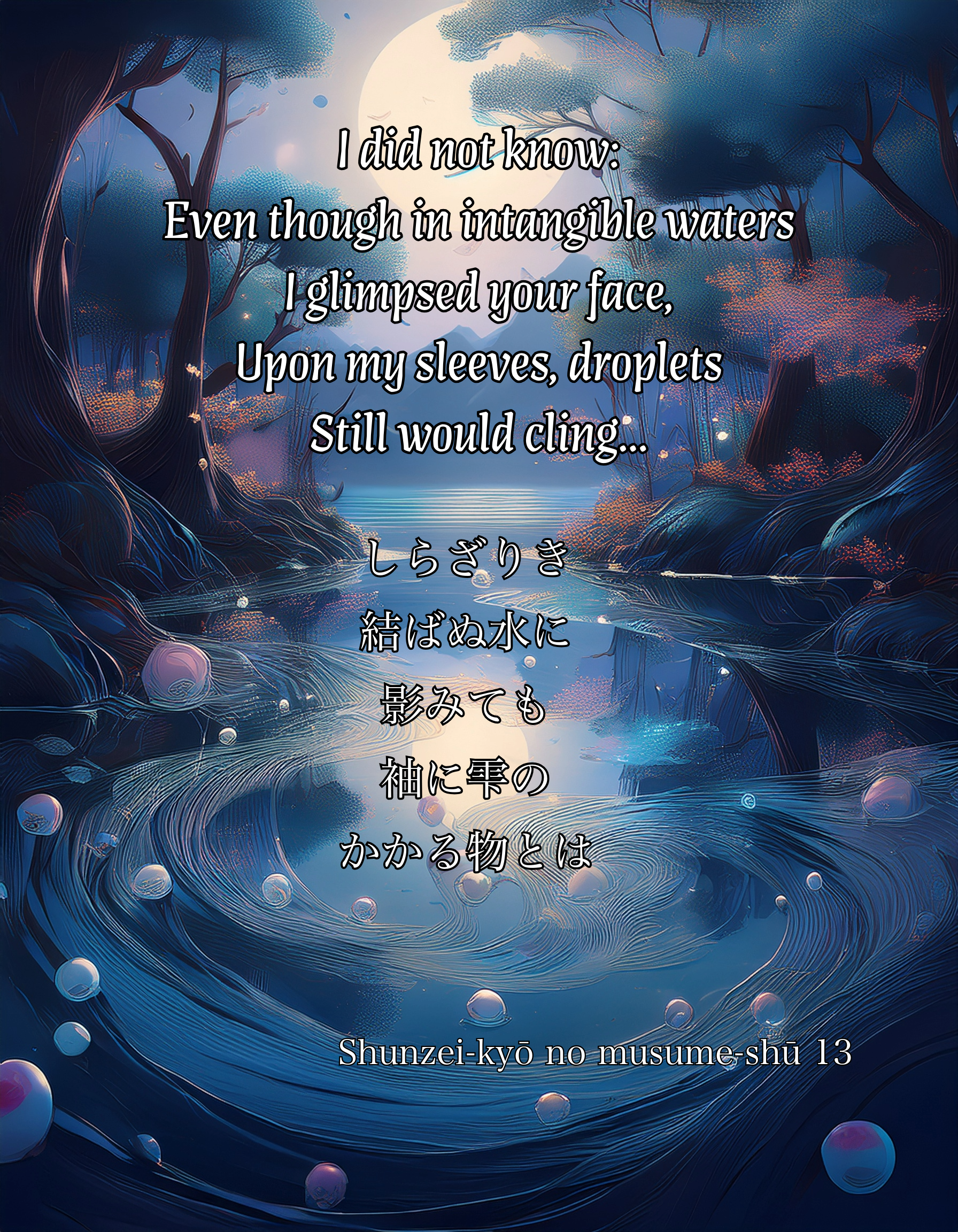
shirazariki musubanu mizu ni kage mitemo sode ni shizuku no kakaru mono to wa
I did not know: Even though in intangible waters I glimpsed your face, Upon my sleeves, droplets Still would cling…[i]
13
[i] An allusive variation on: Composed on the conception of love, when hundred poem sequences were presented during the reign of former Emperor Horikawa. おもひあまり人にとはばやみなせ川むすばぬ水に袖はぬるやと omoi’amari / hito ni towaba ya / minasegawa / musubanu mizu ni / sode wa nuru ya to ‘Love consumes me and so / I would ask her: / Do the ever dry Minase River’s / Intangible waters / Yet soak your sleeves?’ Major Counsellor Kinzane (Senzaishū XII: 704)
Composed after I had met Dharma Eye Teinin,[i] and heard him tell the tale of Ōmine[ii] among other things.
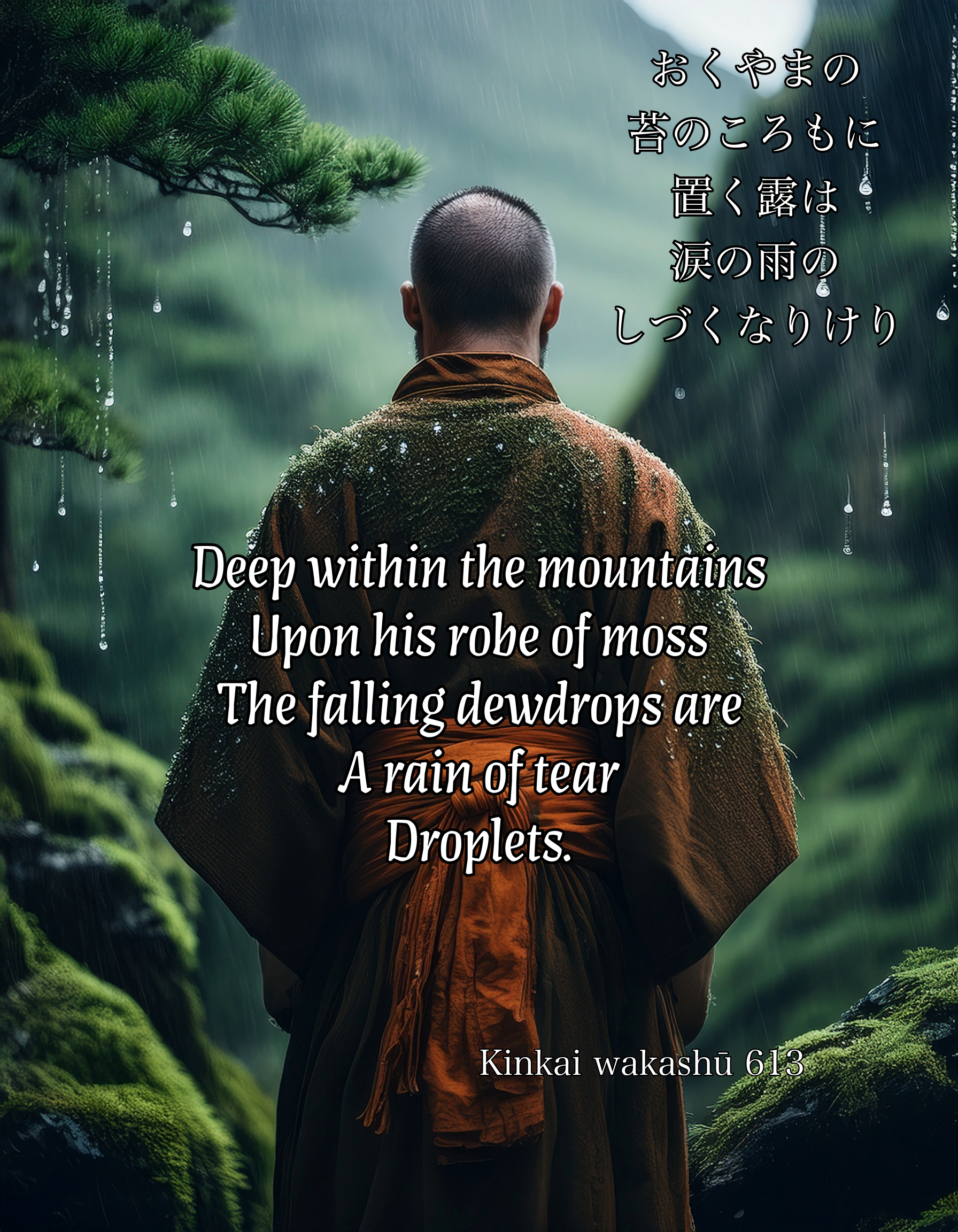
おくやまの苔のころもに置く露は涙の雨のしづくなりけり
okuyama no koke no koromo ni oku tsuyu wa namida no ame no shizuku narikeri
Deep within the mountains Upon his robe of moss The falling dewdrops are A rain of tear Droplets.
613
[i] Teinin 定忍 has not been identified, but from the context here, he must have been a yamabushi 山伏, an itinerant Buddhist monk and practitioner of shugendō.
[ii] Ōmine 大峰 was a mountain in Yoshino in Yamato which was a major location for practitioners of the ascetic Buddhist practice of shugendō 修験道, which involved, among other things, ascending the mountain to increase one’s spiritual power.
naniwagata ashi no maroya no tabine ni wa shigure wa noki no shizuku ni zo shiru
In Naniwa’s tidelands, In a reed-roofed hut, Dozing on my travels— A shower by the eaves Dripping droplets is revealed!
Lord Tsunemori 85
Right
つのくにのこやのたびねにしぐれしてなにかはもらむあしのやへぶき
tsu no kuni no koya no tabine ni shigureshite nani ka wa moramu ashi no yaebuki
In the land of Tsu In Koya, in a hut dozing on my travels During a shower— Will anything drip through My roof’s eightfold thatch?
Lord Yorisuke 86
Both Left and Right are set in a traveller’s lodge in Sesshū province, but the Left appears to lack configuration and conception, it has long been said that using four of the character in a poem in a poetry match is a fault, but it does not sound to me as if the four uses of no here are a particular problem. With that being said, starting with ‘dozing on my travels’ [tabine ni wa]and then having ‘a shower by the eaves’ [shigure ni wa] uses wa twice and this seems to sound a bit discordant. The Right, while it refers to the same sort of shower from a cloudless sky, starts with ‘during a shower’ and follows this with ‘will anything drip through?’, which seems to sound a bit contradictory. I can’t help but feel it would have been better had it been ‘even though it showers’ and then had ‘will anything’. However, both poems are about reed roofed huts during a shower and it really is difficult to distinguish between them. Thus, I make this a tie.