izuku nite yo oba tsukusamu sugawara ya fushimi no sato mo arenu to iu mono o
Where, indeed, Should I live my life? For among the sedge beds The estate of Fushimi Lies in ruins…[i]
690
[i] See: Topic unknown. いざこゝにわが世は經なむ菅原や伏見の里の荒れまくもおし iza koko ni / wa ga yo wa henamu / sugawara ya / fushimi no sato no / aremaku mo oshi ‘So, here / I will pass my days: / The sedge beds of / My estate at Fushimi are / All overgrown – so sad!’ Anonymous (Kokinshū XVIII: 981)
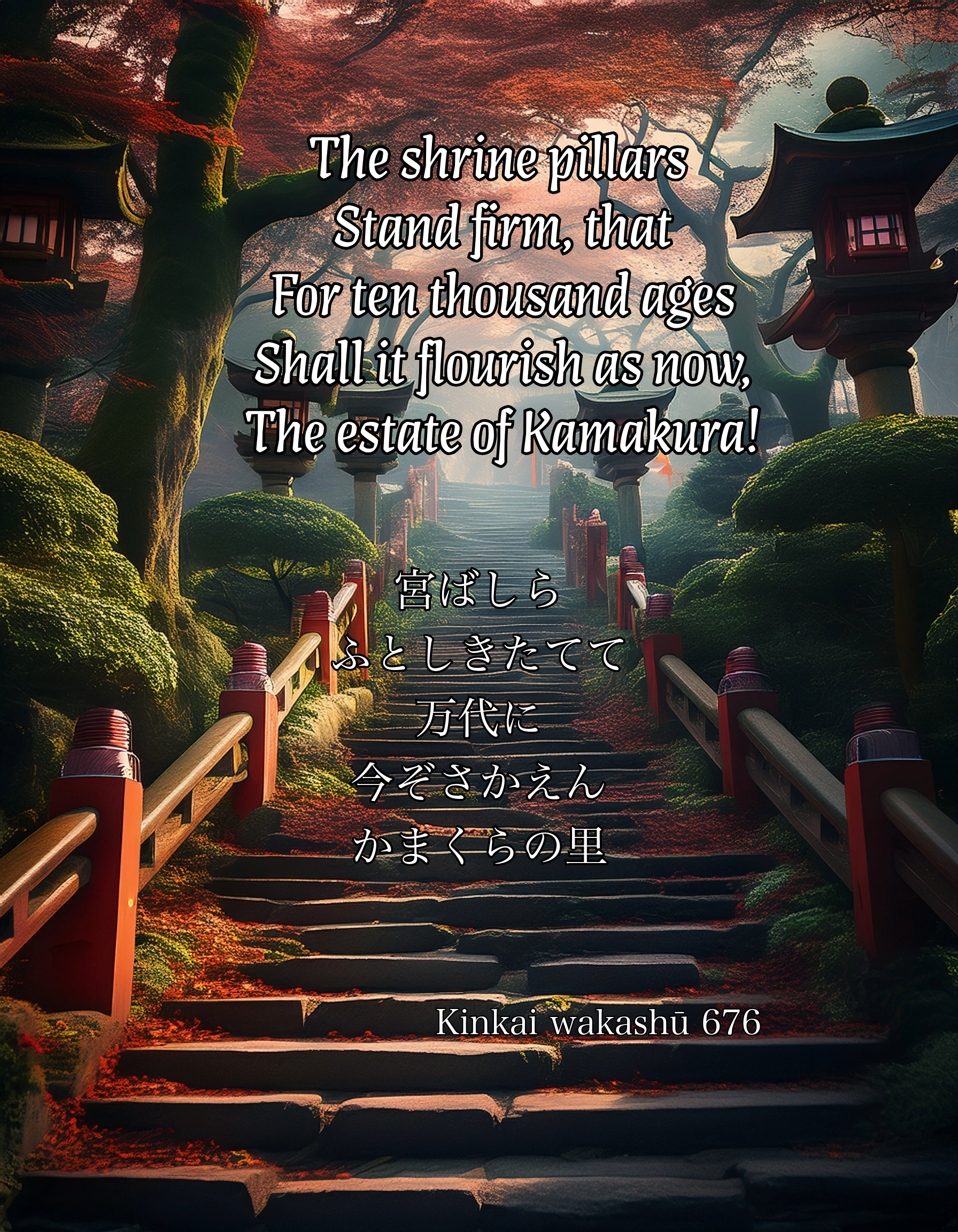
miyabashira futoshiki tatete yorozuyo ni ima zo sakaen kamakura no sato
The shrine pillars[i] Stand firm, that For ten thousand ages Shall it flourish as now, The estate of Kamakura!
676
[i] The shrine Sanetomo is referring to here is the Tsurugaoka Hachiman Shrine in Kamakura (see poem 623). This burned down in 1191, but was then reconstructed by Minamoto no Yoritomo (Higuchi 2016, 208).
obotsukana izure izuchi no michi naramu shiori mo miezu fureru shirayuki
How strange! Which is which Path, I wonder? Even the laden branches go unseen In the falling snow, so white.
Retired from the World 47
Right
雪ふかみとなりのさともうづもれてけぶりのみこそしるしなりけれ
yuki fukami tonari no sato mo uzumorete keburi nomi koso shirushi narikere
So deep the snow, that The estate next door Is buried; Trails of smoke are the only Sign it’s there!
Senior Assistant Minister Past Lecturer
48
The poem of the Left’s ‘even the laden branches go unseen’ and what follows is both poetic and a familiar usage. As for the Right’s poem, how can ‘the estate next door be buried’ unless it’s the only place that snow is falling and nowhere else? Thus, I feel that the snow falling to conceal the broken branches has more feeling to it.
The Left’s ‘which path’ gives me the impression that there are many of them. This sense of multiplicity is something I can imagine—which is a good thing—and, I think, see me using myself. ‘Laden branches’ are something which occur on peaks deep in the mountains. It might be a bit remiss of me, but I wonder whether I can imagine snow drifting so high on a mountain peak?
As for the Right’s poem, we use ‘next door’ when there’s a fence of some sort between one estate and another, don’t we? As such, saying that the smoke is the sign is rather vague. Even if there’s been a quite extraordinary snowfall, there would be something other to notice as well as the smoke, so this is an error, isn’t it. It would be acceptable to refer to smoke if the estate were further away.
How deeply Moving might it be? For a cuckoo To have long awaited and He then comes to call…
Cell of Everlasting Truth 22
In regard to the Left’s poem, in the Poetry Match held in Engi 3, there was a compostion which went ‘Until in Kataoka / The plains of Ashita / Does resound / The mountain cuckoos / Are singing now!’[i] When this was recited, His Majesty laughed and so it was not read aloud all the way to the end. The expression ‘resound’ is poor. The diction of the Right’s poem is terribly stilted and really doesn’t trip off the tongue, but strictly speaking it has no particular faults. I make it the winner.
The Left’s poem seems move my heart to the greatest degree. However, it really is the case that ‘resounding with song’ is something which happens after hearing it—that’s when it would seem right to compose ‘come resound with song’. It’s extremely imprudent to guess and say that somewhere ‘might resound with song’ without hearing it. And yet, there is the conception of there being times, too, when the cuckoo doesn’t sing. In the Right’s poem ‘To have long awaited’ lacks harmony, and I would want there to be a break there, so I should say that the Left wins.
samidare ni nuru to mo yukamu hototogisu futakoe kinaku sato wa ari ya to
By the summer showers We will be drenched, yet let’s away! For the cuckoo Has come to sing and sing again At that estate, perchance…
Retired from the world 19
Right
さ月やみくらくはくらくほととぎすこゑはかくれぬ物にぞありける
satsuki yami kuraku wa kuraku hototogisu koe wa kakurenu mono ni zo arikeru
In the Fifth Month’s gloomy Darkness deep, The cuckoo Is unable to conceal his cry With anything at all!
Senior Assistant Minister Past Lecturer 20
Both Left and Right are workmanlike poems with little evidence of thought. With that being said, however, the conclusion of the Right’s poem is identical to that of a famous work by the Horikawa Minister. That poem is ‘The River Sao: / Mist rises, and from beyond / Come plover cries, / Their calls uninterrupted / By anything.’[1] And the Right here is, at the very least, extraordinarily redolent of it! Still, I feel the Left does linger in the heart.
The Left’s poem is not particularly remarkable, yet it has no faults worth mentioning. It doesn’t contain any distasteful expressions and resembles familiar compositions. The poem of the Right’s ‘darkness deep’ sounds like something said by a black-hearted scoundrel—I don’t feel it’s poetic diction at all! In addition, on the matter of the concluding ‘unable to conceal his cry’,[i] well, this appears in a range of earlier poems, as does ‘his cry uninterrupted’, so one should be hesitant about using it. I make the faultless Left the winner.
[1] Composed on plovers for a poetry competition in Eishō 4 [1050]. 佐保川の霧のあなたに鳴く千鳥聲は隔てぬ物にぞ有ける saogawa no / kiri no anata ni / naku chidori / koe wa hedatenu / mono ni zo arikeru ‘The River Sao: / Mist rises, and from beyond / Come plover cries, / Their calls uninterrupted / By anything.’ The Horikawa Minister of the Right [Fujiwara no Yorimune] (GSIS VI: 388)
[i] The only surviving example of this usage pre-dating this match is: Written on the edge of a folding screen by a painting of geese flying in the clouds, when His Majesty ordered a celebration for the Junior Principal Handmaid. 白雲の中にまがひてゆく雁もこゑはかくれぬ物にざりける shirakumo no / naka ni magaite / yuku kari mo / koe wa kakurenu / mono ni zarikeru ‘Within the clouds, so white, / Entangled / Goes a goose, / Unable to conceal his cry / With anything at all!’ Fujiwara no Kanesuke (Kanesuke-shū 48). There is also one further example in later poetry: Composed and sent when he heard that Inspector Kinmichi had had a number of people compose poems on the bush warbler at his residence. 春霞たちへだつれど鶯の声はかくれぬものとしらずや harugasumi / tachihedatsuredo / uguisu no / koe wa kakurenu / mono to shirazu ya ‘The haze of spring / Arising, interferes, yet / The warbler / Is unable to conceal his cry— / I wonder if he know it?’ Former Consultant Tsunemori (GYS I: 50)
akenbono wa namida ya moroki hototogisu naku ne ni otsuru mori no shitazuyu
With the dawn Are you swiftly to tears moved By the cuckoo’s Calling cries, falling from The forest drip dewdrops?
Dōchin 39
Right
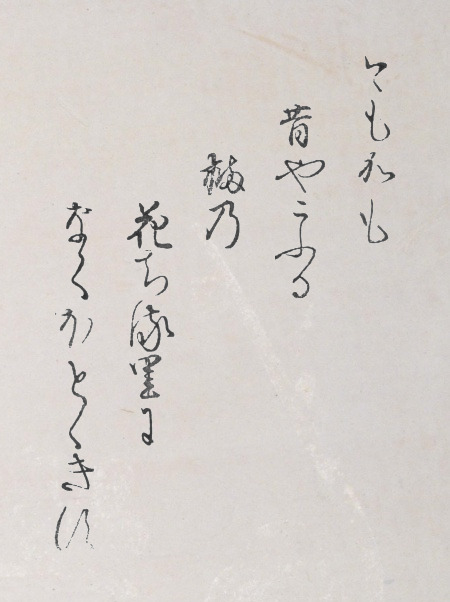
今もかも昔やこふる橘の花ちる里になく郭公
ima mo kamo mukashi ya kouru tachibana no hana chiru sato ni naku hototogisu
I wonder, is she now, As in days gone by, beloved Where orange Blossom falls on the estate— The calling cuckoo?[1]
Dharma Master Nyokan 40
Both Left and Right are of the same quality, yet I wonder about the sound of the Right poem’s final section, so the Left wins.
[1] An allusive variation on: A poem by the Governor-General of Dazai, Lord Ōtomo. 橘の花散る里の霍公鳥片恋しつつ鳴く日しぞ多き tachibana no / hana chiru sato no / hototogisu / kata koishitsutsu / naku hi shi zo ōki ‘Orange / Blossom scatters round my estate where / The cuckoo / For unrequited love / Does cry on many a day…’ Ōtomo no Tabito (MYS VIII: 1473)