Tag Archives: evening

Yōzei’in miko futari uta’awase 15

Left

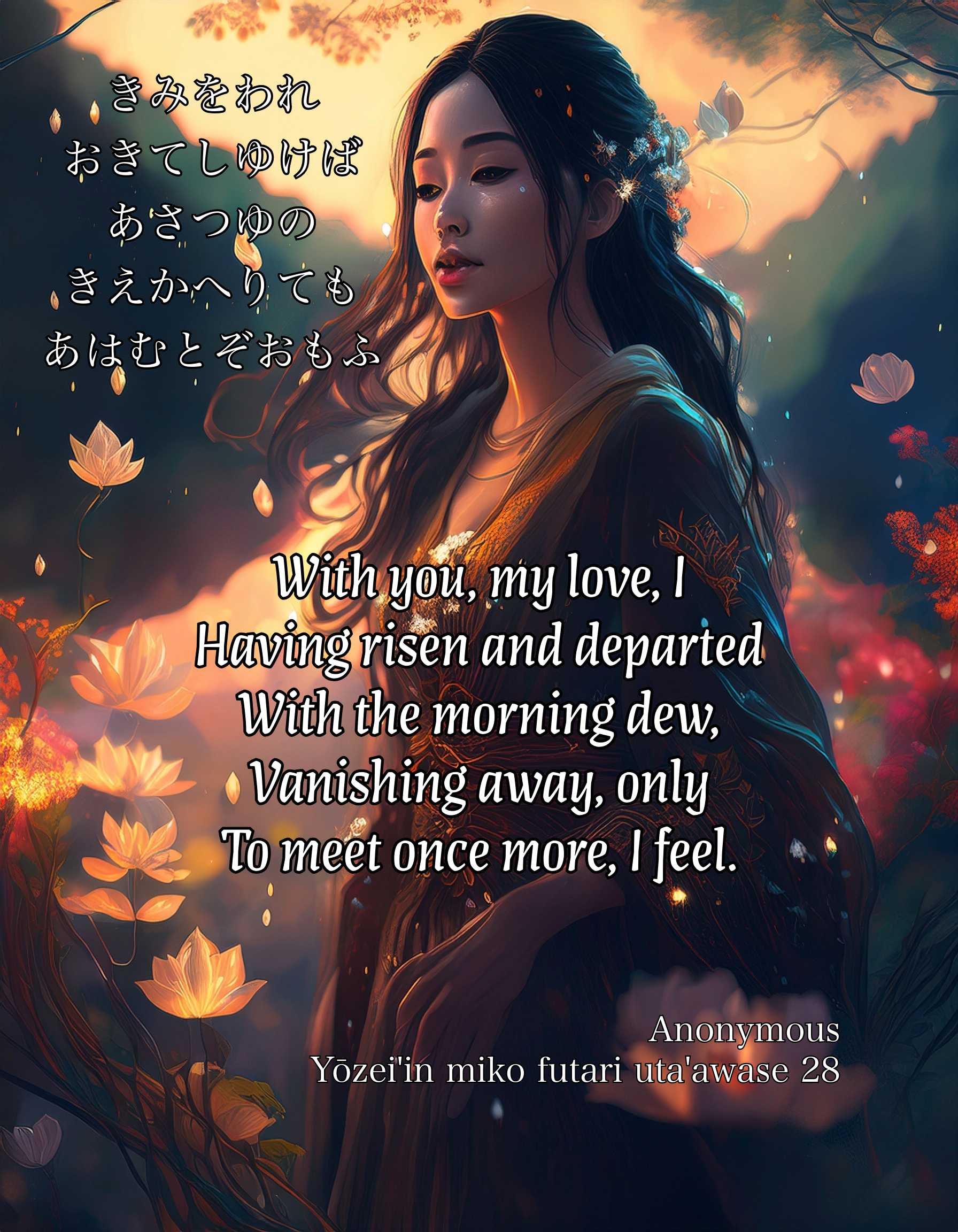
きみをわれおきてしゆけばあさつゆのきえかへりてもあはむとぞおもふ

kimi o ware
okiteshi yukeba
asatsuyu no
kiekaerite mo
awamu to zo omou
With you, my love, I
Having risen and departed
With the morning dew,
Vanishing away, only
To meet once more, I feel.

28

Right

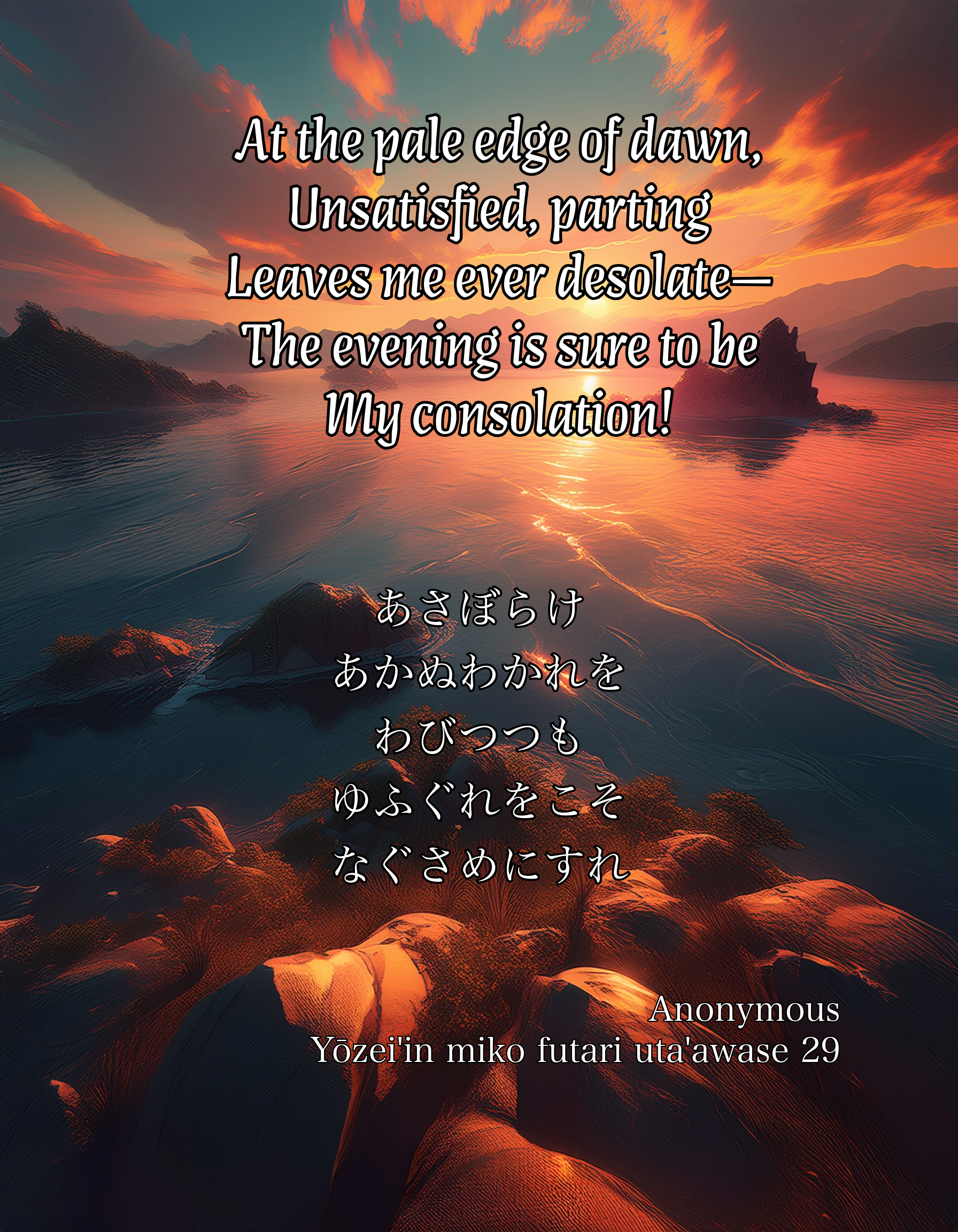
あさぼらけあかぬわかれをわびつつもゆふぐれをこそなぐさめにすれ

asaborake
akanu wakare o
wabitsutsu mo
yūgure o koso
nagusame ni sure
At the pale edge of dawn,
Unsatisfied, parting
Leaves me ever desolate—
The evening is sure to be
My consolation!

29

Nishinomiya uta’awase 08

Round Eight

Left

風さむみゆふかげ草にかくろへてはたおる虫の声聞ゆなり

kaze samumi
yūkage kusa ni
kakuroete
hataorumushi no
koe kikoyu nari
Chill the wind
Upon the evening grasses, from
Whence, concealed,
The crickets’
Cries I hear.

Chikafusa
15

Right

誰がためとあやめも見えぬ夕ざれにはたおる虫の声聞ゆらん

ta ga tame to
ayame mo mienu
yūzare ni
hataorumushi no
koe kikoyuran
For whose sake
Amidst the gloam
Of eventide, might
The crickets’
Cries I hear?

Lady Hȳoe
16

At present, ‘Amidst the gloam / Of eventide’ appears to have a bit more conception than ‘the evening grasses, from / Whence, concealed, / The crickets’.

Nishinomiya uta’awase 07

Insect and Evenings

Round Seven

Left

はふりこがしめゆふ野べの鈴虫は夕つけてこそふりたててなけ

hōriko ga
shimeyū nobe no
suzumushi wa
yū tsukete koso
furitatete nake
The priests have
Garlanded the meadows where
The bell crickets
With the fall of evening
Sing out so loud.

Major Archbishop
13

Right

神がきのいはねにさせる榊葉にゆふかけてなく鈴虫のこゑ

kamigaki no
iwane ni saseru
sakakiba ni
yū kakete naku
suzumushi no koe
Within the sacred precincts
At the crags’ foot thrust
Are leaves from the sacred tree
To the garlands clinging, as crying
Come the bell crickets’ songs.

Tadasue, Senior Assistant Minister of the Sovereign’s Household
14

I would say that both of these, Left and Right, are of the same quality in terms of diction and configuration.

Entō ōn’uta’awase 30

Round Thirty

Left (Tie)

玉をぬく真野の糸萩かたよりにおのれみだるる秋の夕暮

tama o nuku
mano no itohagi
katayori ni
onore midaruru
aki no yūgure
Strung with gems
The bush-clover twigs at Mano
All align together
In their own tangles
On an autumn evening.

Shō
59

Right

待ちわたる時や来ぬらん白露の玉しく庭の秋はぎの花

machiwataru
toki ya konuran
shiratsuyu no
tama shiku niwa no
akihagi no hana
Has that long-awaited
Time arrived, perhaps?
When silver dewdrop
Pearls will spread o’er the grounds
From the autumn bush clover blooms…

Nagatsuna
60

The poems of Left and Right have different diction, but the same configuration.

Entō ōn’uta’awase 28

Round Twenty-Eight

Left

故郷の萩の下葉も色づきぬ露のみふかき秋のうらみに

furusato no
hagi no shitaba mo
irozukinu
tsuyu nomi fukaki
aki no urami ni
In this old, familiar place
The bush clover’s underleaves, too,
Have changed their hue—
Only the dew is deep
As autumn’s misery…[1]

Dōchin
55

Right (Win)

白露の玉ぬきみだる萩が枝に涙かずそふ秋の夕暮

shiratsuyu no
tama nukimidaru
hagi ga e ni
namida kazusou
aki no yūgure
Silver dewdrop
Pearls are strung in tangles on
The bush clover’s branches—
Innumerable tears added
On an autumn evening…

Dharma Master Nyokan
56

Left and Right both have a refined style, yet the Right has a better tone and sounds elegant. Thus, it wins.


[1] An allusive variation on: 比日之 暁露丹 吾屋前之 芽子乃下葉者 色付尓家里 kono koro no / akatoki tsuyu ni / wa ga yado no / hagi no shitaba wa / irozukinikeri ‘Around thus time near / Dawn, the dewfall on / My dwelling’s / Bush clover underleaves / Has changed their hue!’ Anonymous (MYS X: 2182)