Tag Archives: hagiwara

Entō ōn’uta’awase 31

Round Thirty-One

Left

露すがる庭の萩原色付きぬいかなる人の思ひそむらん

tsuyu sugaru
niwa no hagiwara
irozukinu
ika naru hito no
omoisomuran
All clung with dew,
The bush clover grove in the grounds
Has taken on such hues, that
I wonder who it is
Might have just fallen into passion’s flames?

Chikanari
61

Right (Win)

おく露は秋のならひの萩が枝にあまるや雁の涙なるらん

oku tsuyu wa
aki no narai no
hagi ga e ni
amaru ya kari no
namida naruran
Dewdrops falling is
Autumn’s custom for
The bush clover branches, but
Added to them are the goose
Tears, perhaps?[1]

Ie’kiyo
62

The Left’s poem has a person’s feelings being dyed by the bush-clover, but I cannot think why this should be?  The Right’s poem seems particularly pleasant. Thus, it wins.


[1] An allusive variation on: Composed on the occasion of a poetry competition at Prince Koresada’s house. 秋の夜のつゆをばつゆとおきながらかりの涙やのべをそむらむ aki no yo no / tsuyu oba tsuyu to / okinagara / kari no namida ya / nobe o somuran ‘On Autumn nights / The dew as dewdrops / Falls, but, / Perhaps goose tears / Stain the fields?’ Mibu no Tadamine (KKS V: 258)

Entō ōn’uta’awase 29

Round Twenty-Nine

Left (Win)

宮城のの木下風や過ぎぬらん露におくるる秋萩の花

miyagino no
ko no shitakaze ya
suginuran
tsuyu ni okururu
akihagi no hana
On Miyagi Plain has
The breeze beneath the trees
Passed by? For
Missing the dewfall are
The autumn bush clover blooms…

Takasuke
57

Right

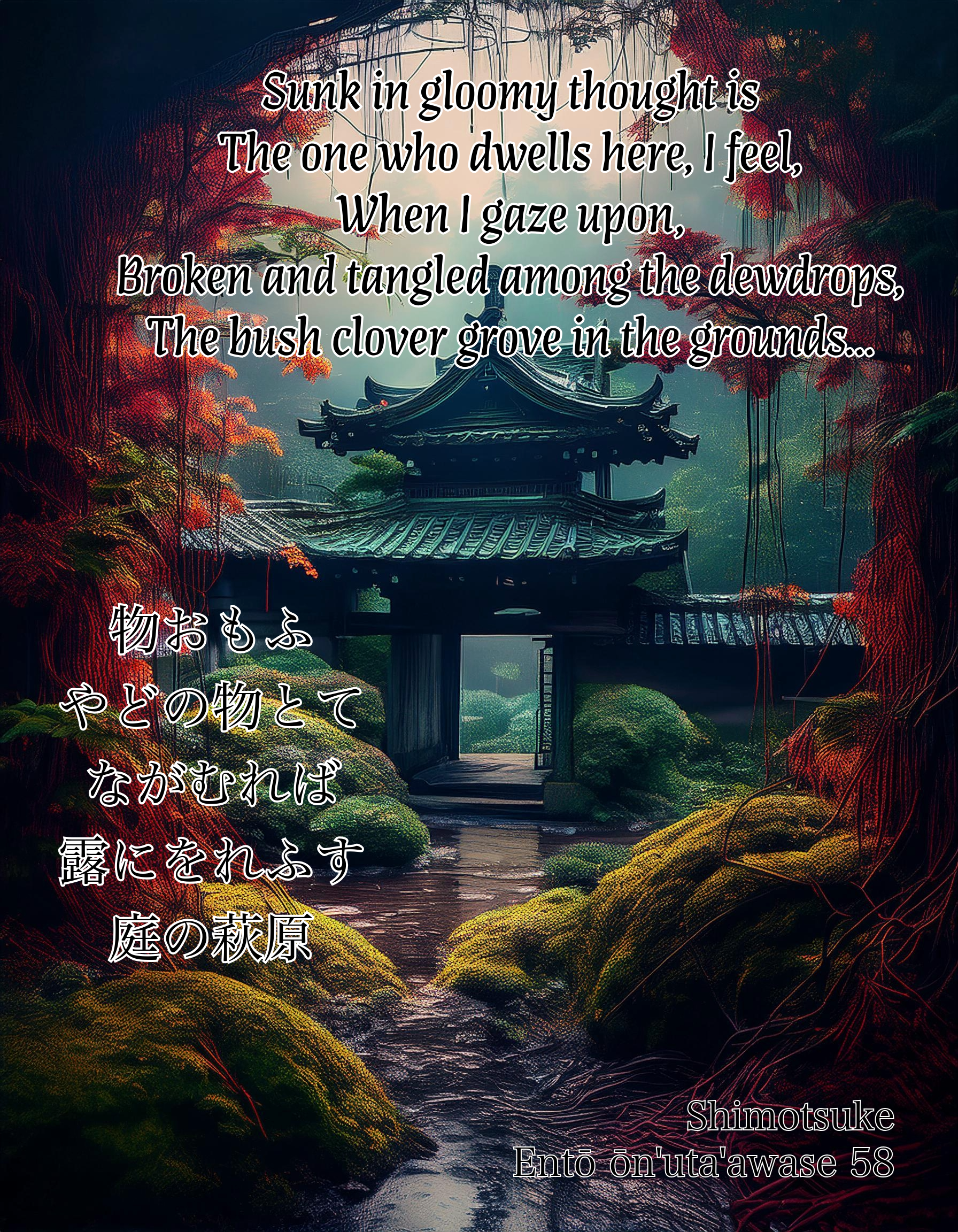
物おもふやどの物とてながむれば露にをれふす庭の萩原

mono’omou
yado no mono tote
nagamureba
tsuyu ni orefusu
niwa no hagiwara
Sunk in gloomy thought is
The one who dwells here, I feel,
When I gaze upon,
Broken and tangled among the dewdrops,
The bush clover grove in the grounds…

Shimotsuke
58

The Left poem’s ‘Missing the dewfall are the autumn bush clover’ sounds pleasant. The Right poem has no faults either, yet the Left should win.

Daikōtaigōgū no suke taira no tsunemori-ason ke uta’awase 08

Round Eight

Left (Tie)

うづら鳴く遠里小野の小萩はら心なき身も過ぎうかりけり

uzura naku
tōsato ono no
kohagiwara
kokoronaki mi mo
sugi’ukarikeri
Quails cry from
Tōsato plain’s
Bush-clover groves—
Even one as insensitive as I
Finds it hard to pass them by.

Kenshō Sukenokimi
15

Right

あきの野の花に心をそめしよりくさかやひめもあはれとぞ思ふ

aki no no no
hana ni kokoro o
someshi yori
kusakayahime mo
aware to zo omou
Since the autumn meadows’
Blooms my heart
Did fill, for
Kusakayahime
Fondness, I feel!

Tōren
16

As for the Left, if one is composing about bush-clover groves, then I would want the poem to mention Miyagi Plain. As for the Right’s Kusakayahime, I wondered if she appeared in the Chronicles of Japan, but in that work you have Izanagi-no-miko and Izanami-no-miko, who wed and create the first land, Akitsushima, and then many provinces, mountains, rivers and seas and thus trees and plants, too. It further states that the primordial tree was Kukunochi and the primordial plant was Kayanohime. The conception of the Right’s poem does not differ from this, yet it continues to mention Kusakayahime, which is unclear. I get the feeling that this poem was composed with the works composed for the banquet held for the completion of the Chronicles of Japan in mind, which refer to each and every spring and the ancient Kayanohime, but even these poems did not differ in conception from that of the main work. It’s impossible to pick a loser or winner.

Love VIII: 29

Left (Win)
つらからん中こそあらめ萩原やした松蟲の聲をだに問へ

tsurakaran
naka koso arame
hagiwara ya
shita matsumushi no
koe o dani toe
Cold will
Our bond, no doubt, become, but
Among the bush clover
Eagerly awaiting, the bell-cricket’s
Call is all that I would ask…

A Servant Girl
1077

Right
夜もすがら人まつ蟲の鳴く聲を我身の上によそへてぞ聞く

yo mo sugara
hito matsu mushi no
naku koe o
wa ga mi no ue ni
yosoete zo kiku
All through the night
A cricket pines –
The song it sings
Upon myself does
Seem to dwell – or so it sounds…

Lord Tsune’ie
1078

The Gentlemen of the Right state: we have no reason to mention any faults in the Left’s poem. The Gentlemen of the Left state: the Right’s poem is pedestrian.

In judgement: both poems refer to ‘bell crickets’, with the Left saying, ‘our bond, no doubt, become’ (naka koso arame), then ‘call is all that I would ask’ (koe o dani toe), and ‘eagerly awaiting, the bell cricket’ (shita matsumushi) – all of these are extremely difficult to grasp, however, the Right’s poem is pointlessly pedestrian. So, the Left wins.