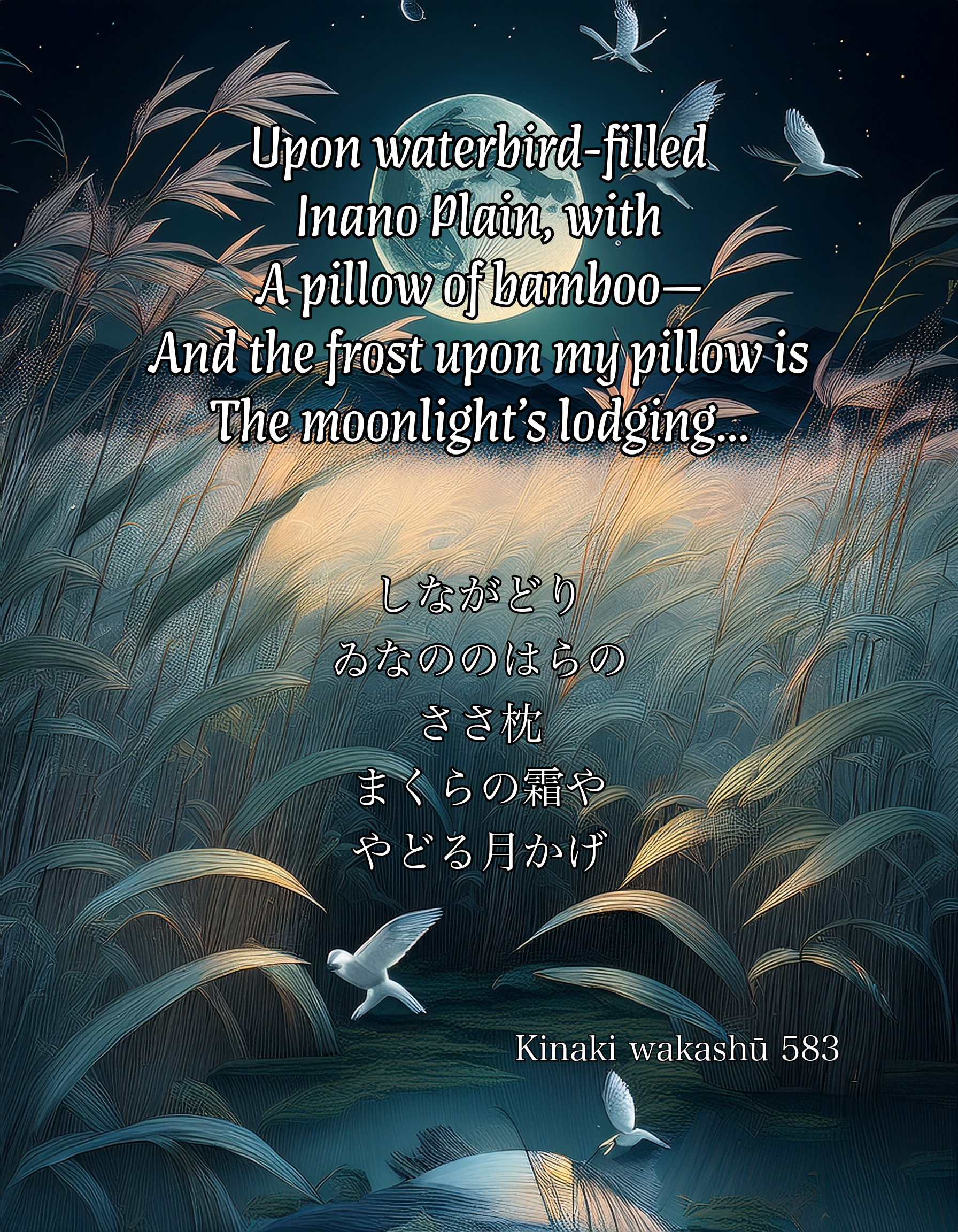
shinagadori inano no hara no sasamakura makura no shimo ya yadoru tsukikage
Upon waterbird-filled Inano Plain, with A pillow of bamboo— And the frost upon my pillow is The moonlight’s lodging…[i]
583
[i] See: Topic unknown. しながどりゐなのをゆけばありまやま夕ぎり立ちぬやどはなくして shinagadori / inano o yukeba / arimayama / yūgiri tachinu / yado wa nakushite ‘Through waterbird-filled / Inano I go, as / Upon Arima Mountain / Evening mist has risen, and / Me without a lodging…’ Anonymous (Shinkokinshū X: 910)
yomosugara matsu ni wa nakade hototogisu ashita no hara ni hitokoe zo kiku
All through the night I pined without a song, O, cuckoo Then with the morn on Ashita plain I hear a single call!
Cell of Fragrant Cloud 25
Right (Win)
五月にはしばなくやとぞほととぎすなほうらまちにさぬるよもなし
satsuki ni wa shiba naku ya to zo hototogisu nao uramachi ni sanuru yo mo nashi
In the Fifth Month Incessantly might he sing—I think, so The cuckoo I am already eagerly awaiting, Sleeping not at all on any night!
Cell of Compassionate Light 26
The Left’s poem seems to have an extraordinary conception, yet its diction is insufficient. The Right’s poem is old-fashionedly artless and thus has elements which are entirely poetically backward-looking.
The Left’s poem is particularly oddly composed in that is fails to account for the essential meaning of Ashita Plain. Does saying a ‘single call now’[1] mean that that one could wait expectantly during the day, too?
As for the Right’s poem, a cuckoo is not something that calls incessantly, yet I wonder if this composition is not, in some form, a plea that it would? As for ‘eagerly await’, well, I feel that it would be better to have ‘awaited’ rather than ‘awaiting’—that sounds like something one would have done ‘nothing but’ first. It seems a bit distasteful, like a poem by someone who has been perusing the Collection of a Myriad Leaves.
[1] On a folding screen for the Coming-of-Age Ceremony of the Northern Princess. 行きやらで山ぢくらしつほととぎす今ひとこゑのきかまほしさに yukiyarade / yamaji kurashitsu / hototogisu / ima hitokoe no / kikamahoshisa ni ‘I cannot go ahead / As twilight falls upon the mountain paths / For a cuckoo’s / Single call now / Is what I long to hear…’ Minamoto no Kintada (SIS II: 106)