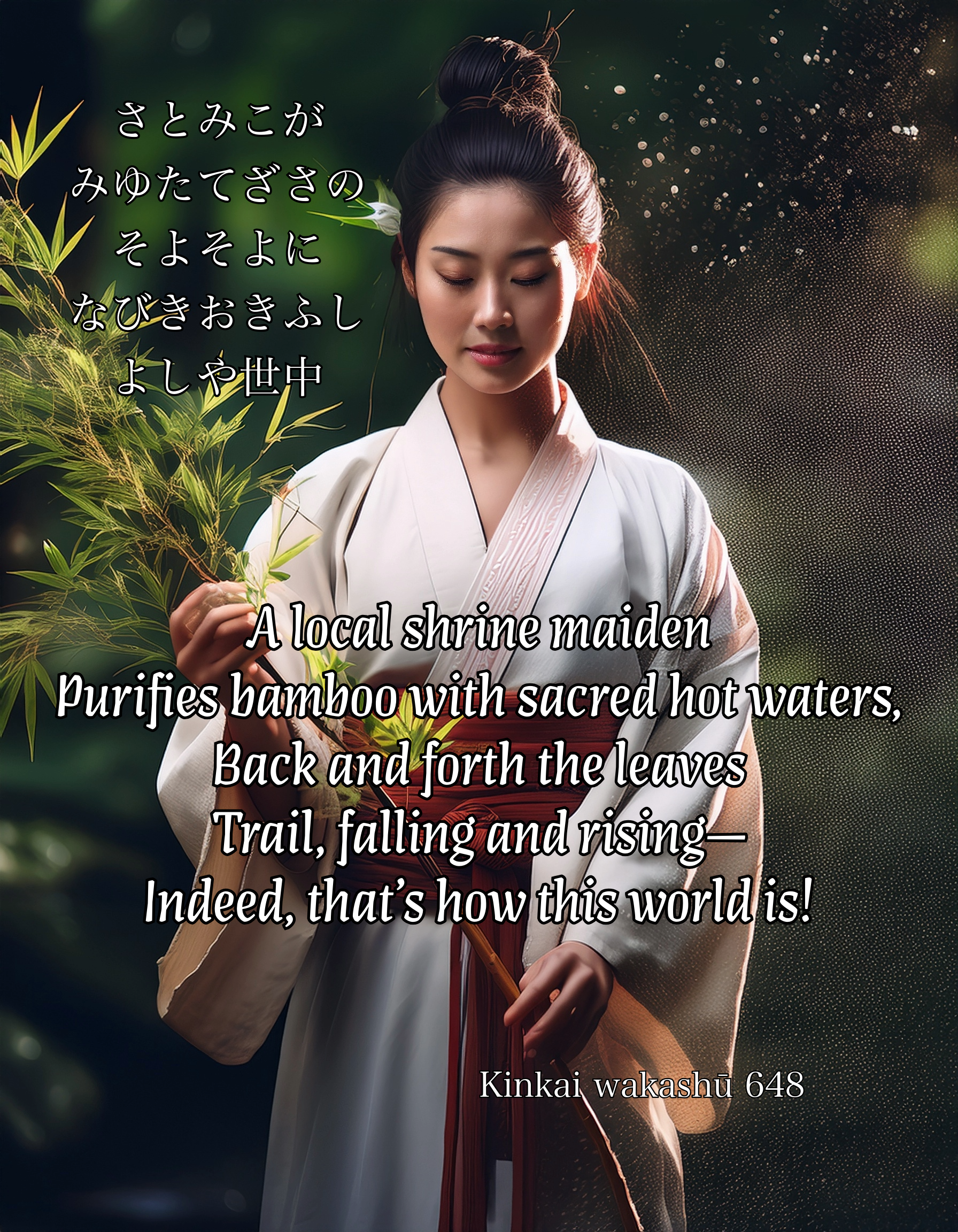
satomiko ga miyu tatezasa no soyosoyo ni nabiki okifushi yoshi ya yo no naka
A local shrine maiden Purifies bamboo with sacred hot waters, Back and forth the leaves Trail, falling and rising— Indeed, that’s how this world is![i]
648
[i] There was a shrine purification ritual whereby a shrine maiden (miko 巫女) would soak a branch of dwarf bamboo (sasa 笹) in water which she had heated, and then shake the water from the leaves, moving the branch up and down, scattering the droplets over both herself and pilgrims to the shrine. Sanetomo’s poem uses a description of this ritual as a preface (jo 序), before pivoting at the end of the fourth stanza to say that everyday life is just a sequence of both getting up and then going back to sleep (lying down) again and again (Higuchi 2016, 148).
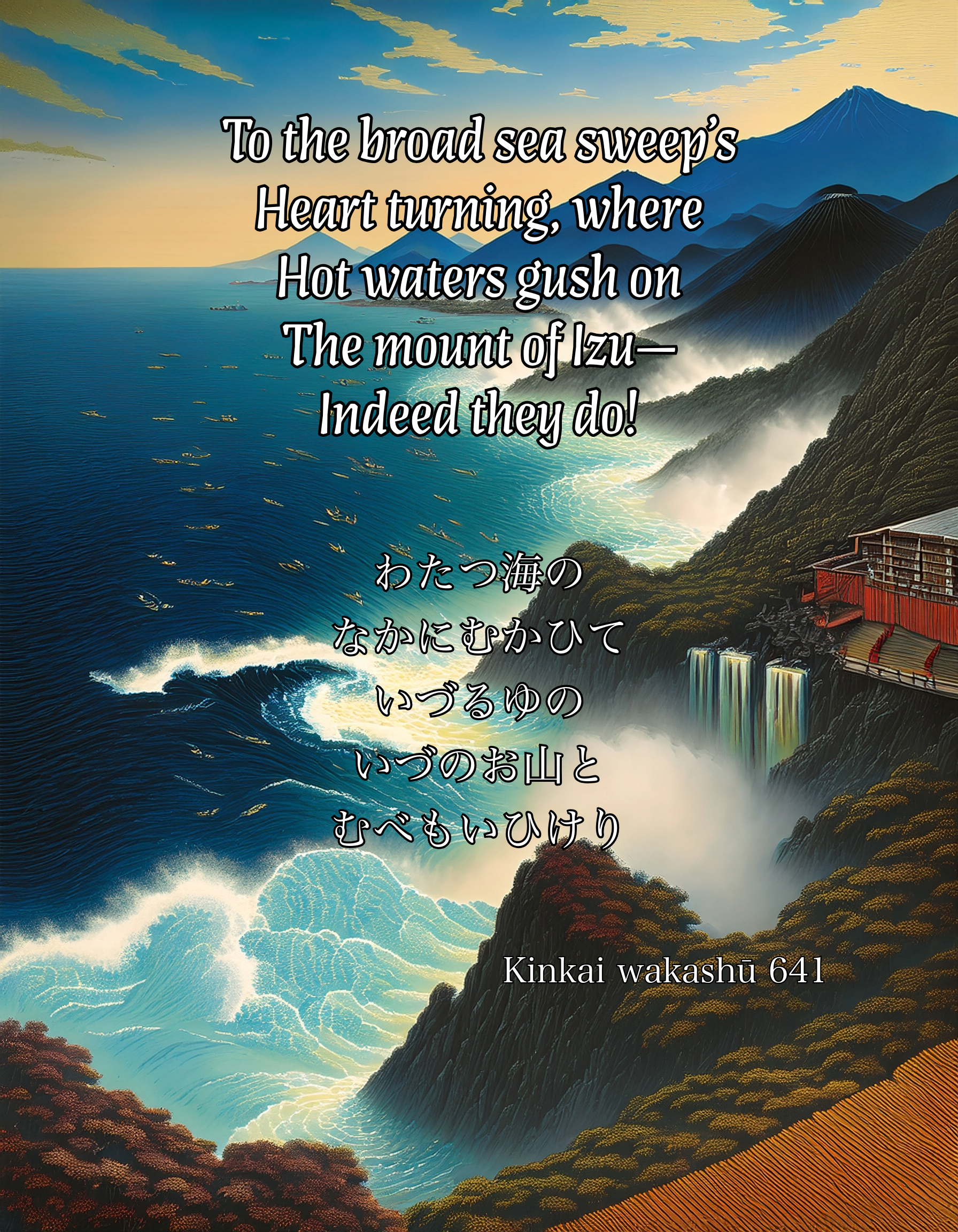
When I made a pilgrimage to Hashiriyu Mountain.[i]
わたつ海のなかにむかひていづるゆのいづのお山とむべもいひけり
watatsumi no naka ni mukaite izuru yu no izu no oyama to mube mo iikeri
To the broad sea sweep’s Heart turning, where Hot waters gush on The mount of Izu— Indeed they do![ii]
641
[i] Hashiriyu Mountain (hashiriyusan 走湯山), which literally means the ‘mountain where hot water runs’, was a sobriquet applied to Izusan Shrine (Izusan jinja 伊豆山神社) in Izu province (modern Shizuoka). The shrine had a close relationship with the Kamakura shogunate, as Minamoto no Yoritomo 源頼朝 (1147-1199), the first shogun, prayed there for the revival of the clan’s fortunes.
[ii] Sanetomo builds his poem around a play on words which is impossible to replicate in translation, in that izu(ru) 出づ(る) (‘gush (out)’) echoes the place name Izu 伊豆, so a closer paraphrase of the poem’s meaning is ‘Hot water gushes out [izu] at the mountain called “gushes” [izu], which is no surprise, is it!’