Tag Archives: inishie

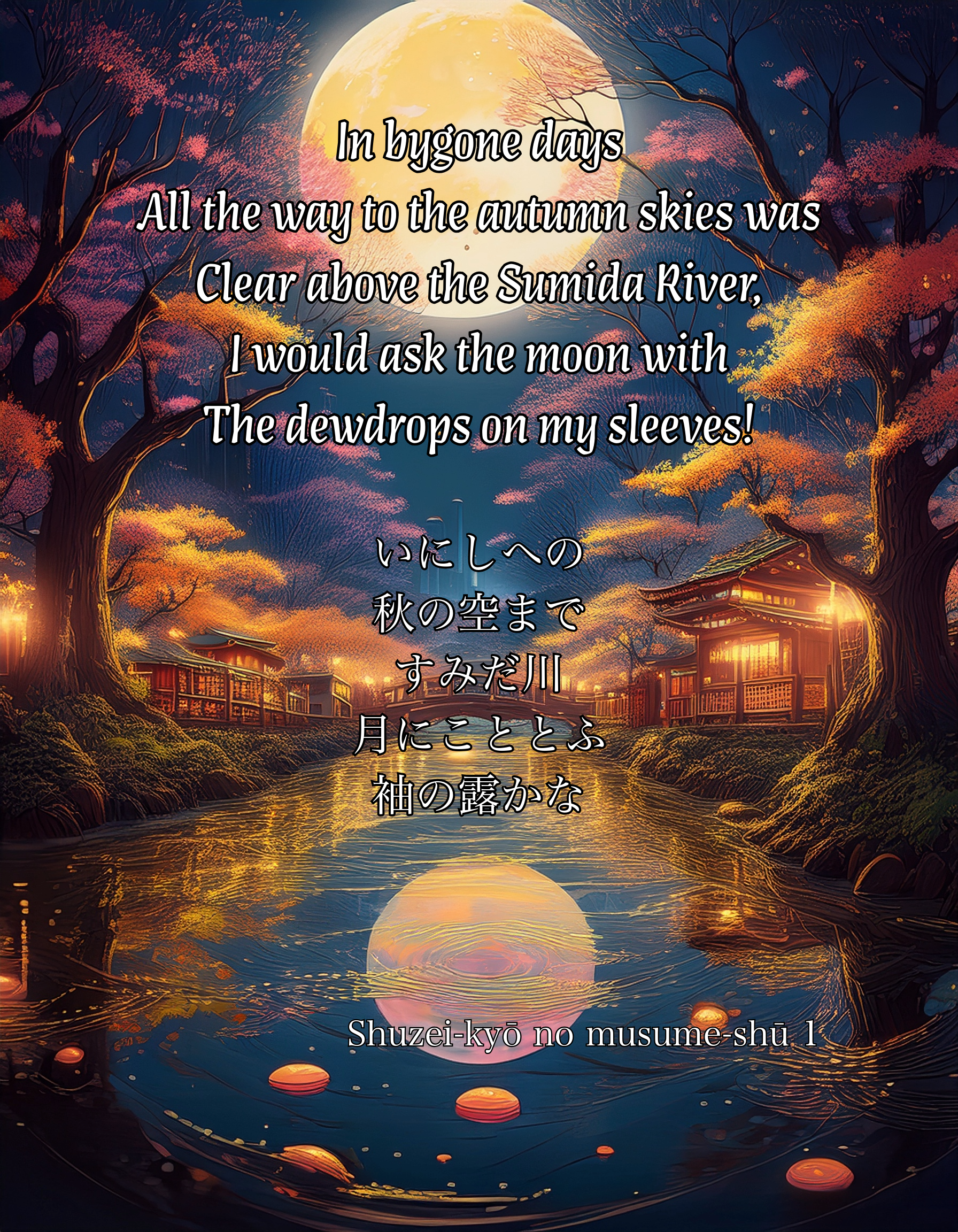
Shunzei-kyō no musume-shū 1

From among the poems for the Fifteenth Night[i] (when I was thirty-four[ii]) and had heard that His Late Lordship[iii] was holding an entertainment.[iv]

いにしへの秋の空まですみだ川月にこととふ袖の露かな

inishie no
aki no sora made
sumidagawa
tsuki ni koto tou
sode no tsuyu kana
In bygone days
All the way to the autumn skies was
Clear above the Sumida River,
I would ask the moon with
The dewdrops on my sleeves![v]

[i] Jūgoya 十五夜: typically this referred to the night of the 15th day of the Eighth Month, when the moon was believed to be at its fullest and most beautiful.

[ii] The Japanese text in the original is ambiguous here and this is only one of several interpretations which have been offered for it. The most likely other one is that this is a simple miscopying of an entirely different phrase ‘when I presented three poems’.

[iii] A reference to Fujiwara (Kujō) no Yoshitsune 藤原(九条)良経 (1169-1206).

[iv] In this case, a poetry meet.

[v] An allusive variation on: When they arrived at the banks of the Sumida River, between the provinces of Musashi and Shimotsūsa, they thought fondly of the capital and, dismounting for a while on the river bank, they thought sadly about how far they had come. While they were gazing into space, the ferryman said, “Get on the boat quickly! The sun is going down.” So, they boarded and were about to set off, each one thinking miserably about someone he had left in the capital, when they saw a white bird with a red bill and legs splashing about in the river shallows. As it was a bird never seen in the capital, none of them could say what it was, so they asked the ferryman, and he replied that it was a miyakodori (capital bird); hearing this, Narihira composed the following: 名にしおはばいざ事とはむ宮こどりわが思ふ人はありやなしやと na ni shi owaba / iza koto towamu / miyakodori / wa ga omou hito wa / ari ya nashi ya to ‘If your name fits you, / There’s something I would ask, / O, Capital bird: / Is the lady in my thoughts / Still quite safe?’ Ariwara no Narihira (Kokinshū IX: 411)

SIS XX: 1279

While gazing at the blossom, after Middle Counsellor Atsutada has passed away, and various people had gone to a mountain retreat at Nishisakamoto on Mount Hiei.

いにしへはちるをや人の惜みけん花こそ今は昔こふらし

inisiFe Fa
tiru wo ya Fito no
osimiken
Fana koso ima Fa
mukasi koFurasi
Long ago
Their scattering would he
Ever regret, but
Now, ‘tis the blossom
That seems to long for bygone days.

The Ichijō Regent

Ise monogatari, Chapter 32

Sent to a lady with whom he had once been intimate, after some years had passed.

いにしへのしづのをだまき繰りかへし昔を今になすよしもがな

inishie no
shizu no odamaki
kurikaeshi
mukashi o ima ni
nasu yoshi mogana
In times long gone
Thread upon a bobbin was
Wound back—
Just so, the present into the past
I wish we could make!

65

It seems, though, that the lady thought nothing of it.

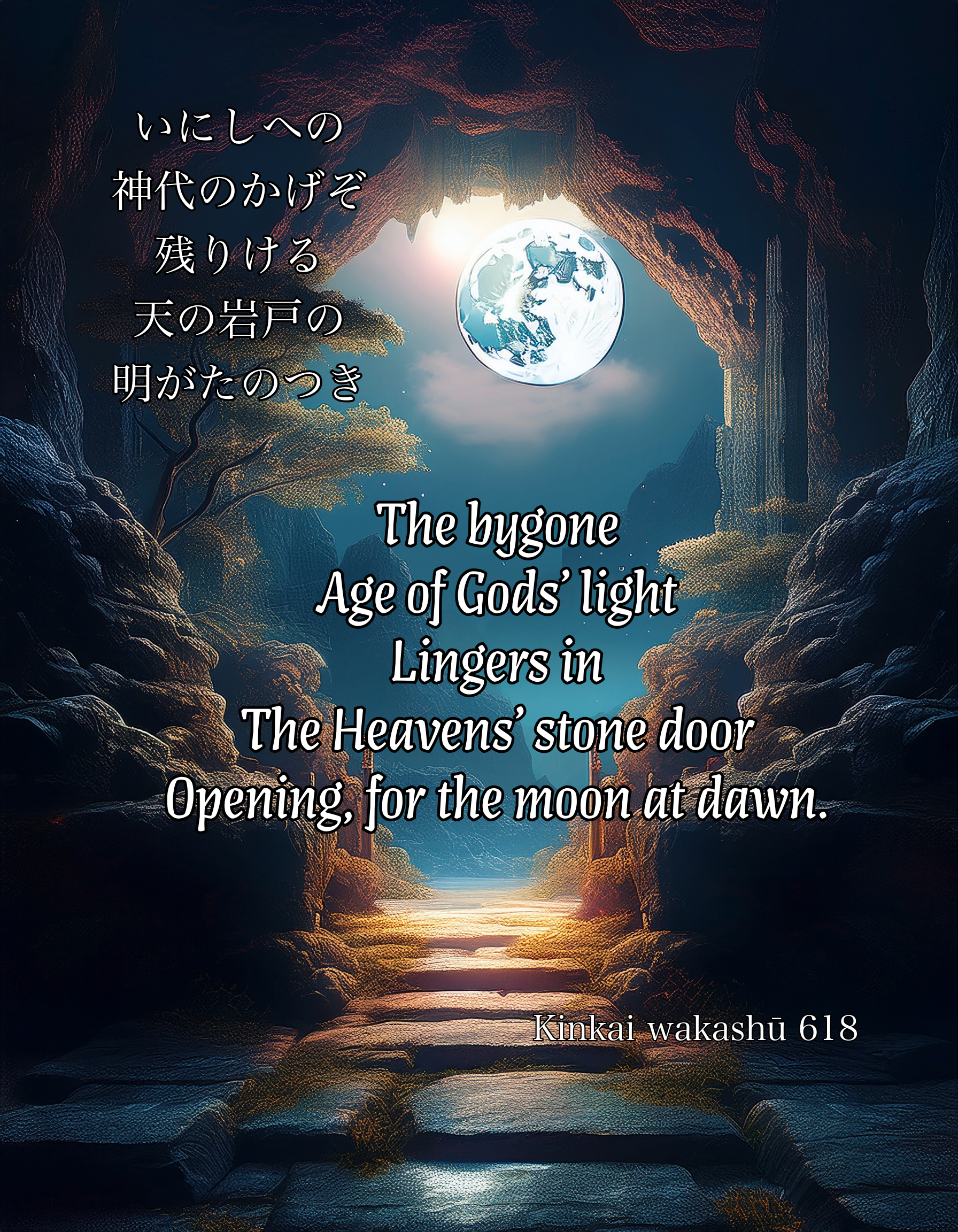
Kinkai wakashū 618

Among my Shinto poems

いにしへの神代のかげぞ残りける天の岩戸の明がたのつき

inishie no
kamiyo no kage zo
nokorikeru
ama no iwato no
akegata no tsuki
The bygone
Age of Gods’ light
Lingers in
The Heavens’ stone door
Opening, for the moon at dawn.[i]

618


[i] See: On the conception of the moon at dawn, for the Kasuga Poetry Match. 天の戸をおしあけがたの雲間より神よの月の影ぞ残れる ama no to o / oshi akegata no / kumoma yori / kamiyo no tsuki no / kage zo nokoreru ‘Upon the gates of Heaven / Pushing brightening / Through the cloud-gaps / From the Age of Gods, the moon’s / Light lingers.’ The Regent and Chancellor (Shinkokinshū XVI: 1547)

Kinkai wakashū 160

Orange blossom at an ancient estate.

いにしへをしのぶとなしにふる里のゆふべの雨ににほふたち花

inishie o
shinobu to nashi ni
furusato no
yūbe no ame ni
niou tachibana
Bygone days
I do not recall, but
At an ancient estate
In the evening rain
Comes the scent of orange blossom.[i]

[i] This poem functions as a reply to: Topic unknown. さつきまつ花橘のかをかげば昔の人の袖のかぞする satsuki matsu / hana tachibana no / ka o kageba / mukashi no hito no / sode no ka zo suru ‘Awaiting the Fifth Month / The orange blossoms’ / Scent fills the air, and / Folk from long ago / With their perfumed sleeves come back to me.’ Anonymous (KKS III: 139).

SKS I: 29

Composed during the reign of former Emperor Ichijō, when His Majesty was presented with a gift of some eightfold cherry blossom from Nara and, being in attendance, he ordered her to composed a poem on this gift of blossom.

いにしへのならの宮このやへざくらけふここのへににほひぬるかな

inishie no
nara no miyako no
yaezakura
kyō kokonoe ni
nioinuru kana
The ancient
Capital of Nara had
Eightfold cherry blossom, that
Today within the ninefold palace
Does shine!

Ise no Taiyū

A kuzushiji version of the poem's text.
Created with Soan.