Willows by the waterside.
みなそこにふかきみどりの色みえて風になみよるかはやなぎかな
| minasoko ni fukaki midori no iro miete kaze ni nami yoru kawayanagi kana | In the waters’ depths Deep green, Their hue appears, then Shifting with the wind-blown waves, Willows by the river! |
55
Round Eighty-Seven
Left
けふまでも木ずゑは冬のいろながらこぞにはかはるゆきのした草
| kyō made mo kozue wa fuyu no iro nagara kozo ni wa kawaru yuki no shitagusa | Until today The treetops winter’s Hues did hold, but With the change to the year before Grasses grow up ‘neath the snow. |
Lord Yasusue
173
Right
くれはどりあやにながめのなりゆくかみどりの空にあそぶいとゆふ
| kurehadori aya ni nagame no nariyuku ka midori no sora ni asobu itoyū | A chequered Pattern–when I gaze out how strange It becomes: In the verdant skies Sports heat haze… |
The Minister of the Centre
174
Although it sounds a bit difficult to grasp the sense of the Left’s ‘grasses ‘neath the snow with the change to the year before’, there’s nothing wrong with composing about grasses growing beneath fallen snow, so the configuration is pleasant. The Right’s poem, too, has no faults to mention, so this round, too, should tie.
The moon in winter—the late Major Counsellor[i] had me compose it one year, as a poem for Kitano.[ii]
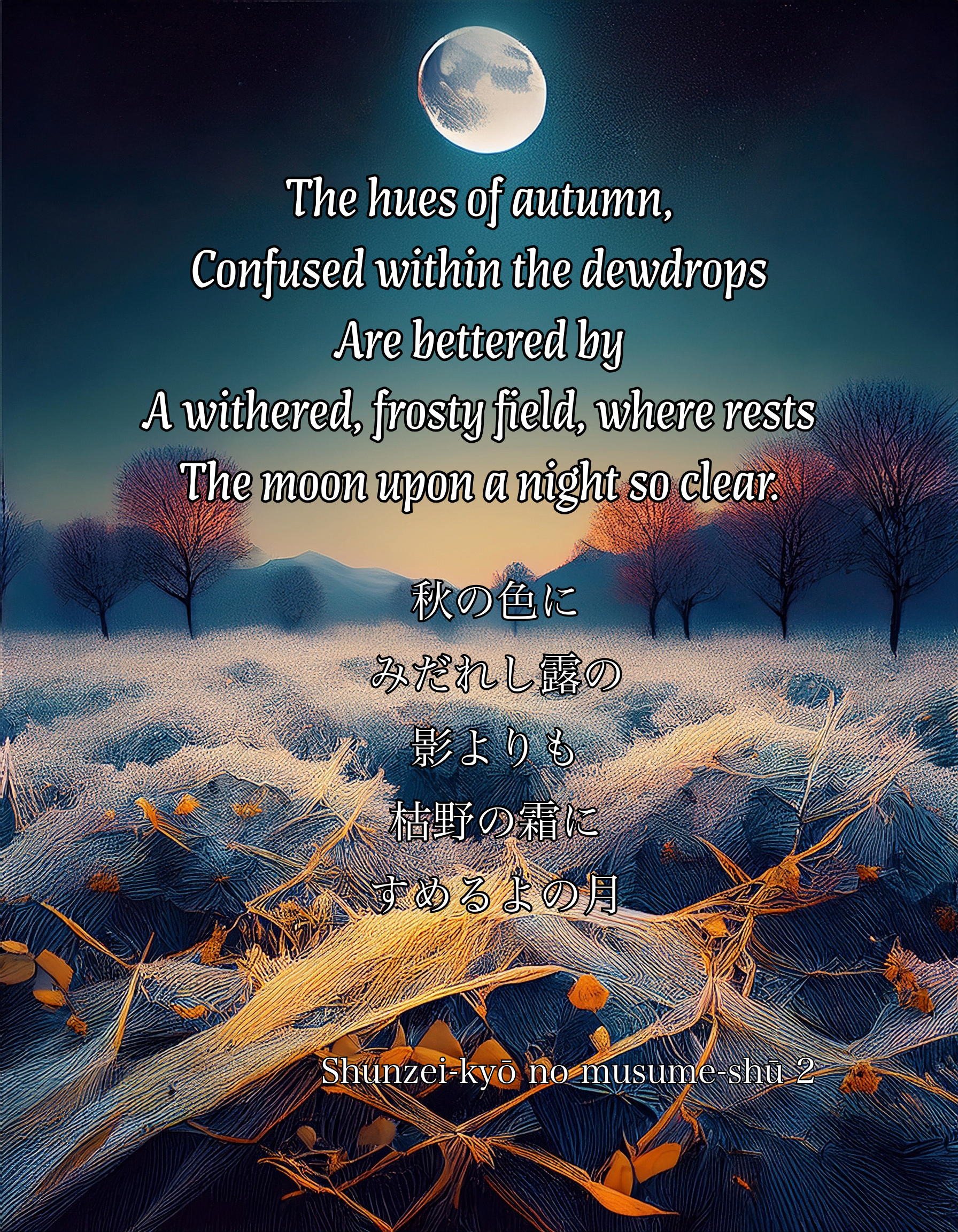
秋の色にみだれし露の影よりも枯野の霜にすめるよの月
| aki no iro ni midareshi tsuyu no kage yori mo kareno no shimo ni sumeru yo no tsuki | The hues of autumn, Confused within the dewdrops Are bettered by A withered, frosty field, where rests The moon upon a night so clear.[iii] |
[i] Her husband, Minamoto no Michitomo 源通具 (1171-1227).
[ii] Probably meaning she composed this for a poetry match or meet which was due to be held at the Kitano Tenmangū 北野天満宮 shrine in the north of the capital.
[iii] See: The cold, clear moon above the grasses. はなにおく露にやどりし影よりもかれのの月はあはれなりけり hana ni oku / tsuyu ni yadorishi / kage yori mo / kareno no tsuki wa / aware narikeri ‘Fallen on the flowers / The lodging dewdrops / Sight is bettered by / The moon above a withered field: / ‘Tis more moving by far.’ Saigyō (Gyokuyōshū VI: 903)
This is a poem which was written on a poetry slip and attached to the diorama when it was presented to the young prince,[i] on the day following the match.
なでしこのはなさきそむる夏の野にけふひぐらしのこゑかきこゆる
| nadeshiko no hana sakisomuru natsu no no ni kyō higurashi no koe ka kikoyuru | The pinks In bloom have begun to be On the summer plains From today the sunset crickets’ Cries do I hear? |
7[ii]
In reply from His Highness, the prince.[iii]
ひぐらしのなくもことわりなでしこのかひあるなつの野べとみゆれば
| higurashi no naku mo kotowari nadeshiko no kai aru natsu no nobe to miyureba | That the sunset crickets Should cry makes sense, for The pinks bring A point to the summer Meadows, or so it seems to me… |
8
A further reply from within the Hall of Cool Purity.
みやぎのにけふさきそむるなでしこはならはぬいろに人やみるらむ
| miyagino ni kyō sakisomuru nadeshiko wa narawanu iro ni hito ya miruramu | On Miyagi Plain Today has begun to bloom A pink— Its extraordinary hue I wonder, will folk see? |
9[iv]


[i] A reference to Imperial Prince Norihira 憲平, the future Emperor Reizei 冷泉 (950-1011; r. 967-969).
[ii] Anonymous (Fubokushō IX: 3461); (Nakatsukasa-shū 120)
[iii] Given that Norihira would have been only six years old when this match was held, it is most likely that this reply was penned in his stead by his mother, Fujiwara no Yasuko (Anshi) 藤原安子 (927-964).
[iv] This poem is included in Fubokushō (IX: 3469) attributed to the ‘Seiryōden Junior Consort’ (Seiryōden nyōgo 清涼殿女御), with the headnote ‘Poetry Match held by Junior Consort Yoshiko (Hōshi) in the Fifth Month, Tenryaku 10’. It is now generally believed that the Fubokushō attribution is erroneous, and this was, instead, composed by Emperor Murakami.
Left
あしひきのやまとなでしこいろふかきけふやこふてふひとをまたまし
| ashihiki no yamato nadeshiko iro fukaki kyō ya kou chō hito o matamashi | Leg-wearying the Mountains of Yamato, the pinks’ Hues so deep, that I wonder for today and one to love them Have they awaited? |
Nakatsukasa
3[i]
Right (Tie)
みなそこにかげさへにほふなでしこはなみのはなをやいろにそむらむ
| minasoko ni kage sae niou nadeshiko ha nami no hana o ya iro ni somuramu | The very riverbed With their shapes does glow— Do the pinks Even the spray from off the waves Dye with their hues, I wonder? |
4[ii]


[i] A similar poem to this is included in Nakatsukasa’s personal collection, Nakatsukasa-shū (118): かきほなるやまとなでしこいろふかきけふやこふこふ人をまたまし kakio naru / yamato nadeshiko / iro fukaki / kyō ya kou / hito o matamashi ‘By the lattice fence / The Yamato pinks’ / Hues are so deep, that / I wonder for today and one to love them / Have they awaited?’
[ii] Some texts of this match have an alternate wording for this poem: みなそこにかげさへみゆるなでしこのなみのはなをやいろにそむらむ minasoko ni / kage sae miyuru / nadeshiko no / nami no hana o ya / iro ni somuramu ‘Upon the very riverbed / Their shapes do appear— / Do the pinks / Even the spray from off the waves / Dye with their hues, I wonder?’
Willow
Left (Win in a certain text)
あをやぎのえだにかかれるいとなくははるのくるをもしらずやあらまし
| aoyagi no eda ni kakareru ito naku wa haru no kuru o mo shirazu ya aramashi | If, from the green willow Branches hanging Were there no threads, then Of spring’s coming Would there be any knowing? |
15
Right (Win)
あさごとにまづもみるかなあをやぎのいとはよるよるいろやまさると
| asa goto ni mazu mo miru kana aoyagi no ito wa yoruyoru iro ya masaru to | Every single morning First will I behold them! For the green willow Threads after each night Might be the best hue of all? |
16
Rhododendron [sakunamusa].
紫の色にはさくなむさしのの草のゆかりと人もこそ見れ
| murasaki no iro ni Fa saku na musasino no kusa no yukari to Fito mo koso mire | In violet Hues it must bloom not— Lest on Musashi Plain With the grasses a bond Folk, too, imagine! |
Dharma Master Jogan
Jogan alludes to the sentiments expressed in KKS XVII: 867 here.
The only surviving poem from this match[i] occurs in the personal collection of Fujiwara no Takamitsu 藤原高光 (939-?), Takamitsu-shū (11), with the headnote, ‘From a scarlet plum blossom match.’
うぐひすのすをくひそむるむめの花いろもにほひもをしくも有るかな
| uguisu no su o kuisomuru mume no hana iro mo nioi mo oshiku mo aru kana | The warbler has His nest begun to weave Among the plum blossom; Their hues and glow, both, How he must regret! |
1
While scarlet plum (kōbai 紅梅) is used as a topic for acrostics in Uda’in uta’awase (905), there are no other examples of it being used in any other poetry match, nor are there any other examples of ‘scarlet plum matches’ (kōbai awase 紅梅合) recorded. Given what we know of the details of Takamitsu’s life and career (see below), Hagitani (1958, 419) suggests that it is most likely that this was a private event for Takamitsu’s intimate circle, held in late 960 or early 961.
Takamitsu was the eighth son of Fujiwara no Morosuke 藤原師輔 (909-960) and was appointed to the position of Minor Captain of the Inner Palace Guards, Right Division (Ukonoe shōshō 右近衛少将) in 960; he is also listed among the participants in the Dairi uta’awase – Tentoku yo-nen. In 961, however, he took orders under the name of Jokaku 如覚, settling in Tōnomine 多武峰 in what is now Nara prefecture the following year.[ii] The poems he exchanged here with his wife and sister formed the basis for Tōnomine shōshō monogatari 多武峯少将物語 (‘Tale of the Minor Captain in Tōnomine’), a short work thought to be produced a few years afterwards. Despite his limited poetic oeuvre, Fujiwara no Kintō regarded him sufficiently highly to include him as one of the Thirty-Six Poetic Immortals, although perhaps this is unsurprising as Takamitsu’s daughter was the mother of Kintō’s wife; he has a total of twenty-three poems in imperial anthologies, including four in Shūishū, under both his lay and religious names.[iii]
[i] Aru tokoro no kōbai awase 或所紅梅合
[ii] Eiga monogatari relates the events surrounding Takamitsu’s taking orders, remarking, ‘Someone is sure to mention Takamitsu whenever people speak of sad things’ (McCullough and McCullough 1980, 92)
[iii] The poems are: Rhododendron [sakunamusa]. 紫の色にはさくなむさしのの草のゆかりと人もこそ見れ murasaki no / iro ni wa saku na / musashino no / kusa no yukari to / hito mo koso mire ‘In violet hues / It must bloom not— / Lest on Musashi Plain / With the grasses a bond / Folk, too, imagine!’ Dharma Master Jogan (VII: 360); When gazing at the moon, around the time he got the idea to become a monk. かくばかりへがたく見ゆる世の中にうら山しくもすめる月かな kaku bakari / hegataku miyuru / yo no naka ni / urayamashiku mo / sumeru tsuki kana ‘When so very / Hard it seems to pass through / This mundane world / Indeed, I envy / The moon, dwelling there, so clear!’ Fujiwara no Takamitsu (VIII: 435); While he was residing at Mount Hiei, and someone asked him for some incense, he sent this, attached to a branch of plum from which the blossom had scattered. 春すぎてちりはてにける梅の花ただかばかりぞ枝にのこれる haru sugite / chirihatekeru / mume no hana / tada ka bakari zo / eda ni nokoreru ‘Spring is gone and / All scattered are / The plum blossoms: / Only their fragrance / Lingers on the branch!’ Dharma Master Jogan (XVI: 1063); and: Written down on a pieice of folded paper when the snow was falling, around when he was deciding to become a monk. 世の中にふるぞはかなき白雪のかつはきえぬる物としるしる yo no naka ni / furu zo hakanaki / shirayuki no / katsu wa kienu / mono to shirushiru ‘Through this mundane world / Fleetingly falling / The snow, so white, / Is swift to vanish— / That I know only too well…’ Fujiwara no Takamitsu (XX: 1332)