sode no ue ni narurugao naru hikari kana tsuki koso tabi no kokoro shirikere
Upon my sleeves Seeming to run with tears Does the light! Even the moon the journey’s Mood does know![i]
27
[i] An allusive variation on: Topic unknown. あひにあひて物思ふころのわが袖にやどる月さへぬるるかほなる ai ni aite/ mono’omou koro no / wa ga sode ni / yadoru tsuki sae / nururu kao naru ‘So many times have we met; / In gloomy thought / Upon my sleeves / Where rests the moon / Even her face wet with tears.’ Ise (Kokinshū XV: 756)
Sent to someone’s residence when the picking of fresh herbs took place on the Day of the Rat.[i]
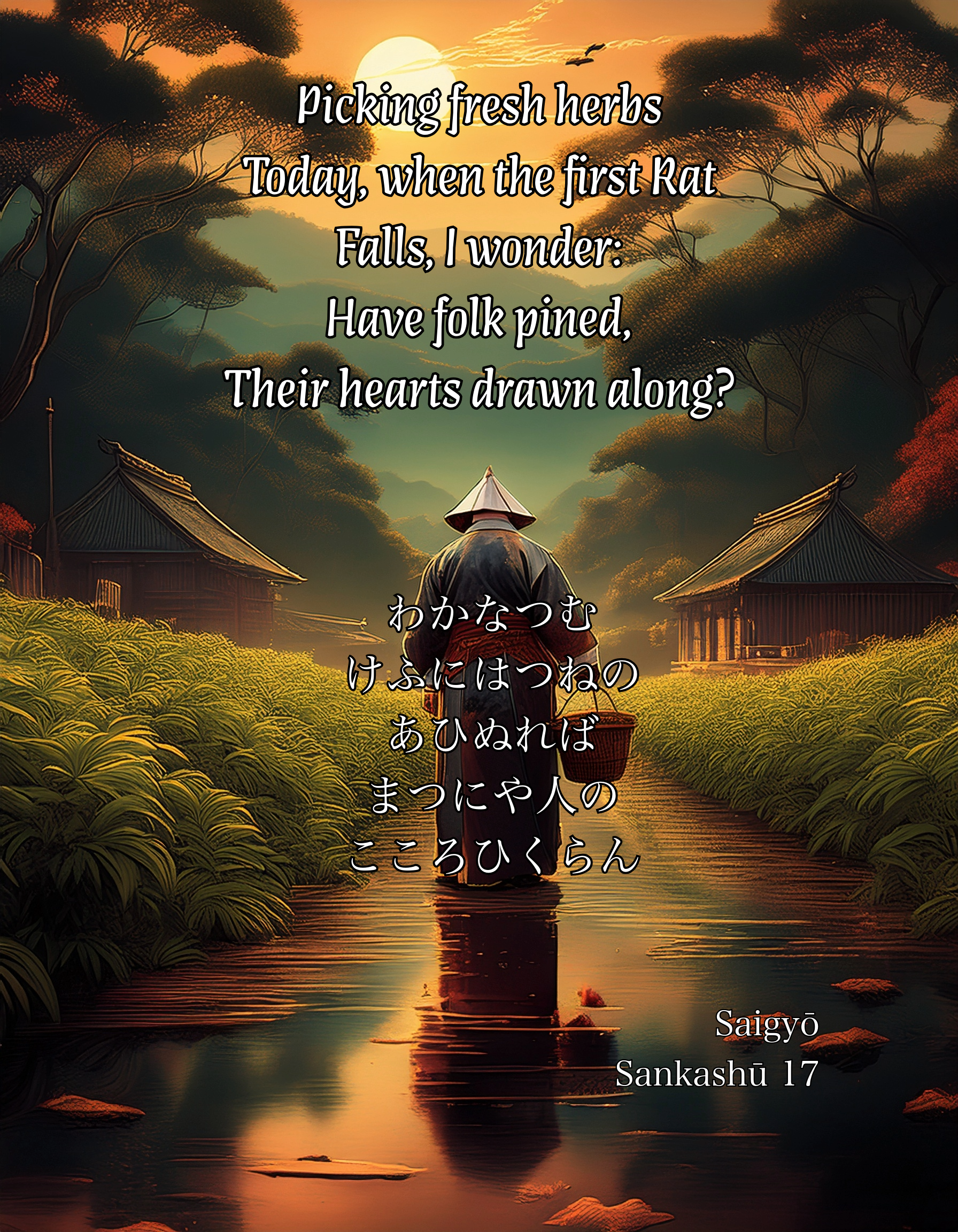
わかなつむけふにはつねのあひぬればまつにや人のこころひくらん
wakana tsumu kyō ni hatsune no ainureba matsu ni ya hito no kokoro hikuran
Picking fresh herbs Today, when the first Rat Falls, I wonder: Have folk pined, Their hearts drawn along?[ii]
17
[i] The picking of ‘fresh herbs’ (wakana 若菜) was an important part of the New Year for both aristocrats and commoners alike. Traditionally, this took place on the first Day of the Rat in the First Month, but later, due to the need for a fixed date in the court’s annual calendar of observances—the beginning of the First Month was particularly busy—the celebration of picking fresh herbs was set on the 7th day of the First Month. This date was chosen because there were, in fact, seven ‘herbs’ which were picked for the event. The headnote to the poem means that in the year in which Saigyō wrote it, the 7th of the month happened to fall on the Day of the Rat, too (Gotō 1982, 13).
[ii] Saigyō employs a dual play-on-words in the poem with matsu standing for both matsu 松 (‘pine tree’), evoking the pine seedlings which were one of the plants being picked, and matsu 待つ (‘wait’)—here it is the Day of the Rat and its events which people have being awaiting. In addition, hiku is both hiku 引く (‘pull [up a seedling]’) and hiku 惹く (‘attract’; ‘charm’), here used to refer to the enjoyment which people derive from the Day of the Rat celebrations.