Sent to someone’s residence when the picking of fresh herbs took place on the Day of the Rat.[i]
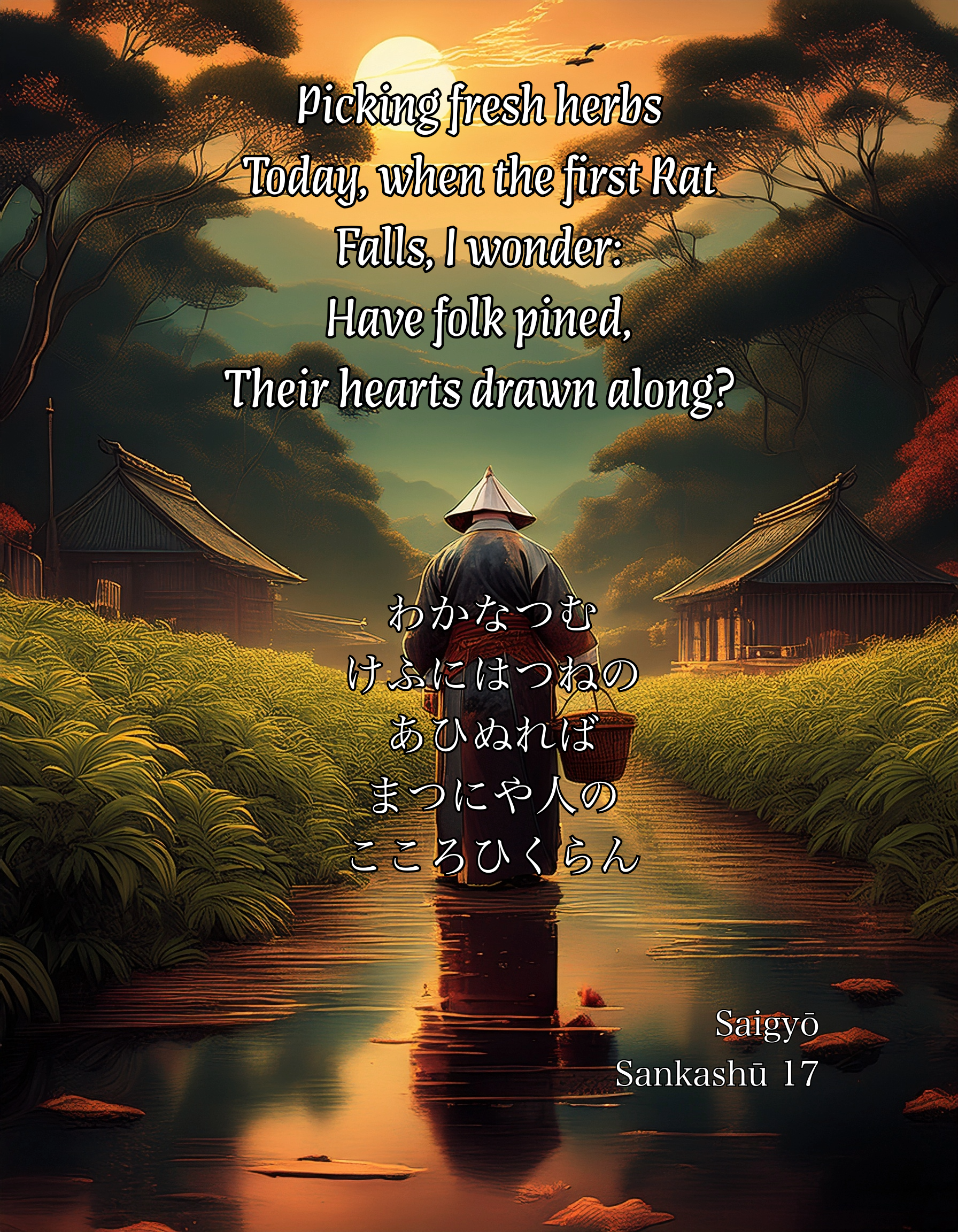
わかなつむけふにはつねのあひぬればまつにや人のこころひくらん
wakana tsumu kyō ni hatsune no ainureba matsu ni ya hito no kokoro hikuran
Picking fresh herbs Today, when the first Rat Falls, I wonder: Have folk pined, Their hearts drawn along?[ii]
17
[i] The picking of ‘fresh herbs’ (wakana 若菜) was an important part of the New Year for both aristocrats and commoners alike. Traditionally, this took place on the first Day of the Rat in the First Month, but later, due to the need for a fixed date in the court’s annual calendar of observances—the beginning of the First Month was particularly busy—the celebration of picking fresh herbs was set on the 7th day of the First Month. This date was chosen because there were, in fact, seven ‘herbs’ which were picked for the event. The headnote to the poem means that in the year in which Saigyō wrote it, the 7th of the month happened to fall on the Day of the Rat, too (Gotō 1982, 13).
[ii] Saigyō employs a dual play-on-words in the poem with matsu standing for both matsu 松 (‘pine tree’), evoking the pine seedlings which were one of the plants being picked, and matsu 待つ (‘wait’)—here it is the Day of the Rat and its events which people have being awaiting. In addition, hiku is both hiku 引く (‘pull [up a seedling]’) and hiku 惹く (‘attract’; ‘charm’), here used to refer to the enjoyment which people derive from the Day of the Rat celebrations.
kyō made mo kozue wa fuyu no iro nagara kozo ni wa kawaru yuki no shitagusa
Until today The treetops winter’s Hues did hold, but With the change to the year before Grasses grow up ‘neath the snow.
Lord Yasusue 173
Right
くれはどりあやにながめのなりゆくかみどりの空にあそぶいとゆふ
kurehadori aya ni nagame no nariyuku ka midori no sora ni asobu itoyū
A chequered Pattern–when I gaze out how strange It becomes: In the verdant skies Sports heat haze…
The Minister of the Centre 174
Although it sounds a bit difficult to grasp the sense of the Left’s ‘grasses ‘neath the snow with the change to the year before’, there’s nothing wrong with composing about grasses growing beneath fallen snow, so the configuration is pleasant. The Right’s poem, too, has no faults to mention, so this round, too, should tie.