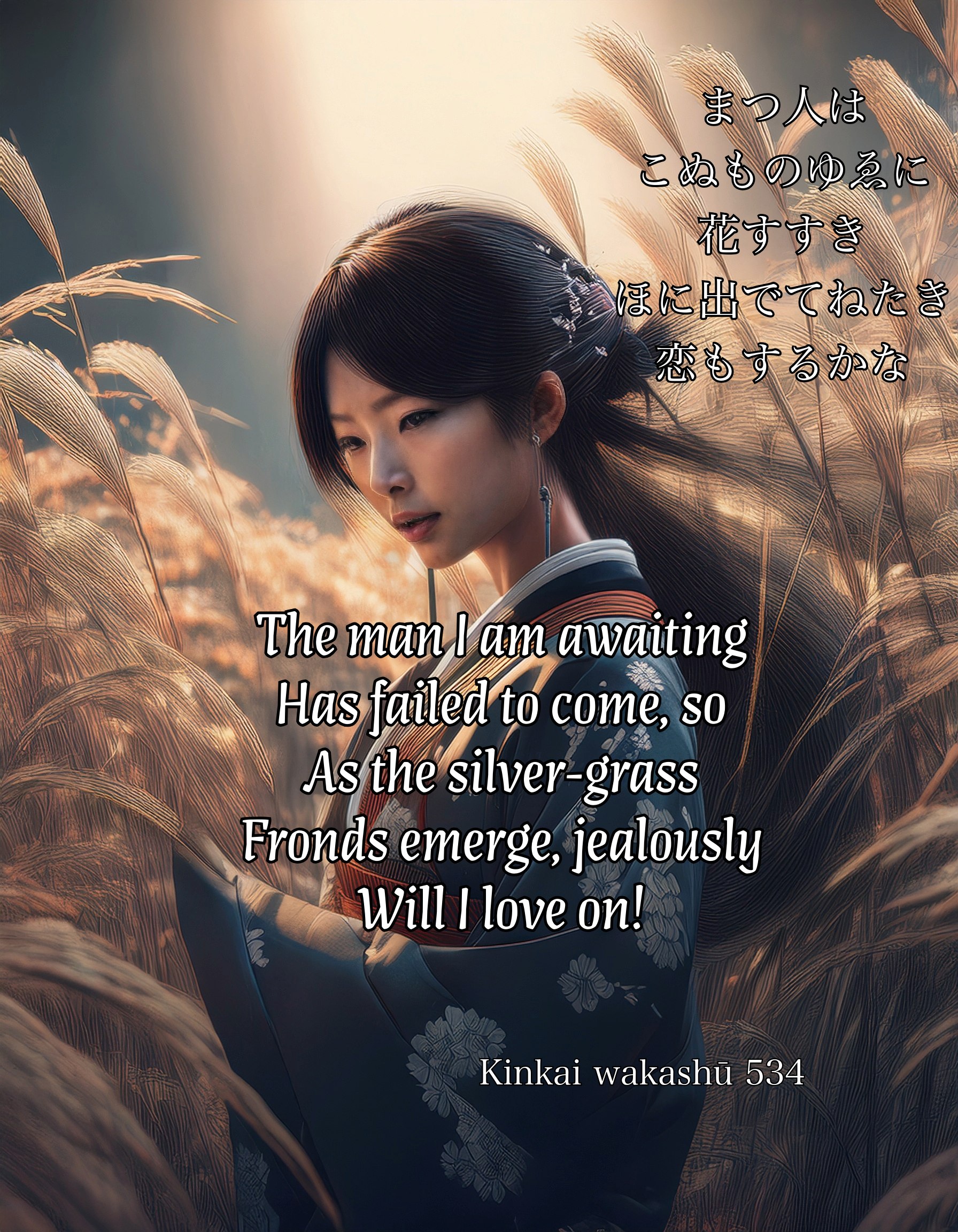
Love and Silver-grass.
まつ人はこぬものゆゑに花すすきほに出でてねたき恋もするかな
| matsu hito wa konu mono yue ni hanasusuki ho ni idete netaki koi mo suru kana | The man I am awaiting Has failed to come, so As the silver-grass Fronds emerge, jealously Will I love on! |
534
The Moon
Round One
Left (Win)
いたまよりねざめのとこにもる月をこひしきひととおもはましかば
| itama yori nezame no toko ni moru tsuki o koishiki hito to omowamashikaba | Between the boards, Waking me in my bed Drips moonlight— The man I love If only it did more than bring to mind… |
Lord Dainagon
29
Right
くれはどりふたむらやまをきて見ればめもあやにこそ月も見えけれ
| kurehadori futamurayama o kite mireba me mo aya ni koso tsuki mo miekere | When the weave of twilight Upon Futamura Mountain One comes to see, Another pattern fills the eye— Bright moonlight. |
Lord Chūnagon
30
The poem of the Left has an extremely refined configuration, but is lacking much of a conception of the moon, and has a much greater one of love. The poem of the Right has a moving conception, but it is about scarlet leaves that one says ‘another pattern fills the eye’. There have been no compositions to date utilizing this about the moon. As both poems have dubious elements, I feel they are of the same quality.
I must say that the initial section of the poem of the Left, ‘between the boards’, is something that not even the poets of bygone days placed at the beginning of their poems. I would say that such expressions as ‘between the boards of a ruined house’ sound blended, implying that the appearance within is fine. Perhaps the poet mistook this? In addition, I do not feel that this is a moon poem, and would have to say that it’s a love one. It really is very odd, isn’t it—suddenly including a love poem here. The poem of the Right has nothing about it worth mentioning, yet it appears to be a moon poem superficially. There’s nothing for it but, faced with the poem of the Left, which beats the hastiest of hasty retreats and ignores the essential meaning of the topic, but to make it the winner!


On waiting for love through the years, when folk had composed poetry.[i]
故郷のあさぢが露にむすぼほれひとりなく虫の人をうらむる
| furusato no asaji ga tsuyu ni musubōre hitori naku mushi no hito o uramuru | At this ancient estate The cogon grass by dew Is held fast, as All alone a single insect cries, Hating that man… |
513

In days long past, when a man was passing a certain lady’s apartments at the palace, the lady, seeming to bear him some ill will, called out, ‘Go on, then, you creeper and see what becomes of you!’[1] The man replied:
罪もなき人をうけへば忘れ草おのが上にぞ生ふといふなる
| tsumi mo naki hito o uke’eba wasuregusa ono ga ue ni zo ou to iu naru | When a sinless Man you curse, Forgotten, among the day-lillies Upon you Growing, will you be, they say! |
64
Some among the women were very vexed by that.

[1] Sanjōnishi Sanetaka (1455-1537) identifies this as part of a poem from Shoku man’yōshū:
忘れゆくつらさはいかにいのちあらばよしや草葉よならむさがみむ
| wasureyuku tsurasa wa ika ni inochi araba yoshi ya kusaba naramu saga mimu | To gradually forget Your cruelty, somehow Had I but life left, Go on, then, you creeper, and See what becomes of you! |
Shoku man’yōshū is no longer extant, and so the accuracy of this cannot be determined (Horiuchi and Akiyama 1997, 111).
Kusaba (‘blade of grass’), which I have translated as ‘creeper’, was a slang term used to refer to an unfaithful man.
Round Seven
Left (Win)
萩がはな分けゆく程は古郷へかへらぬ人もにしきをぞきる
| hagi ga hana wakeyuku hodo wa furusato e kaeranu hito mo nishiki o zo kiru | When through the bush-clover blooms He forges his way, To his ancient home Never to return—that man, too, Wears a fine brocade! |
Minamoto no Arifusa, Minor Captain in the Inner Palace Guards, Right Division
13
Right
声たてて鳴くむしよりも女郎花いはぬ色こそ身にはしみけれ
| koe tatete naku mushi yori mo ominaeshi iwanu iro koso mi ni wa shimikere | They lift their songs in Plaintive cries, but far more than the insects ‘Tis the maidenflower’s Wordless hue that truly Pierce my soul! |
Junior Assistant Minister of Central Affairs Sadanaga
14
The Left is well-composed, but what is the Right’s ‘wordless hue’? Are we supposed to imagine that the expression means ‘silent yellow’? This is difficult to grasp, isn’t it. Whatever way you look at it, the Left seems to win.


Round Sixteen
The Moon
Left (Tie)
今よりはふけ行くまでに月はみしその事となく涙おちけり
| ima yori wa fukeyuku made ni tsuki wa mishi sono koto to naku namida ochikeri | From now Until it set, Did I gaze upon the moon Had it not been there, then Would have my tears fell. |
Lord Kiyosuke
31
Right
待つ人のこぬもおもへばつらからずねなばこよひの月をみましや
| matsu hito no konu mo omoeba tsurakarazu nenaba koyoi no tsuki o mimashi ya | The man I await Has failed to come, I think, but I’ll not be downcast, for Had I to bed tonight Would I have gazed upon the moon? |
Kūnin
32
Both have deep feeling—it really is impossible to distinguish them.


Composed as a love poem, when she presented a hundred poem sequence.
あら磯の岩にくだくる浪なれやつれなき人にかくる心は
| ara’iso no iFa ni kudakuru nami nare ya turenaki Fito ni kakuru kokoro Fa | Along the stony shore Upon the rocks shattering Are the waves—just like That cruel man does Break my heart, perhaps? |
Taikenmon’in Horikawa


Sent to the house of a lady whom another man was visiting regularly.
われならぬ人に心をつくば山したにかよはむ道だにやなき
| ware naranu hito ni kokoro o tsukubayama shita ni kayowamu michi dani ya naki | ‘Tis not I, but Another man your heart Holds close—Tsukuba Mountain Has secret paths to go back and forth, But is there none for me? |
Lord Ōnakatomi no Yoshinobu

Composed on the conception of love at the end of the Third Month.
春はをし人はこよひとたのむればおもひわづらふ今日のくれかな
| Faru Fa wosi Fito Fa koyoi to tanomureba omoFiwazuraFu keFu no kure kana | Regretting the departure of spring, and Tonight, my man Expecting, Wracked with painful thoughts Does today reach its dusk! |
The Minister of the Centre

