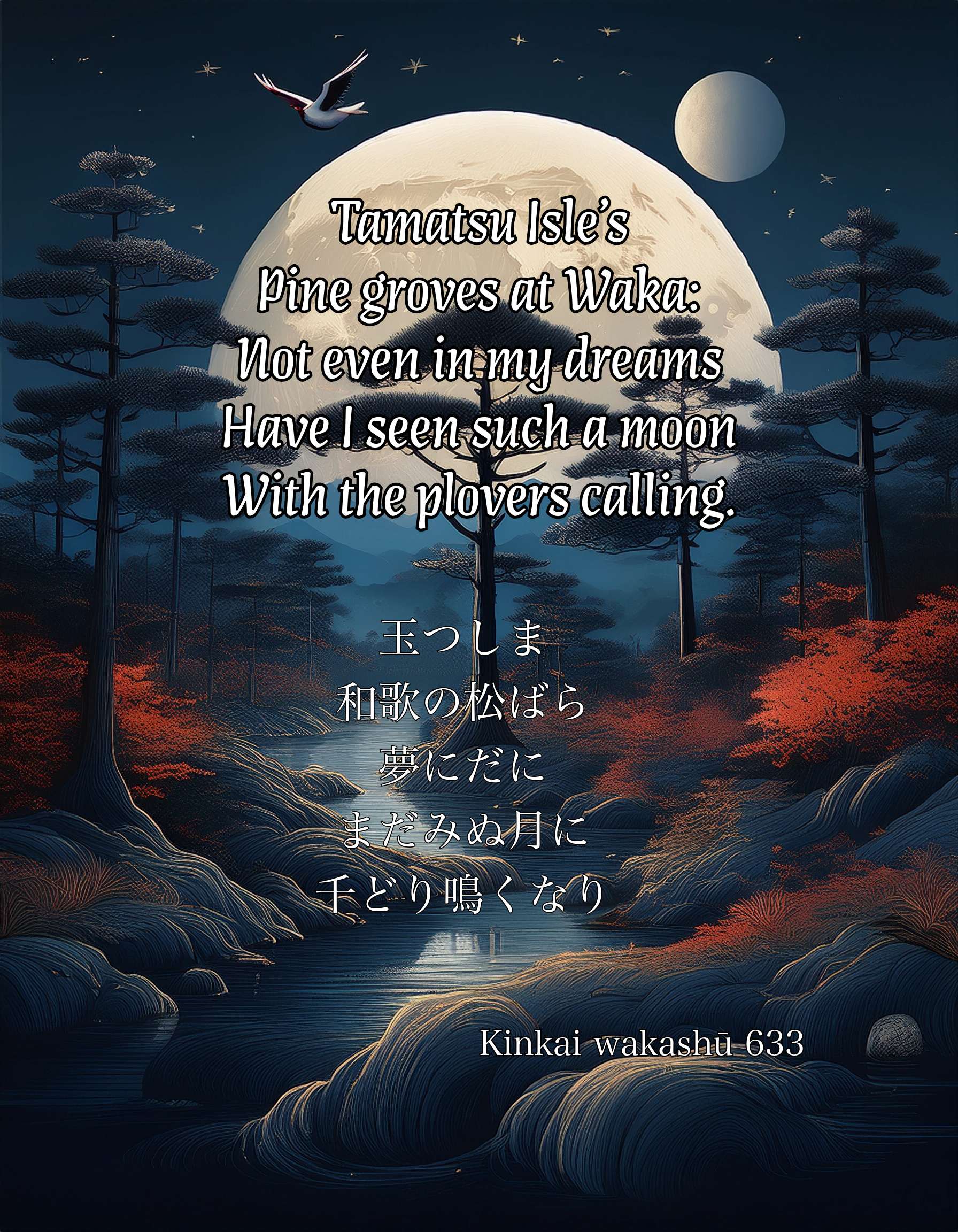
Plovers before the moon.
玉つしま和歌の松ばら夢にだにまだみぬ月に千どり鳴くなり
| tamatsushima waka no matsubara yume ni dani minu tsuki ni chidori naku nari | Tamatsu Isle’s Pine groves at Waka: Not even in my dreams Have I seen such a moon With the plovers calling. |
633
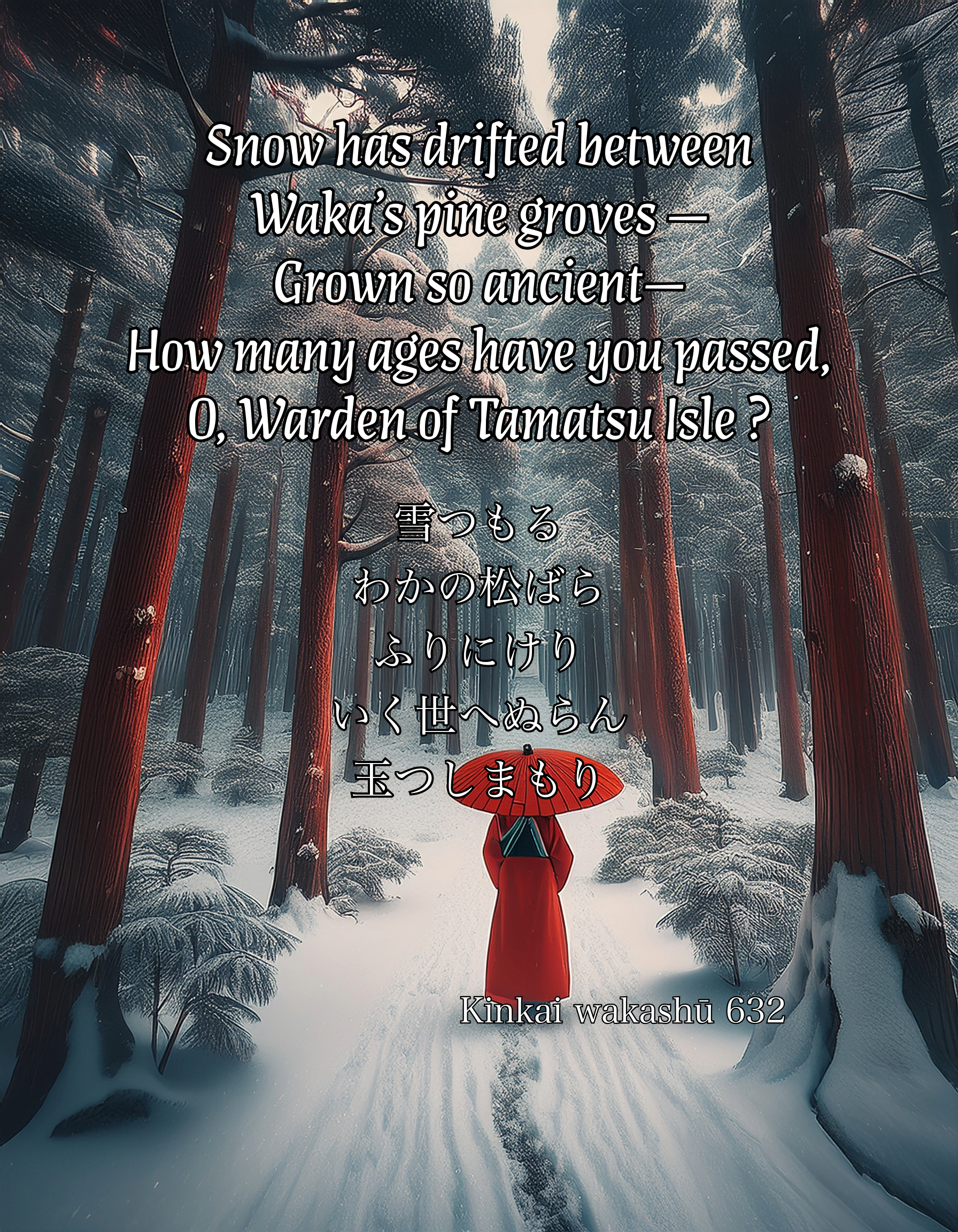
Snow between the pines.
雪つもるわかの松ばらふりにけりいく世へぬらん玉つしまもり
| yuki tsumoru waka no matsubara furinikeri ikuyo henuran tamatsushimamori | Snow has drifted between Waka’s pine groves[i]— Grown so ancient— How many ages have you passed, O, Warden of Tamatsu Isle[ii]?[iii] |
632
[i] The ‘pine groves of Waka’ (waka no matsubara 和歌の松原) were located in Ise, but Sanetomo mistakenly associates them with Waka Bay (waka no ura 和歌浦) in Kii—hence his reference to Tamatsushima in the poem.
[ii] In this context, ‘Tamatsu Isle’ (Tamatsushima 玉津島) is understood as referring to Tamatsushima Shrine which is located near the coast in Wakayama. One of the deities venerated at this shrine is Sōtorihime-no-mikoto 衣通姫尊, one of the patron gods of waka poetry, which Sanetomo evokes with his reference the ‘pine groves of Waka’.
[iii] See: Kokinshū XVII: 905.
Original
かすがののけふのみゆきをまつばらのちとせのはるはきみがまにまに
| kasugano no kyō no miyuki o matsubara no chitose no haru wa kimi ga manimani | On Kasuga Plain Today’s progress Awaited have the pine groves, A thousand years of springtimes, Just as my Lady’s thoughts. [1] |
Mitsune
31
Left
ゆくさきのはるをとほくしまかすればいまはちとせのうたがひもなし
| yukusaki no haru o tōkushi makasureba ima wa chitose no utagai mo nashi | Future Springtimes to distant times May we entrust, for Now that she will live a thousand years more There is no doubt, at all. |
32
Right (Win)
むれたちてわれをまつてふかすがののみどりふかくやおもひそめけむ
| muretachite ware o matsu chō kasugano no midori fukaku ya omoisomekemu | Growing crowded together, and Awaiting me are the pines On Kasuga Plain— Why should their green so deeply Seem to think of me? |
33


[1] A minor variant of this poem occurs in Mitsune-shū (325) with the same headnote as for poem (22), above.
Composed on the night when coming-of-age ceremonies were held for the son and daughter of the Captain of the Outer Palace Guards, in the Twelfth Month, Shōhei 5 [935].
大原やをしほの山の小松原はやこだかかれ千世のかげみん
| ōhara ya oshio no yama no komatsubara haya kodaka kare chiyo no kage min | In Ōhara On Oshio Mountain Among the young pine groves Fly swiftly, fledgling hawk, For you will see the light of a thousand generations! |
When a woman who had long been an acquaintence of Left Middle Captain Naritoki departed for Tsukushi, Lord Sanekata, went as a messenger to Usa, and she gave this to him out of concern.
今日迄は生の松原いきたれど我身のうさに歎てぞふる
| keFu made Fa iki no matubara ikitaredo wa ga mi no usa ni nagekite zo Furu |
Up until today Among the pine groves of Iki Have I lived, yet In my desolation Am I drowned in grief. |
The Daughter of Fujiwara no Nochiō
藤原後生女
Left (Tie).
尋ても逢はずは憂さやまさりなん心づくしに生の松原
| tazunete mo awazu wa usa ya masarinan kokoro zukushi ni iki no matsubara |
Paying a visit and Not meeting: the despair Reaches new heights, Exhausting my heart, as a journey to Iki in Matsubara! |
653
Right.
行逢はん契も知らず花薄ほの見し野邊に迷ひぬる哉
| yukiawan chigiri mo shirazu hana sususki hono mishi nobe ni mayoinuru kana |
Go, and I will meet her! Heedless of if such a bond exists, The miscanthus fronds Briefly glimpsed across the fields, Drive me to confusion! |
654
The Gentlemen of the Left and Right state the opposing team’s poem lacks thought.
Shunzei’s judgement: The Left draws excessively on conceits of Kyushu. In the Right’s poem, ‘confusion in the fields’ (nobe no mayoi) does not seem to lead anywhere. Both of these poems lack any real conception other than their use of conceits. The round ties.
Written when on a visit to the province of Ise in the tenth month of the twelfth year of Tenpyō (743).
いもにこひわかの松ばらみわたせばしほひのかたにたづなきわたる
| imo ni koi waka no matsubara miwataseba shioi no kata ni tazu nakiwataru |
Thinking of my love, At Matsubara in Waka, As I look out Across the mud-flats A crane’s cry drifts across, and I go weeping on my way. |
Emperor Shōmu (701-756, r. 724-749)