tamaboko no michi wa tōku mo aranaku ni tabi to shi omoeba wabishikarikeri
The jewelled-spear straight Road distant Is not, but even so, When I think of travelling How desolate I am! [i]
564
[i] See: Sent to his Junior Consort when she was away from the palace. たまぼこのみちははるかにあらねどもうたてくもゐにまどふころかな tamaboko no/ michi wa haruka ni / aranedomo / utate kumoi ni / madou koro kana ‘Down a jewelled-spear straight / Road’s distance / You are not, yet / Somehow, among the clouds, extremely / Lost am I, these days!’ Former Emperor Suzaku (Shinkokinshū XIV: 1248)
Hidden in the grass on the path o’er the plains[i]
Left
なつくればのべのくさばもしげりあひていづれかみちとみえぞわかれぬ
natsu kureba nobe no kusaba mo shigeriaite izure ka michi to mie zo wakarenu
When the summer comes, The blades of grass upon the plains Grow lushly together, so Which is the path to take I cannot tell by looking!
9
Right
をちこちのみちみえぬまでなつののはくさばしげくもなりにけるかな
ochikochi no michi mienu made natsuno no wa kusaba shigeku mo narinikeru kana
Until both distant and nearby Paths I cannot see Across the summer plains Have the blades of grass so lushly Grown, indeed!
10
Do they not know the features of the summer plains conveyed by ‘Hidden in the grass on the path o’er the plains’? While both Left and Right use ‘blades of grass’, this puts one in mind of fresh grass sprouting in spring showers; and then of the two of them, the Right uses ‘distant and nearby’, which is nothing more than an archaic expression from the Age of Gods used for leg-wearying mountain paths, while at least the Left does not have a tangled argument.
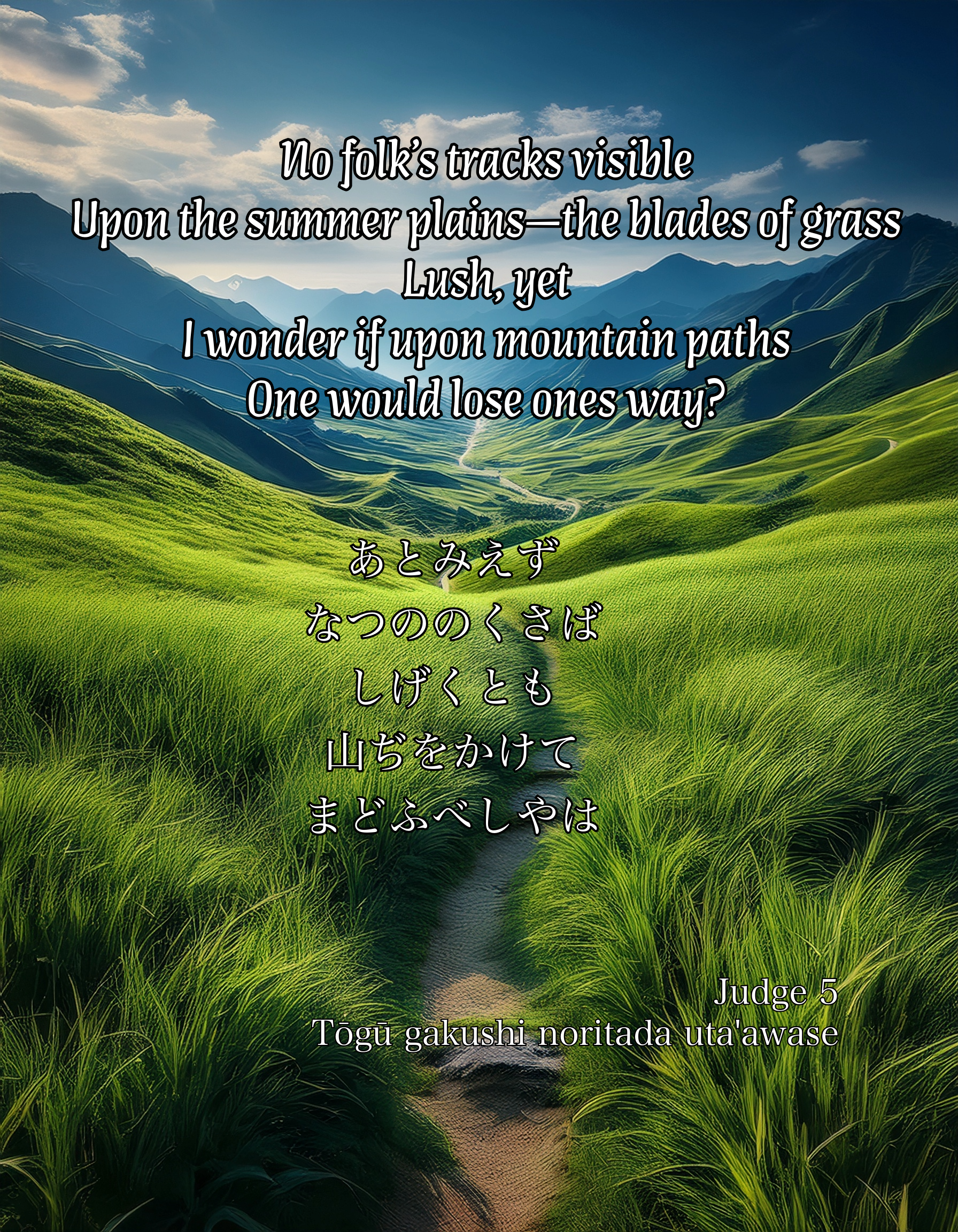
ato miezu natsuno no kusaba shigeku tomo yamaji o kakete madoubeshi ya wa
No folk’s tracks visible Upon the summer plains—the blades of grass Lush, yet I wonder if upon mountain paths One would lose ones way?
obotsukana izure izuchi no michi naramu shiori mo miezu fureru shirayuki
How strange! Which is which Path, I wonder? Even the laden branches go unseen In the falling snow, so white.
Retired from the World 47
Right
雪ふかみとなりのさともうづもれてけぶりのみこそしるしなりけれ
yuki fukami tonari no sato mo uzumorete keburi nomi koso shirushi narikere
So deep the snow, that The estate next door Is buried; Trails of smoke are the only Sign it’s there!
Senior Assistant Minister Past Lecturer
48
The poem of the Left’s ‘even the laden branches go unseen’ and what follows is both poetic and a familiar usage. As for the Right’s poem, how can ‘the estate next door be buried’ unless it’s the only place that snow is falling and nowhere else? Thus, I feel that the snow falling to conceal the broken branches has more feeling to it.
The Left’s ‘which path’ gives me the impression that there are many of them. This sense of multiplicity is something I can imagine—which is a good thing—and, I think, see me using myself. ‘Laden branches’ are something which occur on peaks deep in the mountains. It might be a bit remiss of me, but I wonder whether I can imagine snow drifting so high on a mountain peak?
As for the Right’s poem, we use ‘next door’ when there’s a fence of some sort between one estate and another, don’t we? As such, saying that the smoke is the sign is rather vague. Even if there’s been a quite extraordinary snowfall, there would be something other to notice as well as the smoke, so this is an error, isn’t it. It would be acceptable to refer to smoke if the estate were further away.