Tag Archives: mine

Reikeiden no nyōgo uta’awase 01

Poetry Match held by the Reikeiden Junior Consort

Poems matched by the retainers of the Reikeiden Junior Consort, around the Third Month, Tenryaku 10.

Haze

Left (Tie)

あさひさすみねのしらゆきむらぎえてはるのかすみはたなびきにけり

asahi sasu
mine no shirayuki
muragiete
haru no kasumi wa
tanabikinikeri
Morning sun shines upon
The snow upon the peak, so white,
All vanishing with
The haze of spring
A’trailing.

Kanemori
1

Right

みよしのはゆきふりやまずさむけれどかすみぞはるのしるべなりける

miyoshino wa
yuki furiyamazu
samukeredo
kasumi zo haru no
shirube narikeru
In fair Yoshino, where
Never does the snow stop falling,
‘Tis cold, yet
Haze of spring
Is a sign.

2

Kinkai wakashū 623

Composed and sent to the residence of the Superintendent Abbot of Tsurugaoka[i] on a morning when snow had fallen.

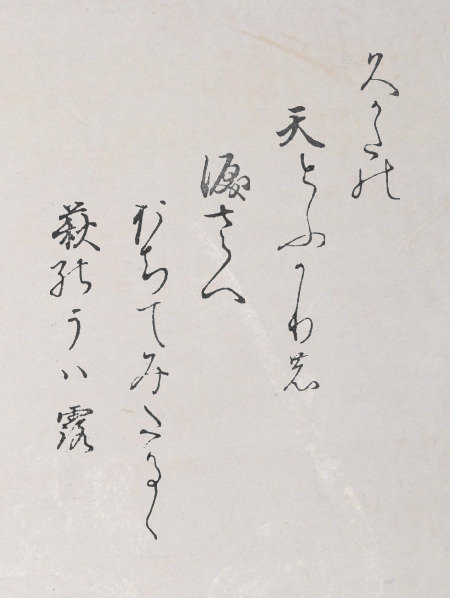
つるの岡あふぎてみれば峰の松梢はるかに雪ぞつもれる

tsuru no oka
ōgite mireba
mine no matsu
kozue haruka ni
yuki zo tsumoreru
When to the Hill of Cranes
I lift up my gaze,
On the peaks beyond, pine
Treetops in the distance
Are covered with drifted snow.

623


[i] Tsurugaoka Hachiman Shrine (Tsurugaoka hachimangū 鶴岡八幡宮) is located in Yukinoshita in Kamakura and venerated Hachiman, the deity of war and warriors as the patron of the Minamoto clan. The shrine thus was, and still is, one of the focal points of the city and where many of its most important festivals are held. It was also the location of Sanetomo’s assassination in 1219. The Superintendent Abbot (bettō sōzu  別当僧都) to whom Sanetomo sent this time was probably the shrine’s third, Teigyō 定暁 (dates unknown) (Higuchi 2016, 96).

Kinkai wakashū 602

いはねふみいく重のみねをこえぬともおもひもいでむ心へだつな

iwane fumi
ikue no mine o
koenu tomo
omoi mo idemu
kokoro hedatsu na
Treading past the crags’ feet, and
Layer upon layer of peaks
A’crossing, still
Will my yearning for you grow, so
Let us not be strangers…[i]

602


[i] See: Composed in the conception of parting when he took part in a hundred-poem sequence. 別れても心へだつな旅ごろも幾重かさなる山路なりとも wakarete mo / kokoro hedatsu na / tabigoromo / ikue kasanaru / yamaji naritomo ‘We may part, yet / Let us not be strangers; / Travellers’ robes / Place layer on layer, / Though mountain paths lie in-between.’ Fujiwara no Sada’ie (Senzaishū VII: 497)

Kinkai wakashū 587

For the place on a folding screen with a picture of snow falling somewhere with a large number of travellers.

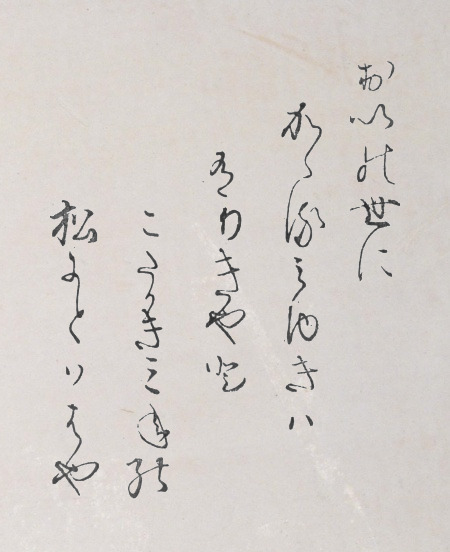
かたしきの衣手いたくさえわびぬ雪ふかきよのみねの松風

katashiki no
koromode itaku
saewabinu
yuki fukaki yo no
mine no matsukaze
A single spread
Sleeve is truly filled
With lonely chill,
On a night deep amidst the snow
With the pinewinds on the peak.

587

Yōzei’in ichi no miko himegimi uta’awase 06

Original

さほやまのははそのいろはうすけれどあきはふかくもなりにけるかな

saoyama no
hahaso no iro wa
usukeredo
aki wa fukaku mo
narinikeru kana
On Mount Sao
The oaks’ hues are
Frail, yet
Autumn ever deeper
Grows!

Sakanoue no Korenori
15

Left (Win)

さほやまのみねのもみぢばいろいろにたつあさぎりぞそらにしるらむ

saoyama no
mine no momijiba
iroiro ni
tatsu asagiri zo
sora ni shiruramu
On Mount Sao
The autumn leaves upon the peak
Have many hues—
The rising morning mists mean
That ‘tis surely known up in the skies.

16

Right

うすきこきいろのかぎりぞさほやまはあきはつるまであさきとなみそ

usuki koki
iro no kagiri zo
saoyama wa
aki hatsuru made
asaki to na mi so
Both deep and pale
Hues are fair extreme!
But on Mount Sao
Until the end of autumn
Frail I would not have them be!

17

Eien narabō uta’awase 35

Round Seven

Left

かすがやまちえにさかゆるさかきばはよろづよまでのきみがためか

kasugayama
chie ni sakayuru
sakakiba wa
yorozuyo made no
kimi ga tame ka
Upon Kasuga Mountain
A thousand branches grow,
Leafy, on the sacred tree—
Until ten thousand ages pass
Will they ward my Lord!

Lady Kazusa
69

Right

君がよはいふかぎりなしみよしののこがねがみねにみよをまつまで

kimi ga yo wa
iu kagiri nashi
miyoshino no
kogane ga mine ni
miyo o matsu made
My Lord’s reign—
Words cannot describe:
‘til fair Yoshino’s
Golden peak’s
Age one must await!

Lady Shikibu
70

The poem of the Left seems poetic to an extraordinarily outlandish degree! The poem of the Right’s ‘‘til fair Yoshino’s / Golden peak’s / Age one must await!’ has a sufficient conception of felicitation. Thus, these tie.

That the Left is addressed to Mount Kasuga is highly admirable. Is the Right’s ‘golden peak’ a reference to Mount Mitake? It’s very difficult to say anything profound here. Arbitrarily, I would make this a tie—the quality of the poems makes that seem right.

Eien narabō uta’awase 34

Round Six

Left (Win)

うれしさはおほつのはまにたつなみのかずもしられぬきみがみよかな

ureshisa wa
ōtsu no hama ni
tatsu nami no
kazu mo shirarenu
kimi ga miyo kana
My joy is
Great, as upon Ōtsu Beach
Break waves
In numbers quite unknown,
Such is my Lord’s reign most fair!

Cell of Fragrant Cloud
67

Right

かすがやまみねのしらがしよろづよをきみにといへばかみもいさめず

kasugayama
mine no shiragashi
yorozuyo o
kimi ni to ieba
kami mo isamezu
Kasuga Mountain has
White-barked evergreen oaks upon its peak:
‘Ten thousand generations
For my Lord!’—should I say that,
The God will surely not refuse!

Cell of Compassionate Light
68

The poem of the Left’s ‘Great, as upon Ōtsu Beach’ and what follows is something that sounds grievously prosaic. With that said, there are many parts of the poem which are not. What is the poem of the Right’s ‘White-barked evergreen oaks on its peak / Ten thousand generations’ linked with in the remainder of the poem? I wonder what it’s composed about… The Left doesn’t contain any errors, so I still say it wins.

The Left’s poem, as I have said in an earlier round, appears to lack smoothness. Is the poem of the Right’s ‘white-barked evergreen oaks’ a long-standing expression? I can’t seem to recall a prior precedent. ‘The God will surely not refuse’ is vague, too. Is it asking the deity’s favour for the speaker? While I am somewhat hesitant, given my appallingly constricted knowledge, I will, fearfully, say that this is inferior.