Tag Archives: momijiba

Yōzei’in ichi no miko himegimi uta’awase 11

Original

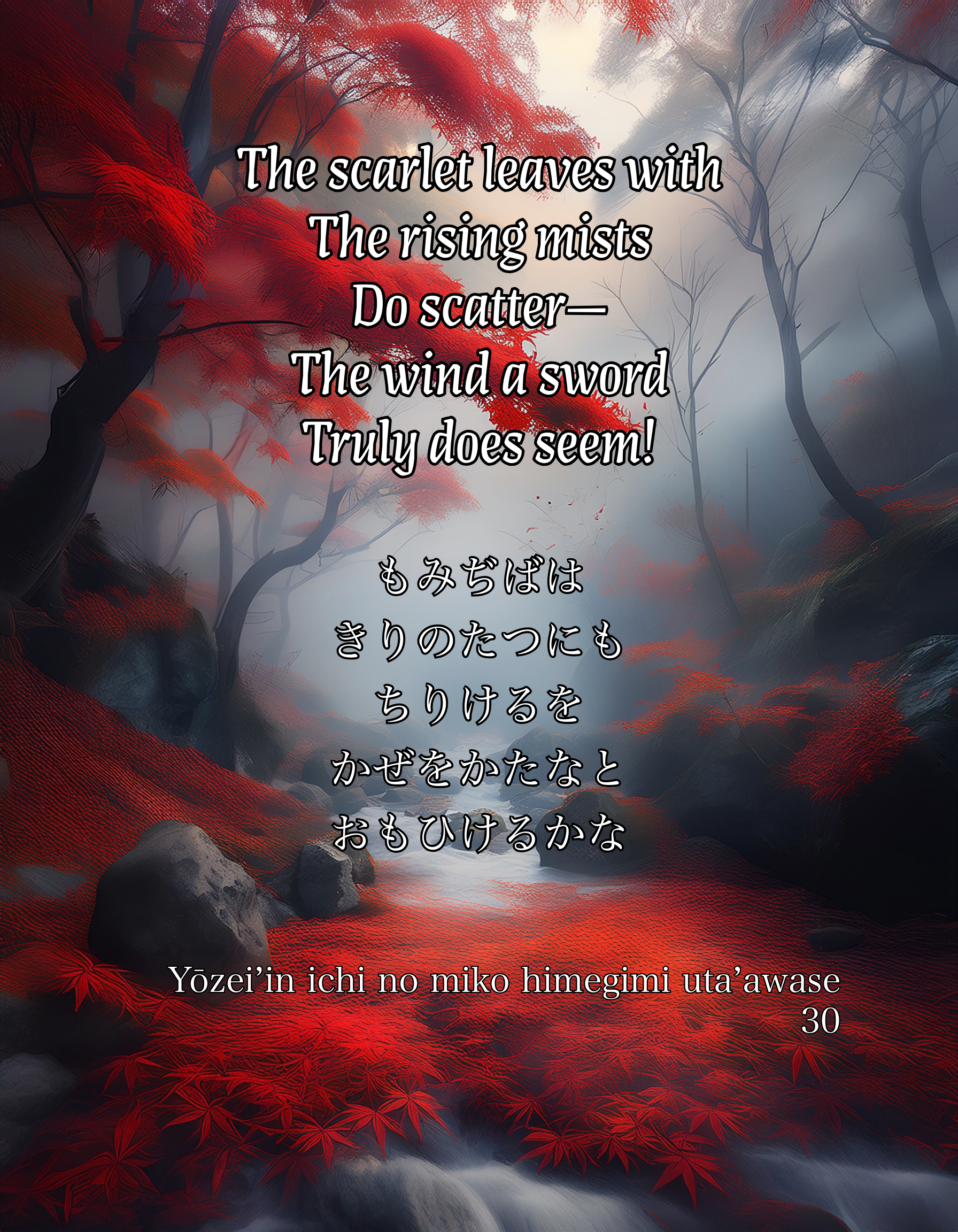
もみぢばはきりのたつにもちりけるをかぜをかたなとおもひけるかな

momijiba wa
kiri no tatsu ni mo
chirikeru o
kaze o katana to
omoikeru kana
The scarlet leaves with
The rising mists
Do scatter—
The wind a sword
Truly does seem!

30

Left

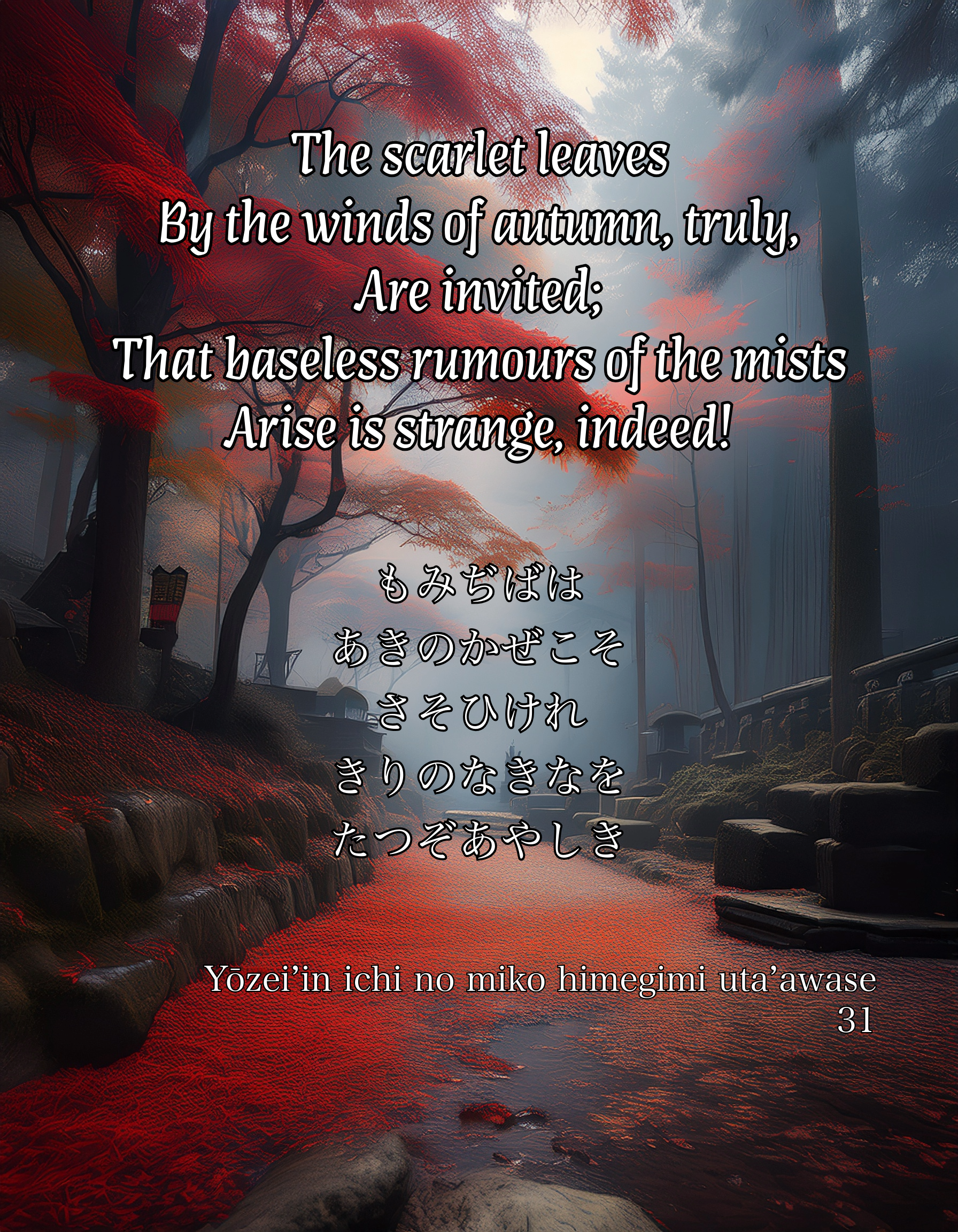
もみぢばはあきのかぜこそさそひけれきりのなきなをたつぞあやしき

momijiba wa
aki no kaze koso
sasoikere
kiri no nakina o
tatsu zo ayashiki
The scarlet leaves
By the winds of autumn, truly,
Are invited;
That baseless rumours of the mists
Arise is strange, indeed!

31

Right

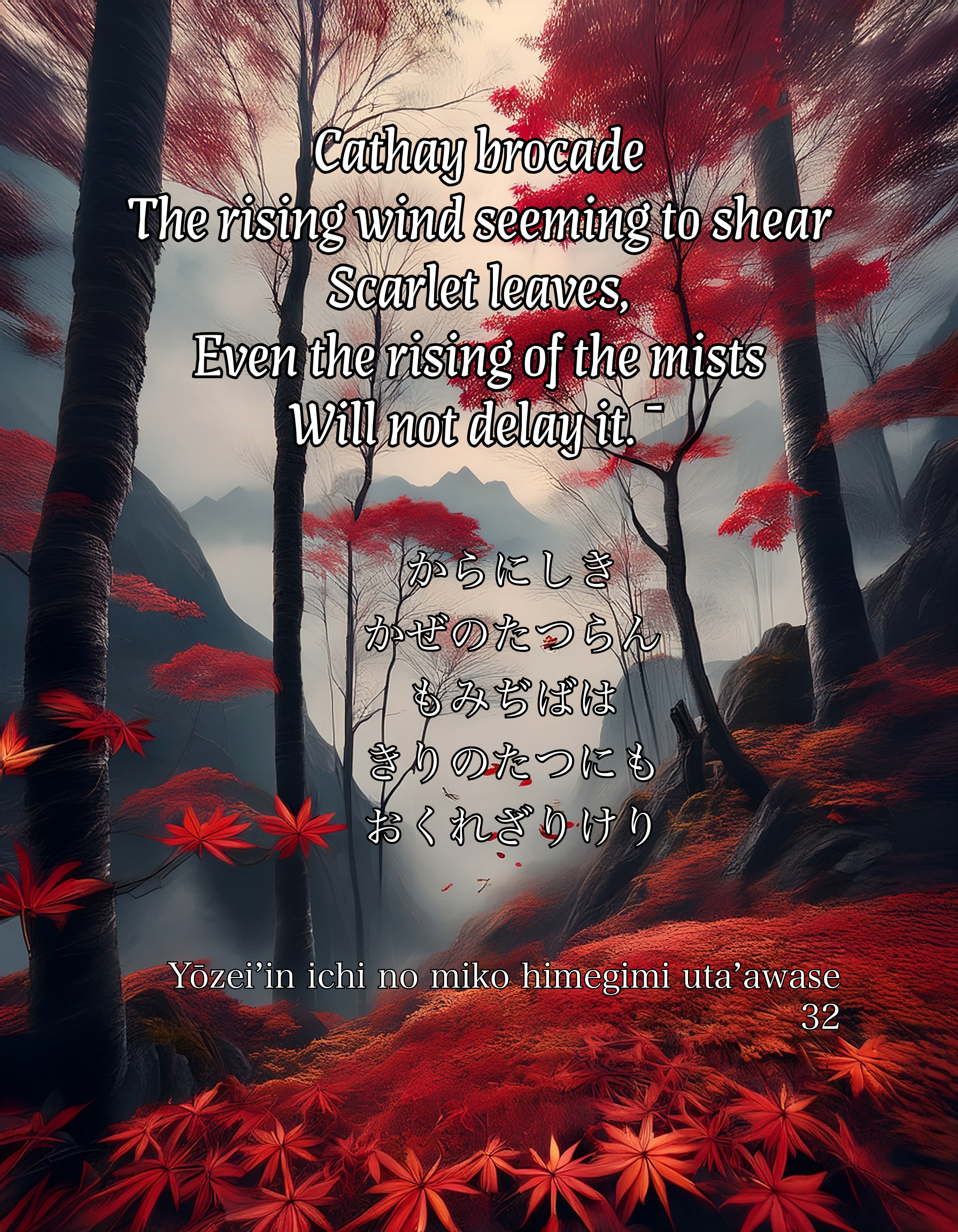
からにしきかぜのたつらんもみぢばはきりのたつにもおくれざりけり

karanishiki
kaze no tatsuran
momijiba wa
kiri no tatsu ni mo
okurezarikeri
Cathay brocade
The rising wind seeming to shear
Scarlet leaves,
Even the rising of the mists
Will not delay it.¯

32

Yōzei’in ichi no miko himegimi uta’awase 06

Original

さほやまのははそのいろはうすけれどあきはふかくもなりにけるかな

saoyama no
hahaso no iro wa
usukeredo
aki wa fukaku mo
narinikeru kana
On Mount Sao
The oaks’ hues are
Frail, yet
Autumn ever deeper
Grows!

Sakanoue no Korenori
15

Left (Win)

さほやまのみねのもみぢばいろいろにたつあさぎりぞそらにしるらむ

saoyama no
mine no momijiba
iroiro ni
tatsu asagiri zo
sora ni shiruramu
On Mount Sao
The autumn leaves upon the peak
Have many hues—
The rising morning mists mean
That ‘tis surely known up in the skies.

16

Right

うすきこきいろのかぎりぞさほやまはあきはつるまであさきとなみそ

usuki koki
iro no kagiri zo
saoyama wa
aki hatsuru made
asaki to na mi so
Both deep and pale
Hues are fair extreme!
But on Mount Sao
Until the end of autumn
Frail I would not have them be!

17

Nishinomiya uta’awase 04

Round Four

Left

いとどしく照りこそまされもみぢばに日影うつろふ天のかご山

itodoshiku
teri koso masare
momijiba ni
hikage utsurou
ama no kagoyama
All the more
Brightly do shine
The scarlet leaves
Reflecting the sunshine
On heavenly Mount Kago!

Minor Captain Lord Kin’nori, Fourth Rank
7

Right

天の原時雨にくもるけふしもぞ紅葉の色はてりまさりける

ama no hara
shigure ni kumoru
kyō shimo zo
momiji no iro wa
terimasarikeru
The plain of heaven is
Clouded with showers, but
Today for certain
The hues of the scarlet leaves
Shine most bright.

The Daughter of His Excellency, the Head
8

Considering the Left’s ‘Reflecting the sunshine / On heavenly Mount Kago’ about scarlet leaves reflecting the sun’s light, gives me the feeling that this must be a mistaken reference to the garlands of scarlet clubmoss worn by minor officiants at the Great Thanksgiving Service. In addition, among all of the many mountains in various places whose leaves turn scarlet, it seems something of a stretch to go so far as to mention Heavenly Mount Kago, considering it is an archaic expression found in the Collection of a Myriad Leaves, among other places. The Right’s ‘Clouded with showers, but / Today for certain’ is an expression perfectly in tune with the topic, making one wonder whether the leaves’ hue is the result of single drenching which has dyed them superbly.

Nishinomiya uta’awase 03

Scarlet Leaves and Daytime

Round Three

Left

朝霧のはれ行くままにもみぢ葉はあかねさしてぞ色まさりける

asagiri no
hareyuku mama ni
momijiba wa
akanesashite zo
iro masarikeru
As the morning mists
Are clearing away
The autumn leaves
Shine madder red,
Their hue the best of all.

Daishin
5

Right

月草の色どる比はかへれどもははそのもみぢこころにぞしむ

tsukikusa no
irodoru koro wa
kaeredomo
hahaso no momiji
kokoro ni zo shimu
At times the moon-grass’
Fair hues
Will shift, yet those of
The oaks in autumn
Pierce right to the heart!

His Excellency Akinaka
6

The Left poem’s sequencing isn’t bad, but ‘shining madder red’ has, since ancient times, been used of the sun in poetry, while here it is simply ‘Shine madder red, / Their hue the best of all’. It gives the impression that there is some emotion missing. In a poem for this type of poetry match, I wonder if omitting a single element like this is a grave fault? Even so, I have no recollection of a poem being composed in this manner in any poetry match which people have used for reference from days gone by. In addition, the Right’s  ‘At times the moon-grass’ / Fair hues / Will shift, yet’ and what follows shows little evidence of poetic cultivation, so in sum, it’s difficult to say anything here.

Tsurayuki uta’awase 13

Love

Left

淡く濃く染めはじめたるもみぢ葉になどわが恋をおもひそむらむ

usuku koku
somehajimetaru
momijiba ni
nado wa ga koi o
omoisomuramu
Both lightly and deeply
Have begun to colour
The scarlet leaves, so
Why should my love
Seem to occupy my thought so?

25

Right

白露のおきてわかれし朝より消えかへりても恋ひわたるかな

shiratsuyu no
okite wakareshi
ashita yori
kiekaeritemo
koiwataru kana
Silver dewdrops
Fell as we parted—
With the morning
They may vanish, yet
My love for you continues on!

26

Tōin senzai awase 11

Left – Gentian

かはのうへにけふよりうたむあじろにはまづもみぢばやよらんとすらむ

kawa no ue ni
kyō yori utamu
ajiro ni wa
mazu momijiba ya
yoramu to suramu
Atop the river
From today will they strike
Upon the fish traps—
Is it the scarlet leaves that first
Will make to draw near?

19a

かはのうへにいまよりうたむあじろにはまづもみぢばやよらんとすらむ

kawa no ue ni
ima yori utamu
ajiro ni wa
mazu momijiba ya
yoramu to suramu
Atop the river
From this moment will they strike
Upon the fish traps—
Is it the scarlet leaves that first
Will make to draw near?

19b

Right – Missing

This poem is an acrostic, with ‘gentian’ (riutamu) contained within yori utamu.

Naidaijin-ke uta’awase 08

Round Eight

Left (Both Judges – Tie)

神無月三室の山の紅葉ばも色に出でぬべく降るしぐれかな

kaminazuki
mimuro no yama no
momijaba mo
iro ni idenubeku
furu shigure kana
In the Godless Month
On Mount Mimuro
The autumn leaves
Show no hues at all, despite
The falling showers!

Lord Morikata
15

Right

かみな月時雨れてわたるたびごとに生田の杜をおもひこそやれ

kaminazuki
shigurete wataru
tabi goto ni
ikuta no mori o
omoi koso yare
In the Godless Month
Showers pass by and
Every time
The sacred grove at Ikuta
I do recall.

Lord Tadataka
16

Toshiyori states: ‘Godless Month’ is the name given to a specific month of the year. It’s somewhat unclear why one would use ‘Godless Month’ in conjunction with ‘Mount Mimuro’ – is there a prior poem to evidence this? It’s quite normal for lines which would normally have five syllables to be written with six, or those with seven to have eight, and this can sound fine in some cases. Here, though, it does sound obviously excessive and I do wonder about that. The second poem is plainly based on an earlier work, and is not at all clear, but as it has precedent, these two are about the same.

Mototoshi states: neither of these poems appears bad, so I say they tie.

Naidaijin-ke uta’awase 02

Round Two

Left (T – Tie; M – Win)

あやしくも時雨にかへる袂かなゐなの笠はらさして行けども

ayashiku mo
shigure ni kaeru
tamoto kana
ina no kasawara
sashite yukedomo
How strange that
From the shower I shelter
Beneath my sleeves!
Though into the umbrella of the dwarf-bamboo groves of Ina
Is where I’m heading…

A Court Lady
3

Right

ぬるれども嬉しくもあるか紅葉ばの色増す雨の雫とおもへば

nuredomo
ureshiku mo aru ka
momijiba no
iro masu ame no
shizuku to omoeba
Soaked, yet
Happy am I!
For the scarlet leaves
Take on brighter hues with these rain
Drops, I feel…

Lord Akikuni
4

Toshiyori states: The first poem’s section on ‘the umbrella of the dwarf-bamboo groves of Ina’ is well expressed, but then is ‘shower I shelter’ referring to clothing? The second poem can be read as meaning that the speaker is happily being soaked by raindrops standing beneath scarlet leaves on one particular day, but getting drenched by any old shower, even if it’s one which stains leaves scarlet is not something that would make one happy and, sounds tedious. Both poems sound vague, so they should tie.

Mototoshi states: ‘the shower I shelter / Beneath my sleeves’ is better than ‘Happy am I!’