omoi’ideyo mishi yowa yoso ni narinu tomo arishi nagori no ariake no tsuki
O, remember me! The nights we were together distant Have become, yet I still have the keepsake of The moon at dawn…[i]
610
[i] See: For the Poetry Match held at the Residence of the Regent and Chancellor. 風ふかばみねにわかれむ雲をだにありしなごりのかたみともみよ kaze fukaba / mine ni wakaremu / kumo o dani / arishi nagori no / katami to mo miyo ‘If the wind should blow, / Parting from the peak, / Even the clouds / My memories / Seem to represent!’ Lord Ietaka (Shinkokinshū XIV: 1292/Roppyakuban uta’awase 720)
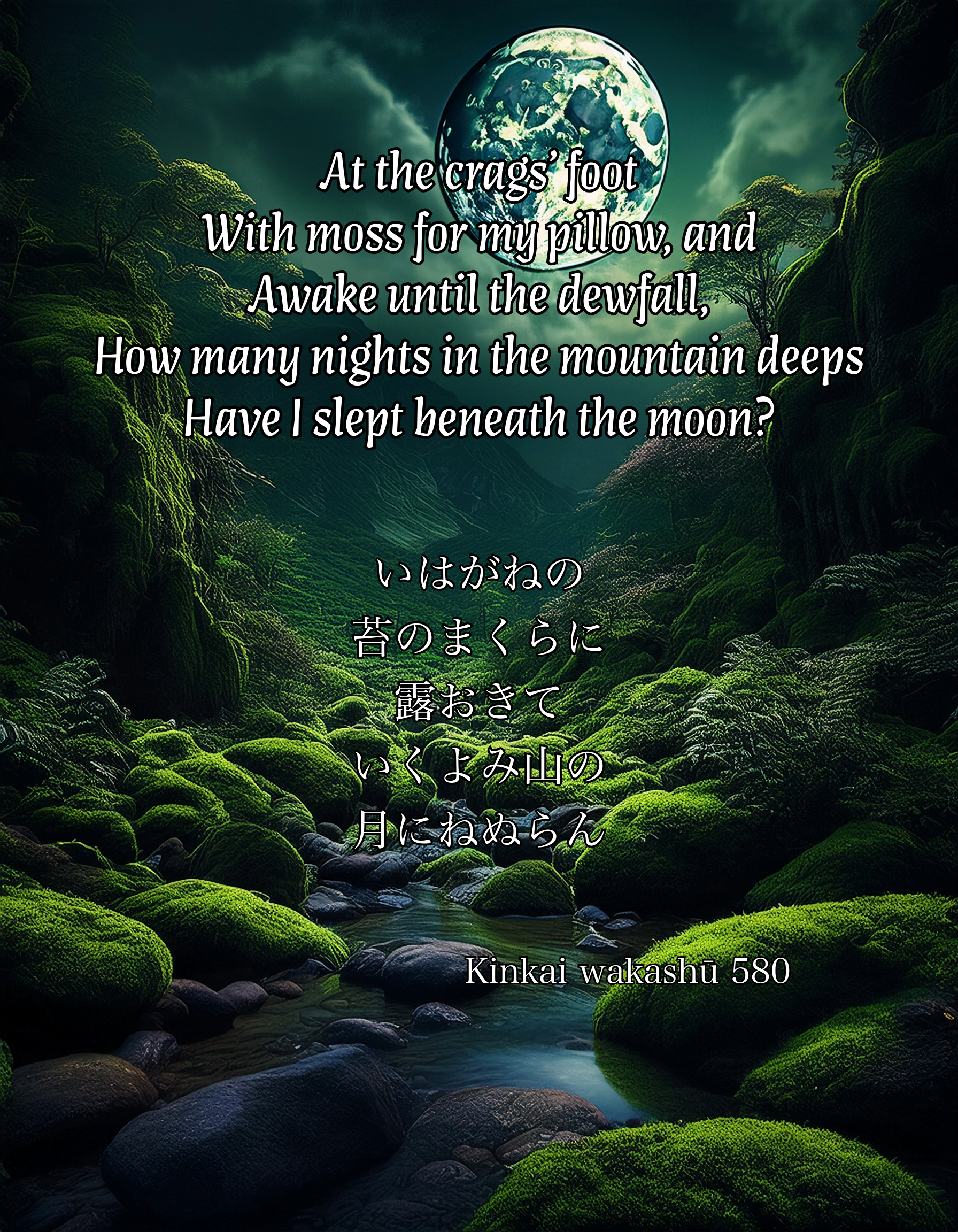
iwa ga ne no koke no makura ni tsuyu okite iku yo miyama no tsuki ni nenuran
At the crags’ foot With moss for my pillow, and Awake until the dewfall, How many nights in the mountain deeps Have I slept beneath the moon.[i]
580
[i] See: On the conception of seeing the moon while travelling, while at a place called the Barrier Gate Hall. 草枕ほどぞへにける都いでていくよかたびの月にねぬらむ kusamakura / hodo zo henikeru / miyako idete / ikuyo ka tabi no / tsuki ni nenuramu ‘Grassy pillows / For a while have been my lot! / Since departing the capital / For some days on my travels / Will I sleep beneath the moon.’ Ōe no Yoshitoki (Shinkokinshū X: 931)
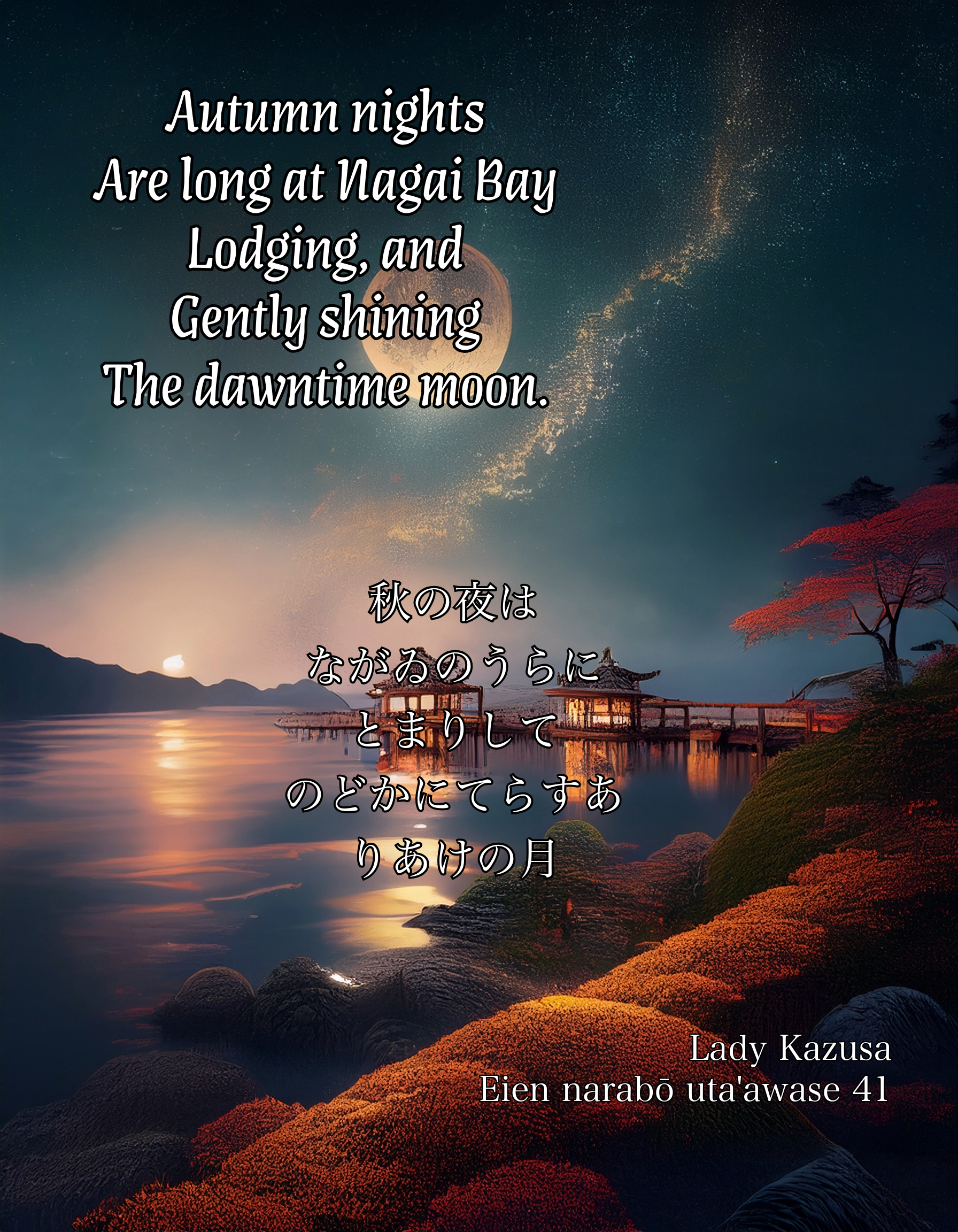
aki no yo wa nagai no ura ni tomarishite nodoka ni terasu ariake no tsuki
Autumn nights Are long at Nagai Bay Lodging, and Gently shining The dawntime moon.
Lady Kazusa 41
Right (Win)
秋の夜のくもふきはらふあらしこそ月みるひとのこころなりけれ
aki no yo no kumo fuki’harau arashi koso tsuki miru hito no kokoro narikere
On an autumn night The clouds a’blowing away, The storm wind, truly, As someone gazing upon the moon Has the selfsame heart!
Lady Shikibu 42
The poem of the Left certainly imagines the scene just as it is. With that being said, however, the dawntime moon is not present long enough. The Right’s poem simply sounds like one composed by Atsutaka for the ‘Poetry Match held at the Residence of the Former Captain of the Outer Palace Guards, Left Division’.[i] Thus, it’s impossible for me to determine a winner or loser.
It’s a poem which we see in the Poetry Match at Lord Moroyori’s Residence.
冬のよの雲ふきはらふ木枯や月見る人の心なるらむ
fuyu no yo no kumo fuki’harau kogarashi ya tsuki miru hito no kokoro naruramu
On a winter’s night The clouds a’blowing away, The bitter wind, indeed, As someone gazing upon the moon The same heart seems to have![ii]
In the poem of the Left, is it the moon or the poet who is lodging at Nagai Bay? If it’s the moon, then ‘lodging’ is erroneous; if it’s the poet, then ‘gently shining’ doesn’t work. In addition to this vagueness, I do also question whether ‘dawntime’ sounds appropriate. As for the Right’s poem, ‘as someone gazing at the moon / Has the selfsame heart!’ is an elegant conception, and the diction is also smooth. It reminds me of an earlier work by someone else. Thus, it wins.
[i] This match has a several different titles, Mototoshi refers to here as both: Zen sa-hyōe no kami no ie no uta’awase 前左兵衛督家歌合 and also Moriyori-kyō no ie uta’awase 師頼卿家歌合, but it is also known as the ‘Poetry Match held by the Late Master of the of the Crown Prince’s Household’ (Ko-tōgū daibu ie uta’awase 故東宮大夫家歌合) and the ‘Poetry held by Moroyori, Captain of the Outer Palace Guards, Right Division’ (U-hyōe no kami moroyori uta’awase 右兵衛督師頼歌合): the text of this match is no longer extant, but it is known to have taken place in the winter Tennin 天仁 2 (1109). Fujiwara no Kiyosuke notes that it was judged by Toshiyori, but Mototoshi disagreed with his assessments and submitted at set of judgements of his own in appeal (Fujioka 1995, 212).
[ii] This poem is included in Shoku shikashū (VI: 293), attributed to Moroyori, with the headnote, ‘Composed on the moon in winter’.
yamamoto no mori no shimenawa nagaki yo o aki no oshika no nakiakasuran
At the mountains’ foot lies A sacred grove with garlands Long as the nights In autumn when the stag Bells in the dawn.
Tomoshige 79
Right
なよ竹のよながき秋の山風に幾たび鹿のね覚しつらん
nayotake no yo nagaki aki no yamakaze ni ikutabi shika no nezameshitsuran
Green bamboo with Knots as apart as the autumn night is long, While with the mountain wind How many times might the stag Have awakened?[1]
Dharma Master Zenshin 80
The Left’s poem has ‘at the mountains’ foot lies a sacred grove with garlands long as the nights’ which sounds pleasant. The Right has ‘knots as apart as the autumn night is long, while with the mountain wind’—these, too, seem to have no clear winner or loser, yet still, the Left should be superior and should win.[2]
[1] An allusive variation on: Composed when the gentlemen in the Crown Prince’s service were presented with wine, on the occasion of Tadafusa being appointed Secretary of an embassy to China, during the reign of the Kanpyō emperor. なよ竹のよながきうへにはつしものおきゐて物を思ふころかな nayotake no / yo nagaki ue ni / hatsushimo no / oki’ite mono o / omou koro kana ‘Green bamboo with / Knots as far apart as the night is long / While the first frost settles on my active / Thoughts these days!’ Fujiwara no Tadafusa (KKS XVIII: 993)
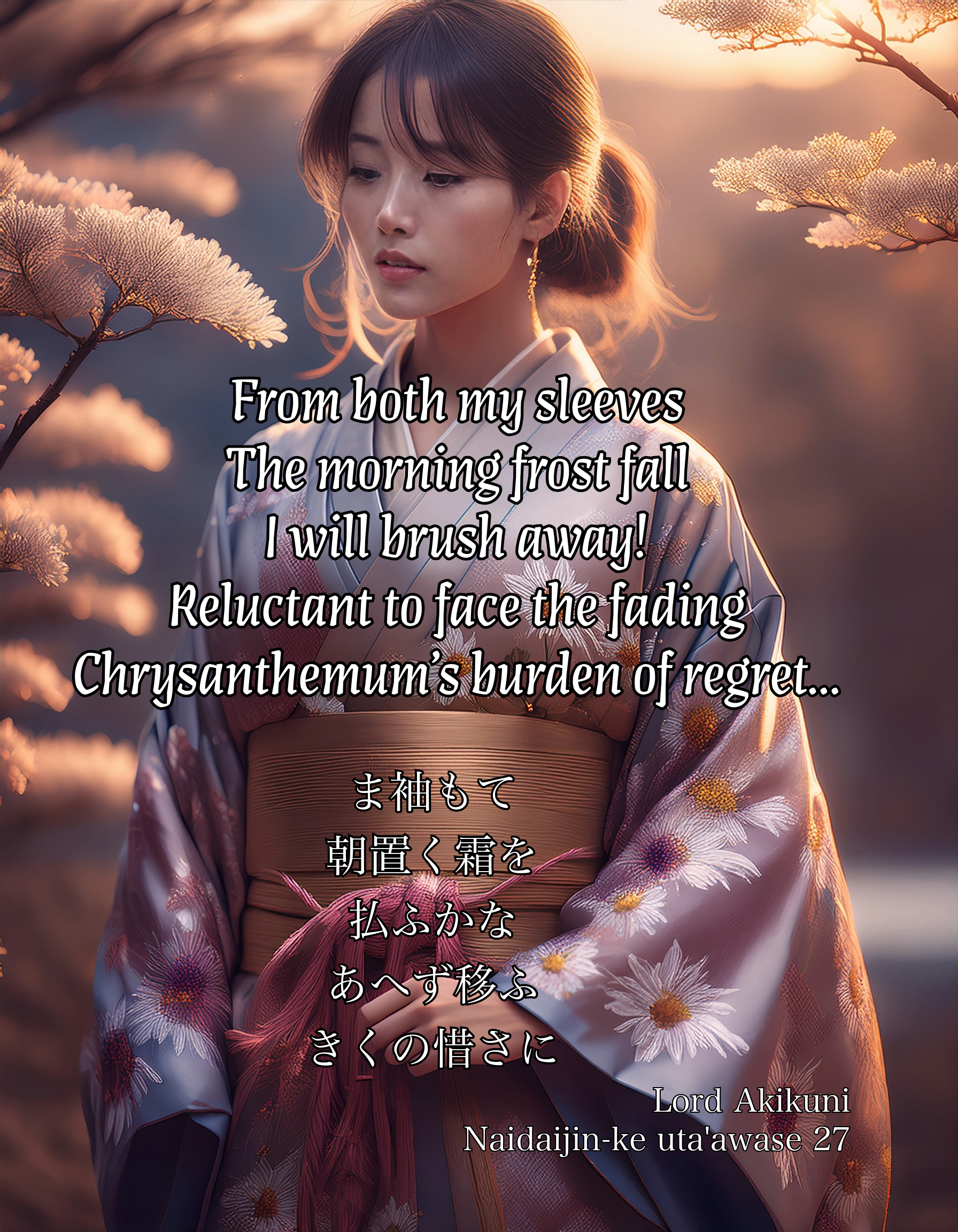
masodemote asa oku shimo o harau kana aezu utsurou kiku no oshisa ni
From both my sleeves The morning frost fall I will brush away! Reluctant to face the fading Chrysanthemum’s burden of regret…
Lord Akikuni 27
Right (Both Judges – Win)
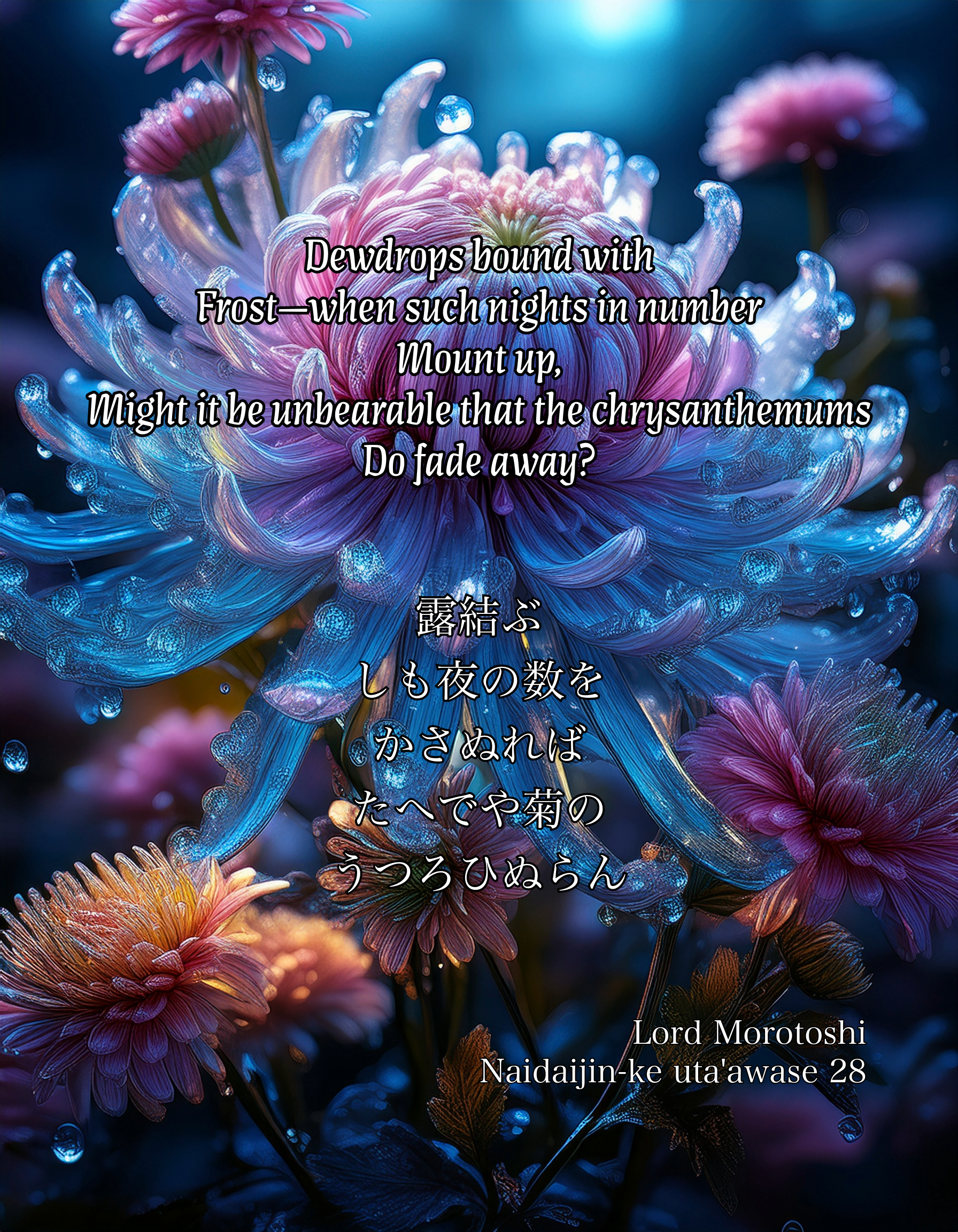
露結ぶしも夜の数をかさぬればたへでや菊のうつろひぬらん
tsuyu musubu shimo yo no kazu o kasanureba taede ya kiku no utsuroinuran
Dewdrops bound with Frost—when such nights in number Mount up, Might it be unbearable that the chrysanthemums Do fade away?
Lord Morotoshi 28
Toshiyori states: the first poem is extremely charming. Nevertheless, I must question the use of ‘reluctant to face the fading’ as I feel this is something I have not heard before. I can grasp the sense of diction such as ‘unable to do anything about’ or ‘without taking on autumn hues’, but did the poet mean to use the diction ‘unbearable’, perhaps? Even though this is somewhat archaic phrasing, it is used in composition. This poem’s expressions, though, I feel are somewhat unfamiliar. The conception and diction of the second poem are both extremely charming. However, this poem, too, is vague. What is going on with the initial ‘dewdrops bound’? Does it mean that the dewdrops get turned into frost? If so, then, from what is known of the calendar, this is something which only occurs on a single night, and from the following night there is only frost. It sounds as if the conception of this poem, though, is that night after night dew turns to frost, and this would be a fault. Despite this vagueness, however, its tone is elegant, so it seems superior.
Mototoshi states: the poem of the Left has a poetic configuration, but I strongly feel that it would have been preferable not to use the diction ‘both my sleeves’. It does seem as if this was used in the ancient Collection of a Myriad Leaves, but even given that was the case, in the preface to the Ancient and Modern, I recall it saying, ‘On examining the poems of ancient times, we find they use many archaic expressions. These were there not just to please the ear, but simply for moral instruction’. It appears that there are no instances of this piece of diction being used in poetry matches from the period of the Ancient and Modern, Later Selection and Gleanings, and these were all conducted for entertainment. Even in a poetry match conducted in Engi 12 [912], when the term ‘sleeve’ was used, I get the feeling that it was such a source of amusement that the poem was not recited. While the quality of the Right’s poem is not superb, the tone of ‘Dewdrops bound with / Frost—when such nights in number’ is not bad, so I feel the dew can still remain bound!