あそぶいとの春のはやしにただよふは花のにしきやはつれゆくらん
| asobu ito no haru no hayashi ni tadayou wa hana no nishiki ya tsureyukuran | The heat haze o’er The springtime woods A’drifting, Does it the blossoms’ brocade Take with it, I wonder? |
Akihiro
When I had gone to a place called the Kawara Mansion with friends to view the plum blossom, and there was no plum blossom there, only the distant sight of cherry.
春霞たちななよりそうすくこき錦とみゆる山のさくらに
| harugasumi tachi na na yori so usu koki nishiki to miyuru yama no sakura ni | O, haze of spring, Arise not and cover not, Either thick or thin, The seeming brocade of Cherry o’er the mountains… |
The only surviving poem from this match[i] is by Kiyowara no Motosuke and is included in Shūishū (I: 42) with the headnote ‘From a poetry match held by the Reikeiden Junior Consort and Chūjō Lady of the Bedchamber during the reign of the Tenryaku Emperor’.
春霞立ちなへだてそ花ざかりみてだにあかぬ山のさくらを
| harugasumi tachi na hedate so hanazakari mite dani akanu yama no sakura o | O, haze of spring, Arising, do not block The flowers’ profusion, for Even of the sight I cannot get my fill Of mountain cherry blossoms… |
Given the lack of other evidence of this match, Hagitani (1958, 417) outlines various possibilities for its provenance, including that it might have originally been composed for the Tentoku 4 Palace Poetry Match (see above), but eventually concludes that due to the existence of other matches between ladies in the imperial harem from around this period, and that the women in question, the Reikeiden Junior Consort, Princess Sōshi 荘子女王 (930-1008) and the Chūjō Lady of the Bedchamber, Fujiwara no Shūshi 藤原修子 (dates unknown) were cousins and thus might have been closer than some of the other women in the rear palace, it is not inconceivable that they might have held a joint poetry match, and thus categorises this as coming from a separate event, the records of which have otherwise been lost. It is not possible to date this event with any accuracy, other than that it took place during Murakami’s reign (946-967), but the likelihood is that it was toward the end of the period.
Hagitani also notes the ‘identical construction’ of this poem and one included in Mototsuke’s personal collection:
When I had gone to a place called the Kawara Mansion with friends to view the plum blossom, and there was no plum blossom there, only the distant sight of cherry.
春霞たちななよりそうすくこき錦とみゆる山のさくらに
| harugasumi tachi na na yori so usu koki nishiki to miyuru yama no sakura ni | O, haze of spring, Arise not and cover not, Either thick or thin, The seeming brocade of Cherry o’er the mountains… |
This leads Komachiya (1990, 15) to categorise the poem from this match as ‘a blossom-viewing poem from the Kawara Mansion’ suggesting he considers it a reworking of Motosuke’s other work.
[i] Reikeiden no nyōgo chūjō miyasudokoro uta’awase 麗景殿女御・中将御息所歌合
Original
さほやまのははそのもみぢちりぬべみよるさへみよとてらすつきかげ
| saoyama no hahaso no momiji chirinubemi yoru sae miyo to terasu tsukikage | Upon Sao Mountain The oaks’ autumn leaves Must have scattered, for Even at night behold! The shining moonlight… |
12
Left (Win)
ひさかたのつきなかりせばさほやまのもみぢはよるのにしきならまし
| hisakata no tsuki nakariseba saoyama no momiji wa yoru no nishiki naramashi | Were the eternal Moon to cease to be, then Sao Mountain’s Autumn leaves for night’s Brocade would I wish! |
13
Right
つきかげのさやけくみゆるさほやまのもみぢをかぜにまかせずもがな
| tsukikage no sayakeku miyuru saoyama no momiji o kaze ni makasezu mogana | In the moonlight, So clear, I see Sao Mountain’s Autumn leaves—to the wind I would entrust them not! |
14
Left
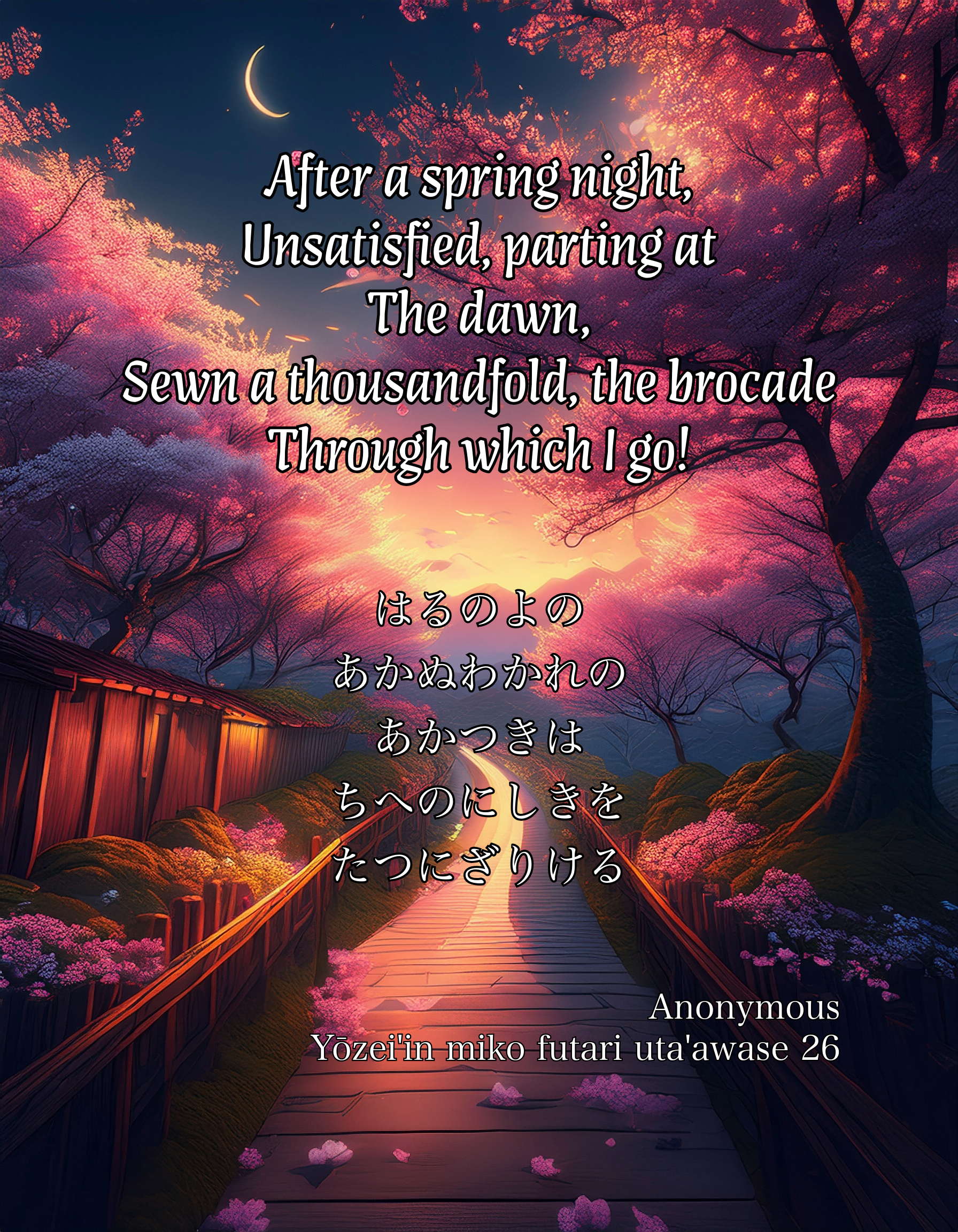
はるのよのあかぬわかれのあかつきはちへのにしきをたつにざりける
| haru no yo no akanu wakare no akatsuki wa chie no nishiki o tatsu ni zarikeru | After a spring night, Unsatisfied, parting at The dawn, Sewn a thousandfold, the brocade Through which I go! |
26
Right
あけぬてふこゑもなみだももろともにうちいづるからにそでぞぬれける
| akenu chō koe mo namida mo morotomo ni uchi’izuru kara ni sode zo nurekeru | ‘Tis dawn, say Birdsongs and tears Both, Bursting out, so My sleeves are soaked! |
27
Round Ten
Left
秋はぎの下葉の露にあらねども消えぬばかりぞ人は恋しき
| akihagi no shitaba no tsuyu ni aranedomo kienu bakari zo hito wa koishiki | Upon the autumn bush clover’s Underleaves a dewdrop I am not, yet Simply will I fade away So much do I love him! |
Taiyu no Suke
19
Right
わすられて年ふる里の浅茅生に誰がためしける萩の錦ぞ
| wasurarete toshi furu sato no asajū ni ta ga tame shikeru hagi no nishiki zo | All forgotten Through the passing years, at my home Among the tangled mugwort, For whose sake is spread The bush clover’s brocade? |
The Daughter of His Excellency, the Head
20
I feel that the poem of the Left is conspicuously poetic, saying ‘Simply will I fade away / So much do I love him!’ while the poem of the Right’s ‘Through the passing years, at my home / Among the tangled mugwort, / For whose sake is spread / The bush clover’s brocade?’ makes me want to ask the bush clover the same question! The pull my heart in more than one direction, so here, too, I feel it’s not possible to decide on a winner or loser.
Showers at one’s lodgings on a journey
Round One
Left
しぐれするもみぢのにしきゆかしきにあけてをたたむふたむらのやま
| shiguresuru momiji no nishiki yukashiki ni akete o tatamu futamura no yama | Under the showers The scarlet leaves’ brocade I long to see, so With the dawn let’s set forth To Mount Futamura! |
Jakunen
51
Right (Win)
みやこにもおもひやすらむくさまくらうちしぐれたるよはのねざめを
| miyako ni mo omoiyasuramu kusamakura uchishiguretaru yowa no nezame o | Even in the capital Might you think of me? On a grassy pillow With a shower Awoken at midnight… |
Suke
52
The Left poem’s ‘With the dawn let’s set forth / To Mount Futamura’ sounds charming, but as we can see from Lord Kanesuke’s poem ‘Futami Bay / Let’s see with the dawn’, it is quite pedestrian. Then there is the expression ‘long to see’—this really isn’t appropriate diction for poetry. I will admit that it appears from time to time in imperial anthologies, and so it is certainly permissible depending upon the style of the poem, though. There’s also the term ‘long to know’—one really shouldn’t use diction in a poetry match which doesn’t express the poet’s true feelings. As for the Right’s poem, it’s also quite pedestrian to say that showers fall on one’s way on a journey, but don’t necessarily fall in the capital, but saying that folk there might think of you waking on your journey, well, why wouldn’t they do that? The conception of the poem is pleasant, and I make it the winner.


Round Eleven
Left
おぼつかないづれうらごの山ならんみなくれなゐにみゆる紅葉ば
| obotsukana izure urago no yama naran mina kurenai ni miyuru momijiba | How strange it is— Where is Urago Mountain, I wonder? When all the same scarlet Seem the autumn leaves… |
Kiyosuke
93
Right (Win)
大ゐ河きしのもみぢのちるをりは浪にたたするにしきとぞみる
| ōigawa kishi no momiji no chiru ori wa nami ni tatasuru nishiki to zo miru | At the River Ōi, When the scarlet leaves upon the bank Come to fall, Cut out by the waves, Does their brocade appear! |
Mikawa
94
When I listen to the Left I wonder what on earth it’s actually about—the end seems redolent of love. The Right doesn’t seem to have any particular faults, so it should win.


Round Six
Left (Win)
山姫はもみぢのにしきおりてけりたちなやつしそ嶺の朝霧
| yamahime wa momiji no nishiki oritekeri tachi na yatsushi so mine no asagiri | The mountain’s princess, Of scarlet leaves brocade Has woven; In your rising don’t despoil it, O, morning mists upon the peak! |
Lord Kinshige
83
Right
しぐれには紅葉の色ぞまさりける又かきくもる空はいとはじ
| shigure ni wa momiji no iro zo masarikeri mata kakikumoru sora wa itowaji | A shower makes The scarlet leaves’ hues Most fine; So, the swiftly clouding Sky I could not dislike. |
Lord Masahira
84
The Right sounds as if the poet has just come to the revelation that, even though a showery sky is charming, can one possibly dislike it, given that it improves the hues of the scarlet leaves. The Left isn’t bad, but it does have two identical sounds ending lines, and this has been called the same-sounding rhyme fault, I believe. With that being said, in the Tentoku Poetry Match, there were some poems with this feature which were criticized, and some which were not, so I wonder if this is not something to particularly worry about. In this poem it doesn’t sound like a defect and, taking this together with the fact that the Right’s poem is poor, the Left should win.


