Tag Archives: oak

Eien narabō uta’awase 25

Round Four

Left

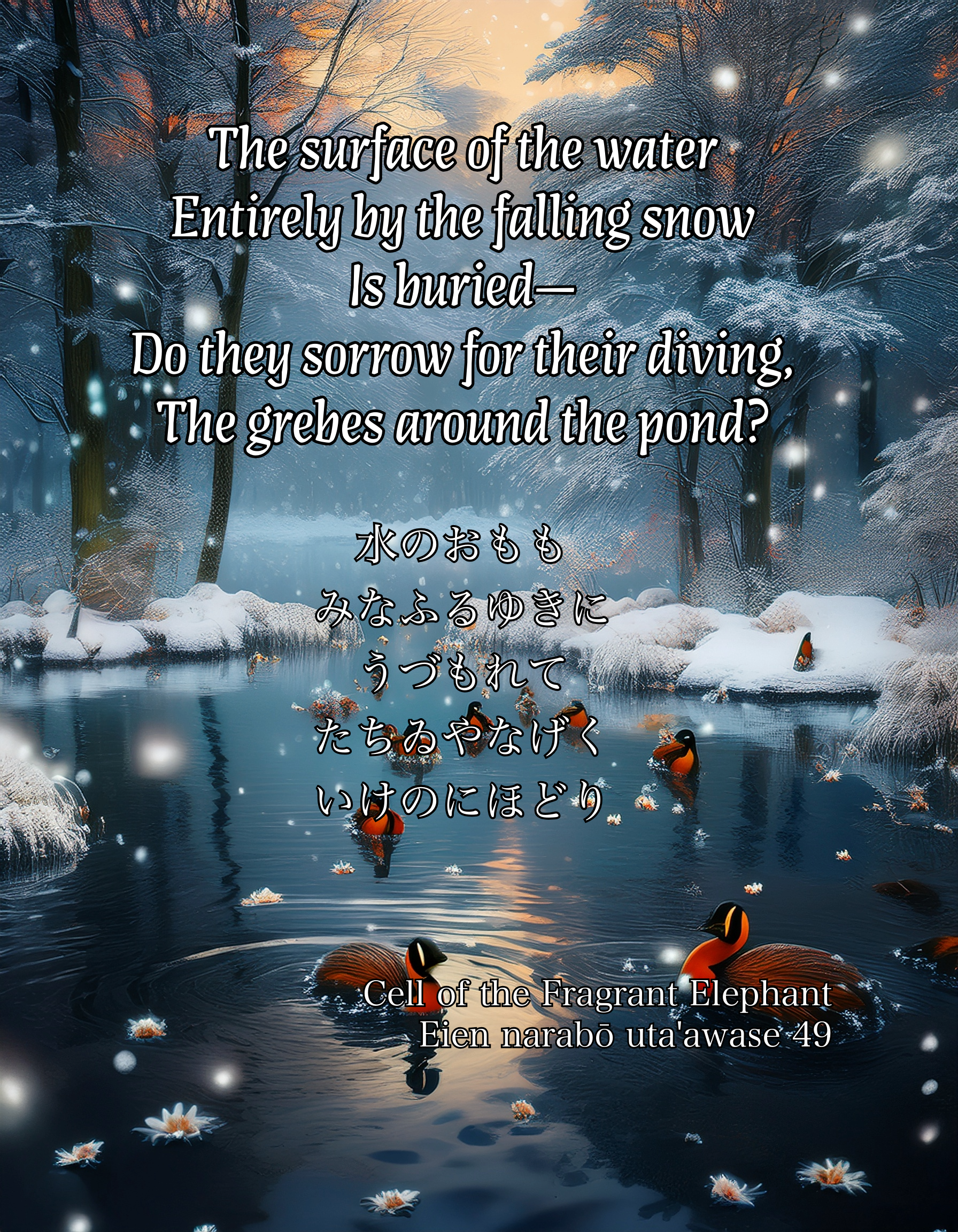
水のおももみなふるゆきにうづもれてたちゐやなげくいけのにほどり

mizu no omo mo
mina furu yuki ni
uzumorete
tachi’i ya nageku
ike no niodori
The surface of the water
Entirely by the falling snow
Is buried—
Do they sorrow for their diving,
The grebes around the pond?

Cell of the Fragrant Elephant
49

Right (Win)

みよしのに雪ふりぬれば我がやどのならのかれ葉はいとどさびしも

miyoshino ni
yuki furinureba
wa ga yado no
nara no kareba wa
itodo sabishi mo
In fair Yoshino
Snow has fallen, so
At my house
The withered oak leaves are
All the more alone…

Cell of the Everlasting Truth
50

The poem of the Left’s ‘surface of the water entirely buried by snow’ is something that I have never heard before. ‘Grieving grebes’, too, are something I have yet to encounter. Really, what sort of poem is this? As for the poem of the Right, while ‘all the more alone’ and what precedes it fails to sound elegant, at the current time I feel it’s a little bit superior.

It’s extremely difficult to conceive of the surface of a body of what which hasn’t yet frozen being buried in snow. If snow fell extremely heavily, then, surely, the water would overflow, then freeze, and then get buried, wouldn’t it? I might be going a little too far here, though. As for the Right’s poem, is ‘my house’ in Yoshino? Or is it on an estate elsewhere? If it’s on an estate, is the poet looking at the falling snow and imagining Yoshino? It’s vague. Then again, as the poem doesn’t say explicitly that the oaks are buried by the snow, is it only imagining this? How might something be which has not been seen for sure? The oaks here, too, would be like that, as snow is something which doesn’t distinguish where it falls…
Naidaijin-ke uta’awase 07

Round Seven

Left (Both Judges – Win)

音にさへ袂をぬらす時雨かな槙の板屋のよはの寝覚に

oto ni sae
tamoto o nurasu
shigure kana
maki no itaya ni
yowa no nezame ni
Even the sound
Does soak my sleeves with
A shower
Striking my roof of cedar boards,
Awaking at midnight…

Lord Sadanobu
13

Right

しぐれとて柞の杜にたちよれば木のはとともに降りかかるかな

shigure tote
hahaso no mori ni
tachiyoreba
ko no ha to tomo ni
furikakaru kana
When with a shower’s fall
Within the oak forest
I head to stand
Together with the leaves,
It strikes me as it falls!

Lord Munekuni
14

Toshiyori states: the first poem’s composition on one’s sleeves getting soaked on hearing a sound is extremely charming. It sounds like that’s really how it is. The latter poem, too, is smooth, and the final line appears to have had some thought put into it, so I dread having to say that the first poem wins.

Mototoshi states: ‘a shower at midnight upon a roof of cedar boards’ is a particularly superlative image, and that this would drench one’s sleeves is also extremely charming. While ‘the oak forest’ does not appear bad, it’s not that remarkable, and ‘waking at midnight’ is something that certainly occurs, I feel.

Naidaijin-ke uta’awase 05

Round Five

Left (T – Tie)

時雨には菅の小笠も水もりて遠の旅人ぬれやしぬらん

shigure ni wa
suga no ogasa mo
mizu morite
ochi no tabibito
nure ya shinuran
In such a shower
A little hat of woven sedge, too,
Drips with water;
A distant traveller
Is drenched, no doubt…

Lady Kazusa
9

Right (M – Win)

霜さえて枯行くをのの岡べなるならの朽葉にしぐれ降るなり

shimo saete
kareyuku ono no
okabe naru
nara no kuchiba ni
shigure furu nari
Chill the frost upon
The sere meadows on
The hillside where
Upon the withered oak leaves
A shower is falling.

Lord Mototoshi
10

Toshiyori states: In the first poem, ‘drips with water’ is vague. In the second poem, ‘hillside where’ lacks smoothness. What are we to make of ‘withered oak leaves’? If leaves have withered away, then they wouldn’t make any sound, would they. Is this even possible?

Mototoshi states: the diction of ‘In such a shower / A little umbrella of woven sedge, too, / Drips with water’ is something which lacks any prior precedent. ‘Dripping with water’ give the impression of a painted pot with a crack in it, so what kind of shower can this be? It would be more normal to refer to having to shelter beneath one’s sleeves. While it is lacking in any superlative features, I feel that the sound of a shower on withered oak leaves is somewhat more commonplace.

Naidaijin-ke uta’awase 03

Round Three

Left (T – Win)

時雨には色ならぬ身の袖笠もぬるればかをる物にぞ有りける

shigure ni wa
iro naranu mi no
sodegasa mo
nurureba kaoru
mono ni zo arikeru
When, amidst a shower
My colourless
Umbrella of sleeves
Is soaked, something scented
Does it become!

Lady Shōshō
5

Right (M – Win)

冬くれば散りしく庭のならの葉に時雨音なふみ山べのさと

fuyu kureba
chirishiku niwa no
nara no ha ni
shigure oto nau
miyamabe no sato
When the winter comes
Scattered and spread across the grounds
Are oak leaves,
Sounding among the showers
On this deep mountain estate…

Lord Masakane
6

Toshiyori states: the first poem has ‘my colourless’—does this mean that the garment the poet is wearing is white? Or that the speaker is lacking in passion? If the garment is white, then it’s difficult to say that it changes colours, while if one is lacking in passion, it’s also difficult to see the connection with an umbrella of sleeves being scented. In general, though, the poem’s style is lacking in fault. The second poem appears to have replicated all the faults of an earlier work. While one can certainly say ‘Oak leaves / Scattered and spread’, saying ‘Scattered and spread / Oak leaves’ gives one the feeling that something is out of sequence. This is a bit unreasonable, but because it’s difficult to avoid the faults of its earlier model, I still feel it should lose.

Mototoshi states: one really wants to know what sort of lack there is. The poem says ‘soaked, something scented’, but doesn’t reference an earlier work which, for example, mentions plum blossom. Still, I feel that ‘Sounding among the showers / On this deep mountain’ is conspicuously good.

Sumiyoshi-sha uta’awase kaō ni-nen 46

Round Twenty-One

Left (Tie)

かきくもりたびねのいほにしぐれしてつゆけさまさるくさまくらかな

kakikumori
tabine no io ni
shigureshite
tsuyukesa masaru
kusamakura kana
Clouds claw in above
The hut where I doze upon my travels, and
Showers fall—
Dew-drenched, above all, is
My grassy pillow!

Lord Shigenori
91

Right

まばらなるいほよりもりてむらしぐれをりしくならのはにぞおとする

mabara naru
io yori morite
murashigure
orishiku nara no
ha ni zo otosuru
Leaky is
My hut, so dripping through come
The cloudbursts;
Plucked and spread the oak
Leaves make such a sound!

Lord Morikata
92

The Left sounds very straightforward. The Right appears heart-rendingly desolate, but I wonder if it isn’t a bit excessive to go so far as the poet reclining on spread oak leaves which are making a sound due to the shower dripping through the hut’s roof? Then again, the Left’s latter section appears to contain little feeling, so comparing the two poems’ together, they should tie, I feel.

Sumiyoshi-sha uta’awase kaō ni-nen 35

Round Ten

Left (Tie)

くさまくらしぐれもそでをぬらしけりみやこをこふるなみだならねど

kusamakura
shigure mo sode o
nurashikeri
miyako o kouru
namida naranedo
On a pillow of grass
The showers, too, my sleeves
Have soaked;
Longing for the capital
These tears are not, yet…

Hiromori
69

Right

かりいほさすならのからはのむらしぐれあはれはまきのおとばかりかは

kari’io sasu
nara no karawa no
murashigure
aware wa maki no
oto bakari ka wa
Erecting a crude hut,
The withered leaves of oak are
Struck by cloudbursts;
Does sadness in the evergreens’
Sound solely lie?

Dharma Master Chikyō
70

Both Left and Right appear to have elegant configuration and diction, but the Left seems to presents the soaking of sleeves by showers as something novel, while the Right gives a feeling that it is only the sound of evergreens that makes one sad. Thus, these tie.

Naidaijin-ke uta’awase gen’ei gan-nen jūgatsu futsuka 24

山家にはならのから葉の散敷きてしぐれの音もはげしかりけり

yamaga ni wa
nara no karaba no
chirishikite
shigure no oto mo
hageshikarikeri
In a mountain hut
The withered oak leaves
Scattering around and
The shower’s sound is
Severe, indeed!

Tamemitsu

Toshiyori’s judgement:

The poem on a mountain hut uses ‘withered oak leaves’ which sounds particularly poor; if one wants to refer to withered leaves then I would conclude the poem with this and not continue. In addition, I wonder about saying ‘the shower’s sound is severe’ – it gives the impression of standing on the peak of Mount Arachi and looking down upon the valley below.

A kuzushiji version of the poem's text.
Created with Soan.