Hidden in the grass on the path o’er the plains[i]
Left
なつくればのべのくさばもしげりあひていづれかみちとみえぞわかれぬ
natsu kureba nobe no kusaba mo shigeriaite izure ka michi to mie zo wakarenu
When the summer comes, The blades of grass upon the plains Grow lushly together, so Which is the path to take I cannot tell by looking!
9
Right
をちこちのみちみえぬまでなつののはくさばしげくもなりにけるかな
ochikochi no michi mienu made natsuno no wa kusaba shigeku mo narinikeru kana
Until both distant and nearby Paths I cannot see Across the summer plains Have the blades of grass so lushly Grown, indeed!
10
Do they not know the features of the summer plains conveyed by ‘Hidden in the grass on the path o’er the plains’? While both Left and Right use ‘blades of grass’, this puts one in mind of fresh grass sprouting in spring showers; and then of the two of them, the Right uses ‘distant and nearby’, which is nothing more than an archaic expression from the Age of Gods used for leg-wearying mountain paths, while at least the Left does not have a tangled argument.
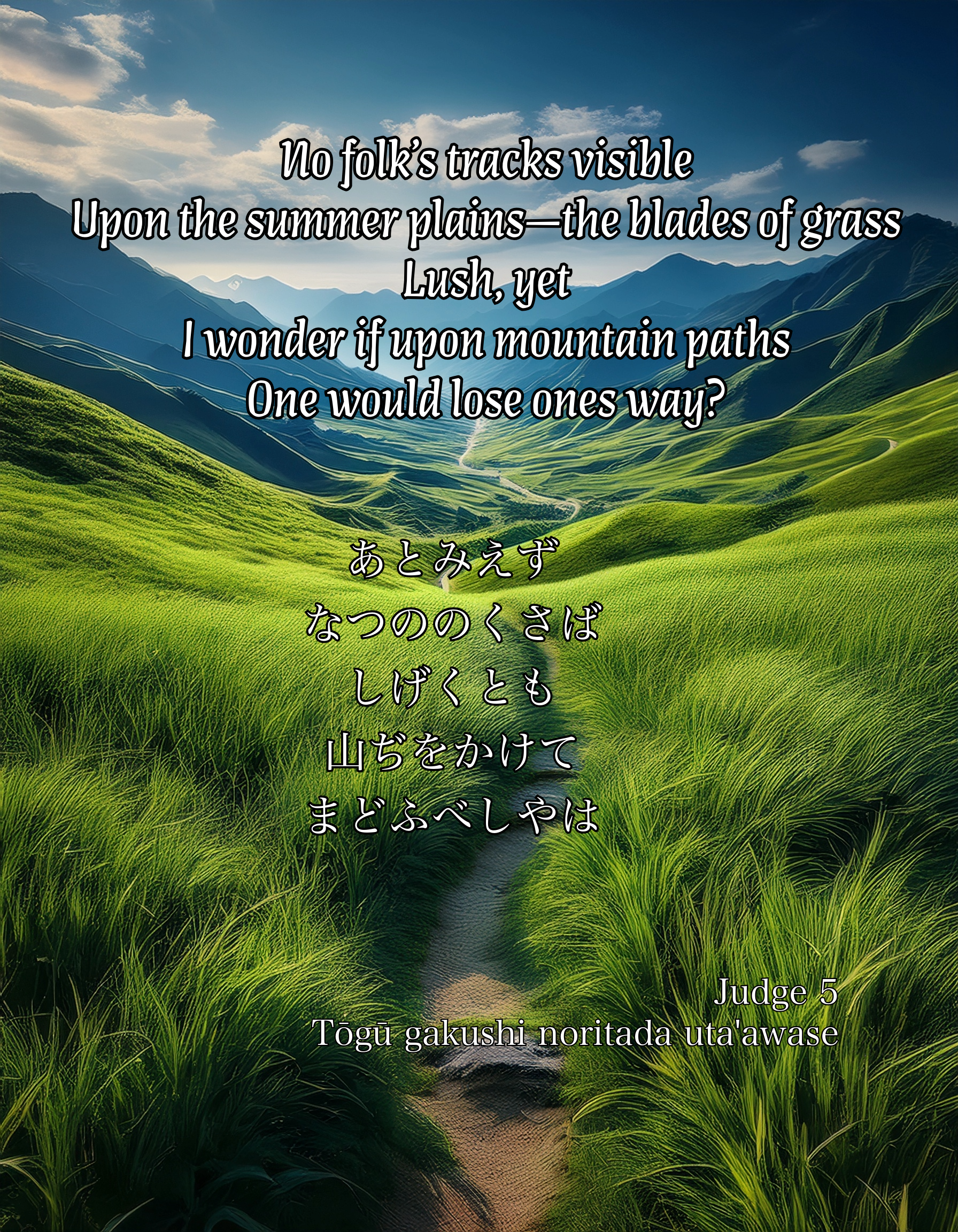
ato miezu natsuno no kusaba shigeku tomo yamaji o kakete madoubeshi ya wa
No folk’s tracks visible Upon the summer plains—the blades of grass Lush, yet I wonder if upon mountain paths One would lose ones way?
furu yuki ni yama no hosomichi uzumorete mare ni toikoshi hito mo kayowazu
With the falling snow The mountain’s narrow pathways Are buried; But rarely did he visit and now Cannot make his way at all.
Cell of Fragrant Cloud 53
Right
あしたつるみわのひばらにゆきふかみみやぎひくをのかよひぢもなし
ashi tatsuru miwa no hibara ni yuki fukami miyagi hiku o no kayoiji mo nashi
Reeds stand tall in Miwa, where the cypress groves Are deep with snow; To cut sacred timber, the woodsman Has no path to tread at all.
Cell of Compassionate Light 54
The Left’s poem, in terms of style and diction, entirely grasps the way someone might feel. What a sense of grief! The Right’s poem is composition that fairly drips and delves into playfulness, but in so doing lacks feeling. Truly, the former poem has superlative qualities, resembling a black dragon’s pearl![i] Thus, the Left must win.
The Left does seem to have been composed but simply stated. It possesses a calm elegance. The Right seems to have been created after a great deal of thought. This poem shows effort and the former such calm that I wish to declare them a tie. This may enrage the poets, but the ignorant may give the appearance of being knowledgeable, as they say. I wonder who composed these…
[i]Riju 驪珠 as an abbreviation of riryū no tama 驪龍の珠 (‘black dragon’s pearl’). Mototoshi uses this analogy deliberately as black dragons were associated with winter. The pearl, which they were often depicted as holding or being located in their throat, was a symbol of the dragon’s spiritual development and a marker of its immortality. This is thus an effusive statement of praise for Shōchō’s poem.
obotsukana izure izuchi no michi naramu shiori mo miezu fureru shirayuki
How strange! Which is which Path, I wonder? Even the laden branches go unseen In the falling snow, so white.
Retired from the World 47
Right
雪ふかみとなりのさともうづもれてけぶりのみこそしるしなりけれ
yuki fukami tonari no sato mo uzumorete keburi nomi koso shirushi narikere
So deep the snow, that The estate next door Is buried; Trails of smoke are the only Sign it’s there!
Senior Assistant Minister Past Lecturer
48
The poem of the Left’s ‘even the laden branches go unseen’ and what follows is both poetic and a familiar usage. As for the Right’s poem, how can ‘the estate next door be buried’ unless it’s the only place that snow is falling and nowhere else? Thus, I feel that the snow falling to conceal the broken branches has more feeling to it.
The Left’s ‘which path’ gives me the impression that there are many of them. This sense of multiplicity is something I can imagine—which is a good thing—and, I think, see me using myself. ‘Laden branches’ are something which occur on peaks deep in the mountains. It might be a bit remiss of me, but I wonder whether I can imagine snow drifting so high on a mountain peak?
As for the Right’s poem, we use ‘next door’ when there’s a fence of some sort between one estate and another, don’t we? As such, saying that the smoke is the sign is rather vague. Even if there’s been a quite extraordinary snowfall, there would be something other to notice as well as the smoke, so this is an error, isn’t it. It would be acceptable to refer to smoke if the estate were further away.
akigiri no taema ni miyuru momijiba ya tachinokoshitaru nishiki naruran
The autumn mists have Gaps revealing Scarlet leaves— Remaining offcuts of Brocade, perhaps?
Lord Tsunemori 75
Right
もみぢちる立田の山はえぞこえぬ錦をふまむ道をしらねば
momiji chiru tatsuta no yama wa e zo koenu nishiki o fumamu michi o shiraneba
Scattered with scarlet leaves Tatsuta Mountain I cannot cross, for To tread upon a brocade Path I know not how…
Lord Yorimasa 76
The Right is a poem on fallen leaves and blossom—something about which many people have composed in the recent past and modern times, too. The Left sounds as if it truly depicts things as they are. Its overall construction is lovely, too, so it should win.