Topic unknown.
鳴く声はたかまの山の時鳥とをちの里の人も聞くらん
| naku koe wa takama no yama no hototogisu tōchi no sato no hito mo kikuran | Calling, crying, On Takama Mountain A cuckoo On the estate of Tōchi Might even be heard. |
Dharma Master Shōchō
Round Twenty-One
Left (Win)
しがらきの外山の末の郭公たが里ちかき初音なるらん
| shigaraki no toyama no sue no hototogisu ta ga sato chikaki hatsune naruran | In Shigaraki At the foothills’ end A cuckoo By whose estate Might let out his first cry? |
Takasuke
41
Right
橘のにほひを空に尋ねきて山時鳥なかぬ日ぞなき
| tachibana no nioi o sora ni tazunekite yamahototogisu nakanu hi zo naki | Orange blossom’s familiar Scent within the skies I seek out, while The mountain cuckoo Fails to sing on not a single day… |
Shimotsuke
42
The Left poem’s ‘near whose estate does it first call’ does not sound bad. The Right’s poem, too, seems to have no faults to mention, yet the Left still wins by a hair.


Round Twenty
Left (Win)
あけぼのは涙やもろき時鳥なくねにおつる杜の下露
| akenbono wa namida ya moroki hototogisu naku ne ni otsuru mori no shitazuyu | With the dawn Are you swiftly to tears moved By the cuckoo’s Calling cries, falling from The forest drip dewdrops? |
Dōchin
39
Right
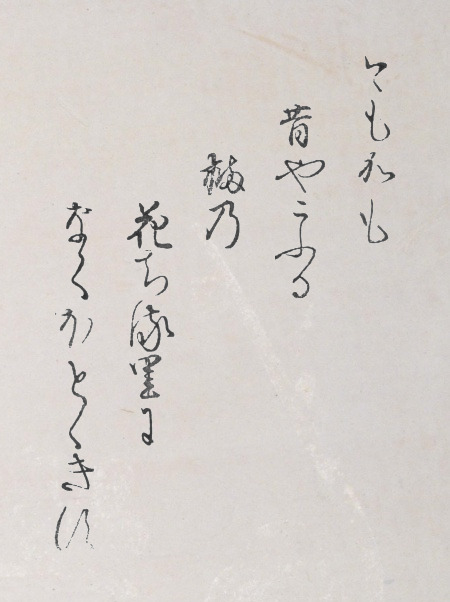
今もかも昔やこふる橘の花ちる里になく郭公
| ima mo kamo mukashi ya kouru tachibana no hana chiru sato ni naku hototogisu | I wonder, is she now, As in days gone by, beloved Where orange Blossom falls on the estate— The calling cuckoo?[1] |
Dharma Master Nyokan
40
Both Left and Right are of the same quality, yet I wonder about the sound of the Right poem’s final section, so the Left wins.


[1] An allusive variation on: A poem by the Governor-General of Dazai, Lord Ōtomo. 橘の花散る里の霍公鳥片恋しつつ鳴く日しぞ多き tachibana no / hana chiru sato no / hototogisu / kata koishitsutsu / naku hi shi zo ōki ‘Orange / Blossom scatters round my estate where / The cuckoo / For unrequited love / Does cry on many a day…’ Ōtomo no Tabito (MYS VIII: 1473)
Round Eighteen
Left (Tie)
神さぶるなげきの森の時鳥ひくしめなはもなくなくやこし
| kamu saburu nageki no mori no hototogisu hiku shimenawa mo nakunaku ya koshi | In divine Nageki’s sacred grove Does the cuckoo to Where the holy garlands Are hung not, come to sing?[1] |
The Former Minister of the Centre
35
Right
さとわかずなけや五月の郭公忍びし比は恨みやはせし
| sato wakazu nake ya satsuki no hototogisu shinobishi koro wa urami ya wa seshi | In every hamlet Sing, O, Fifth Month Cuckoo! For when you chirped before, I did not hate you for it… |
Kozaishō
36
The Left’s poem is based on ‘Prayers / Alone I seem to hear at / This shrine, indeed, but / In the end, passion to grief’s / Grove will turn, no doubt…’ and sounds pleasant. The Right’s poem says ‘For when you chirped before, / I did not hate you for it’ and has a graceful style—thus, they tie.


[1] An allusive variation on: Topic unknown. ねぎ事をさのみききけむやしろこそはてはなげきのもりとなるらめnegigoto o / sanomi kikikemu / yashiro koso / hate wa nageki no / mori to narurame ‘Prayers / Alone I seem to hear at / This shrine, indeed, but / In the end, passion to grief’s / Grove will turn, no doubt…’ Sanuki (KKS XIX: 1055)
Round Three
Left (T – Win)
時雨には色ならぬ身の袖笠もぬるればかをる物にぞ有りける
| shigure ni wa iro naranu mi no sodegasa mo nurureba kaoru mono ni zo arikeru | When, amidst a shower My colourless Umbrella of sleeves Is soaked, something scented Does it become! |
Lady Shōshō
5
Right (M – Win)
冬くれば散りしく庭のならの葉に時雨音なふみ山べのさと
| fuyu kureba chirishiku niwa no nara no ha ni shigure oto nau miyamabe no sato | When the winter comes Scattered and spread across the grounds Are oak leaves, Sounding among the showers On this deep mountain estate… |
Lord Masakane
6
Toshiyori states: the first poem has ‘my colourless’—does this mean that the garment the poet is wearing is white? Or that the speaker is lacking in passion? If the garment is white, then it’s difficult to say that it changes colours, while if one is lacking in passion, it’s also difficult to see the connection with an umbrella of sleeves being scented. In general, though, the poem’s style is lacking in fault. The second poem appears to have replicated all the faults of an earlier work. While one can certainly say ‘Oak leaves / Scattered and spread’, saying ‘Scattered and spread / Oak leaves’ gives one the feeling that something is out of sequence. This is a bit unreasonable, but because it’s difficult to avoid the faults of its earlier model, I still feel it should lose.
Mototoshi states: one really wants to know what sort of lack there is. The poem says ‘soaked, something scented’, but doesn’t reference an earlier work which, for example, mentions plum blossom. Still, I feel that ‘Sounding among the showers / On this deep mountain’ is conspicuously good.


□□さとにをしみぞとむるきくのはな霜にうつろふいろをみむとか
| …sato ni oshimi zo tomuru kiku no hana shimo ni utsurou iro o mimu to ka | Around my … estate Regrets linger for The chrysanthemum blooms, Fading beneath the frost Would I see their hues, I wonder? |
Masau[1]
19
ももしきにうつろふいろははつしものおきてかひあるこよひなりけり
| momoshiki ni utsurou iro wa hatsushimo no okite kai aru koyoi narikeri | Within the hundred-fold palace Fading hues with First frost’s Fall have some significance Tonight. |
Nakatsura[2]
20


[1] Possibly Taira no Masau 平將文
[2] Possibly Minamoto no Nakatsura 源仲連


