sayo fukete nezamezariseba hototogisu hitozute ni koso kikubekarikere
When brief night broke, and I failed to awaken to The cuckoo, Via a message, indeed, Was I able to hear it!
Tadami 27
Right
人ならばまててふべきをほととぎすふたこゑとだにきかですぎぬる
hito naraba mate chōbeki o hototogisu futa koe to dani kikade suginuru
Were you a man, ‘Wait!’ is what I’d tell you, O, cuckoo! For without even a second call For me to hear have you passed by.
Motozane 28
The Left’s poem, where the poet seems to awaken without a thought of hearing the cuckoo, is certainly somewhat odd. Nevertheless, the poem overall is charming. As for the Right’s poem, well, what is the poet trying to say by asking the cuckoo to wait when he will hear its first call, if it were a man? Is the conception, perhaps, for the cuckoo to wait a while? There’s not enough diction for the conception here, I feel. Both of these are about the same standard, so I make this a tie.
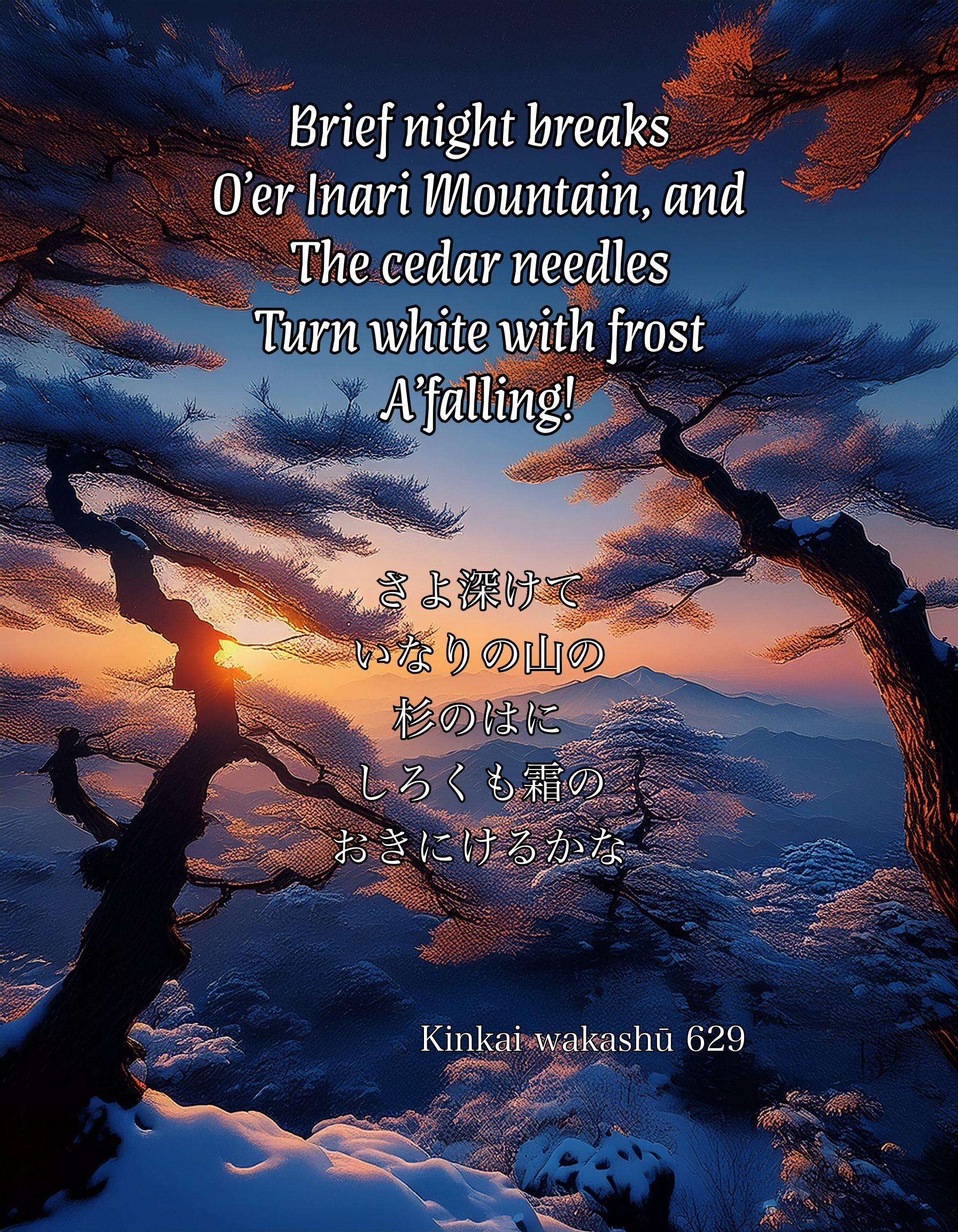
sayo fukete inari no yama no sugi no ha ni shiroku mo shimo no okinikeru kana
Brief night breaks O’er Inari Mountain, and The cedar needles Turn white with frost A’falling![i]
629
[i] See: Drinking vessels [mizunomi]. いなり山しるしのすぎの年ふりてみつのみやしろ神さびにけり inariyama / shirushi no sugi no / toshi furite / mitsu no miyashiro / kamisabinikeri ‘Mount Inari’s / Symbolic cedars / Carry years’ weight: / The three sacred shrines / Are venerable, indeed!’ Bishop Yūkei (Senzaishū XVIII: 1178); and: On warblers on the road to the barrier, while at the Poetry Office. 鶯のなけどもいまだふる雪に杉の葉しろき逢坂の山 uguisu no / nakedomo imada / furu yuki ni / sugi no ha shiroki / ausaka no yama ‘The warbler / Has sung, yet still / Falling snow / Turns white the cedar needles / On the mount of Meeting Hill.’ The Senior Retired Emperor (Shinkokinshū I: 18)
hototogisu hanatachibana ni yadoru to mo nanorazariseba ikade shiramashi
The cuckoo Among the orange blossom May make his lodging, but If he fails to announce himself How would one ever know?
Controller’s Graduate 23
Right
さよなかにみふねの山のほととぎすほのかになきてすぎぬなるかな
sayo naka ni mifune no yama no hototogisu honoka ni nakite suginu naru kana
In the midst of a night so brief Upon Mifune Mountain, A cuckoo, Faintly crying, Has passed his time!
Kerin’in Graduate 24
It is entirely impossible to decide between these two poems.
Neither of these poems is particularly bad. The Left flows smoothly and is elegant; the Right starts with ‘Mifune Mountain’ and then continues with ‘faintly’, which certainly does not lack skill. Thus, I would say that these should tie, although this will doubtless be a source of some dissatisfaction to the writer of the Right.