Tag Archives: showers

Nishinomiya uta’awase 04

Round Four

Left

いとどしく照りこそまされもみぢばに日影うつろふ天のかご山

itodoshiku
teri koso masare
momijiba ni
hikage utsurou
ama no kagoyama
All the more
Brightly do shine
The scarlet leaves
Reflecting the sunshine
On heavenly Mount Kago!

Minor Captain Lord Kin’nori, Fourth Rank
7

Right

天の原時雨にくもるけふしもぞ紅葉の色はてりまさりける

ama no hara
shigure ni kumoru
kyō shimo zo
momiji no iro wa
terimasarikeru
The plain of heaven is
Clouded with showers, but
Today for certain
The hues of the scarlet leaves
Shine most bright.

The Daughter of His Excellency, the Head
8

Considering the Left’s ‘Reflecting the sunshine / On heavenly Mount Kago’ about scarlet leaves reflecting the sun’s light, gives me the feeling that this must be a mistaken reference to the garlands of scarlet clubmoss worn by minor officiants at the Great Thanksgiving Service. In addition, among all of the many mountains in various places whose leaves turn scarlet, it seems something of a stretch to go so far as to mention Heavenly Mount Kago, considering it is an archaic expression found in the Collection of a Myriad Leaves, among other places. The Right’s ‘Clouded with showers, but / Today for certain’ is an expression perfectly in tune with the topic, making one wonder whether the leaves’ hue is the result of single drenching which has dyed them superbly.

Fubokushō VIII: 3062

From the poetry match at Tsurayuki’s house in the Second Month, Tengyō 2 – Love in the midst of summer.

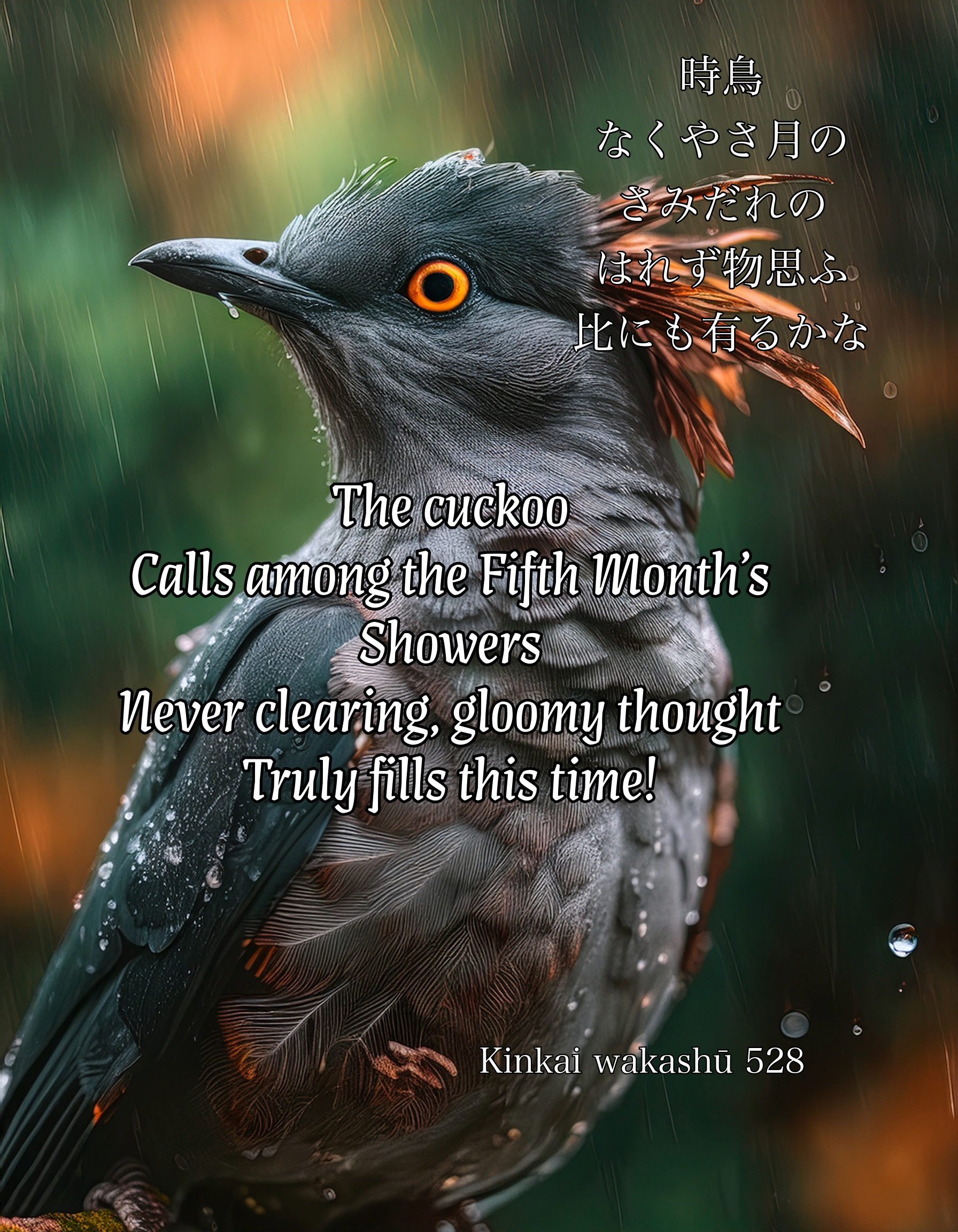
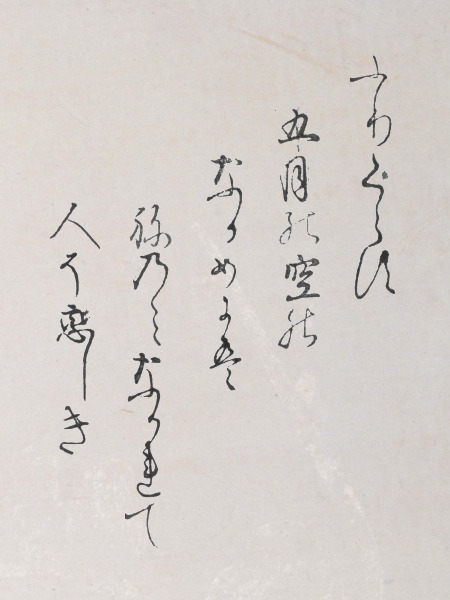
ふりくらす五月の空のながめにはねのみなかれて人ぞ恋しき

furikurasu
satsuki no sora no
nagame ni wa
ne nomi nakarete
hito zo koishiki
Dark with showers
The Fifth Month’s skies
Endlessly do fill my gaze,
Doing nothing but weep
For I love her so!

Anonymous

Naidaijin-ke uta’awase 08

Round Eight

Left (Both Judges – Tie)

神無月三室の山の紅葉ばも色に出でぬべく降るしぐれかな

kaminazuki
mimuro no yama no
momijaba mo
iro ni idenubeku
furu shigure kana
In the Godless Month
On Mount Mimuro
The autumn leaves
Show no hues at all, despite
The falling showers!

Lord Morikata
15

Right

かみな月時雨れてわたるたびごとに生田の杜をおもひこそやれ

kaminazuki
shigurete wataru
tabi goto ni
ikuta no mori o
omoi koso yare
In the Godless Month
Showers pass by and
Every time
The sacred grove at Ikuta
I do recall.

Lord Tadataka
16

Toshiyori states: ‘Godless Month’ is the name given to a specific month of the year. It’s somewhat unclear why one would use ‘Godless Month’ in conjunction with ‘Mount Mimuro’ – is there a prior poem to evidence this? It’s quite normal for lines which would normally have five syllables to be written with six, or those with seven to have eight, and this can sound fine in some cases. Here, though, it does sound obviously excessive and I do wonder about that. The second poem is plainly based on an earlier work, and is not at all clear, but as it has precedent, these two are about the same.

Mototoshi states: neither of these poems appears bad, so I say they tie.

Naidaijin-ke uta’awase 03

Round Three

Left (T – Win)

時雨には色ならぬ身の袖笠もぬるればかをる物にぞ有りける

shigure ni wa
iro naranu mi no
sodegasa mo
nurureba kaoru
mono ni zo arikeru
When, amidst a shower
My colourless
Umbrella of sleeves
Is soaked, something scented
Does it become!

Lady Shōshō
5

Right (M – Win)

冬くれば散りしく庭のならの葉に時雨音なふみ山べのさと

fuyu kureba
chirishiku niwa no
nara no ha ni
shigure oto nau
miyamabe no sato
When the winter comes
Scattered and spread across the grounds
Are oak leaves,
Sounding among the showers
On this deep mountain estate…

Lord Masakane
6

Toshiyori states: the first poem has ‘my colourless’—does this mean that the garment the poet is wearing is white? Or that the speaker is lacking in passion? If the garment is white, then it’s difficult to say that it changes colours, while if one is lacking in passion, it’s also difficult to see the connection with an umbrella of sleeves being scented. In general, though, the poem’s style is lacking in fault. The second poem appears to have replicated all the faults of an earlier work. While one can certainly say ‘Oak leaves / Scattered and spread’, saying ‘Scattered and spread / Oak leaves’ gives one the feeling that something is out of sequence. This is a bit unreasonable, but because it’s difficult to avoid the faults of its earlier model, I still feel it should lose.

Mototoshi states: one really wants to know what sort of lack there is. The poem says ‘soaked, something scented’, but doesn’t reference an earlier work which, for example, mentions plum blossom. Still, I feel that ‘Sounding among the showers / On this deep mountain’ is conspicuously good.

Sumiyoshi-sha uta’awase kaō ni-nen 41

Round Sixteen

Left

くさまくらたびねさびしきやまかげにこのはさそひてしぐれふるなり

kusamakura
tabine sabishiki
yamakage ni
ko no ha sasoite
shigure furunari
On a grassy pillow,
Dozing on my travels, lonely
In a mountain’s shade,
The rustling of the leaves invites
A shower to fall.

Hyōenosuke
81

Right (Win)

すみのえのまつがはひねをまくらにてなみうちそふるしぐれをぞきく

suminoe no
matsu ga haine o
makura nite
nami uchisouru
shigure o zo kiku
At Suminoe
Upon the crawling pine roots
Have I made my pillow, while
Laced with the breaking waves
I listen to the showers.

Lord Naganori
82

The Left’s configuration of ‘the rustling of the leaves invites’, while dozing on one’s journey in the shadow of a mountain, sounds pleasant. While I do wonder about the Right’s diction—concluding with ‘listen to the showers’—in addition to ‘laced with the breaking waves’ sounding pleasant, it also adds the conception of waves beneath ‘the pines of Suminoe’, doesn’t it. I make the Right the winner.

Sumiyoshi-sha uta’awase kaō ni-nen 36

Round Eleven

Left (Win)

かりのいほはそそくしぐれもとまらねばつゆわけごろもほしぞかねつる

kari no io wa
sosoku shigure mo
tomaraneba
tsuyuwakegoromo
hoshi zo kanetsuru
Upon my crude hut,
Dripping, the showers, too,
Never cease, so
My dew-soaked garb
To dry is impossible!

Kyō
71

Right

さらぬだにたびねのとこはつゆけきにいかにせよとてうちしぐるらむ

saranu dani
tabine no toko wa
tsuyukeki ni
ika ni seyo tote
uchishigururamu
Even ‘twere not to be,
My journey-bed is
Drenched with dew, so
What am I to do,
Beneath these falling showers?

Suehiro
72

The Left has ‘dripping, the showers, too’, while the Right has ‘what am I to do’ and so forth—while neither of these is poor in terms of conception and diction, the initial section of the Right sounds extremely commonplace, thus the Left’s conception of agonizing over the being unable to dry dew-soaked garb is slightly superior in the current context.

Sumiyoshi-sha uta’awase kaō ni-nen 34

Round Nine

Left (Win)

うらさむくしぐるるよはのたびごろもきしのはにふにいたくにほひぬ

ura samuku
shigururu yowa no
tabigoromo
kishi no hanyū ni
itaku nioinu
The bay is cold with
Midnight showers, as
My traveller’s robe
With the shore’s ochre clay
Is deeply stained.

Taifu
67

Right

おもへただみやこのうちのねざめだにしぐるるそらはあはれならずや

omoe tada
miyako no uchi no
nezame dani
shigururu sora wa
aware narazu ya
Simply think of me, when
Within the capital
You start from sleep—
A showery sky is
Sad, isn’t it?

Sadanaga
68

While configuration of the Left’s poem, saying ‘With the shore’s ochre clay / Is deeply stained’ feels crude, it does appear to be in the style of the Myriad Leaves. As for the Right’s poem, its conception is good, but starting, ‘Simply think of me’ begs the question of who this is said to. Such diction is used in poetry exchanges or love poems, in particular. The Left’s poem is most likely superior.