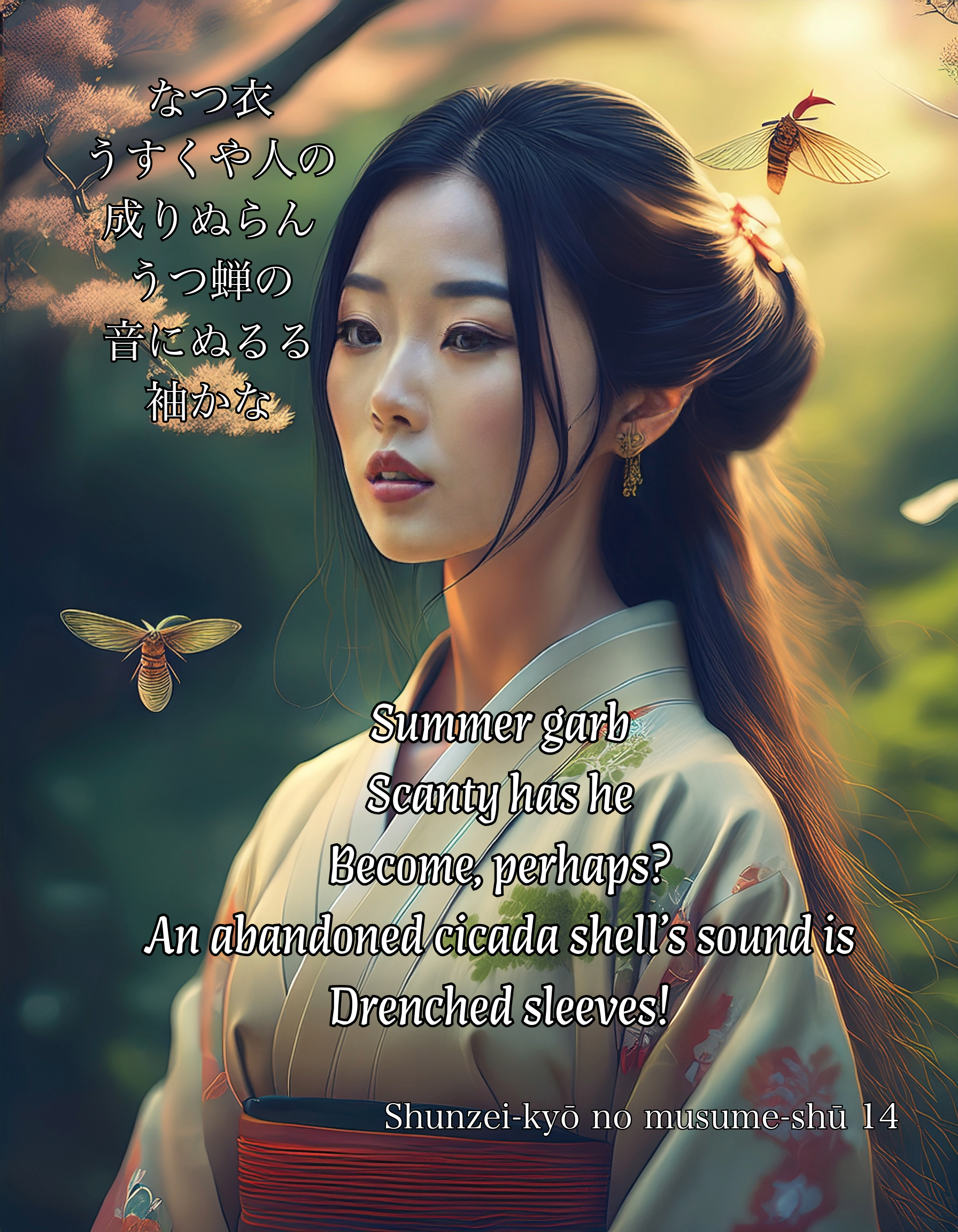
natsugoromo usuku ya hito no narinuran utsusemi no oto ni nururu sode kana
Summer garb Scanty has he Become, perhaps? An abandoned cicada shell’s sound is Drenched sleeves![i]
14
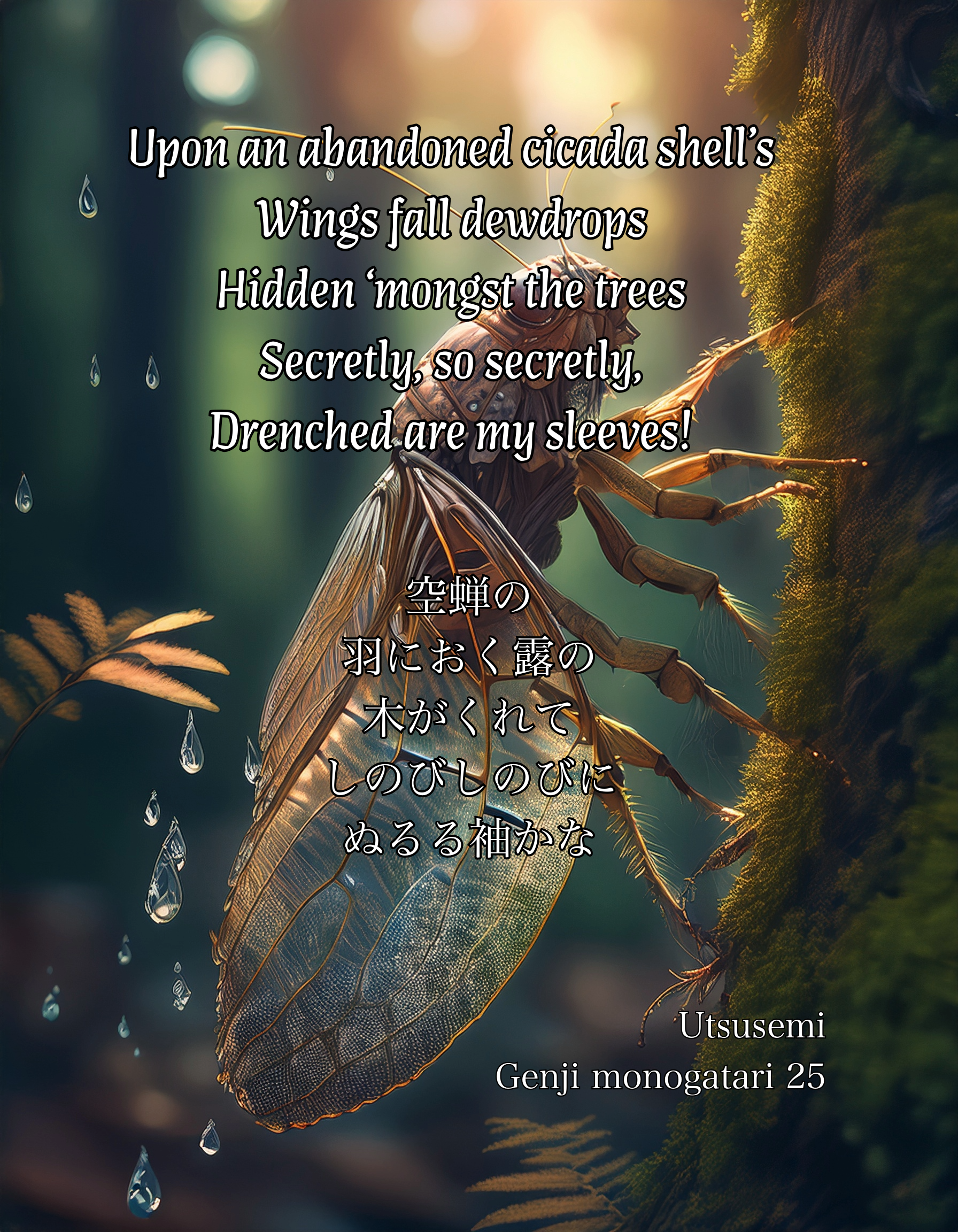
[i] See: 空蝉の羽におく露の木がくれてしのびしのびにぬるる袖かな utsusemi no / ha ni oku tsuyu no / kogakurete / shinobishinobi ni / nururu sode kana ‘Upon an abandoned cicada shell’s / Wings fall dewdrops / Hidden ‘mongst the trees / Secretly, so secretly, / Drenched are my sleeves!’ Utsusemi (Genji monogatari 25)
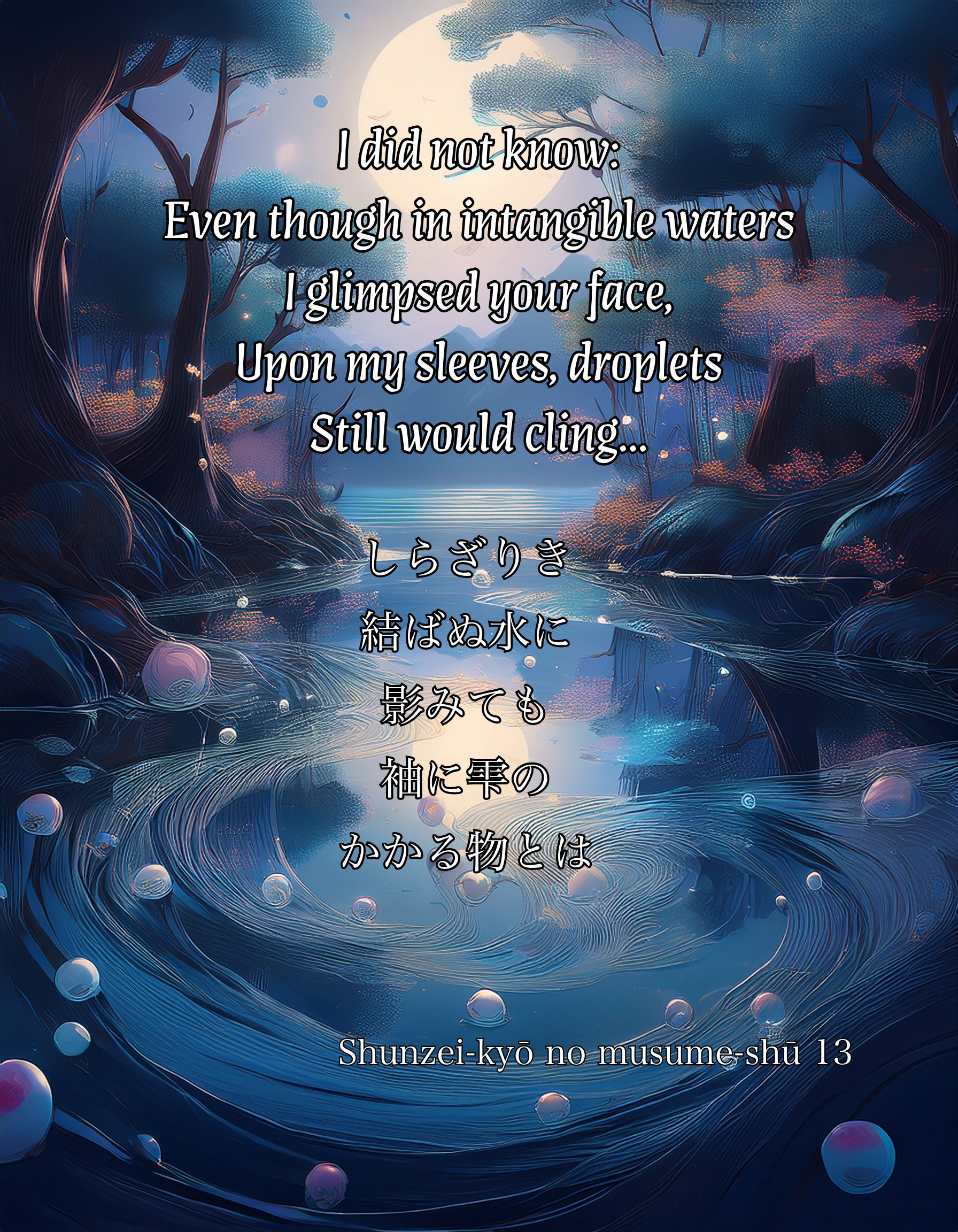
shirazariki musubanu mizu ni kage mitemo sode ni shizuku no kakaru mono to wa
I did not know: Even though in intangible waters I glimpsed your face, Upon my sleeves, droplets Still would cling…[i]
13
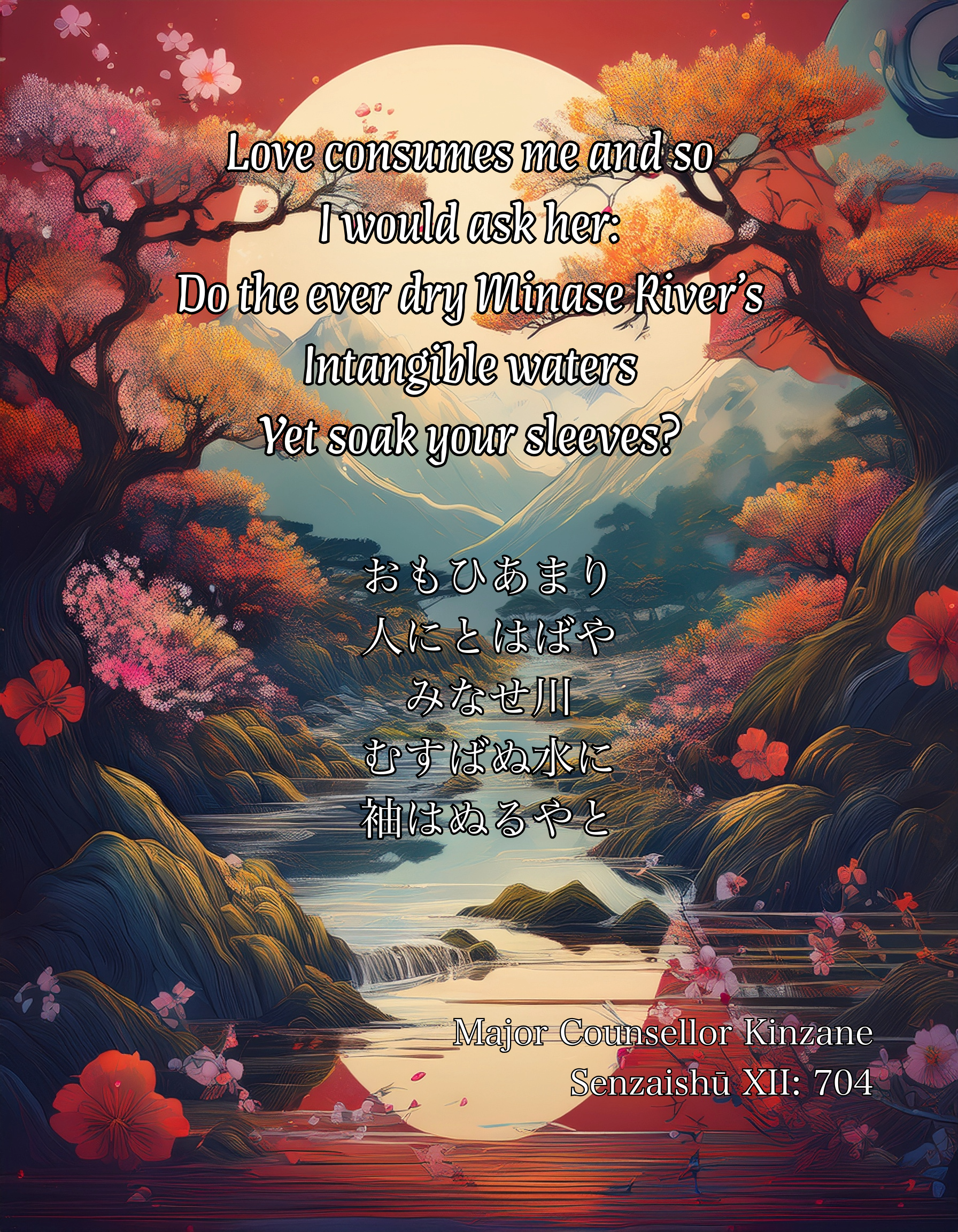
[i] An allusive variation on: Composed on the conception of love, when hundred poem sequences were presented during the reign of former Emperor Horikawa. おもひあまり人にとはばやみなせ川むすばぬ水に袖はぬるやと omoi’amari / hito ni towaba ya / minasegawa / musubanu mizu ni / sode wa nuru ya to ‘Love consumes me and so / I would ask her: / Do the ever dry Minase River’s / Intangible waters / Yet soak your sleeves?’ Major Counsellor Kinzane (Senzaishū XII: 704)
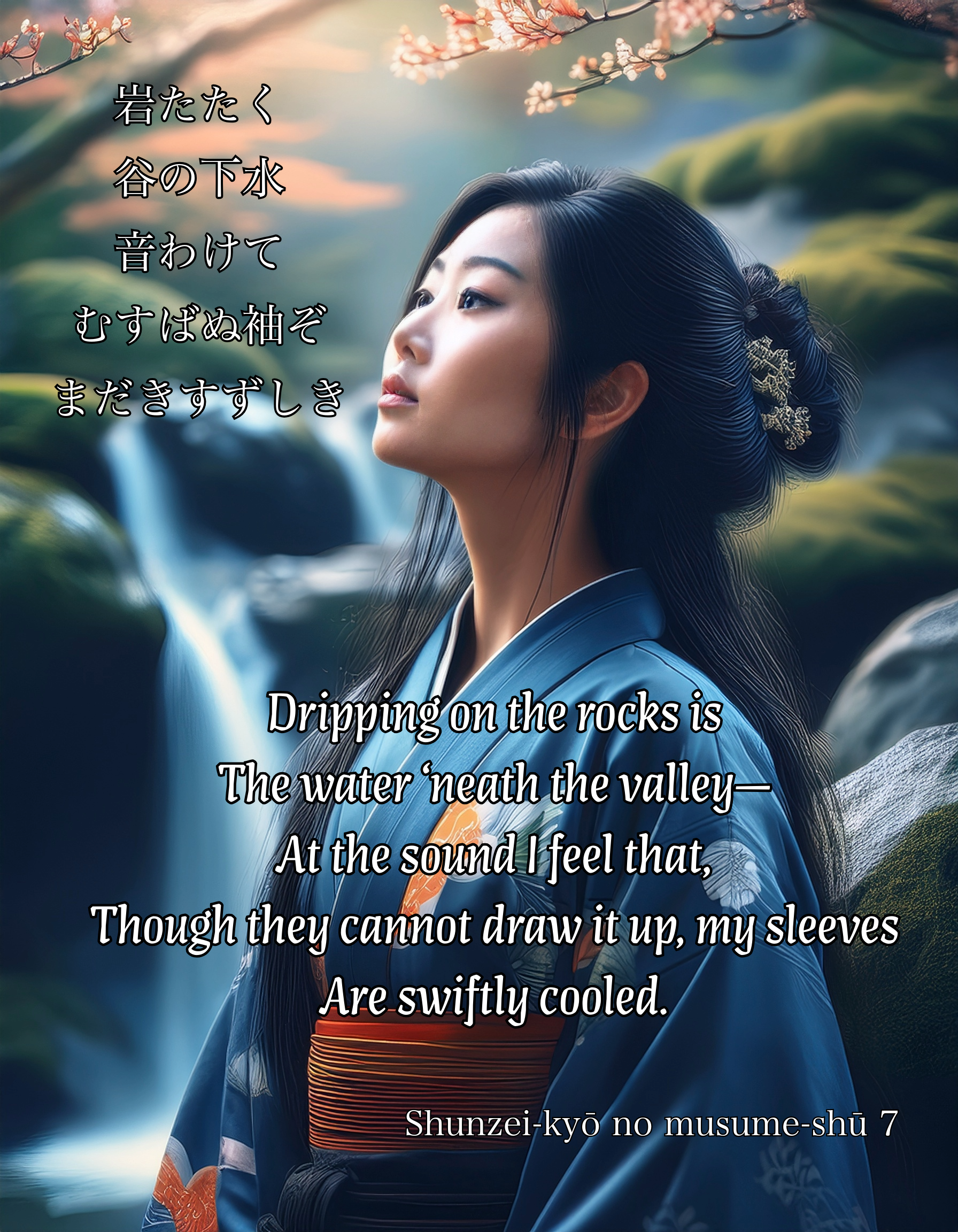
iwa tataku tani no shitamizu oto wakete musubanu sode zo madaki suzushiki
Dripping on the rocks is The water ‘neath the valley— At the sound I feel that, Though they cannot draw it up, my sleeves Are swiftly cooled.[i]
7
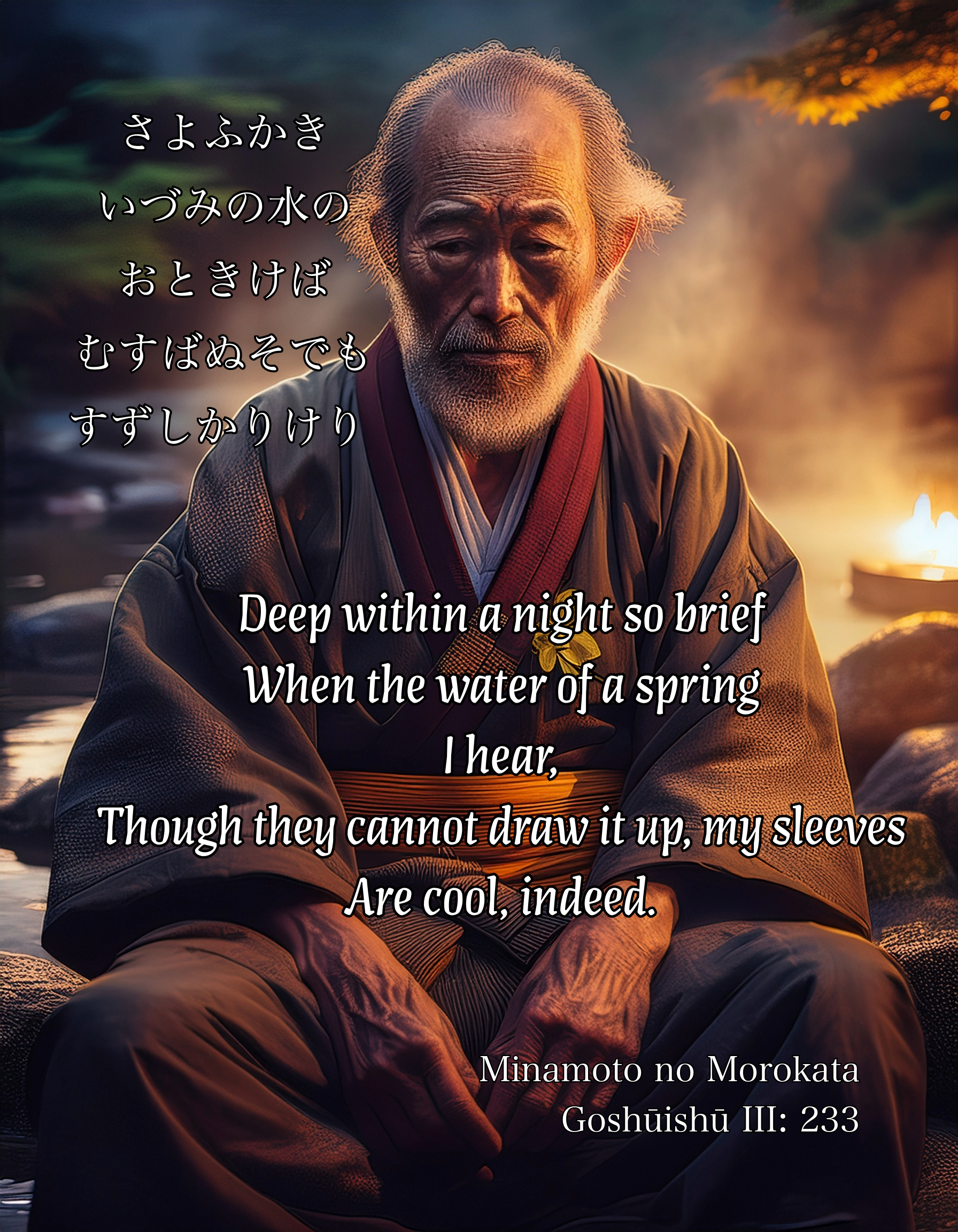
[i] See, for example: Composed when he presented a hundred poem sequence during the reign of former Emperor Horikawa. みむろ山たににや春のたちぬらむ雪のした水いはたたくなり mimuro no yama / tani ni ya haru no / tachinuramu / yuki no shitamizu / iwa tataku nari ‘Upon Mount Mimuro, / In the valleys, I wonder, has spring / Arisen? / For waters ‘neath the snow / Are dripping on the rocks…’ Middle Counsellor Kuninobu (Senzaishū I: 2); Composed on the conception of enjoying the cool of the evening, when Minister of Justice Yorisuke held a poetry match. いはたたく谷の水のみおとづれて夏にしられぬみ山べのさと iwa tataku / tani no mizu nomi / otozurete / natsu ni shirarenu / miyamabe no sato ‘Dripping on the rocks / The valley’s waters, alone, / Pay me a call, / All ignorant of summer / At my deep mountain retreat…’ Former Consultant Norinaga (Senzaishū III: 221); and: Composed on the conception of it being chilly bathing in a spring at night. さよふかきいづみの水のおときけばむすばぬそでもすずしかりけり sayo fukaki / izumi no mizu no / oto kikeba / musubanu sode mo / suzushikarikeri ‘Deep within a night so brief / When the water of a spring / I hear, / Though they cannot draw it up, my sleeves / Are cool, indeed.’ Minamoto no Morokata (Goshūishū III: 233)
From among the poems for the Fifteenth Night[i] (when I was thirty-four[ii]) and had heard that His Late Lordship[iii] was holding an entertainment.[iv]
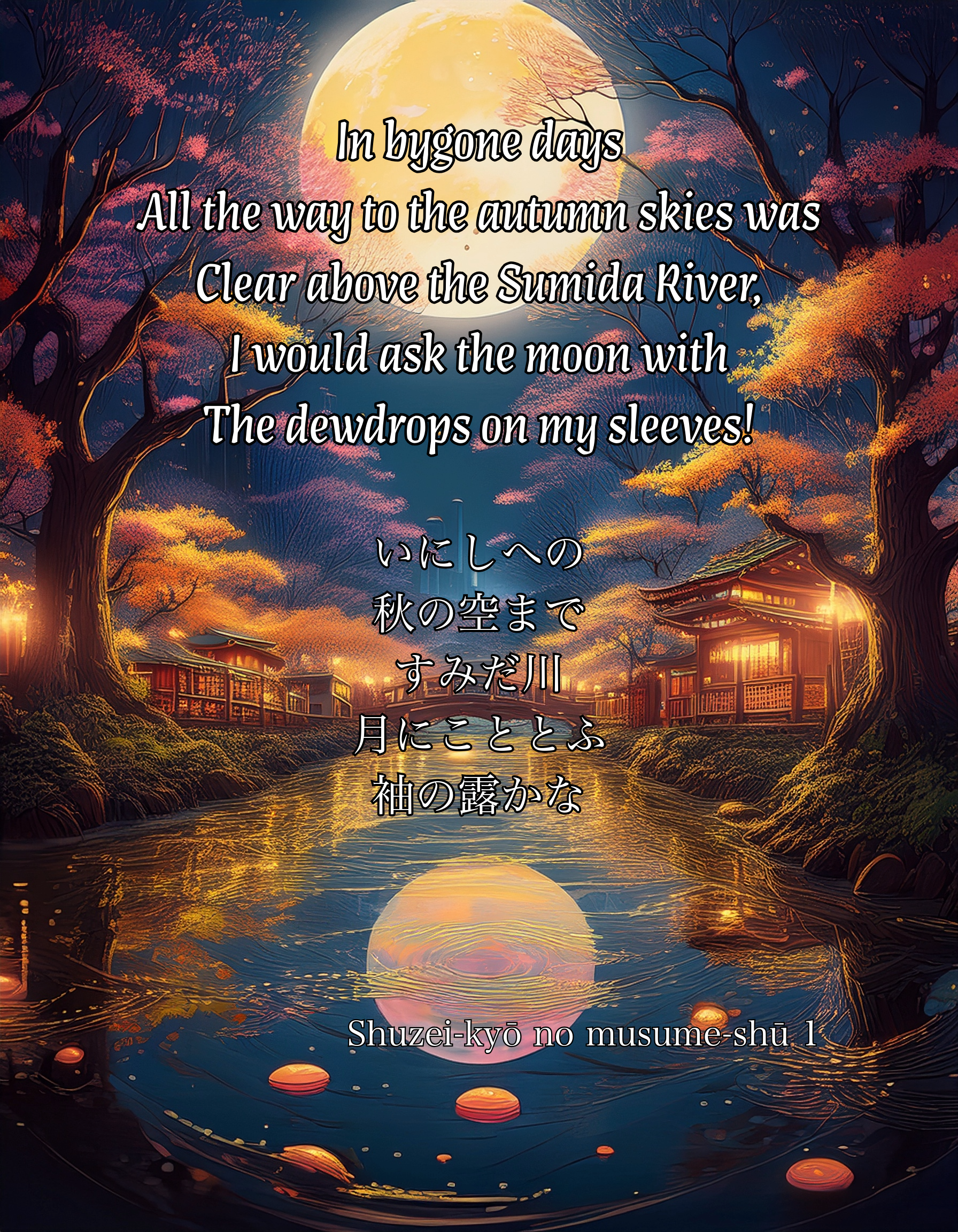
いにしへの秋の空まですみだ川月にこととふ袖の露かな
inishie no aki no sora made sumidagawa tsuki ni koto tou sode no tsuyu kana
In bygone days All the way to the autumn skies was Clear above the Sumida River, I would ask the moon with The dewdrops on my sleeves![v]
[i]Jūgoya 十五夜: typically this referred to the night of the 15th day of the Eighth Month, when the moon was believed to be at its fullest and most beautiful.
[ii] The Japanese text in the original is ambiguous here and this is only one of several interpretations which have been offered for it. The most likely other one is that this is a simple miscopying of an entirely different phrase ‘when I presented three poems’.
[iii] A reference to Fujiwara (Kujō) no Yoshitsune 藤原(九条)良経 (1169-1206).
[v] An allusive variation on: When they arrived at the banks of the Sumida River, between the provinces of Musashi and Shimotsūsa, they thought fondly of the capital and, dismounting for a while on the river bank, they thought sadly about how far they had come. While they were gazing into space, the ferryman said, “Get on the boat quickly! The sun is going down.” So, they boarded and were about to set off, each one thinking miserably about someone he had left in the capital, when they saw a white bird with a red bill and legs splashing about in the river shallows. As it was a bird never seen in the capital, none of them could say what it was, so they asked the ferryman, and he replied that it was a miyakodori (capital bird); hearing this, Narihira composed the following: 名にしおはばいざ事とはむ宮こどりわが思ふ人はありやなしやと na ni shi owaba / iza koto towamu / miyakodori / wa ga omou hito wa / ari ya nashi ya to ‘If your name fits you, / There’s something I would ask, / O, Capital bird: / Is the lady in my thoughts / Still quite safe?’ Ariwara no Narihira (Kokinshū IX: 411)