夏之月 光不惜 照時者 流水丹 遊糸曾立
なつのつき ひかりをしまで てるときは ながるるみづに かげろふぞたつ
| natsu no tsuki hikari oshimade teru toki wa nagaruru mizu ni kagerō zo tatsu | The summer moon Light I’ll not regret, For when it shines From the flowing waters Rises heat haze! |
Composed on the conception of enjoying the cool of the evening, when Minister of Justice Yorisuke held a poetry match.
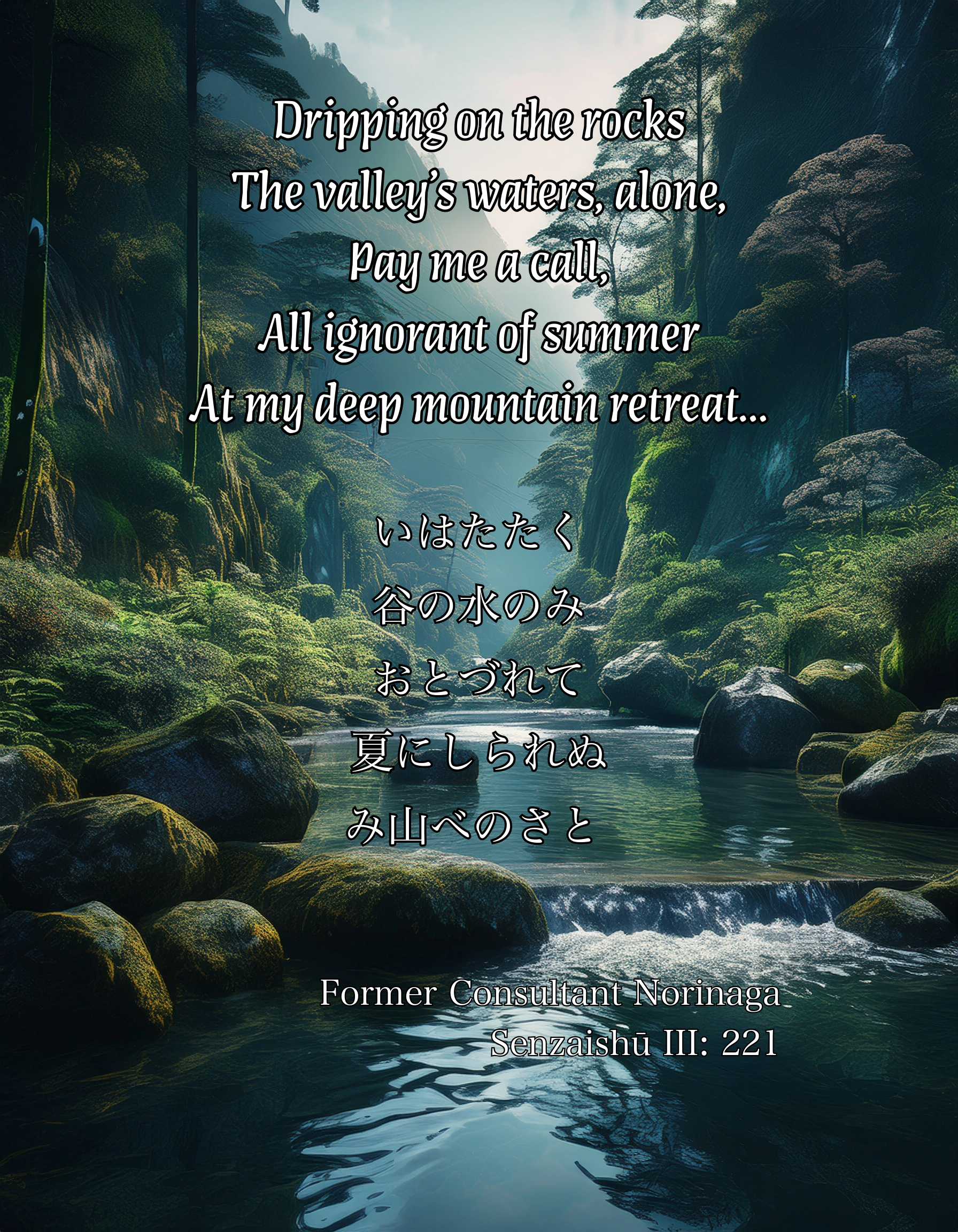
いはたたく谷の水のみおとづれて夏にしられぬみ山べのさと
| iFa tataku tani no midu nomi otodurete natu ni sirarenu yamabe no sato | Dripping on the rocks The valley’s waters, alone, Pay me a call, All ignorant of summer At my deep mountain retreat… |
Former Consultant Norinaga
This is a poem which was written on a poetry slip and attached to the diorama when it was presented to the young prince,[i] on the day following the match.
なでしこのはなさきそむる夏の野にけふひぐらしのこゑかきこゆる
| nadeshiko no hana sakisomuru natsu no no ni kyō higurashi no koe ka kikoyuru | The pinks In bloom have begun to be On the summer plains From today the sunset crickets’ Cries do I hear? |
7[ii]
In reply from His Highness, the prince.[iii]
ひぐらしのなくもことわりなでしこのかひあるなつの野べとみゆれば
| higurashi no naku mo kotowari nadeshiko no kai aru natsu no nobe to miyureba | That the sunset crickets Should cry makes sense, for The pinks bring A point to the summer Meadows, or so it seems to me… |
8
A further reply from within the Hall of Cool Purity.
みやぎのにけふさきそむるなでしこはならはぬいろに人やみるらむ
| miyagino ni kyō sakisomuru nadeshiko wa narawanu iro ni hito ya miruramu | On Miyagi Plain Today has begun to bloom A pink— Its extraordinary hue I wonder, will folk see? |
9[iv]


[i] A reference to Imperial Prince Norihira 憲平, the future Emperor Reizei 冷泉 (950-1011; r. 967-969).
[ii] Anonymous (Fubokushō IX: 3461); (Nakatsukasa-shū 120)
[iii] Given that Norihira would have been only six years old when this match was held, it is most likely that this reply was penned in his stead by his mother, Fujiwara no Yasuko (Anshi) 藤原安子 (927-964).
[iv] This poem is included in Fubokushō (IX: 3469) attributed to the ‘Seiryōden Junior Consort’ (Seiryōden nyōgo 清涼殿女御), with the headnote ‘Poetry Match held by Junior Consort Yoshiko (Hōshi) in the Fifth Month, Tenryaku 10’. It is now generally believed that the Fubokushō attribution is erroneous, and this was, instead, composed by Emperor Murakami.
Dark shade beneath the mountain trees[i]
Left
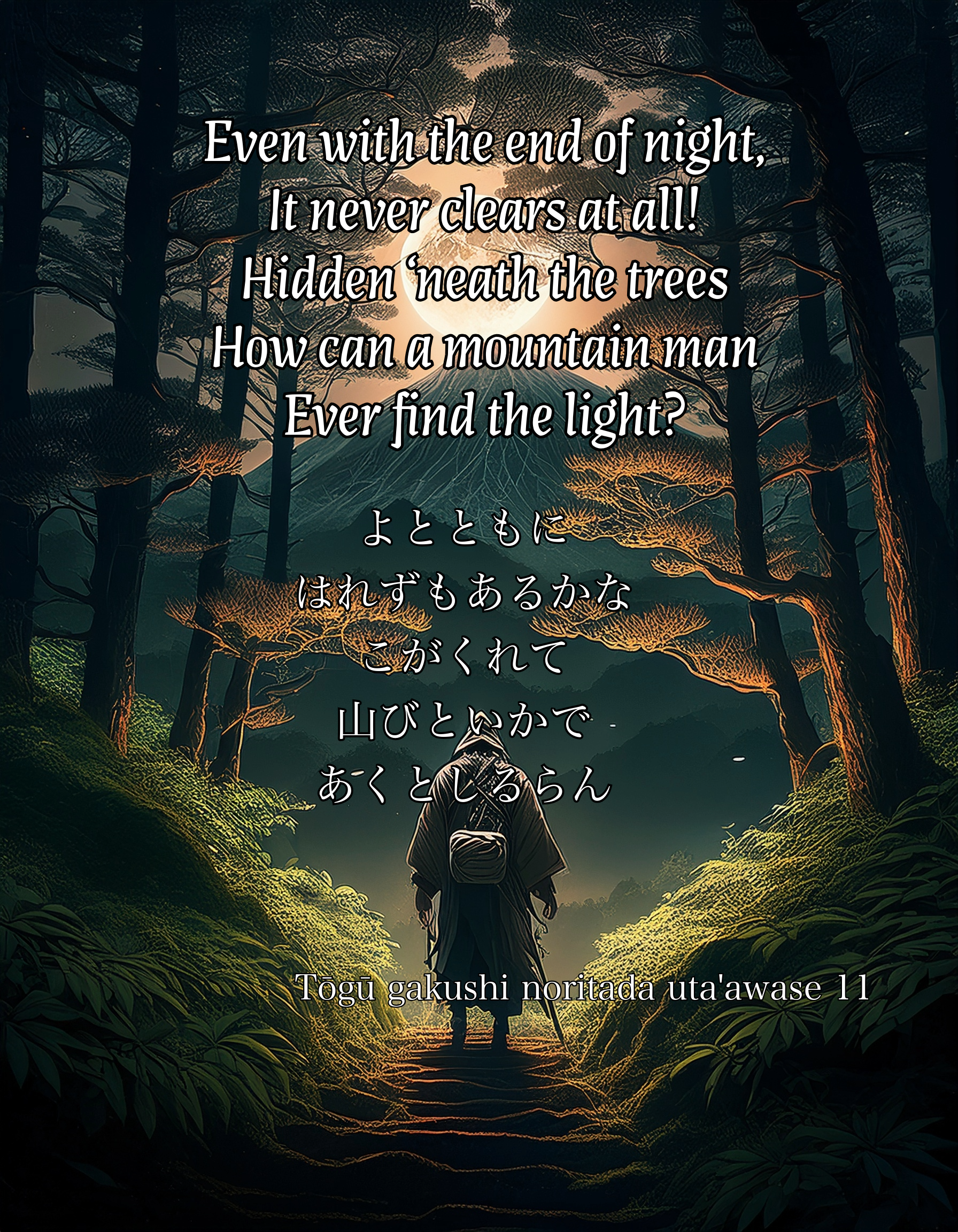
よとともにはれずもあるかなこがくれて山びといかであくとしるらん
| yo to tomo ni harezu mo aru kana kogakurete yamabito ikade aku to shiruran | Even with the end of night, It never clears at all! Hidden ‘neath the trees How can a mountain man Ever find the light? |
11
Right
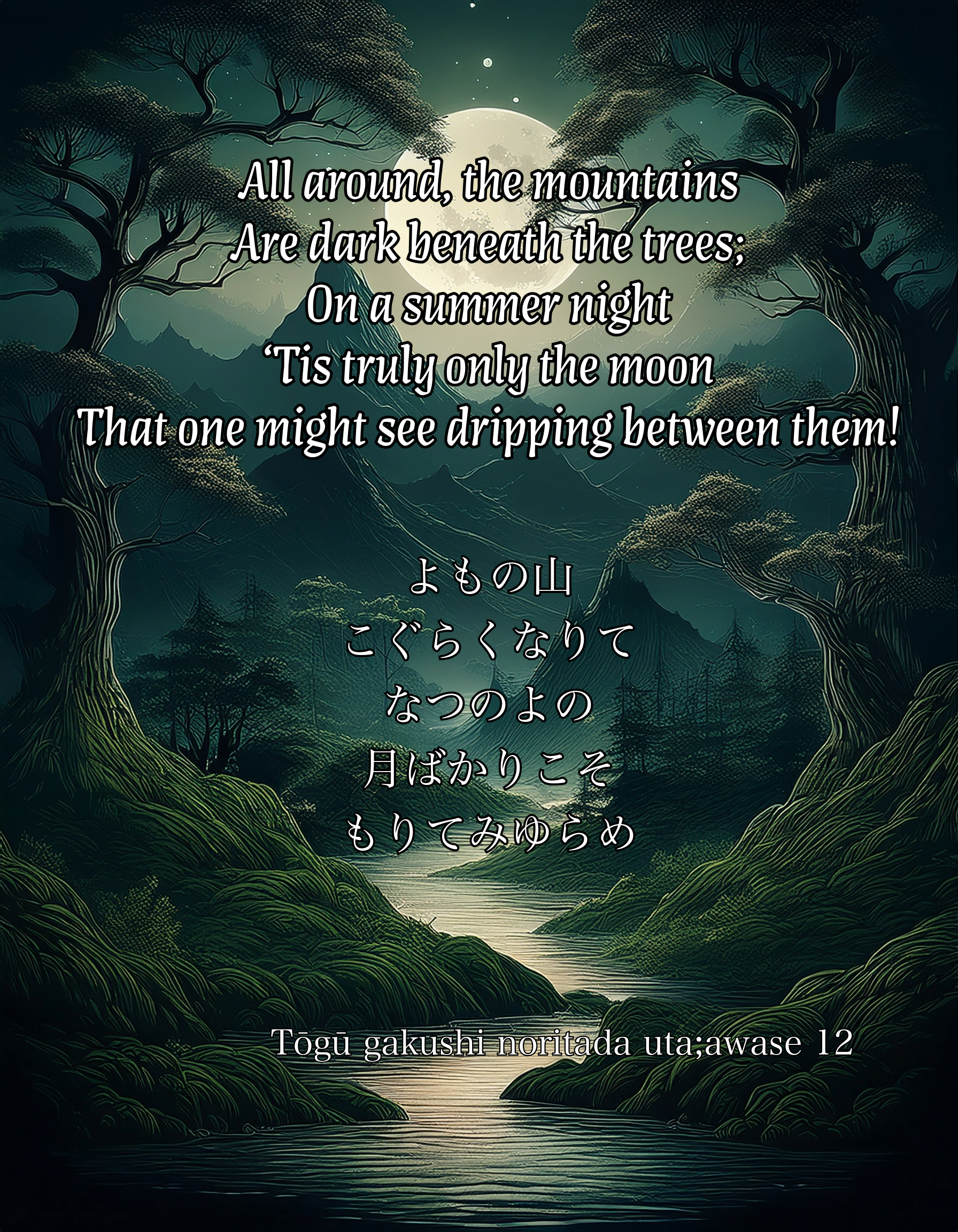
よもの山こぐらくなりてなつのよの月ばかりこそもりてみゆらめ
| yomo no yama koguraku narite natsu no yo no tsuki bakari koso morite miyurame | All around, the mountains Are dark beneath the trees; On a summer night ‘Tis truly only the moon That one might see dripping between them! |
12
This topic refers to a hunted stag concealed among the trees in the summer mountains. There is not a particular strong feeling of either evergreen or other types of mountain forests,[ii] but the Left’s poem has ‘Even with the end of night’, forgetting that this implies a season of biting wind and showers striking the leaves on the trees—thus the darkness here is excessively conceived. While the Right takes ‘dark shade’ as an opportunity to compose with the elevated conception of the moon dripping between the trees—and surpasses the peaks in doing this—I wonder if the conceptions of both poems don’t contain brightness? Thus, both Left and Right are examples of the ‘Reizei Palace’,[iii] so I would decide on a tie for these.
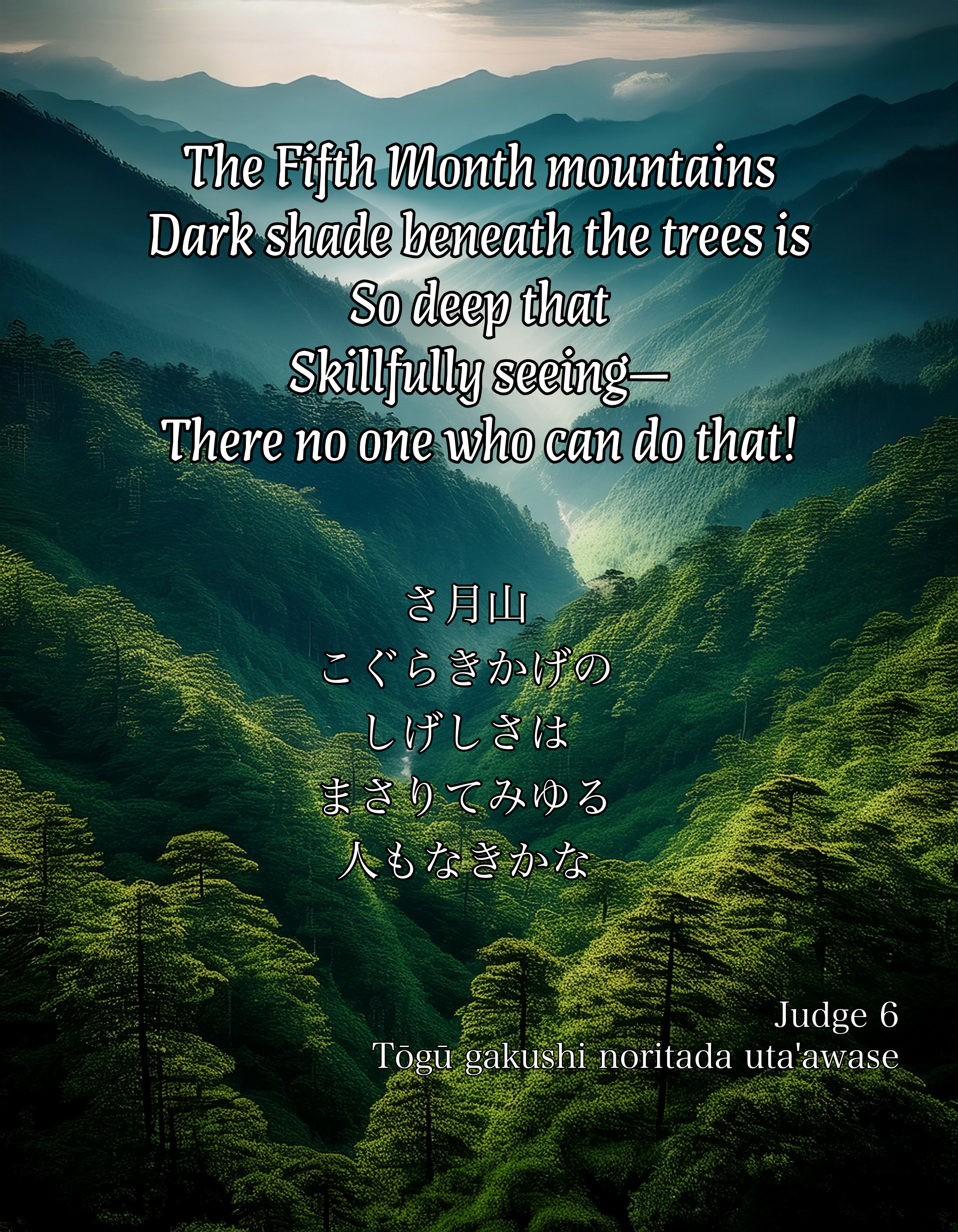
| satsuki yama koguraki kage no shigeshisa wa masarite miyuru hito mo naki kana | The Fifth Month mountains Dark shade beneath the trees is So deep that Skillfully seeing— There no one who can do that! |
Judge 6
[i] Yamagi no kagegurashi山樹蔭暗
[ii] The expression Noritada uses here Tokiwayama makeyama is obscure, so this interpretation is speculative.
[iii] Another unclear expression, but from the context apparently an idiom that means ‘poems not matching the topic’.
Hidden in the grass on the path o’er the plains[i]
Left
なつくればのべのくさばもしげりあひていづれかみちとみえぞわかれぬ
| natsu kureba nobe no kusaba mo shigeriaite izure ka michi to mie zo wakarenu | When the summer comes, The blades of grass upon the plains Grow lushly together, so Which is the path to take I cannot tell by looking! |
9
Right
をちこちのみちみえぬまでなつののはくさばしげくもなりにけるかな
| ochikochi no michi mienu made natsuno no wa kusaba shigeku mo narinikeru kana | Until both distant and nearby Paths I cannot see Across the summer plains Have the blades of grass so lushly Grown, indeed! |
10
Do they not know the features of the summer plains conveyed by ‘Hidden in the grass on the path o’er the plains’? While both Left and Right use ‘blades of grass’, this puts one in mind of fresh grass sprouting in spring showers; and then of the two of them, the Right uses ‘distant and nearby’, which is nothing more than an archaic expression from the Age of Gods used for leg-wearying mountain paths, while at least the Left does not have a tangled argument.
| ato miezu natsuno no kusaba shigeku tomo yamaji o kakete madoubeshi ya wa | No folk’s tracks visible Upon the summer plains—the blades of grass Lush, yet I wonder if upon mountain paths One would lose ones way? |
Judge 5


[i] Yasō no michi shigeshi 野草路滋
Maidens spinning thread
Left
てにかけてくるなつごとにわぎもこがおほくのいとをひきてけるかな
| te ni kakete kuru natsu goto ni wagimoko ga ōku no ito o hikitekeru kana | Through her hands a’running Again, with every summer’s coming, My darling girl So much thread Has spun! |
7
Right
てもたゆくひきおくいとのたえまなくきみがみちよのさかゆべきかな
| te mo tayuku hiki’oku ito no taemanaku kimi ga michiyo no sakayubeki kana | Her weary hands A’spinning thread, Never ending My Lord’s reign through three thousand years Of prosperity! |
8
‘Maidens spinning’ is about their expertise at it, and is not something that you need to need to ponder over and over like a peasant’s hempen thread or struggle to pull apart like a hardened silk cocoon, but both Left and Right really seem to have spun things out, and I feel that, although there’s an air of elegance to start with, the diction at the end of both poems is confused, so I would make these a tie.
| hidari migi hiku te mo tayuku tatsu ito wa izukata e ka wa yorubekaruran | Left and Right, The hands spinning wearily, Produce thread that Heads off but, I wonder where to? |
Judge 4


