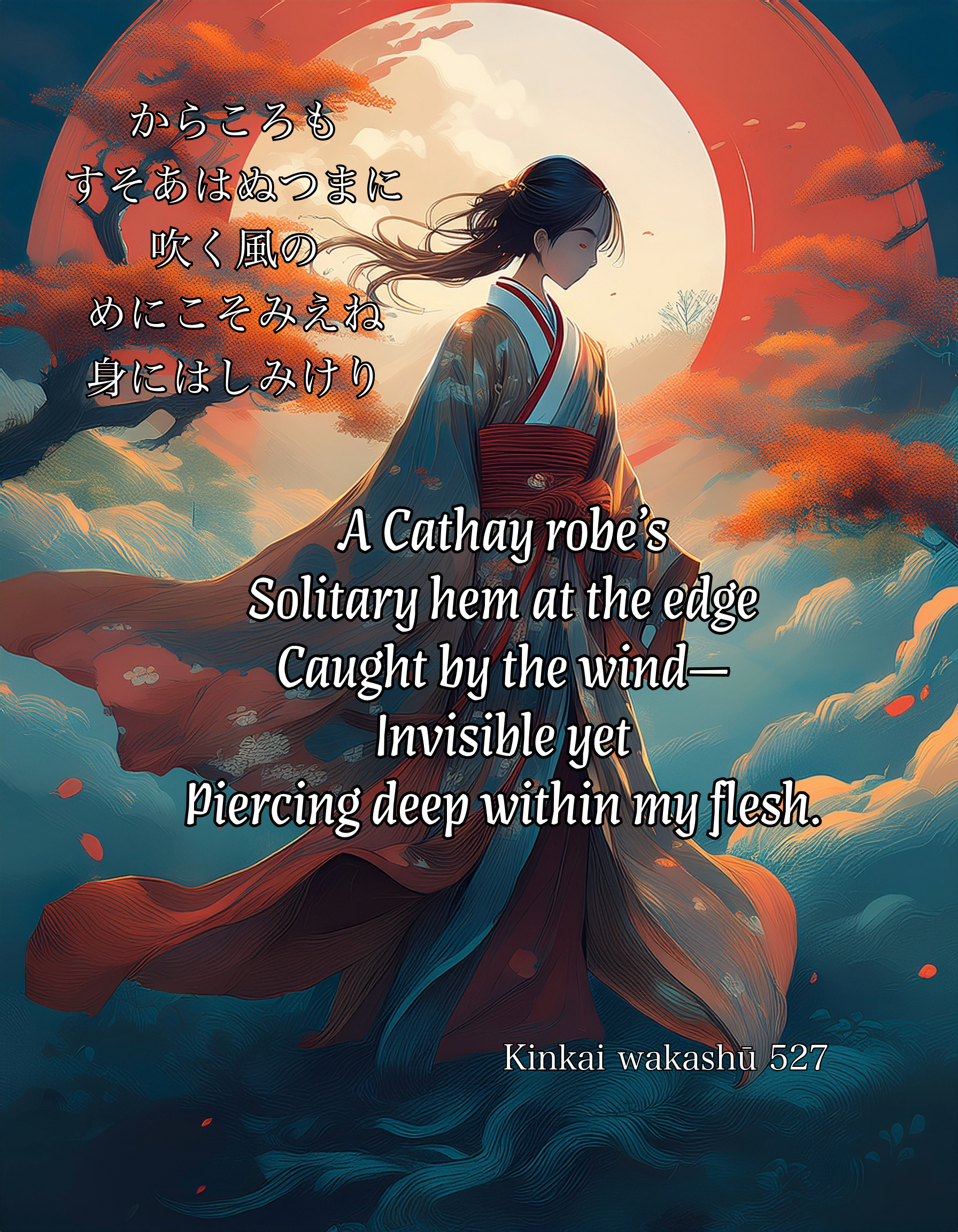
からころもすそあはぬつまに吹く風のめにこそみえね身にはしみけり
| karakoromo suso awanu tsuma ni fuku kaze no me ni koso miene mi ni wa shimikeri | A Cathay robe’s Solitary hem at the edge Caught by the wind— Invisible yet Piercing deep within my flesh. |
527
可良許呂毛 須蘇乃宇知可倍 安波祢杼毛 家思吉己許呂乎 安我毛波奈久尓
からころも すそのうちかへ あはねども けしきこころを あがもはなくに
| karakoromo suso no utikape apanedomo kesiki kokoro o a ga mopanaku ni | A Cathay robe’s Seamed hems cross, but Do not meet together, yet To have a faithless heart I’ll not think, at all…[1] |
Anonymous
In a certain book, this poem is:
可良己呂母 須素能宇知可比 阿波奈敝婆 祢奈敝乃可良尓 許等多可利都母
からころも すそのうちかひ あはなへば ねなへのからに ことたかりつも
| karakoromo suso no utikapi apanapeba nenape no kara ni kototakaritu mo | A Cathay robe’s Seamed hems crossing, but Not meeting— We sleep not together, yet How painful the rumours are… |
[1] This poem relies for its impact on a knowledge of continental clothing designs. Unlike in contemporaneous Japanese garments which were all the same length, continental ones (karakoromo 唐衣 – note that this has been translated as ‘Cathay robe’ for consistency, but the kara element is probably more likely to refer to Kudara 百済, the Korean kingdom of Baekje, in this context) featured multiple robes of differing lengths and thus the hems of these would not align. The use of au 合ふ (‘meet/come together [of objects]’) simultaneously evokes the homophonous au 逢ふ (‘meet [romantically’] and awaseme 合目 (‘seam’).
朝戸出の君が足結を濡らす露原早く起き出でつつ我れも裳裾濡らさな
| asa tode no kimi ga ayupi wo nurasu tuyu para payaku oki idetutu ware mo mosuso nurasana |
In the morning, opening the door Bound up, your belt Will be drenched by the dewy fields; Swiftly rising I, too, shall venture out and Soak my skirt-hem… |
Kakinomoto no Hitomaro Collection
柿本人麻呂歌集
Left (Win).
さらでだに恨みんと思ふ我妹子が衣の裾に秋風ぞ吹く
| sarade dani uramin to omou wagimoko ga koromo no suso ni akikaze zo fuku |
That is not it, yet even so, I do think to hate My darling girl, Her robe hem Blown by the autumn wind… |
Lord Ari’ie.
935
Right.
いかなれば露をば払ふ風の音に物思ふ袖の濡れまさるらん
| ika nareba tsuyu o harau kaze no oto ni mono’omou sode no nuremasaruran |
For some reason Dewdrops blown by The wind – the mere sound Brings to my gloomy sleeves A dampness most extreme… |
Jakuren.
936
The Right state: the Left’s poem is most admirable. The Left state: the Right’s poem is definitely not!
In judgement: to give the gist of the comments by the Gentlemen of the Left and the Right, the Left’s poem is admirable, and the Right’s poem is not admirable at all. I see no need to make much more of this round that that, so, the Left wins.
