みなそこにおふるたまものうちなびき心をよせてこふるこのごろ
| minasoko ni oFuru tamamo no utinabiki kokoro wo yosete koFuru kono goro | In the waters depths Grows gemweed, Trailing, My heart inclines To love these days… |
Hitomaro
On seeing that an attendant to His Majesty had thrown herself in Sarasawa Pond.
わぎもこがねくたれがみをさるさはの池のたまもと見るぞかなしき
| wagimoko ga nekutaregami wo s arusaFa no ike no tamamo to miru zo kanasiki | A maiden’s Sleep-tangled hair in Sarusawa Pond among the gemweed— The sight is so very sad… |
Hitomaro
Also Yamato monogatari 252.

Round Seven
Left
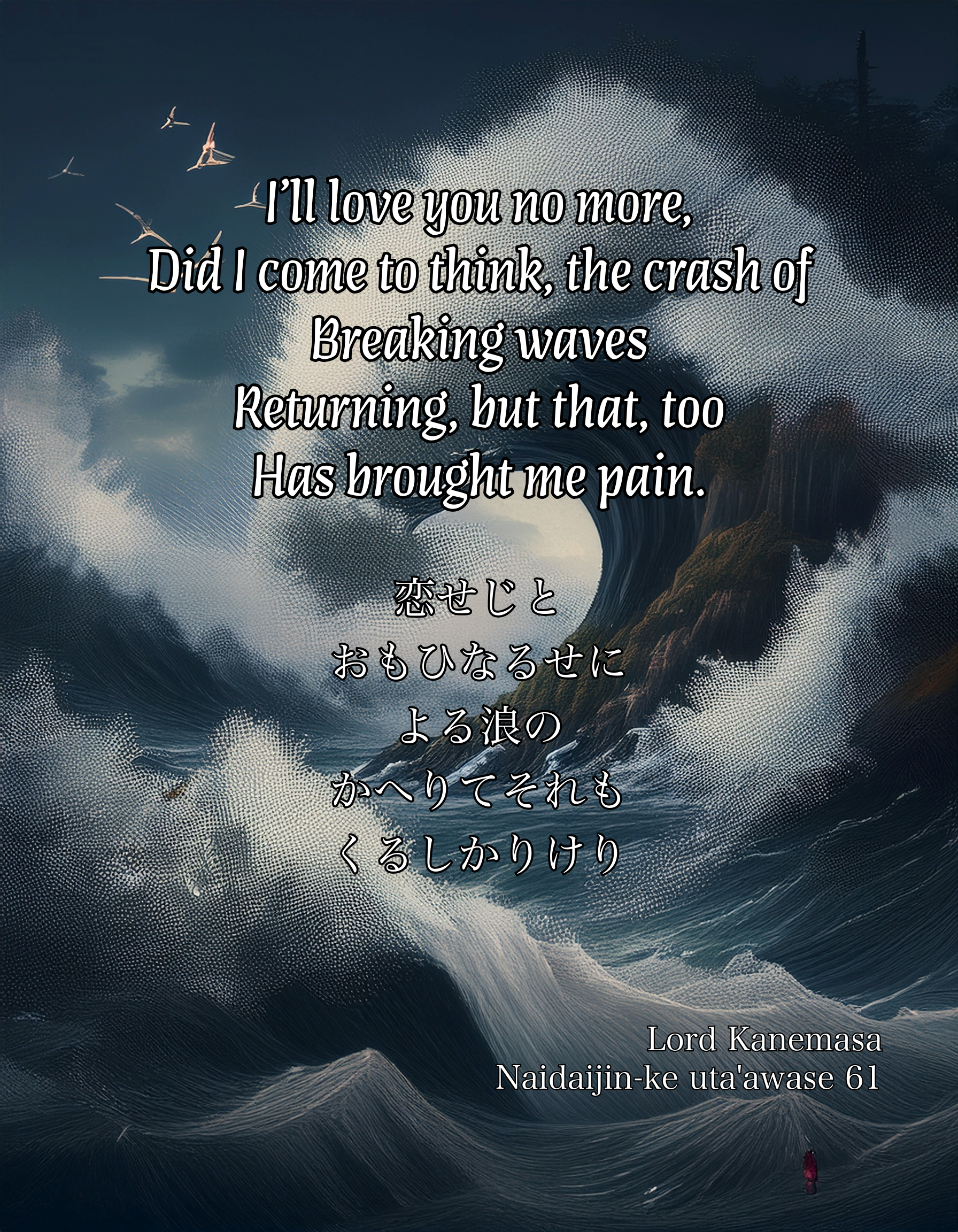
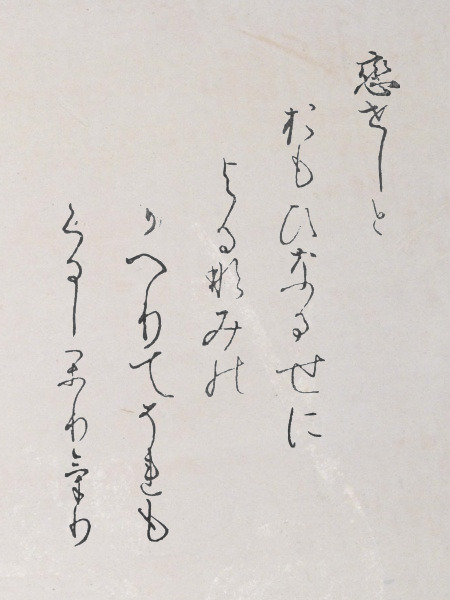
恋せじとおもひなるせによる浪のかへりてそれもくるしかりけり
| koiseji to omoinaru se ni yoru nami no kaerite sore mo kurushikarikeri | I’ll love you no more, Did I come to think, the crash of Breaking waves Returning, but that, too Has brought me pain. |
Lord Kanemasa
61
Right (Both Judges – Win)
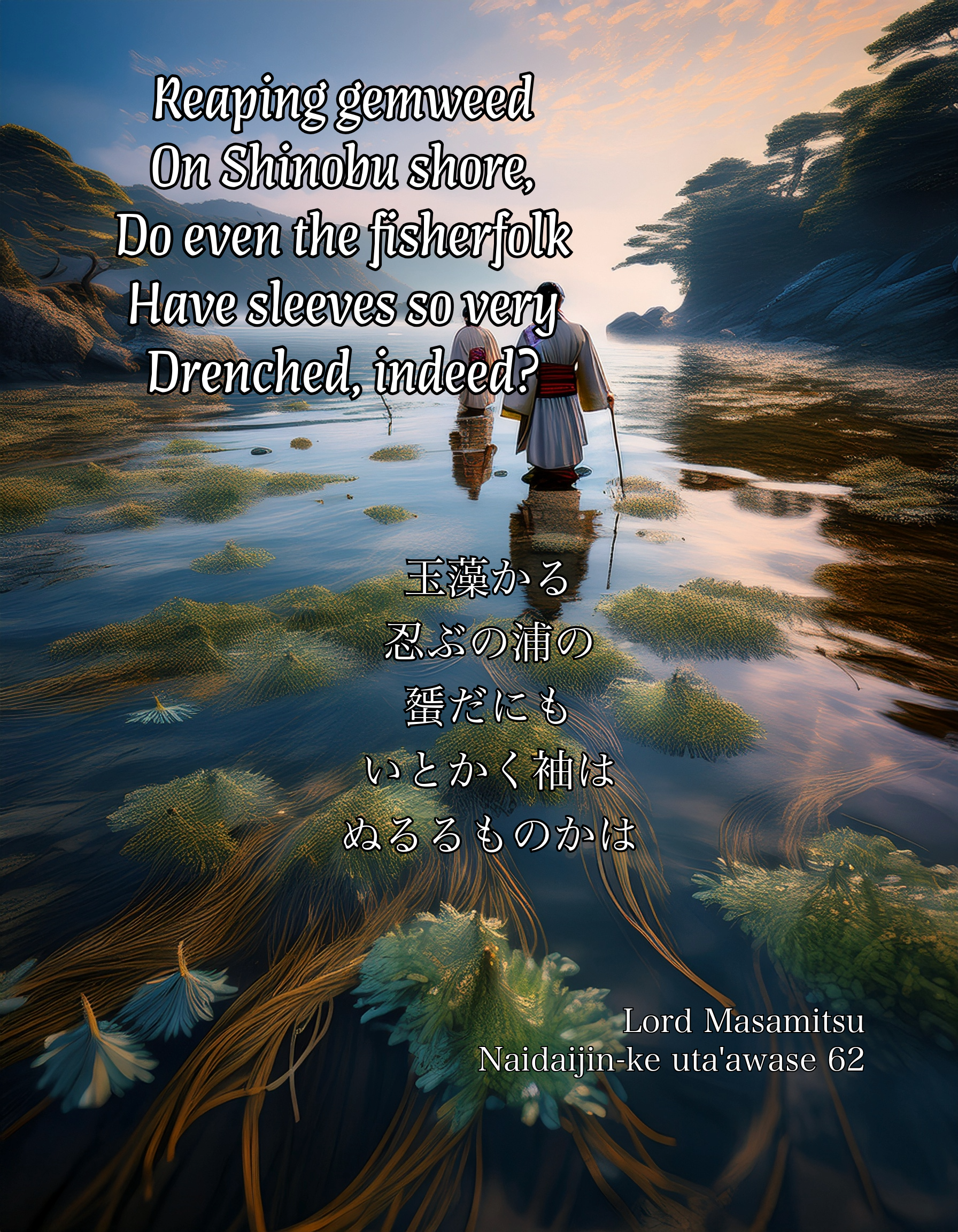
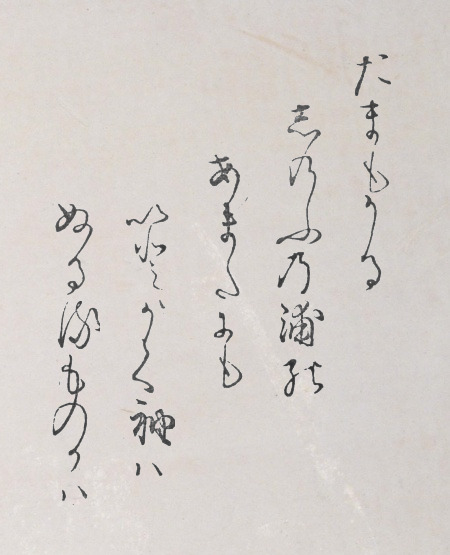
玉藻かる忍ぶの浦の蜑だにもいとかく袖はぬるるものかは
| tamamo karu shinobu no ura no ama dani mo ito kaku sode wa nururu mono ka wa | Reaping gemweed On Shinobu shore, Do even the fisherfolk Have sleeves so very Drenched, indeed? |
Lord Masamitsu
62
Toshiyori states: both of these are charming, however, a line from a famous poem is used for as the initial section, and in such cases the new poem should not closely evoke the source. Someone once said something similar, a long time ago. It’s a bit inferior, isn’t it.
Mototoshi states: neither of these contain any errors, yet the section following the central ‘crash of / Breaking waves’ seems intermittently painful, with sleeves damper than those of the fisherfolk on Shinobu shore. It seems a bit better at present.
Round Twelve
Left
しぐれにはいほりもささじくさまくらおときくとてもぬれぬそでかは
| shigure ni wa iori mo sasaji kusamakura oto kiku tote mo nurenu sode ka wa | Caught in a shower, I’d not erect my hut, for Upon a grassy pillow Listening to the sound, still Would my sleeves be soaked! |
Tsunemasa
73
Right (Win)
たまもふくいそやがしたにもるしぐれたびねのそでもしほたれよとや
| tamamo fuku isoya ga shita ni moru shigure tabine no sode mo shiotareyo to ya | Thatched with gemweed is My roof upon the rocky shore, beneath it Drips a shower, so My sleeves, as I doze upon my travels, Wet with the salty tides – should I say that? |
Nakatsuna
74
The Left wonders whether his sleeves would be soaked, listening to the sound of a shower after abandoning all thought of a hut and grassy pillow—this seems extremely charming, but the configuration and sequencing of the Right, beginning with ‘thatched with gemweed’ and continuing with ‘my sleeves, as I doze upon my travels, / Wet with salty tides’, is extremely moving, isn’t it! Thus I have to award a win, once more, to the poem of the Right.


Left (Tie)
すみよしのきしうつなみにてる月はこかげもあかしまつのむらだち
| sumiyoshi no kishi utsu nami ni teru tsuki wa kokage mo akashi matsu no muradachi | At Sumiyoshi Upon the waves, striking the shore, Shines the moon— The shadows of the trees are bright Among the crowding pines. |
Chūnagon, in service to the Former Ise Virgin[1]
45
Right
としふりてかみさびにけるすみのえのきしのたまもをみがく月かげ
| toshi furite kamisabinikeru suminoe no kishi no tamamo o migaku tsukikage | Ancient in years is The dread Suminoe Shore, where gemweed Is polished by the moonlight. |
Novice Sokaku[2]
46
The Left’s poem has a truly charming conception, with ‘Upon the waves, striking the shore, / Shines the moon’ reflecting and making the pines’ shadows shine. However, what are we to make of the use of ‘bright’ here? My late master once stated that he had too often heard such diction being used. The poem of the right appears to have pleasant configuration and diction, but, while it is only natural to say that the Suminoe’s shore is dread, I wonder about the appropriateness of going so far as to say that gemweed is? It’s going a bit far, I think, to bring in ‘gemweed’ simply to link it to ‘polish’. Nevertheless, the configuration of the poem appears pleasant, so I call this a tie.


[1] Zen-saigū no Chūnagon前斎宮中納言
[2] Shami Sokaku沙弥素覚


