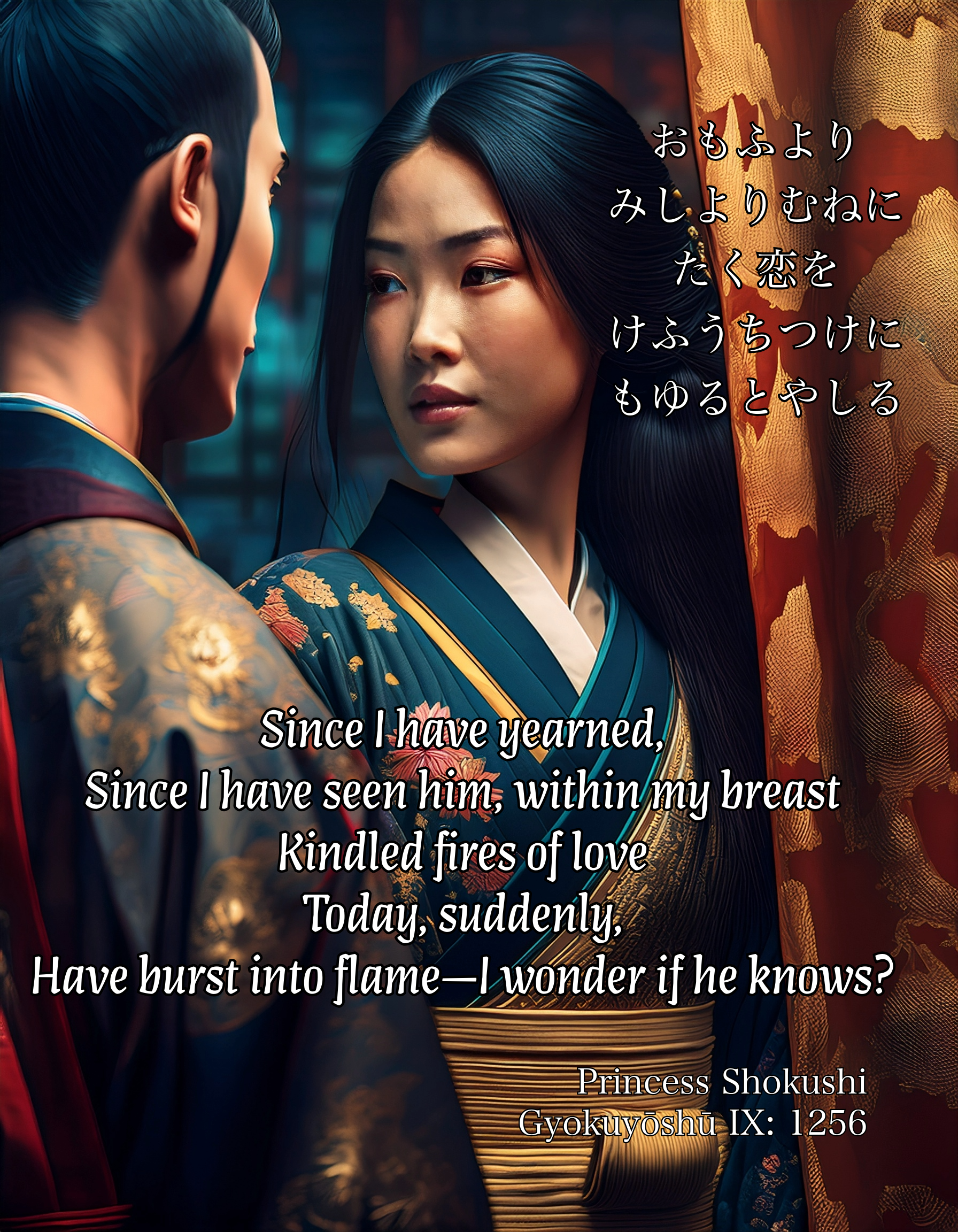
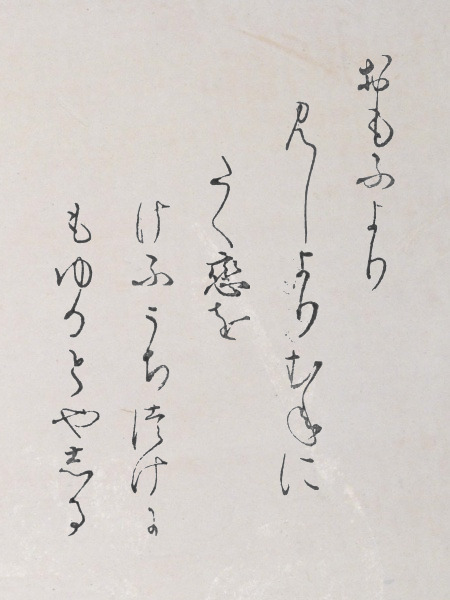
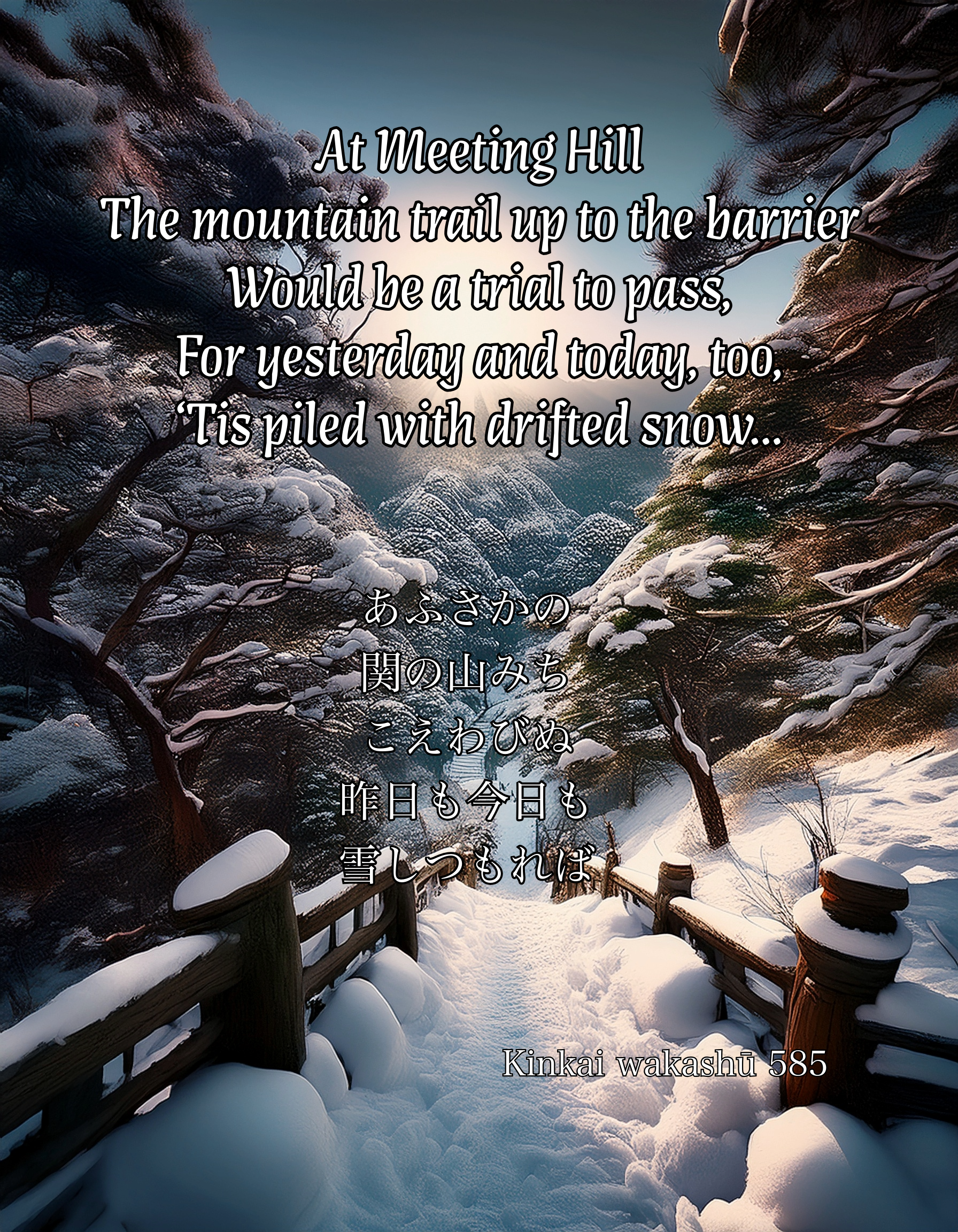
あふさかの関の山みちこえわびぬ昨日も今日も雪しつもれば
| ausaka no seki no yamamichi koewabinu kinō mo kyō mo yuki shi tsumoreba | At Meeting Hill The mountain trail up to the barrier Would be a trial to pass, For yesterday and today, too, ‘Tis piled with drifted snow… |
585
The scent of orange blossom incense on the breeze[i]
Left
ふくかぜに花たちばなぞにほふなるむかしのそでにあやまたれつつ
| fuku kaze ni hanatachibana zo niou naru mukashi no sode ni ayamataretsutsu | With the gusting breeze Orange blossom’s Fragrance comes— For those sleeves of bygone days Do I ever mistake it… |
13
Right
つねよりもことにもあるかなけふをまつはなたちばなのかぜのにほひは
| tsune yori mo koto ni mo aru kana kyō o matsu hanatachibana no kaze no nioi wa | More than ever So special it is! For today have I awaited, Orange blossom’s Scented breeze… |
14
In general, orange blossom is scented during early summer showers or has its fragrance carried on the evening breeze, so I wonder about the folk of bygone days: there’s nothing to compare it with, making the Left’s poem as hackneyed as one on Isonokami, yet there’s nothing special about it, like a weed growing under the eaves. The Right’s poem has ‘for today have I awaited’, which I think requires a reference to sweet-flags. My overall impression of both poems is that their conceptions are unclear.
[Judge’s poem missing]


[i] Rōkitsu bōfū 盧橘芳風
水の泡や種となるらむ浮草のまく人なみの上に生ふれば
| mizu no awa ya tane to naruramu ukikusa no maku hitonami no ue ni oureba | Might the foam upon the waters Be its seeds, perhaps? When the drifting waterweed Twines atop a wave Where it does grow… |
1[i]
山里は冬ぞさびしさまさりける人めも草もかれぬとおもへば
| yamazato wa fuyu zo sabishisa masarikeru hitome mo kusa mo karenu to omoeba | In a mountain retreat Winter’s loneliness Overwhelms As both folks’ gaze and the grasses, too Have withered away, I feel… |
2[ii]
今日人をこふる心はあすか川流るる水に劣らざりけり
| kyō hito o kouru kokoro wa asukagawa nagaruru mizu ni otorazarikeri | Today, for her The love within my heart, By the River Asuka’s Running waters Will not be outdone! |
[i] This poem is included in Shūishū (IX: 524) as an anonymous poem with the headnote ‘Produced but not matched in a poetry contest.’
[ii] This poem is included in Muneyuki-shū (15) with the headnote ‘For a poetry match’.
[iii] This poem is included in Muneyuki-shū (16) with the headnote ‘For a poetry match’.
Mugwort in the Grounds[i]
Left
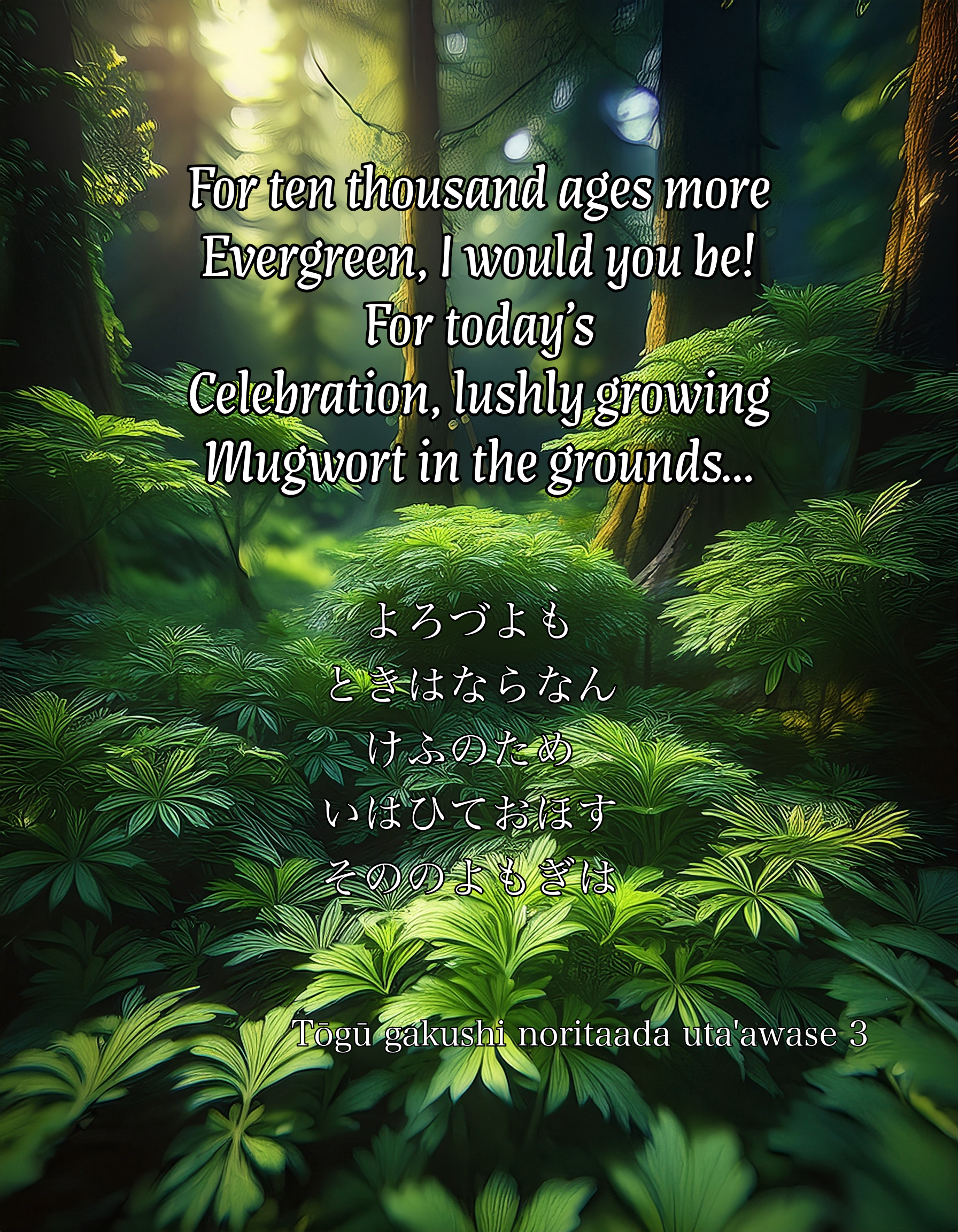
よろづよもときはならなんけふのためいはひておほすそののよもぎは
| yorozuyo mo tokiwa naranan kyō no tame iwaite ōsu sono no yomogi wa | For ten thousand ages more Evergreen, I would you be! For today’s Celebration, lushly growing Mugwort in the grounds… |
3
Right
そののうちにおふるよもぎのえだしげみすゑさかゆべくみゆるきみかな
| sono no uchi ni ouru yomogi no eda shigemi sue sakayubeku miyuru kimi kana | Within the grounds A’growing, the mugwort’s Branches are lush To the very end they flourish, As do you appear to, my Lord! |
4
In ancient times, folk arose on this day with the dawn together with the birds and, taking those branches of mugwort from within their grounds that resembled people, dried them in the shade and made medicinal draughts—I wonder, were both Left and Right unaware of this? There is not even a dewdrop’s worth of diction in accordance with the topic, so I must make this round a tie.
かたかたにとるかたもなきよもぎぐさひとかずならぬここちこそすれ
| katakata ni toru kata mo naki yomogigusa hito kazu naranu kokochi koso sure | Both sides say Nothing noteworthy about Mugwort plants,so Neither is worth much, I feel! |
Judge 2
[i] Sono no naka no yomogi 園中蓬
Round Four
Left
いとどしく照りこそまされもみぢばに日影うつろふ天のかご山
| itodoshiku teri koso masare momijiba ni hikage utsurou ama no kagoyama | All the more Brightly do shine The scarlet leaves Reflecting the sunshine On heavenly Mount Kago! |
Minor Captain Lord Kin’nori, Fourth Rank
7
Right
天の原時雨にくもるけふしもぞ紅葉の色はてりまさりける
| ama no hara shigure ni kumoru kyō shimo zo momiji no iro wa terimasarikeru | The plain of heaven is Clouded with showers, but Today for certain The hues of the scarlet leaves Shine most bright. |
The Daughter of His Excellency, the Head
8
Considering the Left’s ‘Reflecting the sunshine / On heavenly Mount Kago’ about scarlet leaves reflecting the sun’s light, gives me the feeling that this must be a mistaken reference to the garlands of scarlet clubmoss worn by minor officiants at the Great Thanksgiving Service. In addition, among all of the many mountains in various places whose leaves turn scarlet, it seems something of a stretch to go so far as to mention Heavenly Mount Kago, considering it is an archaic expression found in the Collection of a Myriad Leaves, among other places. The Right’s ‘Clouded with showers, but / Today for certain’ is an expression perfectly in tune with the topic, making one wonder whether the leaves’ hue is the result of single drenching which has dyed them superbly.


Round Twelve
Left
霜枯に移ひ残る村菊はみる朝ごとにめづらしきかな
| shimogare ni utsuroinokoru muragiku wa miru asa goto ni mezurashiki kana | Burned by frost, Faded and lingering A cluster of chrysanthemums When I see them every morn Strikes me afresh! |
Lord Toshitaka
47
Right (Both Judges – Win)
置くしものなからましかば菊のはな移ふ色をけふみましやは
| oku shimo no nakaramashikaba kiku no hana utsurou iro o kyō mimashi ya wa | Fallen frost Were there none, then Chrysanthemum blooms Faded hues I would not see today… |
Lord Tamezane
48
Toshiyori states: the first poem has nothing remarkable about it, apart from the undesirable use of ‘clustered chrysanthemums’. The second poem’s sense could be that when the frost has fallen, the chrysanthemum won’t display faded hues, but it is a mistake to link frost fall and being able to see them. However, if we interpret is as meaning it has fallen, so we can then view them for a long time, well, I can understand that, and will make it the winner.
Mototoshi states: this poem has no faults, but it does not appear to be a poem suited to a poetry match—it’s just rather dull. The poem of the Right, too, lacks anything worth pointing out and just says that the poet wants to gaze upon faded hues today—this seems a bit cliched, but I’d say it’s superior.