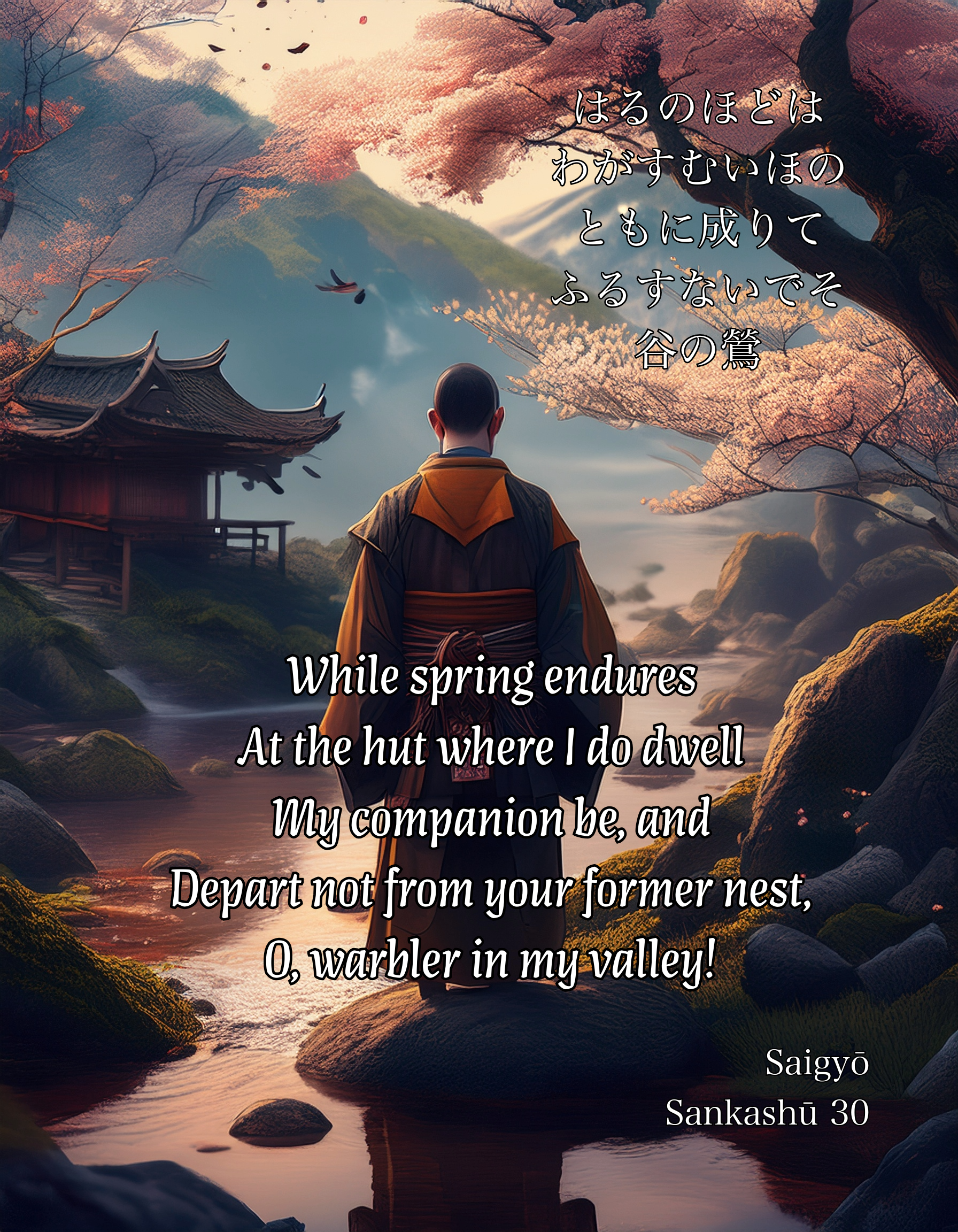
はるのほどはわがすむいほのともに成りてふるすないでそ谷の鶯
| haru no hodo wa wa ga sumu io no tomo ni narite furusu na ide so tani no uguisu | While spring endures At the hut where I do dwell My companion be, and Depart not from your former nest, O, warbler in my valley! |
30
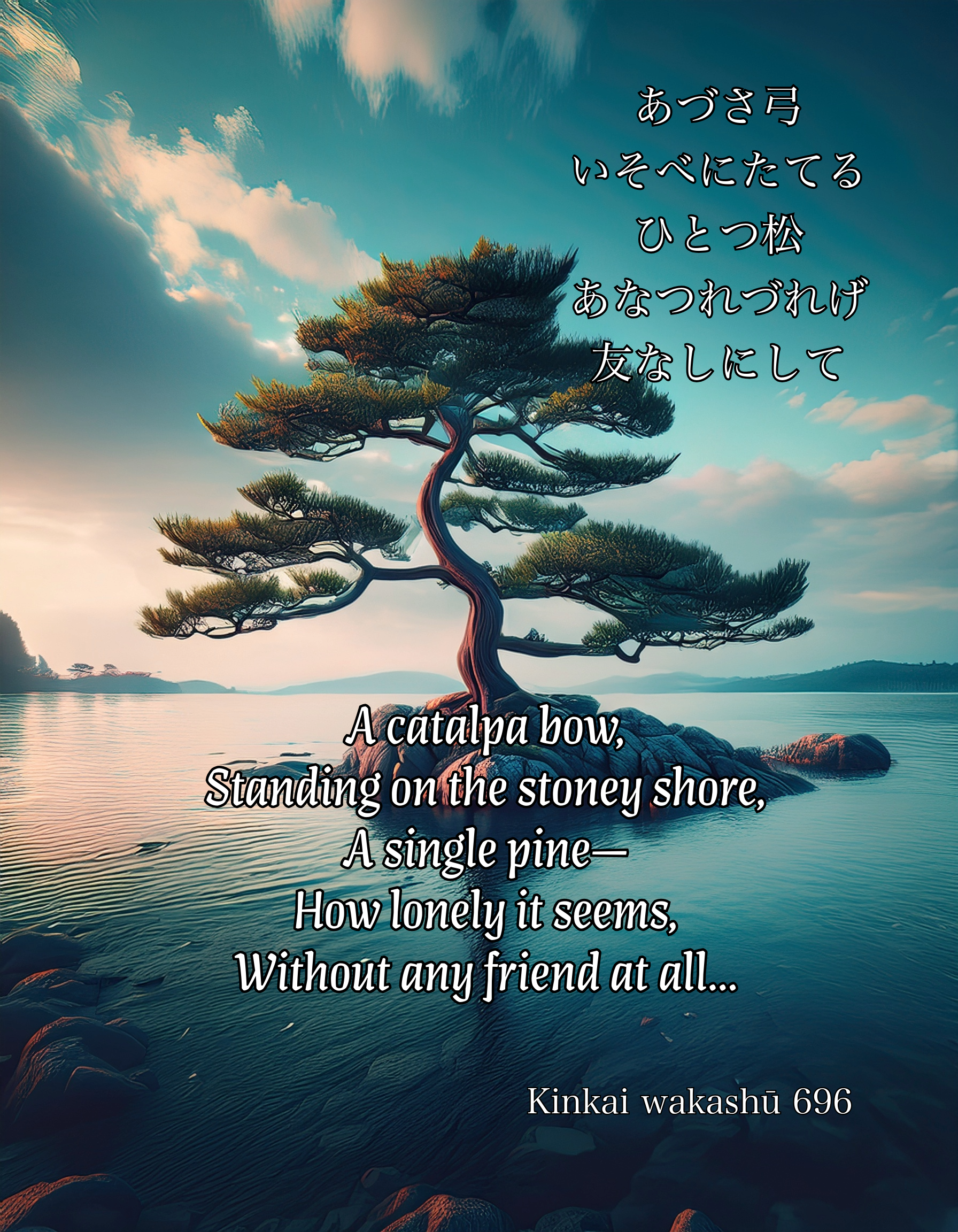
Composed when I saw a single pine tree on the rocky shore when I had gone on a pilgrimage.
あづさ弓いそべにたてるひとつ松あなつれづれげ友なしにして
| azusayumi isobe ni tateru hitotsu matsu ana tsurezurege tomo nashi nishite | A catalpa bow, Standing on the stoney shore, A single pine— How lonely it seems, Without any friend at all… |
696
あひおひの袖のふれにしやどの竹よよはへにけりわがともとして
| ai’oi no sode no furenishi yado no take yoyo wa henikeri wa ga tomo toshite | Growing together, Brushing my sleeves, The bamboo at my house Has passed through the ages— My friend, it is.[i] |
667

[i] See: 晋騎兵参軍王子猷 栽称此君 唐太子賓客白楽天 愛為吾友 shin no kihei sangun ōshi iu / uete kono kimi to shōsu / tō no Taishi hinkaku hakurakuten / aishite wa ga tomo to su ‘In Chin times, Administrator for Cavalry Wang Tzu-yu / Planted it and called it “This Gentleman.” / In T’ang times, Adviser to the Heir Apparent Po Lo-t’ien / loved it as being “my friend.”’ (Rimer and Chaves 1997, 132) Fujiwara no Atsumochi (Wakan rōeishū II: 432); and: When His Majesty was yet a prince and had paid a visit to the Toba Palace to converse the Hachijō’in Princess, Her Highness recited, ‘The bamboo has been my friend these many years,’ so His Majesty composed a poem [along with others present]. わが友と君がみかきのくれ竹は千代にいく世のかげをそふらん wa ga tomo to / kimi ga migaki no / kuretake wa / chiyo ni ikuyo no / kage o souran ‘As “my friend” does / My Lady see, by her fence / Black bamboo— / Its thousand knots o’er how many ages / To her will show their shape?’ Master of the Dowager Empress Household Office, Toshinari (Senzaishū X: 608).
Round Four
Left (Tie)
たびねするあれたるやどのしぐれにはなみだもともにもるにぞありける
| tabinesuru aretaru yado no shigure ni wa namida mo tomo ni moru ni zo arikeru | Sleeping on my travels In a ruined hut, The showers And my tears, both, Do leave me drenched! |
Minamoto no Munenaga
(formerly Michikiyo)
57
Right
ちぎらねどさよのねざめにおとづれてしぐれぞたびのともとなりける
| chigiranedo sayo no nezame ni otozurete shigure zo tabi no tomo to narikeru | It made no vow, yet On awaking from a brief night’s sleep, I am visited by the sound Of showers—my journey’s Companion, have they become. |
Fujiwara no Noritsune
58
The Left conception and configuration appear pleasant, but after saying that one is ‘sleeping on my travels’ to then have ‘a ruined hut’—this does not really sound like somewhere a person would take lodging on their journey. As for the Right, it seems like the only reason the poet has begun with ‘it made no vow, yet’ is because he wished to use ‘companion’, but these pieces of diction are too far apart. Still, it does seem to have some conception, so I make these a tie.


Composed on spending spring accompanied by nothing but blossom.
ちらぬ間は花をともにて過ぎぬべし春よりのちのしる人もがな
| tiranu ma Fa Fana wo tomo nite suginubesi Faru yori noti no siru Fito mogana | While still unscattered The blossom is my only friend, and When ‘tis past And spring is gone, then Would I have folk to know! |
The Hanazono Minister of the Left

Left
心ゆく野路の旅寝の友なくはいとど都や恋しからまし
| kokoro yuku noji no tabine no tomo naku wa itodo miyako ya koishikaramashi | To ease my heart While sleeping on my travels ‘tween the fields I have no friend at all, so How much more the capital Does seem dear to me now! |
Lord Kanemune
1155
Right (Win)
立ち宿る一夜ばかりの契だにさてながらふる人もある世を
| tachiyadoru hitoyo bakari no chigiri dani sate nagarauru hito mo aru yo o | Lodging on one’s travels, For just a single night, A love That lasts with A lady does happen sometimes, yet… |
Nobusada
1156
The Right state: the Left’s poem has no entertainers, or conception of love, either. The Left state: the Right’s poem lacks entertainers.
In judgement: it seems that the Gentlemen of both teams have already stated that both poems lack the conception of Love. However, they seem to me to both capture the conception of entertainers. The Right’s configuration and conception are fine. It should win, I think.