Tag Archives: tonight

Naidaijin-ke uta’awase 16

Round Four

Left (M – Tie)

白砂の霜よに置きてみつれども移ふ菊はまがはざりけり

shirotae no
shimo yo ni okite
mitsuredomo
utsurou kiku wa
magawazarikeri
White as mulberry cloth.
Frost has fallen tonight
I see, and yet
The faded chrysanthemums
I can clearly tell apart.

Lord Masakane
31

Right (T – Win)

八重菊の花の袂をあかずとや霜のうはぎを猶かさぬらん

yaegiku no
hana no tamoto o
akazu to ya
shimo no uwagi o
nao kasanuran
Of eightfold chrysanthemum
Bloomed sleeves
I cannot get my fill, but
Is a frosty jacket
Yet laid upon them?

Lord Tadafusa
32

Toshiyori states: the assemble company have stated about the first poem that in the absence of the moon or the stars it would difficult to distinguish chrysanthemums from the frost, and it certainly sounds like this would be the case. In the latter poem, we need to think of who it is that is feeling that they cannot get their fill of bloomed sleeves—the person wearing them should be included, or if the chrysanthemums are, perhaps, the subject, then ‘eightfold chrysanthemum’ is an error. Even so, the style of the poem seems elevated.

Mototoshi states: the poem stating ‘White as mulberry cloth. / Frost has fallen tonight’ is a bit hackneyed, and it then continues ‘The faded chrysanthemums / I can clearly tell apart’—I question whether one would really mistake faded chrysanthemums and frost. As for the Right’s poem, which says ‘Bloomed sleeves / I cannot get my fill’, well, this really is difficult to grasp. I spent quite a bit of time going back and forth agonizing over whether these were a person’s sleeves or those of the chrysanthemum! I feel that the diction in both poems is skillful, but there’s a lack of necessary information, so it’s impossible to decide a winner or loser here.

Daigo ōntoki kiku awase 10

□□さとにをしみぞとむるきくのはな霜にうつろふいろをみむとか

…sato ni
oshimi zo tomuru
kiku no hana
shimo ni utsurou
iro o mimu to ka
Around my … estate
Regrets linger for
The chrysanthemum blooms,
Fading beneath the frost
Would I see their hues, I wonder?

Masau[1]
19

ももしきにうつろふいろははつしものおきてかひあるこよひなりけり

momoshiki ni
utsurou iro wa
hatsushimo no
okite kai aru
koyoi narikeri
Within the hundred-fold palace
Fading hues with
First frost’s
Fall have some significance
Tonight.

Nakatsura[2]
20


[1] Possibly Taira no Masau 平將文

[2] Possibly Minamoto no Nakatsura 源仲連

Sumiyoshi-sha uta’awase kaō ni-nen 47

Round Twenty-Two

Left

いなむしろしきつのうらのまつかぜはもりくるをりぞしぐれともしる

inamushiro
shikitsu no ura no
matsukaze wa
morikuru ori zo
shigure to mo shiru
A straw mat spread
At Shikitsu Bay, where when
On the wind through the pines
Come dripping droplets
I know a shower is falling!

Lord Kiyosuke
93

Right (Win)

おほぞらもみやこのかたをしのぶらしこよひはことにうちしぐれつつ

ōzora mo
miyako no kata o
shinoburashi
koyoi wa koto ni
uchishiguretsutsu
The heavens, too,
Of the capital
Think fondly, it seems,
For tonight is especially
Filled with constant showers…

Lord Sanetsuna
94

The poem of the Left appears to have a pleasant conception, blending showers with the wind through the pines and saying, ‘Come dripping droplets / I know a shower is falling!’, but it appears that the straw mat has only been spread because of the reference to Shikitsu [spreading] Bay. Considering the actual nature of a straw mat, however, I do not feel that the sense links with Shikitsu Bay, although it would be charming if sleeping on a journey in the shade of the willows beside a river, or even in a hut among the rice-fields. I do not feel it is appropriate to spread a straw mat beneath the pines at Sumiyoshi. In addition, it is only the straw mat here which has the conception of a journey—how should one feel about that? The configuration of the Right’s poem, beginning with ‘The heavens, too’ and following with ‘Of the capital / Think fondly, it seems’, I would say is a poem for a poetry match. While a counter-argument has been made about the Left’s poem, it’s really asking for the impossible, isn’t it. So, I impose victory for the Right.

Sumiyoshi-sha uta’awase kaō ni-nen 24

Left

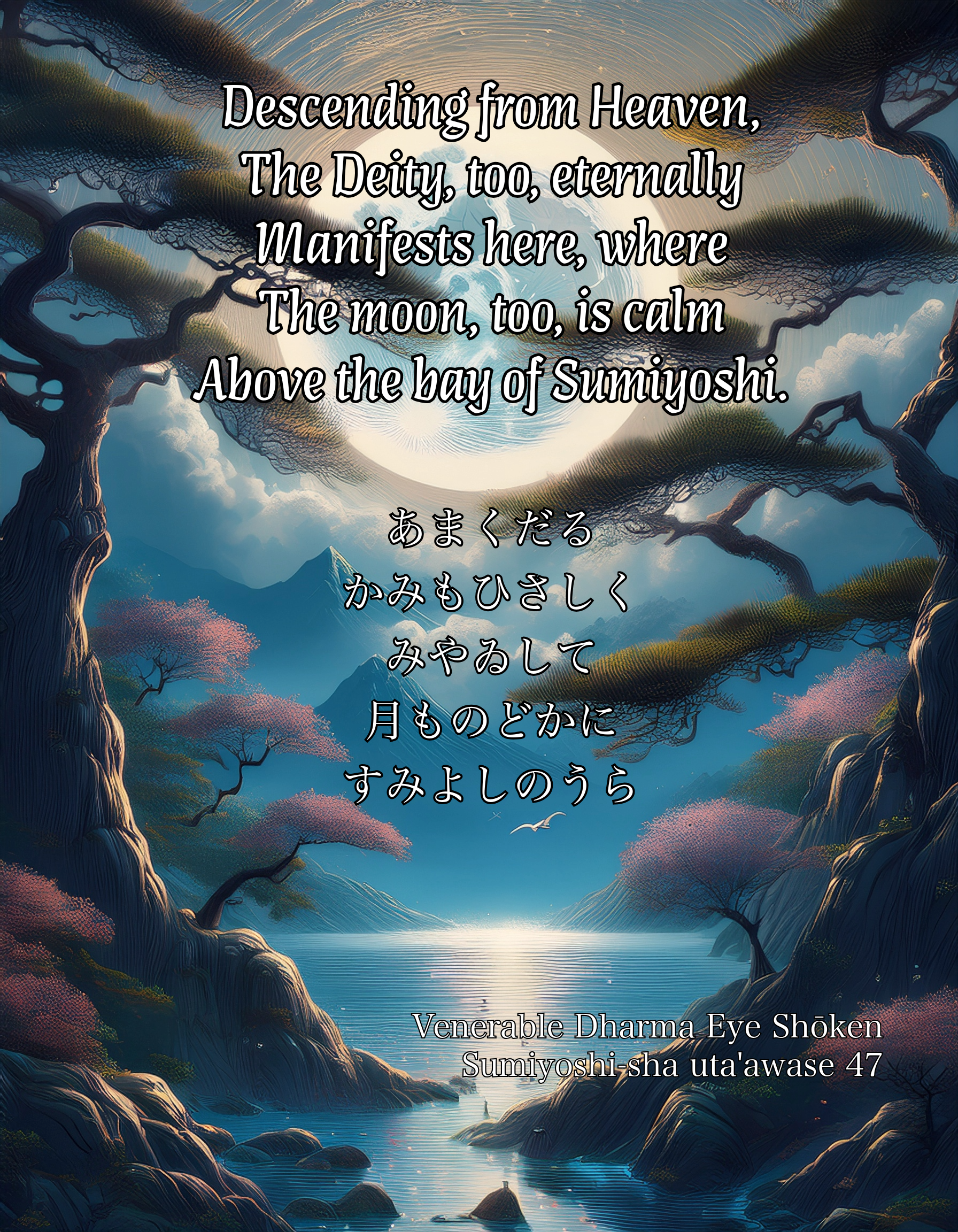
あまくだるかみもひさしくみやゐして月ものどかにすみよしのうら

amakudaru
kami mo hisashiku
miya’ishite
tsuki mo nodoka ni
sumiyoshi no ura
Descending from Heaven,
The Deity, too, eternally
Manifests here, where
The moon, too, is calm
Above the bay of Sumiyoshi.

Venerable Dharma Eye Shōken[1]
47

Right (Win)

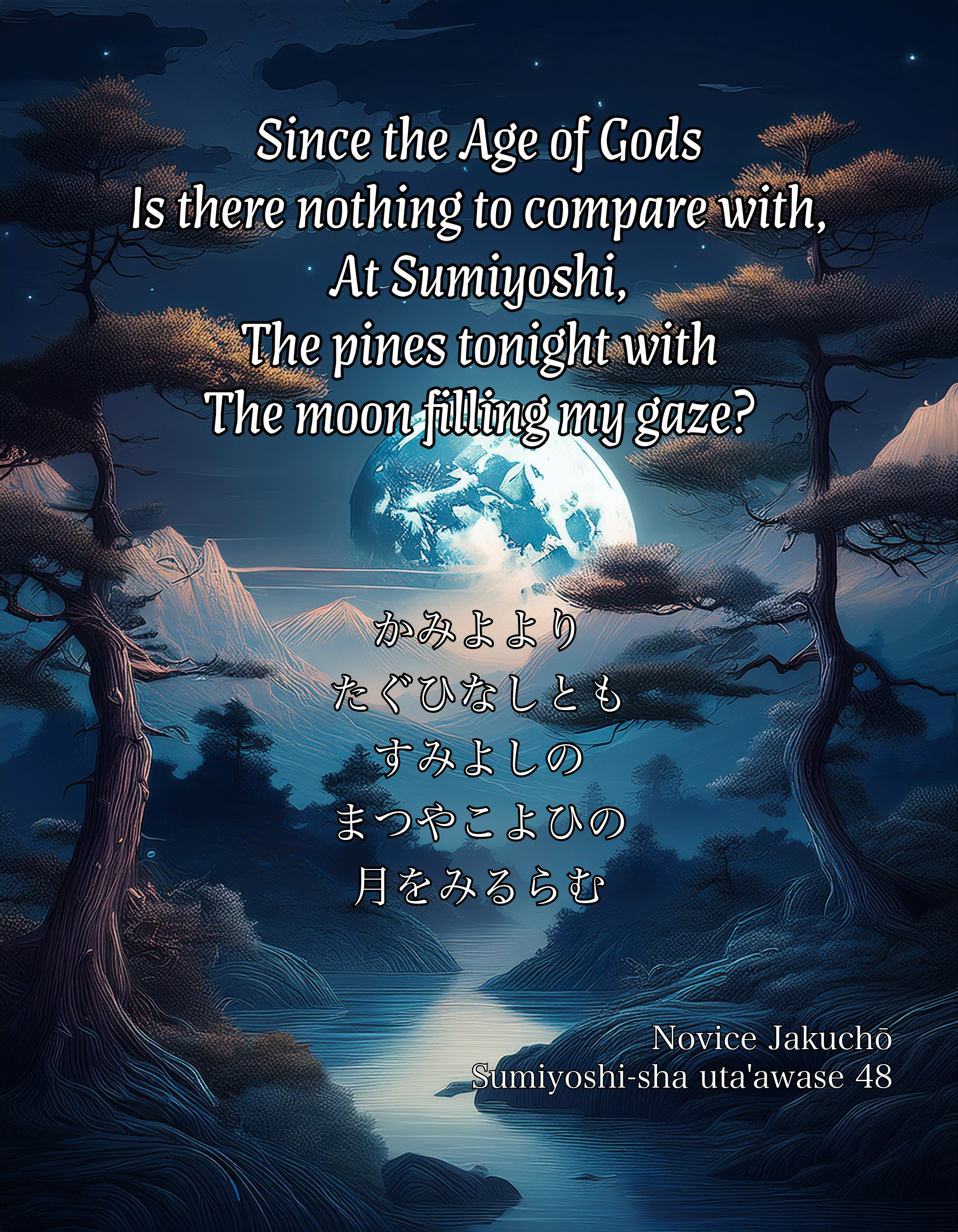
かみよよりたぐひなしともすみよしのまつやこよひの月をみるらむ

kamiyo yori
taguinashi tomo
sumiyoshi no
matsu ya koyoi no
tsuki o miruramu
Since the Age of Gods
Is there nothing to compare with,
At Sumiyoshi,
The pines tonight with
The moon filling my gaze?

Novice Jakuchō[2]
48

The Left appears to have a truly charming conception and configuration, but beginning with ‘The Deity, too, eternally’ and then saying ‘The moon, too, is calm’ and repeating the same word is discordant. The Right, in addition to having no particular faults to mention, has an extremely pleasant-sounding configuration with ‘The pines tonight’. Thus, I make this a win for the Right.


[1] Hōgen kashōi Shōkaku 法眼和尚位静賢

[2] Shami Jakuchō沙弥寂超

Sumiyoshi-sha uta’awase kaō ni-nen 15

Left (Win)

すみよしのまつにとはばやおいがよにこよひばかりの月はみきやと

sumiyoshi no
matsu ni towaba ya
oi ga yo ni
koyoi bakari no
tsuki wa miki ya to
To Sumiyoshi’s
Pines I would ask,
Through all the ancient ages of your lives,
Is tonight, simply,
The finest moon you’ve seen?

Kyō, in service to the Regent’s Household[i]
29

Right

すみよしのうらさえわたる月みればまつのこかげぞくもりなりける

sumiyoshi no
ura saewataru
tsuki mireba
matsu no kokage zo
kumori narikeru
When across Sumiyoshi’s
Bay, so chill crossing
The moon I see,
The shadows from the pines are
The only clouds.

Lord Minamoto no Suehiro
Junior Fifth Rank, Upper Grade
Without Office[ii]
30

While the Left’s poem has no remarkable elements, I must say that the configuration of ‘tonight, simply’ is pleasant. As for the Right’s poem, in addition to it being quite commonplace, when composing about the brightness of the moon, to say that something is the only cloud, if you say that ‘the shadows from the pines are / The only clouds’ it certainly sounds as if that’s what they are at the very least [and thus imply that Sumiyoshi is cloudy, when the topic is the brightness of the moon], so I make the Left the winner.


[i] Sessho no ie no Kyō摂政家卿

[ii] San’i jūgoijō Minamoto ason Suehiro 散位従五位上源朝臣季広

Daikōtaigōgū no suke taira no tsunemori-ason ke uta’awase 27

Round Three

Left (Tie)

おきあかしくまなき月をながむれば野原の草の露もかくれず

oki’akashi
kumanaki tsuki o
nagamureba
nohara no kusa no
tsuyu mo kakurezu
Lying awake ‘til dawn, and
Upon the cloudless moon
A’gazing—
Upon the grasses o’er the plain
Not a single dewdrop is concealed.

Mikawa
53

Right

月をみて心をこよひつくすかなくまなき空は又もこそあれ

tsuki o mite
kokoro o koyoi
tsukusu kana
kumanaki sora wa
mata mo koso are
Seeing the moon,
Tonight, my heart
Exhausts!
The cloudless skies
Once more are such!

Lord Kinshige
54

The Left’s ‘lying awake ‘til dawn, gazing’ suggests that the poet is at their own residence, but then it finally turns out that they are on the plain – what to make of this? It’s also the case that the moon doesn’t necessarily always appear over the plains. This poem should really have included a clearer reason for the poet’s journey. As for the Right, while it isn’t bad, the final line certainly regrettable, so this round is a tie.

Daikōtaigōgū no suke taira no tsunemori-ason ke uta’awase 26

Round Two

Left (Win)

松浦ぶねあかしのしほに漕ぎとめよこよひの月はここにてをみむ

matsurabune
akashi no shio ni
kogitomeyo
koyoi no tsuki wa
koko nite o mimu
O, boat from Matsura,
Upon the tides of Akashi,
Halt your rowing!
For tonight, the moon
I would gaze upon from there…

Lord Tsunemori
51

Right

月影のさえゆくままにおく霜をおもひもあへず鐘やなるらん

tsukikage no
saeyuku mama ni
oku shimo o
omoi mo aezu
kane ya naruran
While the moonlight
Is so chill,
Is it of the falling frost
Quite heedless that
The bells are tolling?

Tōren
52

I wonder if the Right’s conception is that of the bells of Fengling? It appears to be said of them that they ‘rang of their own accord when frost fell’, or something like that. Hence, in the Cathay-style poem with the topic ‘the autumn moon seeming to be frost at night’ there is also the line ‘wouldn’t you have it make the Fengling bells ring out together?’ Here, our moonlight is being thought to be frost, and the bells are tolling in response to it. But, as bells are inanimate objects, it does not seem feasible to think that they would toll upon seeing frost. Thus, saying that they would view the moonlight as frost and heedlessly toll, is odd, I have to say. As for the Left, while there is no clear reason for the initial line, the remainder seems reasonable, and so I feel this should win.

Daikōtaigōgū no suke taira no tsunemori-ason ke uta’awase 21

Round Nine

Left (Tie)

秋はぎを草の枕にむすびてや妻恋ひかねて鹿のふすらん

akihagi o
kusa no makura ni
musubite ya
tsuma koikanete
shika no fusuran
The autumn bush clover
For a grassy pillow
Has he woven—is that why
Unable to love his mate
The stag seems to lie?

Koreyuki
41

Right

妻こふる秋にしなればさをしかの床の山とてうちもふされじ

tsuma kouru
aki ni shi nareba
saoshika no
toko no yama tote
uchi mo fusareji
He yearns for his mate
In autumn, above all, so
In the stag’s
Bed among the mountains
He cannot lay him down, it seems.

Arifusa
42

The Left isn’t bad, but isn’t there Controller Kore’ie’s poem:

秋萩を草の枕にむすぶ夜はちかくもしかのこゑをきくかな

akihagi o
kusa no makura ni
musubu yo wa
chikaku mo shika no
koe o kiku kana
The autumn bush clover
For a grassy pillow
I weave tonight—
Close by, truly, a stag’s
Bell I hear! [1]

While there is this earlier example, neither core nor the conceptions of these poems are the same, and as the Right’s poem is not all that good, after careful consideration I make this a tie.


[1] On hearing a stag at his lodgings. KYS (3) III: 224