[i] This poem is included in Gyokuyōshū (V: 794/795) with the headnote, ‘For the scarlet leaves match during the reign of the Tenryaku emperor’.
[ii] This poem is included in Gyokuyōshū (V: 795/796) with the headnote, ‘For the scarlet leaves match during the reign of the Tenryaku emperor’. It is also included in Mandaishū (V: 1223) with the headnote, ‘A poem from the autumn leaves match held at the palace in the intercalary Ninth Month, Tenryaku 9’ and in Kiyotada-shū (38), with the headnote ‘From an autumn leaves match at the palace, in a year when there were two ninth months’.
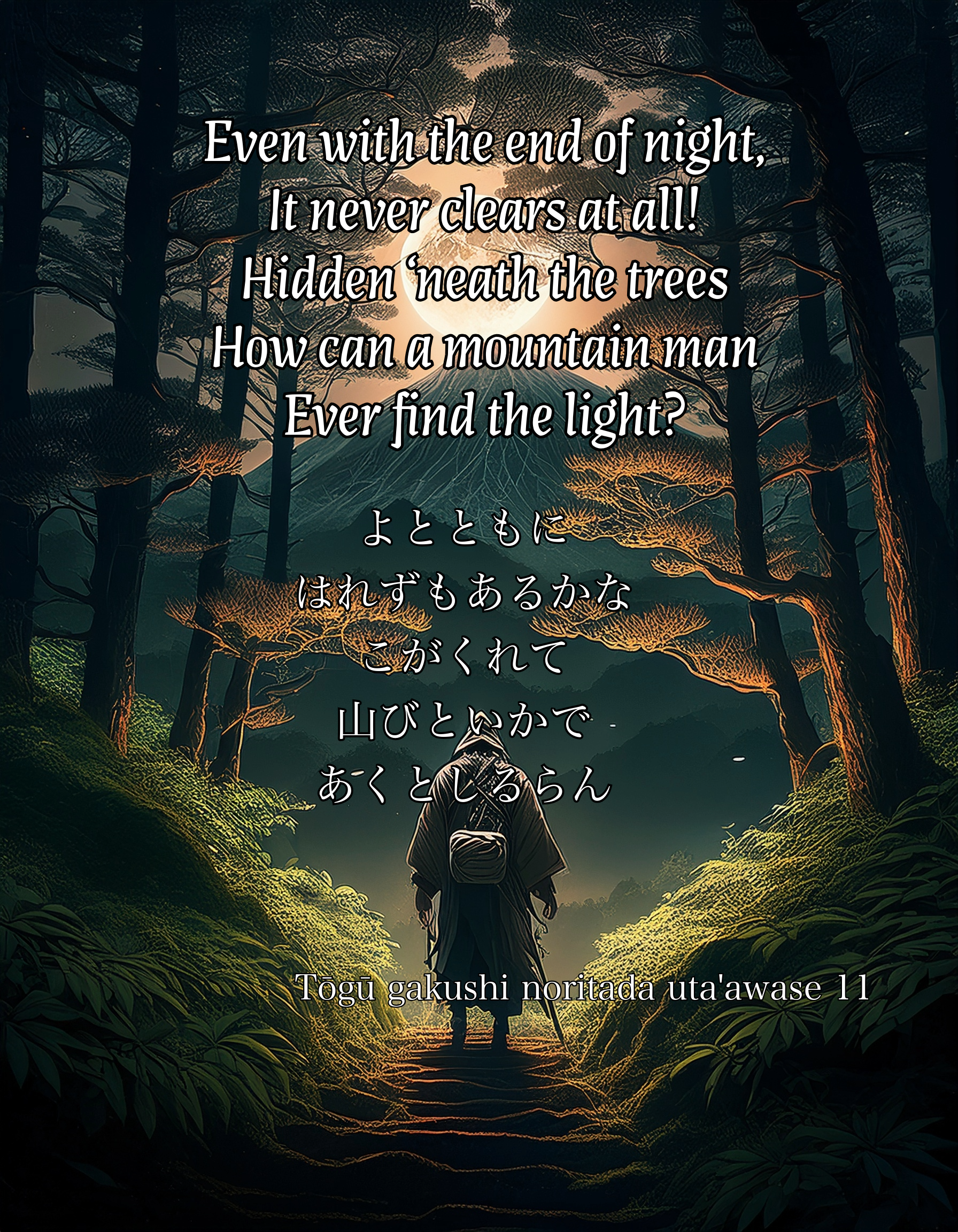
yo to tomo ni harezu mo aru kana kogakurete yamabito ikade aku to shiruran
Even with the end of night, It never clears at all! Hidden ‘neath the trees How can a mountain man Ever find the light?
11
Right
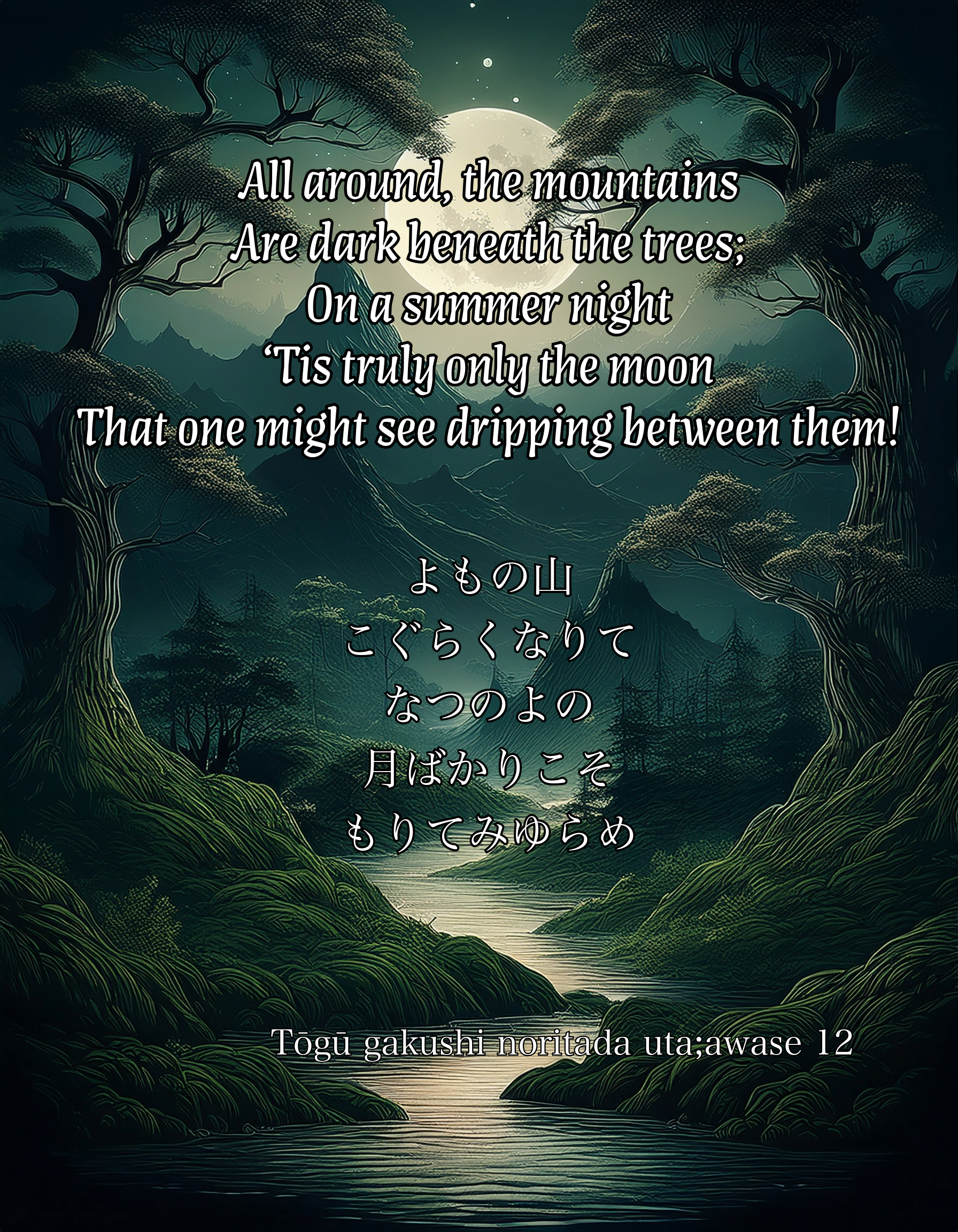
よもの山こぐらくなりてなつのよの月ばかりこそもりてみゆらめ
yomo no yama koguraku narite natsu no yo no tsuki bakari koso morite miyurame
All around, the mountains Are dark beneath the trees; On a summer night ‘Tis truly only the moon That one might see dripping between them!
12
This topic refers to a hunted stag concealed among the trees in the summer mountains. There is not a particular strong feeling of either evergreen or other types of mountain forests,[ii] but the Left’s poem has ‘Even with the end of night’, forgetting that this implies a season of biting wind and showers striking the leaves on the trees—thus the darkness here is excessively conceived. While the Right takes ‘dark shade’ as an opportunity to compose with the elevated conception of the moon dripping between the trees—and surpasses the peaks in doing this—I wonder if the conceptions of both poems don’t contain brightness? Thus, both Left and Right are examples of the ‘Reizei Palace’,[iii] so I would decide on a tie for these.
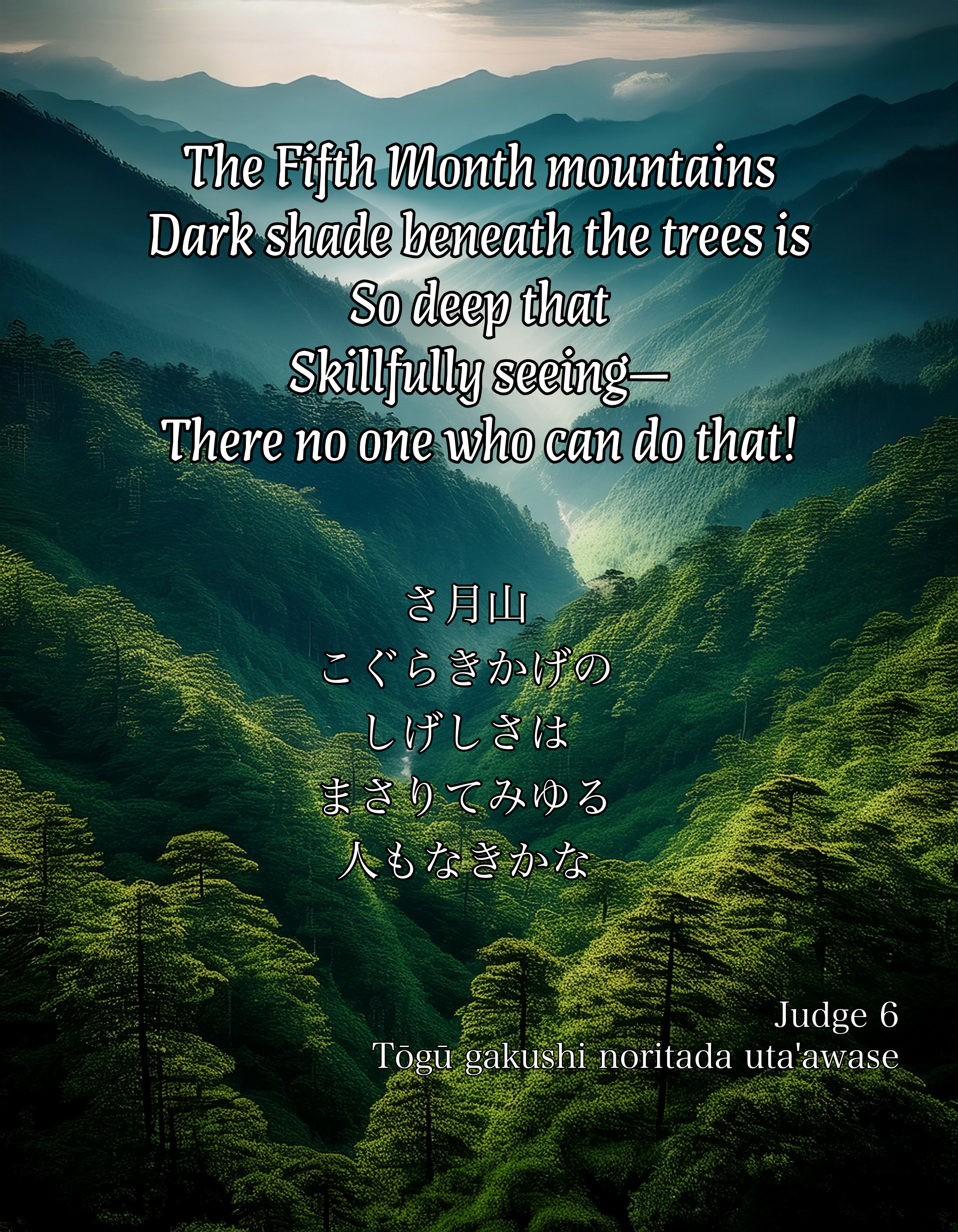
さ月山こぐらきかげのしげしさはまさりてみゆる人もなきかな
satsuki yama koguraki kage no shigeshisa wa masarite miyuru hito mo naki kana
The Fifth Month mountains Dark shade beneath the trees is So deep that Skillfully seeing— There no one who can do that!
uchimurete iwane ni nezasu komatsuba no kigi no chitose wa kimi zo kazoemu
Crowding At the crags’ foot, roots stretching, The dwarf pines’ needles with The trees’ thousand years— My Lord may count them all!
Cell of the Fragrant Elephant 63
Right (Win)
たとふべきものこそなけれ君がよははまのまさごもかずなからめや
tatoubeki mono koso nakere kimi ga yo wa hama no masago mo kazu nakarame ya
A suitable metaphor Is there none, at all! My Lord’s reign: Even the fair sands on the shore Would not exceed its number…
Cell of Everlasting Truth 64
Both of the Left poem’s expressions, ‘crowding’ and ‘dwarf pines’ needles’, seem to sound awkward. ‘Crowding’ is used of cranes, while it would have been preferable to say ‘the needles of the dwarf pines’. The poem of the Right is not especially charming, but it is in a familiar style, so I feel that ‘the fair sands’ number’ is superior.
I feel that ‘crowding’ is better applied to human beings. Perhaps there’s a conception here of looking down on each and every one? This is a mistake, isn’t it? In addition, what is ‘dwarf pines’ needles’? Maybe the poet is trying to say ‘the needles of the dwarf pines’? Is there a prior poem as precedent? It’s a piece of awkward-sounding diction! The Right’s poem appears straightforward, but without errors.
The poem of the Left is entirely lacking in any interest. Isn’t this a sage’s jewelled tree? It really leaves me grief-stricken. The poem of the Right contains two faults in a single work. First, this is not the right time of year to be referring to a ‘verdant mountain’. Second, ‘vanishes from sight’ refers to disappearing in water. In the Collection of a Myriad Leaves ‘vanishing from sight’ is written as ‘hidden in the water’. Thus we have lines such as, ‘swarming frogs hiding in the weeds beneath the waves’. There are no prior poems mentioning ‘mountains vanishing from sight’ in either ancient or modern times.
On the matter of the ‘tree of gems’, I heard a long time ago that this might have appeared in an important source, but as this is something I know little about, even if this is a fault, it’s difficult for me to say anything about it. Well, in any case, it doesn’t sound bad. Would someone who knows all about this compose poorly? The Right’s poem lacks elegance, but it doesn’t sound like it has any other faults. It’s inferior to the Left only in ornamentation.
[i] Some sources identify Mototoshi as the composer of this poem.
[ii] This poem is included in Toshiyori’s personal collection, Sanboku kikashū (670), with the headnote, ‘Composed in place of someone for a poetry match in Nara’,
ima sara ni fushi mo sadamenu shika no ne yo ko no ha no kazu no tsumoru goto ni
At around this time, With his bedding undecided, The stag bells out! Just as the leaves’ from on the trees numbers Do mount up…
Shō 75
Right (Win)
木葉ちる夜半の嵐の月影に心すみてや鹿も鳴くらん
ko no ha chiru yowa no arashi no tsukikage ni kokoro sumite ya shika mo nakuran
Leaves scatter from the trees In the midnight storm In the moonlight From his wild and earthy thoughts Does the stag, too, cry out?
Nagatsuna 76
The Left’s ‘just as the leaves from on the trees numbers do mount up’ at night and so forth, appears to be a novel style, yet the Right poem sounds more gorgeous, so it wins.