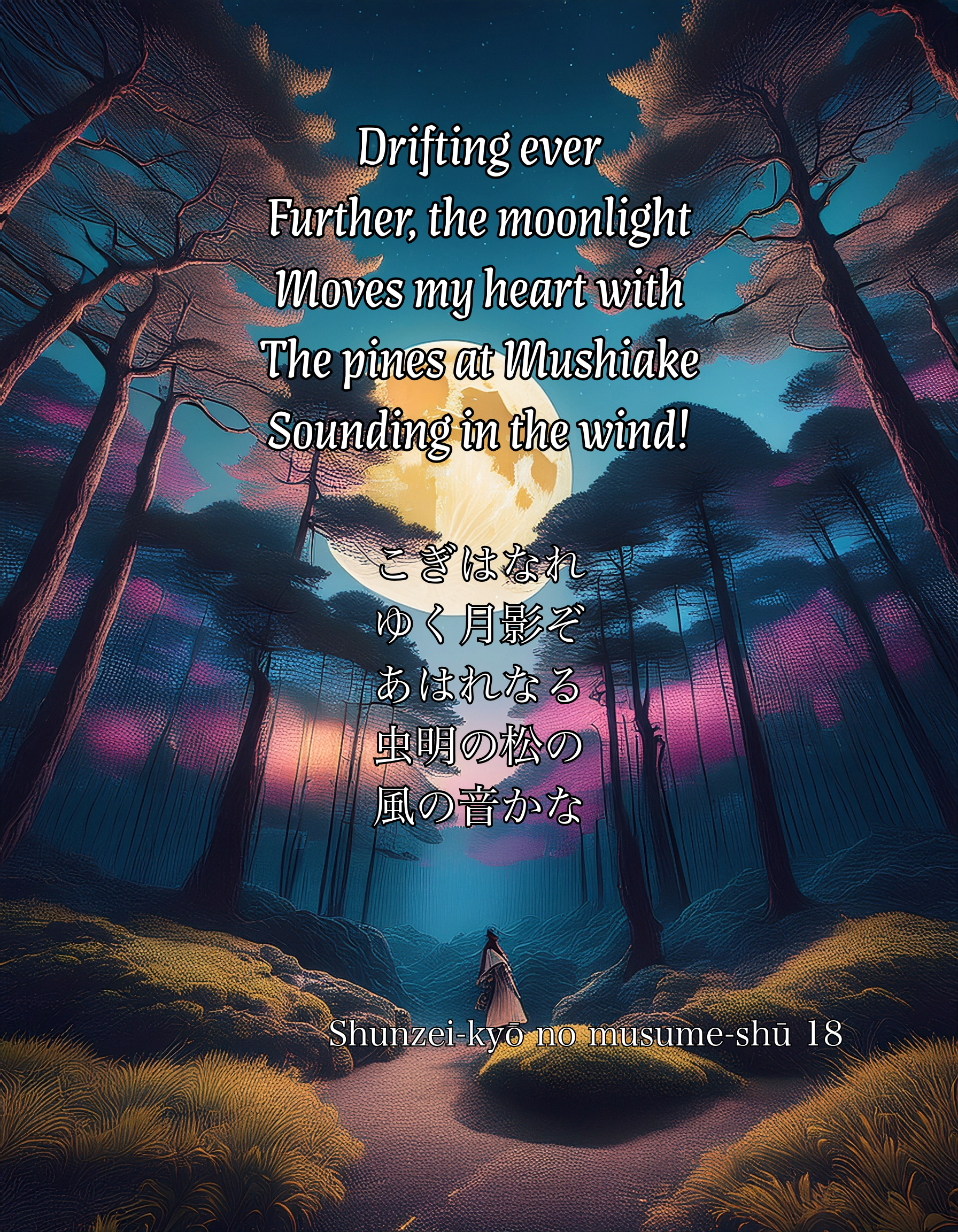
kogihanare yuku tsukikage zo awarenaru mushiake no matsu no kaze no oto kana
Drifting ever Further, the moonlight Moves my heart with The pines at Mushiake Sounding in the wind! [i]
18
[i] See: Seaways. 何となく心ぞとまるそれとみてこぎはなれゆくむしあけの松 nani to naku / kokoro zo tomaru / sore to mite / kogihanareyuku / mushiake no matsu ‘Somehow, / They linger in my heart / Having seen them / Drifting ever further, / The pines of Mushiake.’ (Shunzei gosha hyakushu 491); From a Fifty Poem Sequence on the Moon. むしあけのせとのしほひのあけがたになみの月かげとほざかるなり mushiake no / seto no shiohi no / akegata ni / nami no tsukikage / tōzakaru nari ‘At Mushiake / Strait the receding tide / At dawn, / The waves carrying the moonlight / Into the distance.’ Yoshitsune (Akishino gesseishū I: 64)
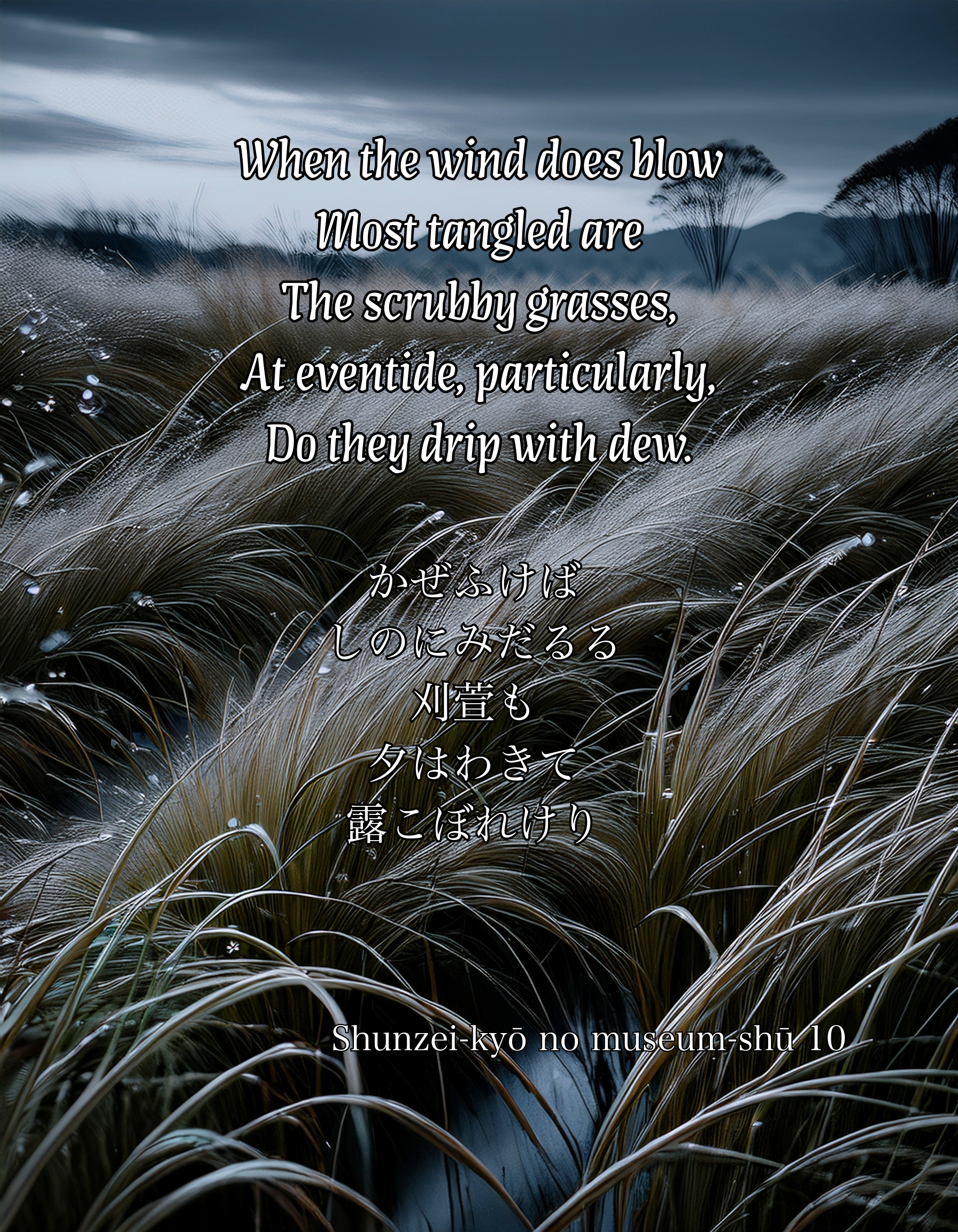
kaze fukeba shino ni midaruru karukaya mo yū wa wakite tsuyu koborekeri
When the wind does blow Most tangled are The scrubby grasses, At eventide, particularly, Do they drip with dew.[i]
10
[i] See: 荻の葉に露ふきむすぶ秋風もゆふべぞわきて身にはしみける ogi no ha ni/ tsuyu fukimusubu / akikaze mo / yūbe zo wakitem / mi ni wa shimikeru‘To the blades of cogon grass / Carrying drenching dewdrops / The autumn breeze / At eventide, particularly, / Pierces my heart.’ Kaoru (Genji monogatari 761); and: Composed as a poem on stags. さをしかのつまよぶこゑもいかなれや夕はわきてかなしかるらん saoshika no / tsuma yobu koe mo / ika nare ya / yū wa wakite / kanashikaruran ‘The stag, / A’crying for his mate: his bell / Why is it that / Particularly at eventide / It should be so sad?’ Master of the Right Capital Office Naganori (Senzaishū V: 317)
toshi goto ni kitsutsu wa ga miru sakurabana kasumi mo ima wa tachi na kakushi so
Every single year I hear of and gaze upon Cherry blossom: The haze, too, now Arising, don’t hide them!
Nakatsukasa
15
The Left’s poem is extremely charming – that really is how things are.
The Right’s poem: where is it that you always hear of and then see them? This is a bit rough. There’s also no reason to include the expression ‘now’ here. Thus, the Left wins.
[1] A variant of this poem was later included in Shūishū (I: 66).