akihagi no shitaba no tsuyu ni aranedomo kienu bakari zo hito wa koishiki
Upon the autumn bush clover’s Underleaves a dewdrop I am not, yet Simply will I fade away So much do I love him!
Taiyu no Suke 19
Right
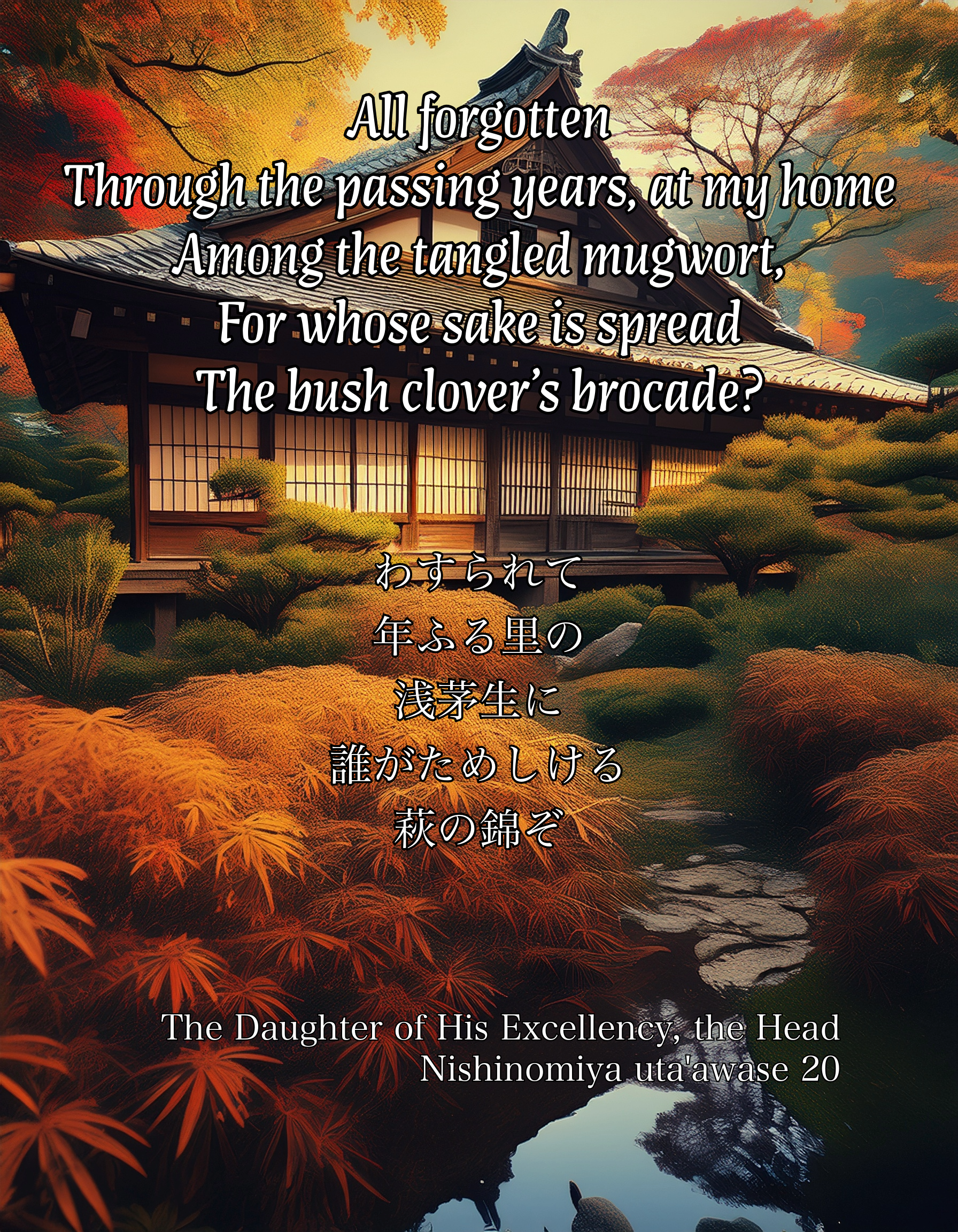
わすられて年ふる里の浅茅生に誰がためしける萩の錦ぞ
wasurarete toshi furu sato no asajū ni ta ga tame shikeru hagi no nishiki zo
All forgotten Through the passing years, at my home Among the tangled mugwort, For whose sake is spread The bush clover’s brocade?
The Daughter of His Excellency, the Head
20
I feel that the poem of the Left is conspicuously poetic, saying ‘Simply will I fade away / So much do I love him!’ while the poem of the Right’s ‘Through the passing years, at my home / Among the tangled mugwort, / For whose sake is spread / The bush clover’s brocade?’ makes me want to ask the bush clover the same question! The pull my heart in more than one direction, so here, too, I feel it’s not possible to decide on a winner or loser.
uchikirashi amagiru sora to mishi hodo ni yagate tsumoreru yuki no shirayama
Suddenly concealed By mist, the skies I glimpsed and In a moment drifted Snow covered Shira Mountain with white.
Controller’s Graduate 51
Right
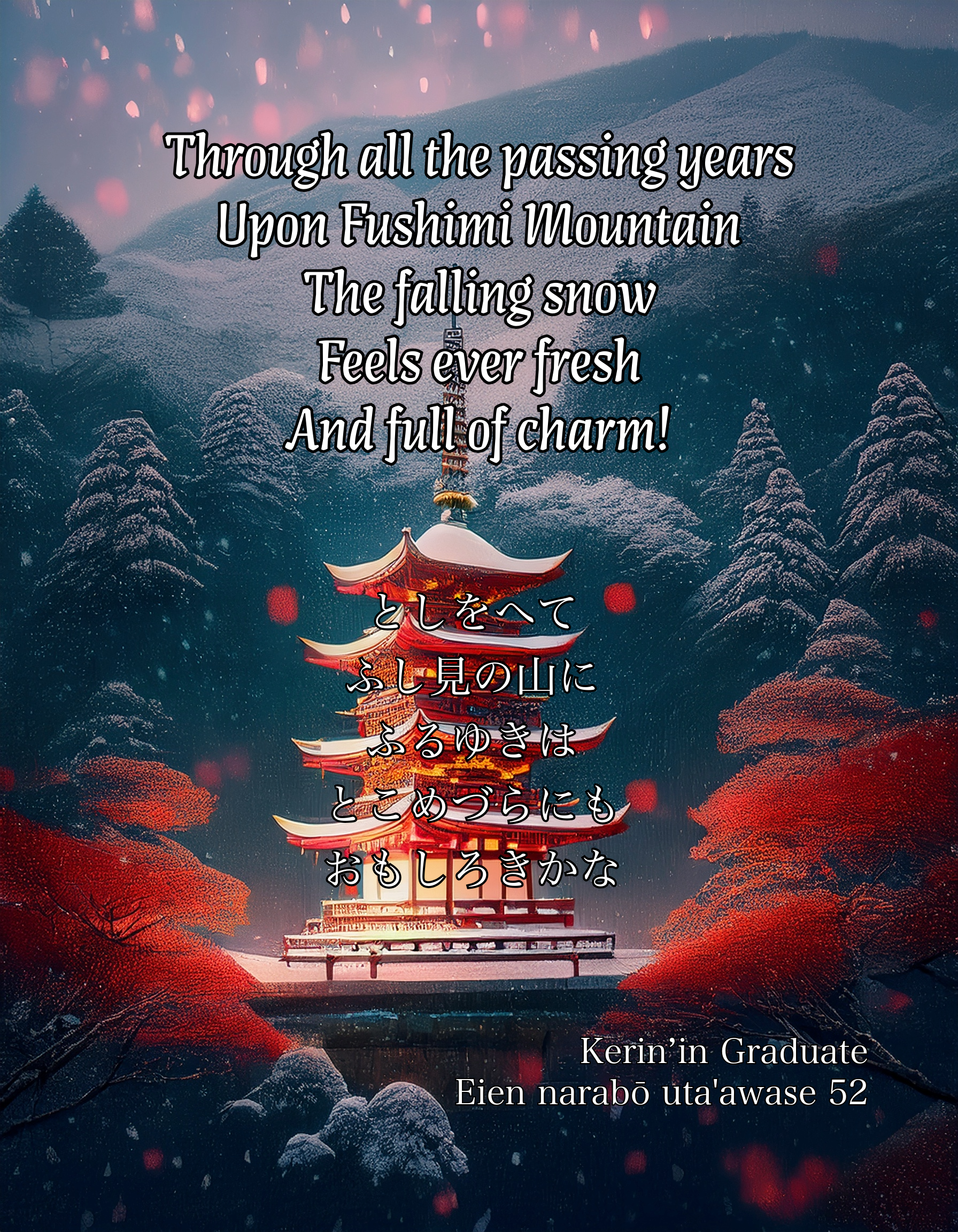
としをへてふし見の山にふるゆきはとこめづらにもおもしろきかな
toshi o hete fushimi no yama ni furu yuki wa tokomezura ni mo omoshiroki kana
Through all the passing years Upon Fushimi Mountain The falling snow Feels ever fresh And full of charm!
Kerin’in Graduate
52
The poem of the Left’s ‘Suddenly concealed / By mist, the skies’ is a clear case of repeating the same meaning. In addition, ‘snow covered Shira Mountain’ is one which is snow-capped regardless of whether it’s summer or winter. It’s not a mountain where one would be startled at seeing it ‘suddenly concealed’. The poem of the Right says that ‘through all the passing years the estate at Fushimi…feels ever fresh’, which seems as if this poem is specifying a period when this applies. It’s certainly a bit of a reach to say that this would be charming, but it’s not incongruous. Thus, I make this a tie.
I am unable to grasp the sense of the Left poem’s ‘suddenly concealed’. If it had been ‘concealed with falling’ then that would be better. In addition, I don’t understand the final ‘snow covered Shira Mountain’ either. I would have preferred it if the order had been ‘Shira Mountain’s snow’, but putting the ‘snow’ first seems to lack fluency and so, regretfully I would change this.
The Right’s ‘Fushimi Mountain’ is difficult to understand. It seems that ‘estate’ is a more standard composition, and ‘mountain’ is a novel usage. Having ‘Fushimi’ ‘feel fresh’ is evidence of thought, but even so, ‘mountain’ is vague.
tsurenasa no tameshi wa ta zo tare nite mo hito nagekasete hate wa yoshi ya wa
For cold cruelty Who is your exemplar? Whoever it might be, Is causing one such grief A good thing, in the end?
Lord Morotoshi 57
Right (M – Win)
逢ふ事をまつの汀に年ふればしづえに波のかけぬ日ぞなき
au koto o matsu no migiwa ni toshi fureba shizue ni nami no kakenu hi zo naki
For a meeting Pining by the waters’ edge As the years go by— Lower boughs by waves Washed not on any day, at all…
Lord Sadanobu 58
Toshiyori states: it is impossible to say that that the configuration and diction of the first poem is anything special. In the second poem, ‘For a meeting / Pining by the waters’ edge’ has poetic qualities, but continuing with ‘Lower boughs by waves / Washed not on any day, at all’ does not seem like a love poem, and if the poet had wanted to allude to tears here, well, it just doesn’t sound like it, does it. The Left has the conception of a Love poem, but it language lacks elegance; the Right is smooth, but has only a faint conception of love, and thus these tie.
Mototoshi states: this poem’s diction is particularly bizarre. What an objectionably unpleasant feeling of love! One does see this in the passage giving the reply by Nakatomi no Tokuin, and then there seems to have been the poem ‘go on then, you creeper’, but that one continues extremely charmingly, while this sounds ghastly. Then ‘For a meeting / Pining by the waters’ edge’, truly is a charming composition, and the subsequent ‘Lower boughs by waves / Washed not on any day, at all’ seems entirely clear. It seems to approach the quality of Komachi’s poem, to me! This is a win for the Right, I have to say.