旅ごろもうらがなしさにあかしかね草の枕は夢もむすばず
| tabigoromo uraganashisa ni akashikane kusa no makura wa yume mo musubazu | In my traveller’s garb My heart-sickness I cannot lift, for My grassy pillow Brings no dreams, at all… |
Hikaru Genji
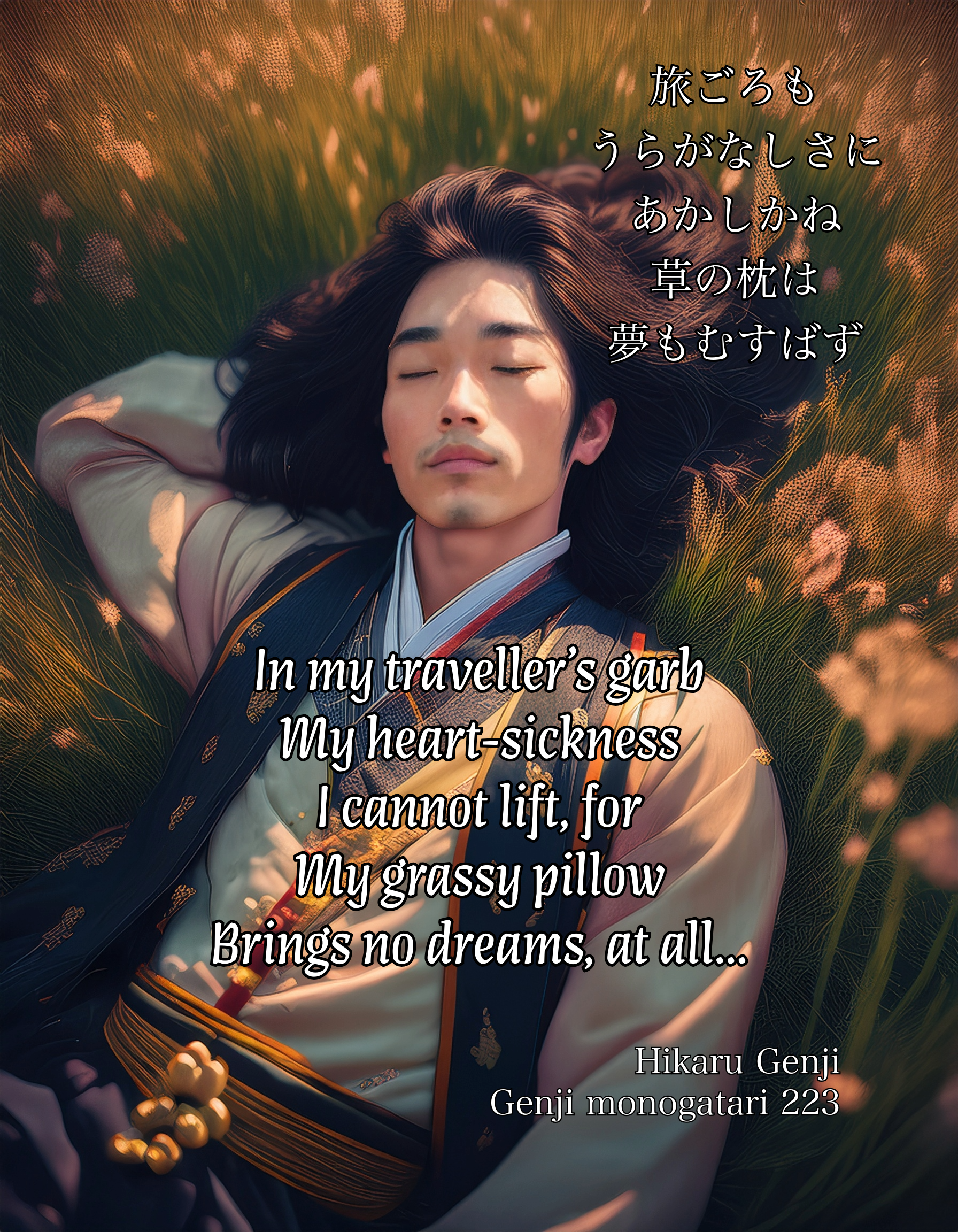
Composed when caught in a shower, while making a pilgrimage to one hundred temples in Higashiyama.
もろともに山めぐりするしぐれかなふるにかひなき身とはしらずや
| morotomo ni yamamegurisuru sigure kana Furu ni kaFinaki mi to Fa sirazu ya | Together with me On my mountain pilgrimage are The showers! ‘Tis pointless to fall On my sorry self, don’t you know! |
Master of the Left Capital Office Michimasa
Left (Tie)
まつかぜにふけゆく月のすみのえはなみのよるこそたちまさりけれ
| matsukaze ni fukeyuku tsuki no suminoe wa nami o yoru koso tachimasarikere | The wind through the pines Blows late upon the moon At Suminoe, where The night’s breaking waves Rise strikingly! |
Novice Jakunen[1]
49
Right
しもならで月もるよひやかたそぎのゆきあはぬひまもかみはうれしき
| shimo narade tsuki moru yoi ya katasogi no yukiawanu hima mo kami wa ureshiki | That ‘tis not frost, but The moon, dripping at night Through the ridge poles Unmatched gaps, Does the Deity feel joy? |
Suke, from the Residence of the Former Minister of the Right[2]
50
The Left poem’s ‘Blows late upon the moon / At Suminoe’ sounds pleasant, but there have been recent poems, such as ‘Brings waves–that / I would tell you!’[3] and ‘Simply with the waves / Did seem to draw near with the night’[4] and while the initial section of the poem here differs, basing a poem on this is not that unusual, I think. The tone of the Right’s poem is charming, but it does not seem likely that the Deity would feel joy simply at the moon coming through the gaps in His ridgepoles. The Deity’s power is limitless and wards eighty isles beyond Sumiyoshi—indeed, there is nowhere in Tsumori’s shore or Sumiyoshi beach, above the waves or in the shad of the pines that it does not reach. I have discussed ridgepoles earlier. Nevertheless, the configuration of the poem isn’t bad, so these should tie, I think.
[1] Shami Jakunen 沙弥寂念
[2] Zen-udaijin no ie no Suke前右大臣家佐
[3] 人しれぬ思ひありそのはま風に浪のよるこそいはまほしけれ hito shirenu omoi ariso no hamakaze ni nami no yoru koso iwamahoshikere ‘Unknown to all / My passion burns—toward a rocky / Beach the breeze / Brings waves–that / I would tell you!’ Middle Captain Toshitada (Horikawa-in enjo awase 17/KYS (2) 468/500)
[4] Composed when he was asked by people in the capital what the moon had been like, when he had returned there, after going to Akashi to gaze upon it, at a time when it was particularly bright. 有明の月もあかしの浦風に波ばかりこそよるとみえしか ariake no tsuki mo akashi no urakaze ni nami bakari koso yoru to mieshika ‘The dawntime Moon’s brightness, with Akashi’s / Beach breezes / Simply with the waves / Did seem to draw near with the night…’ Taira no Tadamori (KYS (2) III: 216/KYS (3) III: 212)
Left
あまくだるかみもひさしくみやゐして月ものどかにすみよしのうら
| amakudaru kami mo hisashiku miya’ishite tsuki mo nodoka ni sumiyoshi no ura | Descending from Heaven, The Deity, too, eternally Manifests here, where The moon, too, is calm Above the bay of Sumiyoshi. |
Venerable Dharma Eye Shōken[1]
47
Right (Win)
かみよよりたぐひなしともすみよしのまつやこよひの月をみるらむ
| kamiyo yori taguinashi tomo sumiyoshi no matsu ya koyoi no tsuki o miruramu | Since the Age of Gods Is there nothing to compare with, At Sumiyoshi, The pines tonight with The moon filling my gaze? |
Novice Jakuchō[2]
48
The Left appears to have a truly charming conception and configuration, but beginning with ‘The Deity, too, eternally’ and then saying ‘The moon, too, is calm’ and repeating the same word is discordant. The Right, in addition to having no particular faults to mention, has an extremely pleasant-sounding configuration with ‘The pines tonight’. Thus, I make this a win for the Right.
[1] Hōgen kashōi Shōkaku 法眼和尚位静賢
[2] Shami Jakuchō沙弥寂超
A poem composed in reply to His Majesty by Tachibana sukune Naramaro.
奥山之 真木葉淩 零雪乃 零者雖益 地尓落目八方
| okuyama no maki no pa sinogi puru yuki no puri pa masu tomo tuti ni otime ya mo | Deep within the mountains Evergreen leaves are weighed down With falling snow, but Even should it keep on falling Will it ever tumble to the ground? |
Composed on an occasion when I had commanded many people to compose on the conception of the last day of the Ninth month.
はつせ山けふをかぎりとながめつつ入相のかねに秋ぞくれぬる
| hatsuseyama kyō o kagiri to nagametsutsu iriai no kane ni aki zo kurenuru | On Mount Hatsuse, Today marks the bound, I think While gazing out, while With the sunset bell Autumn passes into dusk. |


