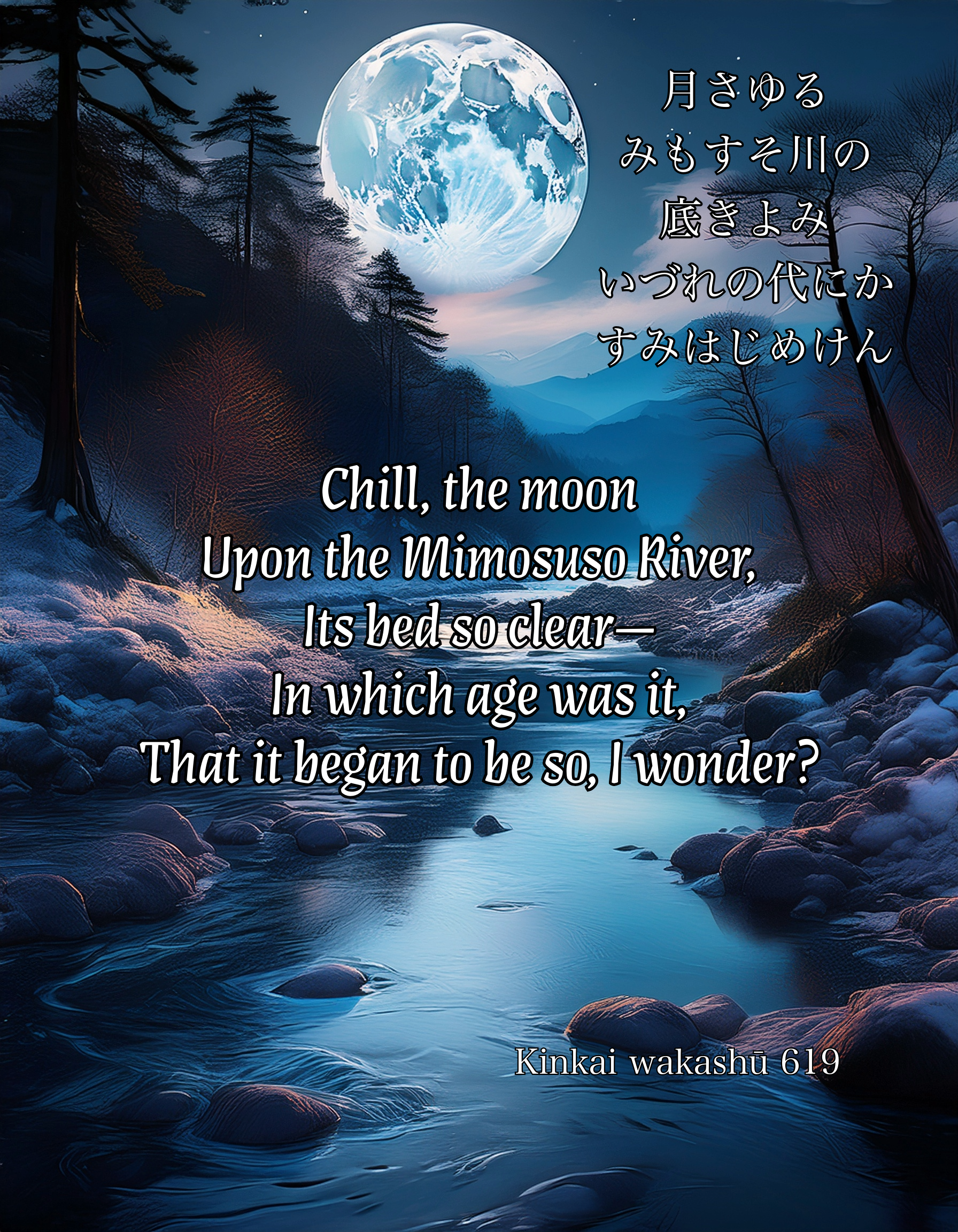
tsuki sayuru mimosusogawa no soko kiyomi izure no yo ni ka sumihajimeken
Chill, the moon Upon the Mimosuso River, Its bed so clear— In which age was it, That it began to be so, I wonder?[i]
619
[i] See: Composed for a picture of the Rinji Festival at the Kamo Shrine on a folding screen prepared for the entrance of a Junior Consort to the palace in the 6th year of Bunji (1190). 月さゆるみたらし河にかげみえてこほりにすれる山あゐの袖 tsuki sayuru / mitarashigawa ni / kage miete / kōri ni sureru / yama’ai no sode ‘Chill, the moon, / Upon the Mitarashi River / Shines, seeming as / A design of ice upon / Indigo sleeves.’ Master of the Dowager Empress’ Household Office Toshinari (Shinkokinshū XIX: 1889)
kasugayama chie ni sakayuru sakakiba wa yorozuyo made no kimi ga tame ka
Upon Kasuga Mountain A thousand branches grow, Leafy, on the sacred tree— Until ten thousand ages pass Will they ward my Lord!
Lady Kazusa 69
Right
君がよはいふかぎりなしみよしののこがねがみねにみよをまつまで
kimi ga yo wa iu kagiri nashi miyoshino no kogane ga mine ni miyo o matsu made
My Lord’s reign— Words cannot describe: ‘til fair Yoshino’s Golden peak’s Age one must await!
Lady Shikibu 70
The poem of the Left seems poetic to an extraordinarily outlandish degree! The poem of the Right’s ‘‘til fair Yoshino’s / Golden peak’s / Age one must await!’ has a sufficient conception of felicitation. Thus, these tie.
That the Left is addressed to Mount Kasuga is highly admirable. Is the Right’s ‘golden peak’ a reference to Mount Mitake? It’s very difficult to say anything profound here. Arbitrarily, I would make this a tie—the quality of the poems makes that seem right.
yorozuyo no aki no katami ni nasu mono wa kimi ga yowai o noburu shiragiku
Of ten thousand ages’ Autumns a keepsake I will make: My Lord’s age Extended by a white chrysanthemum!
Lord Akinaka 29
Right
今朝みればさながら霜をいただきて翁さびゆくしら菊の花
kesa mireba sanagara shimo o itadakite okina sabiyuku shiragiku no hana
When this morn I look That’s how it is: with frost Bestowed A lonesome ancient seems This white chrysanthemum bloom!
Lord Mototoshi 30
Toshiyori states: this first poem is strongly characterized by felicitation, and that’s about all the fault I can mention. As for the second poem, ‘a lonesome ancient seems’ is certainly an expression I don’t know. Still, if I think of examples from prior poems, ‘lone ancient’ could be interpreted as deriving from ‘dotaged ancient’, but then the conception seems different here, so this is most likely wrong. I can only give a decision once I am certain.
Mototoshi states: ‘Of ten thousand ages’ / Autumns a keepsake / Will make’ resembles Kanemori’s famous work,[1] which has often been alluded to in composition, I think. This poem is charming. ‘Will make’ is an extremely abbreviated expression, and so the final ‘age / Extended by a white chrysanthemum’ appears to have little connection to it. There is Tomonori’ s ‘Dew-dappled / Let us pluck and wear’[2], and also responses sent on the 9th day of the Ninth Month to the residences of Tadamine and Tsurayuki like ‘Bearing droplets / Age is extended by / Chrysanthemums’, aren’t there. Given that’s the case there would be many such keepsakes of extended age. As for the Right’s ‘That’s how it is: with frost / Bestowed / A lonesome ancient seems, well, it seems that just how I composed a poem about lingering chrysanthemums—have I done something wrong?