akatsuki ni nari ya shinuran ogurayama naku shika no ne ni tsuki katabukinu
Is the dawning On its way, I wonder? On gloomy Mount Ogura Crying, a stag bell out As the moon sets.
Mototoshi, Former Assistant Captain in the Palace Guards, Left Division 9
Right
暁や声高砂になく鹿をほのかにやきく沖の舟人
akatsuki ya koe takasago ni naku shika o honoka ni ya kiku oki no funabito
At the dawning From the heights, the bell, at Takasago Of a stag Is faintly heard, perhaps, By the boatmen on the offing…
Head 10
The Left’s poem lacks any superlative diction, yet does not appear to have any glaring faults either. As for the Right’s poem, I do question the placement of ‘at’ in ‘at the dawning’ and, in addition, the order seems reversed in ‘From the heights, the bell, at Takasago / Of a stag’—so much so that I find it difficult to grasp the sense. If the poem had been composed to put ‘stag’ before ‘heights of Takasago’, the poem would feel more trustworthy, wouldn’t it.
akihagi o kusa no makura ni musubite ya tsuma koikanete shika no fusuran
The autumn bush clover For a grassy pillow Has he woven—is that why Unable to love his mate The stag seems to lie?
Koreyuki 41
Right
妻こふる秋にしなればさをしかの床の山とてうちもふされじ
tsuma kouru aki ni shi nareba saoshika no toko no yama tote uchi mo fusareji
He yearns for his mate In autumn, above all, so In the stag’s Bed among the mountains He cannot lay him down, it seems.
Arifusa 42
The Left isn’t bad, but isn’t there Controller Kore’ie’s poem:
秋萩を草の枕にむすぶ夜はちかくもしかのこゑをきくかな
akihagi o kusa no makura ni musubu yo wa chikaku mo shika no koe o kiku kana
The autumn bush clover For a grassy pillow I weave tonight— Close by, truly, a stag’s Bell I hear! [1]
While there is this earlier example, neither core nor the conceptions of these poems are the same, and as the Right’s poem is not all that good, after careful consideration I make this a tie.
[1] On hearing a stag at his lodgings. KYS (3) III: 224
kusagakure mienu oshika mo tsuma kouru koe oba e koso shinobazarikere
Hidden by the grasses, Unseen, the stag, too Longing for his mate, His bell, indeed, is unable To conceal!
Lord Yorimasa 37
Right
秋の野の花のたもとに置く露や妻よぶしかの涙なるらむ
aki no no no hana no tamoto ni oku tsuyu ya tsuma yobu shika no namida naruramu
In the autumn meadows, Upon the blossoms’ sleeves Are the fallen dewdrops The stag—calling for his mate— Letting tears fall?
Narinaka 38
The Left is novel, and the Right charming, respectively. The Right’s poem does have a large number of identical syllables—while this is criticized in the Code of the Creation of Poetry as a ‘whole body fault’, it is not the case that poems containing this defect have not appeared in poetry matches from time to time, and I don’t feel it’s necessary to examine whether there are a large number of similar cases here: such things are simply a style of poetry.
kusakare no fushido sabishiku nariyukeba shika koso tsuma mo koishikarurame
Among the withered grasses He lies down, yet into lonely sadness Does he sink, so The stag his mate Seems to long for all the more…
Suketaka 35
Right (Win)
さをしかの声しきるなりみよしののいさかた山に妻やこもれる
saoshika no koe shikiru nari miyoshino no isakatayama ni tsuma ya komoreru
The stag’s Bell rends my heart— In fair Yoshino On Mount Isakata Is his mate secluded.
Tōren 36
I don’t believe I have heard a prior instance of the Right’s ‘Isakata Mountain’, have I? In addition, there doesn’t seem to be any reason for its use here. In general, it’s preferable to compose using terms which are familiar. As for the Left’s poem, it sounds as if the stag only cares for his mate when the grasses are withered, but implying that grass only withers in the Ninth and Tenth Months is at variance with the actual period when it happens, isn’t it? Moreover, it is dubious to compose pivoting around the topic—and doing this has been stated to be undesirable in poetry matches. Indeed, I recall that in the Poetry Match at the Palace in the Fields, when someone composed pivoting on ‘maidenflower’, the judge criticized it, saying, ‘it is mangling the words of our land to compose in this manner.’ Thus, although the poem does have a freshness about it, the Right must win, I think.
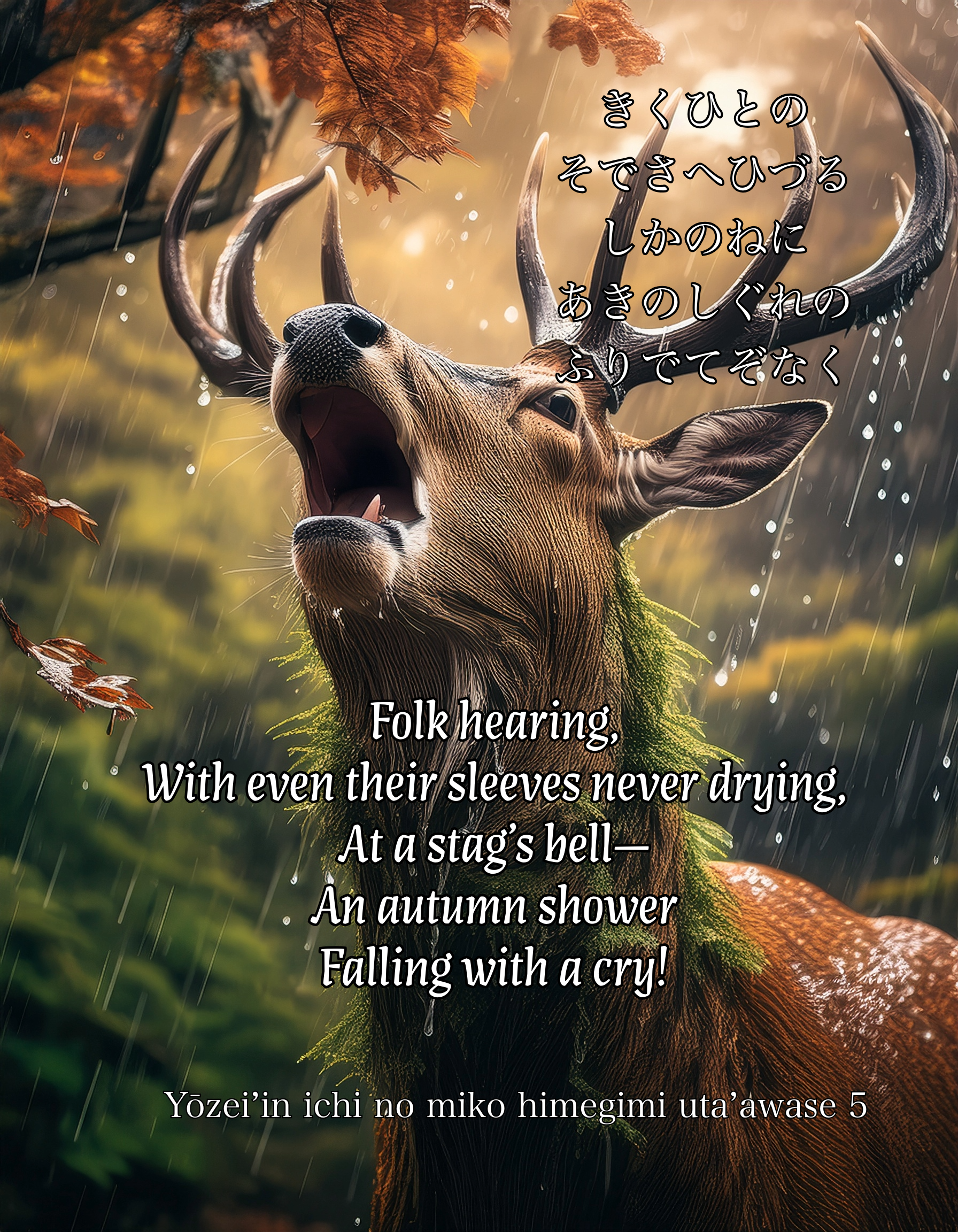
kiku hito no sode mo nurekeri aki no no no tsuyu wakete naku saoshika no koe
Folk who hear him Have dampened sleeves, too— Across the autumn meadows As he forges through the dewdrops The stag’s bell.
Lord Kinshige 33
Right
鹿の音の吹きくるかたにきこゆるはあらしやおのがたちどなるらん
shika no ne no fukikuru kata ni kikoyuru wa arashi ya ono ga tachidonaruran
The stag’s bell Comes, blown, I do hear— Has the storm, himself, Arisen there, I wonder?
Lord Kiyosuke 34
I do wonder about the Left, which implies that one would soak one’s sleeves with tears on hearing a stag belling, given that I am unable to bring to mind any prior poems composed in this vein. What are we to make of the fact that, while the poem by Toshiyori, which I mentioned earlier, was composed about tears, there is still no trace of this usage in any other poetry match? It does seem poetic overall, though. The Right’s ‘Has the storm, himself, arisen’ is remarkably startling, so it’s a personal poem. While it’s not the case that there are no prior compositions in this manner, poems for poetry matches have a certain way about them and that’s simply how it is. Thus, the Left wins.
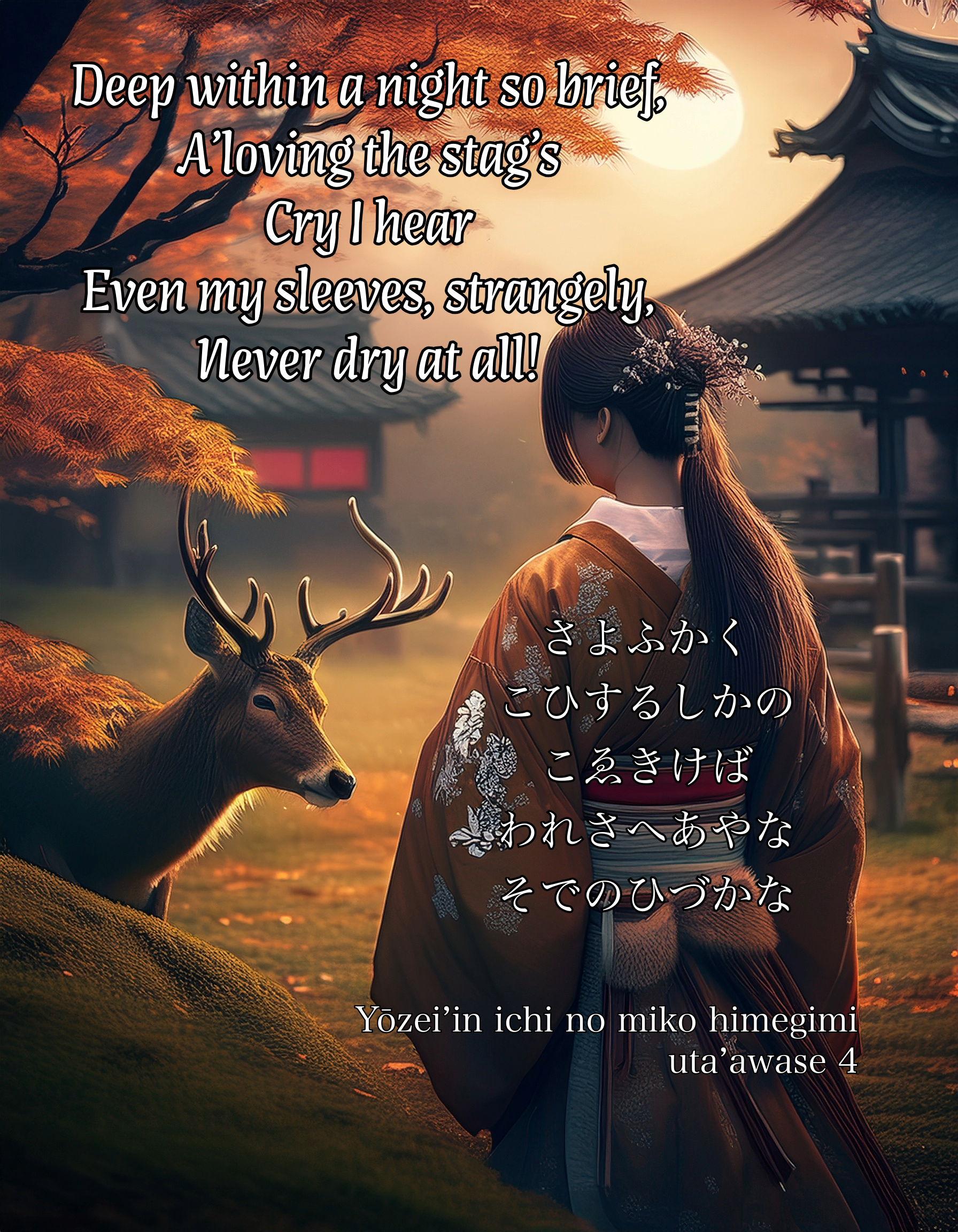
saoshika no naku ne wa yoso ni kikitsuredo namida wa sode no mono ni zo arikeru
The stag’s Sad bell in the distance Did I hear, yet still My tears my sleeves Have covered.
Sadanaga 31
Right (Win)
山たかみおろすあらしやよわるらんかすかに成りぬさをしかの声
yama takami orosu arashi ya yowaruran kasuka ni narinu saoshika no koe
From the mountain’s heights Descending, has the storm wind Weakened? Faintly comes The stag’s bell.
Lord Suetsune 32
I do wonder about the Left, given that there appears to be a poem by the late Lord Toshiyori:
さをしかのなくねは野べにきこゆれどなみだは床の物にぞ有りける
saoshika no naku ne wa nobe ni kikoyuredo namida wa toko no mono ni zo arikeru[1]
The stag’s Sad bell upon the plain I heard, yet My tears my bed Have covered.
I am a little leery of the Right’s central line, but overall it is not the case that this poem lacks conception, so it should win.
[1] KYS (3) III: 225 Composed on ‘listening to stags in a hut in the fields’. Also SZS V: 310 ‘Composed when he heard a stag belling while at a mountain retreat in Tanakami’. Also Sanboku kikashū 451 ‘Listening to stags in a hut in the fields’.