oshimu tote orishi bakari o mume no hana sode ni nioi no taezumaru kana
How dear to me, I think, are, Just plucked, These plum blossoms, for Their scent upon my sleeves Will ever cling!
6
[i] This poem is included in Shoku kokinshū (I: 66), attributed to Kanemori, with the headnote ‘A poem from the Poetry Match held by the Reikeiden Junior Consort’.
[ii] Kanemori’s poem here can be viewed as a response to the emotions expressed by Ono no Komachi in her famous composition: Topic unknown. 花の色はうつりにけりないたづらにわが身世にふるながめせしまに hana no iro wa / utsurinikeri na / itazura ni / wa ga mi yo ni furu / nagameseshi ma ni ‘The colour of this flower / Has already faded away, / While in idle thoughts / My life goes by, / As I watch the long rains fall.’ (Kokinshū II: 113) (Hagitani and Taniyama 1965, 81)
saohime no ito somekakuru aoyagi o fuki na midari so haru no yamakaze
Princess Sao Has dyed the dangling threads of Green willow— O, don’t blow them into tangles, Spring breeze from the mountains!
Kanemori 6
Warblers should have appeared here, but this is a poem about willows, so it loses.
しろたへの雪ふりやまぬ梅がえにいまぞうぐひす花となくなる
shirotae no yuki furiyamanu ume ga e ni ima zo uguisu hana to nakunaru
White as mulberry cloth The snow falls unceasing— Upon the branch of plum, Now, indeed, the warbler, Sings of the blossom!
Kanemori 7
Despite the mistaken composition, His Majesty required the original poem and it was located and recited.
Lord Hiromasa, the Reciter for the Right, mistakenly recited the willow poem. The Left raised an objection, saying, ‘He should have recited the warbler poem but, instead, erroneously recited the willow poem. Should he really be allowed to recite the correct poem now?’ The substance of the Left’s objection was conveyed to His Majesty, who instructed, ‘Provide a report based on prior precedent.’
This minor official advised His Majesty, ‘The Left’s objection is not unreasonable. However, matters such as this are best determined according to the circumstance of the occasion. As this was simply human error, why discriminate against the poem?’
Thus, His Majesty ordered that the poem be recited.
When he did so, Lord Hiromasa turned pale and was unable to recite the poem straight away. Although he finally managed to do so, his voice trembled and the Left laughed at him. Furthermore, the poem’s diction contained the nonsensical expression ‘sings of the blossom’, and thus this was still a loss.
[i] An allusive variation on: A poem from the Empress’ poetry competition held in the Kanpyō period. 花の香を風のたよりにたぐへてぞ鶯さそふしるべにはやる hana no ka o / kaze no tayori ni / taguete zo / uguisu sasou / shirube ni wa yaru ‘The blossoms’ scent / Messaged on the breeze / Brings / An invitation to the warbler / To try and bring him forth!’ Ki no Tomonori (Kokinshū I: 13)
[ii] This poem was included in Gyokuyōshū (I: 42), attributed to Asatada, with the headnote ‘On warblers, from the Palace Poetry Match in Tentoku 4’.
The Left poem’s sense is extremely charming. The Right poem’s pointless introduction of blossom scattering lacks interest and its diction is also poor. Thus, I make the Left the winner.
[i] This poem is included in Shūishū (I: 6); it was also included in the third edition of Kin’yōshū (I: 10).
[ii] This poem was subsequently included in several other collections: Kin’yōshū (first edition) (I: 14); Kin’yōshū (third edition) (I: 11); Shoku goshūishu (II: 114); and Mandaishū (II: 348).
kuraiyama kodakaku naran matsu ni nomi yaoyorozuyo to harukaze zo fuku
On Mount Kurai[i] Tall will become the pines trees ‘Simply wait Eight million ages,’ whispers The gusting breeze of spring!
662
[i] Mount Kurai (kuraiyama 位山), lies in what is now northern Gifu prefecture, and is one of the peaks in the Hida Mountains (hida sanmyaku 飛騨山脈), also known as the Northern Alps, stretching through north central Honshu. Its use here, however, is purely because kurai 位, was homophonous with the word for ‘court rank’. As matsu 松 (‘pine tree’) was also homophonous with matsu 待つ (‘wait’), the poem is a dual play on words
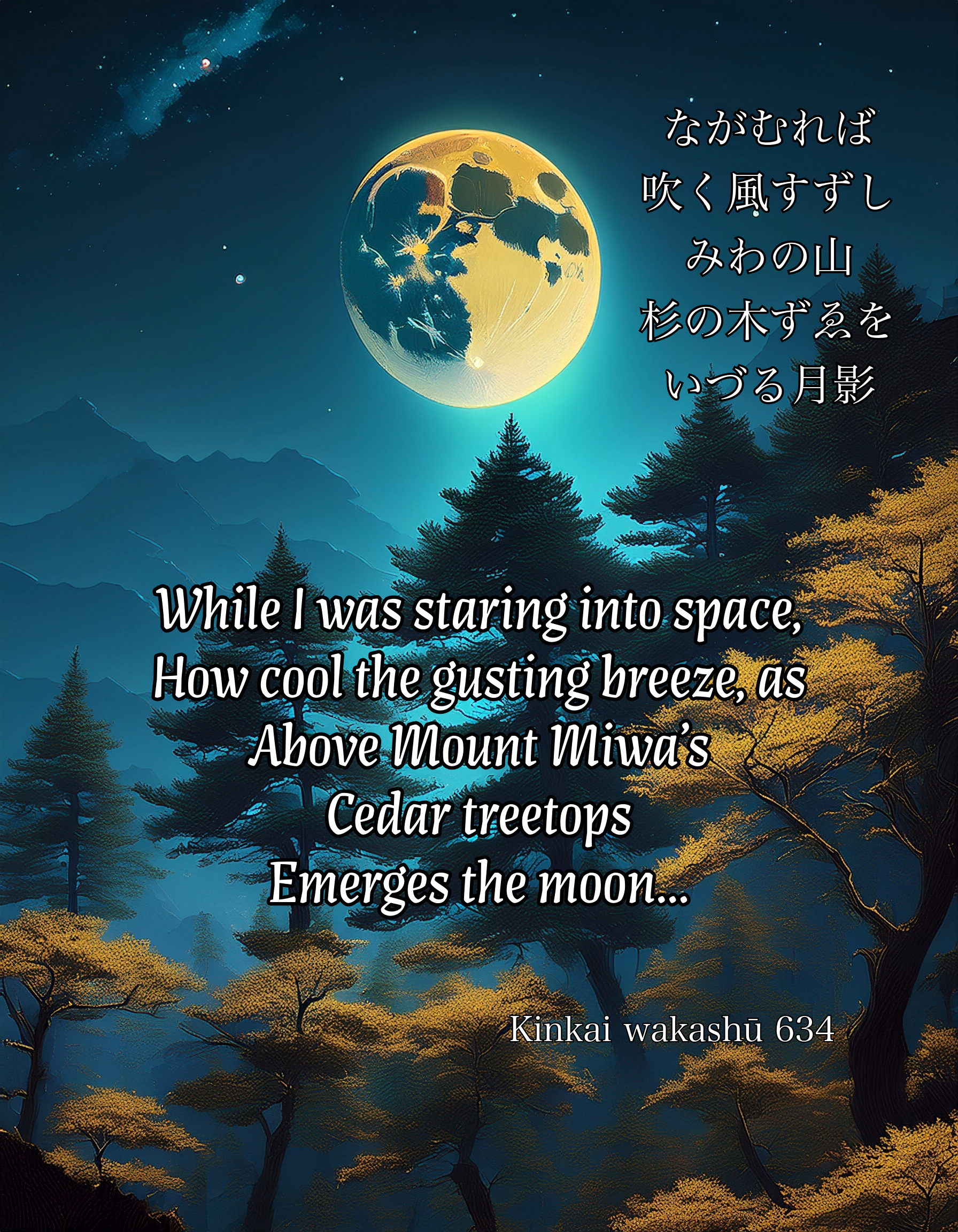
nagamureba fuku kaze suzushi miwa no yama sugi no kozue o izuru tsukikage
While I was staring into space, How cool the gusting breeze, as Above Mount Miwa’s Cedar treetops Emerges the moon…[ii]
634
[i] As with poem 631, the topic here, ‘The summer moon above the shrine’ (shatō kagetsu 社頭夏月) was generally used when the poet had a specific shrine in mind—in this case, Ōmiwa Shrine (Ōmiwa jinja 大神神社).
[ii] See: As part of a hundred-poem sequence. ながむれば衣手すゞしひさかたのあまのかはらの秋のゆふぐれ nagamureba / koromode suzushi / hisakata no / ama no kawara no / aki no yūgure ‘While I was staring into space, / How chill my sleeves became; / Upon eternal / Heaven’s riverbed / Comes an autumn evening.’ Princess Shokushi (Shinkokinshū IV: 321)