君が代に猶ながらへて月きよみ秋のみ空の影をまたなん
| kimi ga yo ni nao nagaraete tsuki kiyomi aki nomi sora no kage o matanan | My Lord’s reign Shall yet continue on, so for The pure moon’s face, Alone in the autumn sky, Let us await. |
672
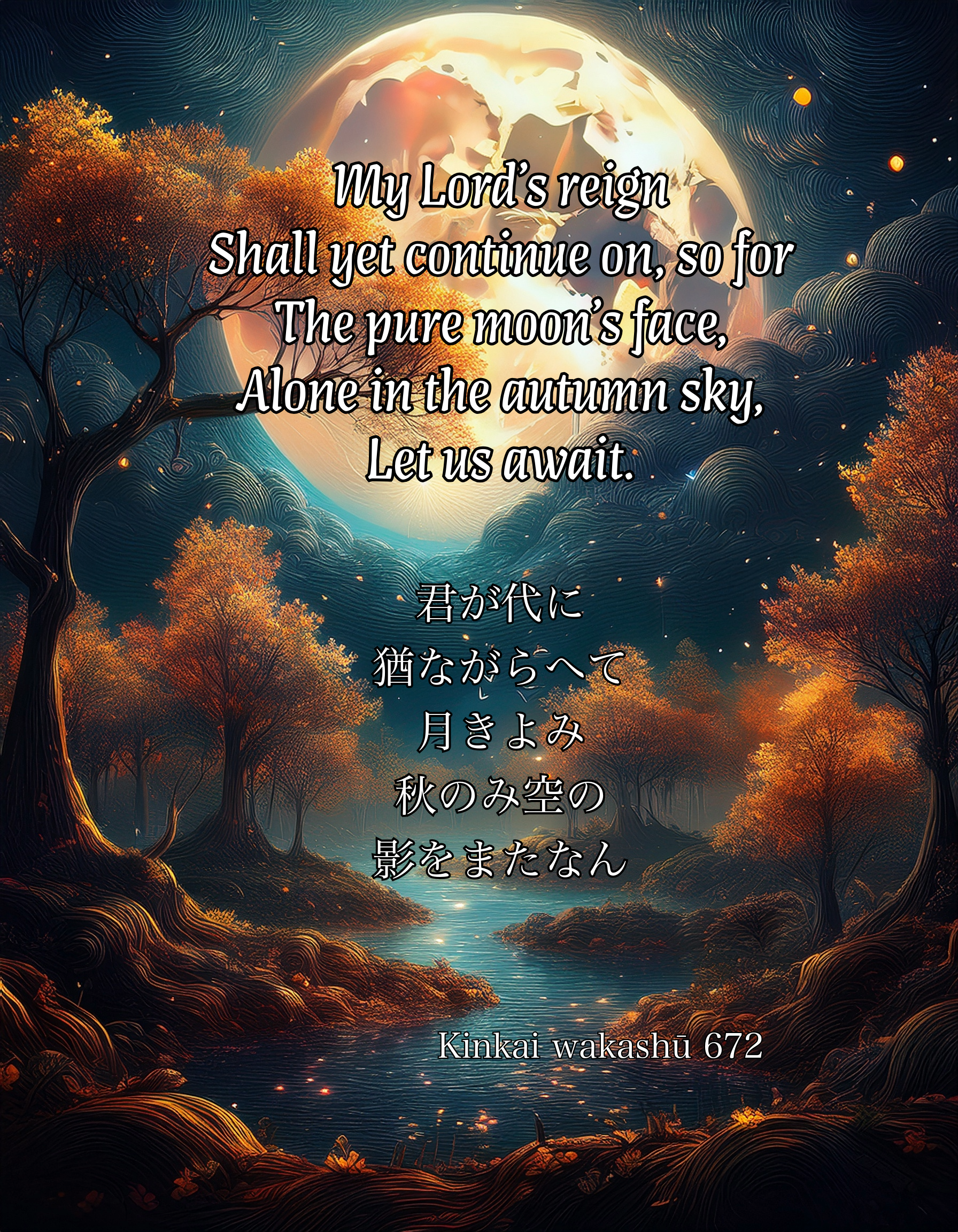
Around autumn, when someone with whom I had been accustomed to speaking had gone somewhere, I took the opportunity to send these by messenger.
うはの空にみし面影をおもひいでて月になれにし秋ぞ恋しき
| uwa no sora ni mishi omokage o omoi’idete tsuki ni narenishi aki zo koishiki | In the heavens’ heights The face that once I saw I do recall, and Accustomed to the moon In autumn do I yearn even more…[i] |
609
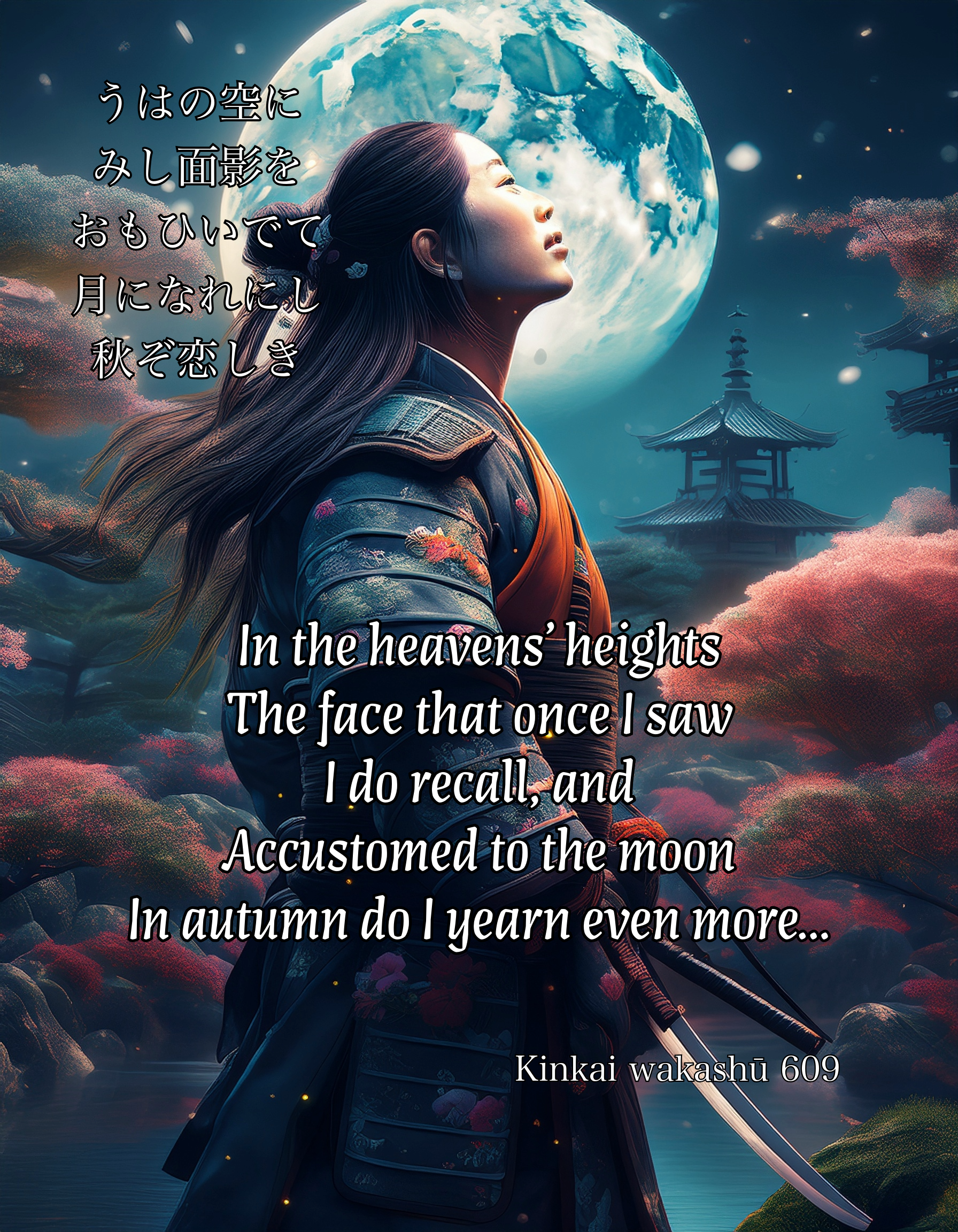
[i] See: On the conception of ‘love, having once met, but no longer’ for the Poetry Match held at the Poetry Office. ゆめかとよみし面影もちぎりしもわすれずながらうつつならねば yume ka to yo / mishi omokage mo / chigiri shi mo / wasurezu nagara / utsutsu naraneba ‘Was it a dream? Or not? / That face I saw, and / His promises, too, / I cannot forget, / Though real they were not…’ The Daughter of Toshinari, Assistant Master of the Dowager Empress Household Office (Shinkokinshū XV: 1391)
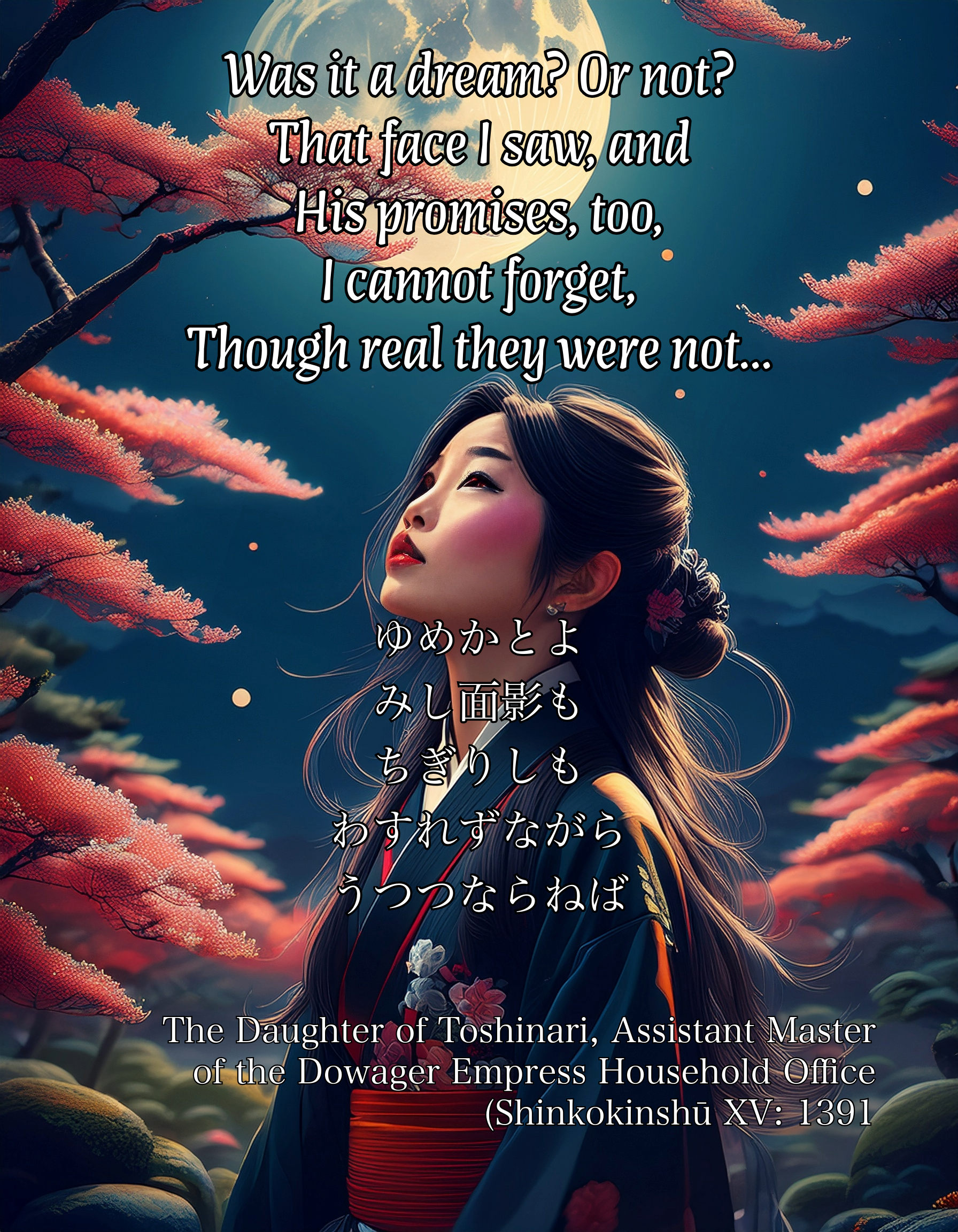
On the conception of ‘love, having once met, but no longer’ for the Poetry Match held at the Poetry Office.
ゆめかとよみし面影もちぎりしもわすれずながらうつつならねば
| yume ka to yo mishi omokage mo chigiri shi mo wasurezu nagara utsutsu naraneba | Was it a dream? Or not? That face I saw, and His promises, too, I cannot forget, Though real they were not… |
The Daughter of Toshinari, Assistant Master of the Dowager Empress Household Office
Round Six
Left
雲かかる高志のやまの明暮に妻まどはせるを鹿鳴くなり
| kumo kakaru takashi no yama no akegure ni tsuma madowaseru oshika naku nari | All hung about with cloud On Takashi Mountain In the gloaming Having lost his mate A stag bells out. |
Nakamasa
11
Right
山がつの先あかつきをしりがほに裾野に出でて鹿ぞ鳴くなる
| yamagatsu no mazu akatsuki o shirigao ni susono ni idete shika zo naku naru | A mountain man First of all, that ‘tis dawn Knows plain upon his face, As he sets out upon the slopes As a stag bells out! |
Head
12
The Left poem’s conclusion, ‘Having lost his mate / A stag bells out’ seems no different from that of a poem by Gō no Jijū in poetry match held by the First Princess.[1] As for the poem of the Right’s ‘A mountain man / Awaits the dawn / Knowing plain upon his face’—what on earth might a mountain man look like while waiting for dawn? There is the tale of Hangu Pass in Cathay, where the barrier guard was waiting for dawn and opened the gate after hearing a cock’s crow, but the expression ‘a mountain man awaits the dawn’ has never appeared before in a poem—either one of Cathay or in the words of Yamato, so I feel that both Left and Right lack any superlative qualities.


[1] Stags. をぐら山たちどもみえぬゆふぎりにつままどはせるしかぞなくなる ogurayama / tachidomo mienu / yūgiri ni / tsuma madowaseru / shika zo nakunaru ‘On gloomy Ogura Mountain / Stands unseen / Among the evening mists / Having lost his mate / A belling stag.’ (Yūshi naishinnō-ke uta’awase eishō go-nen 27). This event was held at the residence of Imperial Princess Sukeko (Yūshi) on the 5th day of the Sixth Month, Eishō 5 [26.10.1050]. The poem won its round, and was later included in Goshūishū (IV: 292).
Love
Left
わが恋は春のなかばになりにけり花のにほひに影やみゆると
| wa ga koi wa haru no nakaba ni narinikeri hana no nioi ni kage ya miyuru to | My love In the heart of spring Has come about: In the glow of blossom Can I see her face… |
7
Right
春はなほくるしかりけりさくら花いろのつきつつ恋のまされば
| haru wa nao kurushikarikeri sakurabana iro no tsukitsutsu koi no masareba | Spring is ever Full of pain: The cherry blossoms’ Hues exhausted, as My love is at its strongest… |
8


Recalling love beneath the moon.
春やあらぬ月は見しよの空ながらなれし昔の影ぞ恋しき
| haru ya aranu tsuki wa mishi yo no sora nagara nareshi mukashi no kage zo koishiki | Is this not that spring? The moon is as I beheld it that night Within the skies, yet I had grown accustomed, long ago, to Her face, so much more dear to me… |
496


When the Gokyōgoku Regent ordered her to produce a hundred poem sequence.
いくめぐり過行く秋にあひぬらむかはらぬ月の影をながめて
| iku meguri sugiyuku aki ni ainuramu kawaranu tsuki no kage o nagamete | How many circuits, Passing through autumn Might I have encountered, The unchanging moon’s Lit face within my gaze? |
Kojijū


