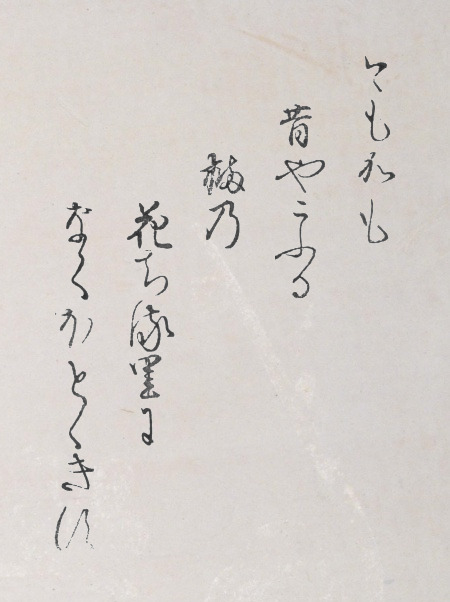
The poem of the Left is entirely lacking in any interest. Isn’t this a sage’s jewelled tree? It really leaves me grief-stricken. The poem of the Right contains two faults in a single work. First, this is not the right time of year to be referring to a ‘verdant mountain’. Second, ‘vanishes from sight’ refers to disappearing in water. In the Collection of a Myriad Leaves ‘vanishing from sight’ is written as ‘hidden in the water’. Thus we have lines such as, ‘swarming frogs hiding in the weeds beneath the waves’. There are no prior poems mentioning ‘mountains vanishing from sight’ in either ancient or modern times.
On the matter of the ‘tree of gems’, I heard a long time ago that this might have appeared in an important source, but as this is something I know little about, even if this is a fault, it’s difficult for me to say anything about it. Well, in any case, it doesn’t sound bad. Would someone who knows all about this compose poorly? The Right’s poem lacks elegance, but it doesn’t sound like it has any other faults. It’s inferior to the Left only in ornamentation.
[i] Some sources identify Mototoshi as the composer of this poem.
[ii] This poem is included in Toshiyori’s personal collection, Sanboku kikashū (670), with the headnote, ‘Composed in place of someone for a poetry match in Nara’,
akenbono wa namida ya moroki hototogisu naku ne ni otsuru mori no shitazuyu
With the dawn Are you swiftly to tears moved By the cuckoo’s Calling cries, falling from The forest drip dewdrops?
Dōchin 39
Right
今もかも昔やこふる橘の花ちる里になく郭公
ima mo kamo mukashi ya kouru tachibana no hana chiru sato ni naku hototogisu
I wonder, is she now, As in days gone by, beloved Where orange Blossom falls on the estate— The calling cuckoo?[1]
Dharma Master Nyokan 40
Both Left and Right are of the same quality, yet I wonder about the sound of the Right poem’s final section, so the Left wins.
[1] An allusive variation on: A poem by the Governor-General of Dazai, Lord Ōtomo. 橘の花散る里の霍公鳥片恋しつつ鳴く日しぞ多き tachibana no / hana chiru sato no / hototogisu / kata koishitsutsu / naku hi shi zo ōki ‘Orange / Blossom scatters round my estate where / The cuckoo / For unrequited love / Does cry on many a day…’ Ōtomo no Tabito (MYS VIII: 1473)
oto ni sae tamoto o nurasu shigure kana maki no itaya ni yowa no nezame ni
Even the sound Does soak my sleeves with A shower Striking my roof of cedar boards, Awaking at midnight…
Lord Sadanobu 13
Right
しぐれとて柞の杜にたちよれば木のはとともに降りかかるかな
shigure tote hahaso no mori ni tachiyoreba ko no ha to tomo ni furikakaru kana
When with a shower’s fall Within the oak forest I head to stand Together with the leaves, It strikes me as it falls!
Lord Munekuni 14
Toshiyori states: the first poem’s composition on one’s sleeves getting soaked on hearing a sound is extremely charming. It sounds like that’s really how it is. The latter poem, too, is smooth, and the final line appears to have had some thought put into it, so I dread having to say that the first poem wins.
Mototoshi states: ‘a shower at midnight upon a roof of cedar boards’ is a particularly superlative image, and that this would drench one’s sleeves is also extremely charming. While ‘the oak forest’ does not appear bad, it’s not that remarkable, and ‘waking at midnight’ is something that certainly occurs, I feel.
[i] This poem is an allusive variation on a variant of KKS IV: 184, which appears in some Kokinshū manuscripts: Topic unknown. このまよりおちたる月の影見れば心づくしの秋はきにけり ko no ma yori / ochitaru tsuki no / kage mireba / kokorozukushi no / aki wa kinikeri ‘Between the trees / Dropped moon / Light, seeing it I know / Heart draining / Autumn, has come at last.’ Anonymous.