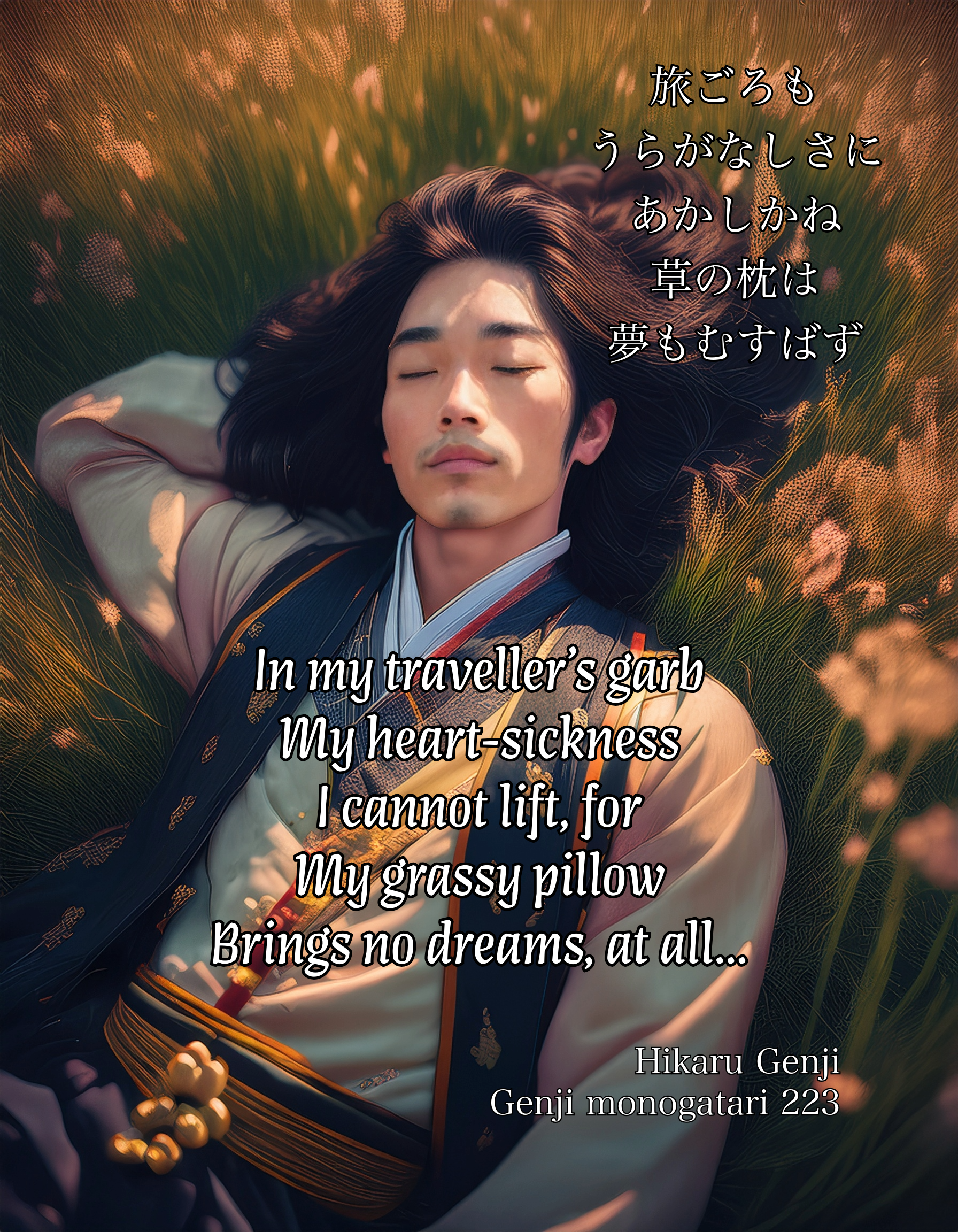
たびごろも袂かたしきこよひもや草のまくらにわれひとりねん
| tabigoromo tamoto katashiki koyoi mo ya kusa no makura ni ware hitori nen | In traveller’s garb, A single spread sleeve, So tonight, as well, Upon a pillow of grass Must I sleep alone? |
567

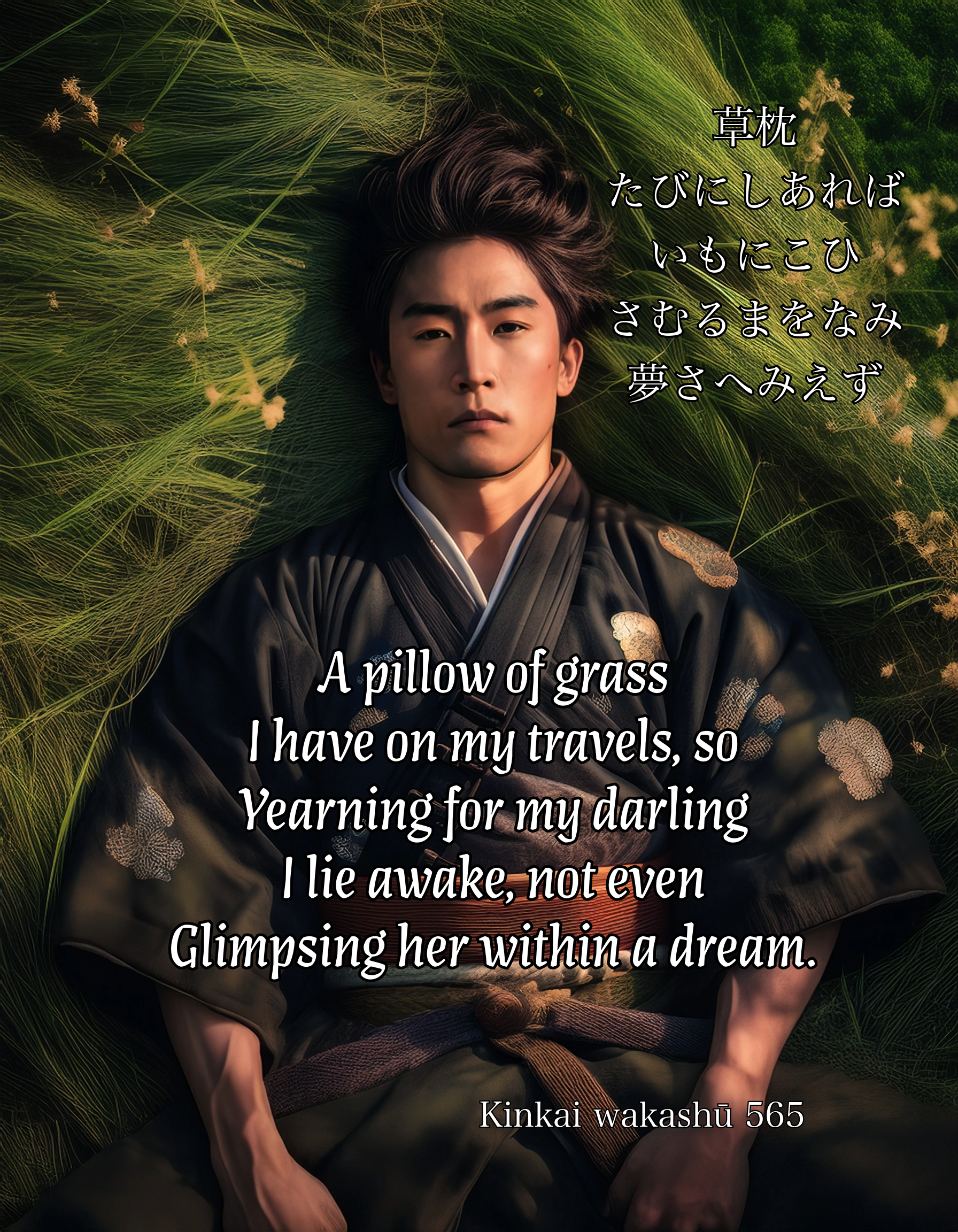
草枕たびにしあればいもにこひさむるまをなみ夢さへみえず
| kusamakura tabi ni shi areba imo ni koi samuru ma o nami yume sae miezu | A pillow of grass I have on my travels, so Yearning for my darling I lie awake, not even Glimpsing her within a dream.[i] |
565
[i] See: 家有者 笥尓盛飯乎 草枕 旅尓之有者 椎之葉尓盛 ie ni areba/ ke ni moru ii o / kusamakura / tabi ni shi areba / shii no ha ni moru ‘When I am at home / The pots are full of rice, but / Pillowed on the grass / On this journey now / Only the chinquapin leaves are plentiful…’ Prince Arima (Man’yōshū II: 142)
Hidden in the grass on the path o’er the plains[i]
Left
なつくればのべのくさばもしげりあひていづれかみちとみえぞわかれぬ
| natsu kureba nobe no kusaba mo shigeriaite izure ka michi to mie zo wakarenu | When the summer comes, The blades of grass upon the plains Grow lushly together, so Which is the path to take I cannot tell by looking! |
9
Right
をちこちのみちみえぬまでなつののはくさばしげくもなりにけるかな
| ochikochi no michi mienu made natsuno no wa kusaba shigeku mo narinikeru kana | Until both distant and nearby Paths I cannot see Across the summer plains Have the blades of grass so lushly Grown, indeed! |
10
Do they not know the features of the summer plains conveyed by ‘Hidden in the grass on the path o’er the plains’? While both Left and Right use ‘blades of grass’, this puts one in mind of fresh grass sprouting in spring showers; and then of the two of them, the Right uses ‘distant and nearby’, which is nothing more than an archaic expression from the Age of Gods used for leg-wearying mountain paths, while at least the Left does not have a tangled argument.
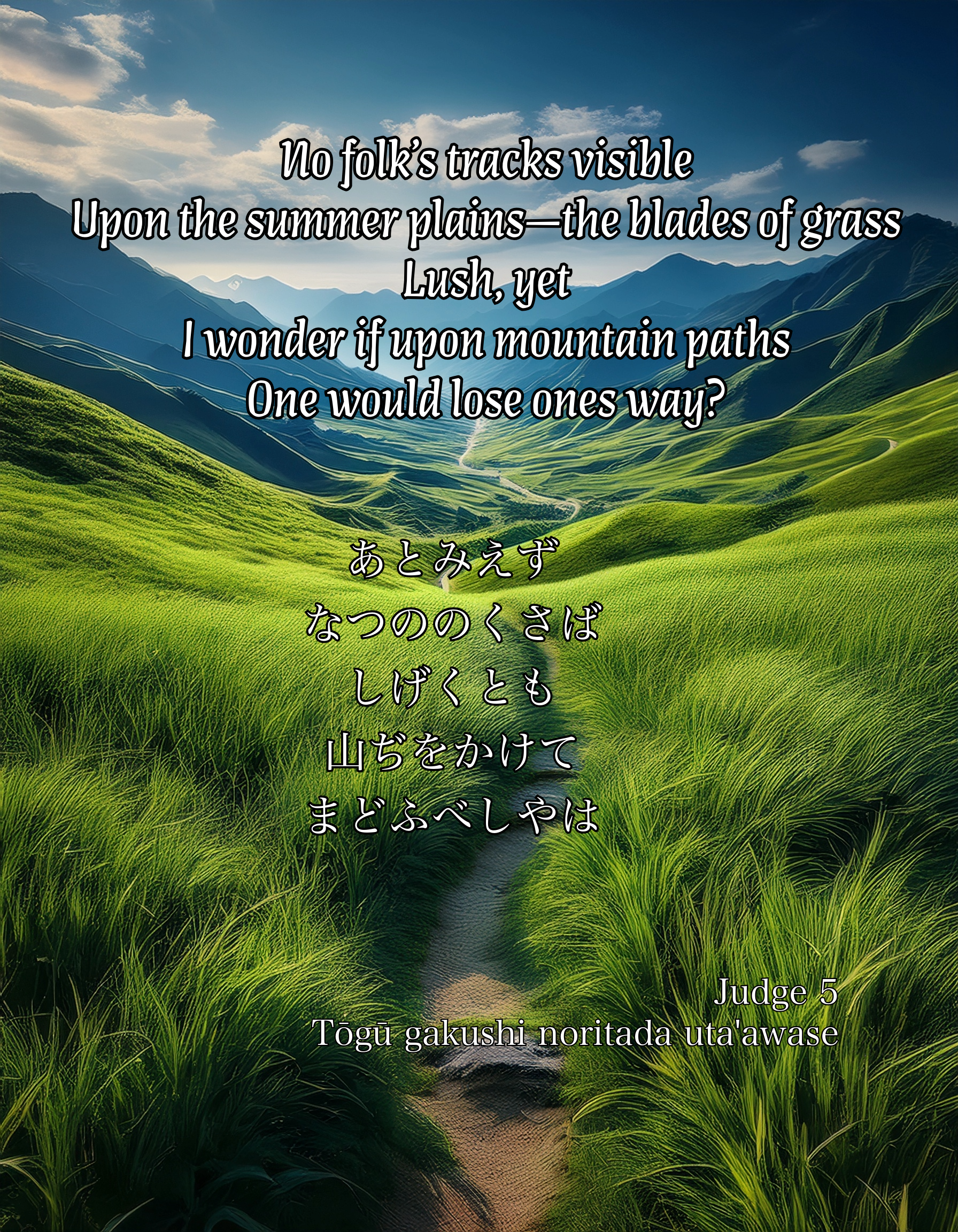
| ato miezu natsuno no kusaba shigeku tomo yamaji o kakete madoubeshi ya wa | No folk’s tracks visible Upon the summer plains—the blades of grass Lush, yet I wonder if upon mountain paths One would lose ones way? |
Judge 5


[i] Yasō no michi shigeshi 野草路滋
Round Ten
Left (Tie)
くさまくらしぐれもそでをぬらしけりみやこをこふるなみだならねど
| kusamakura shigure mo sode o nurashikeri miyako o kouru namida naranedo | On a pillow of grass The showers, too, my sleeves Have soaked; Longing for the capital These tears are not, yet… |
Hiromori
69
Right
かりいほさすならのからはのむらしぐれあはれはまきのおとばかりかは
| kari’io sasu nara no karawa no murashigure aware wa maki no oto bakari ka wa | Erecting a crude hut, The withered leaves of oak are Struck by cloudbursts; Does sadness in the evergreens’ Sound solely lie? |
Dharma Master Chikyō
70
Both Left and Right appear to have elegant configuration and diction, but the Left seems to presents the soaking of sleeves by showers as something novel, while the Right gives a feeling that it is only the sound of evergreens that makes one sad. Thus, these tie.


Round Nine
Left (Tie)
秋はぎを草の枕にむすびてや妻恋ひかねて鹿のふすらん
| akihagi o kusa no makura ni musubite ya tsuma koikanete shika no fusuran | The autumn bush clover For a grassy pillow Has he woven—is that why Unable to love his mate The stag seems to lie? |
Koreyuki
41
Right
妻こふる秋にしなればさをしかの床の山とてうちもふされじ
| tsuma kouru aki ni shi nareba saoshika no toko no yama tote uchi mo fusareji | He yearns for his mate In autumn, above all, so In the stag’s Bed among the mountains He cannot lay him down, it seems. |
Arifusa
42
The Left isn’t bad, but isn’t there Controller Kore’ie’s poem:
秋萩を草の枕にむすぶ夜はちかくもしかのこゑをきくかな
| akihagi o kusa no makura ni musubu yo wa chikaku mo shika no koe o kiku kana | The autumn bush clover For a grassy pillow I weave tonight— Close by, truly, a stag’s Bell I hear! [1] |
While there is this earlier example, neither core nor the conceptions of these poems are the same, and as the Right’s poem is not all that good, after careful consideration I make this a tie.


[1] On hearing a stag at his lodgings. KYS (3) III: 224
Composed on karukaya, when he presented a hundred poem sequence during the reign of former Emperor Horikawa.
秋くればおもひみだるるかるかやのした葉や人の心なるらん
| aki kureba omoimidaruru karukaya no shitaba ya hito no kokoro naruran | When the autumn comes So confused are my thoughts— As the tangled tufts of grass Below are folk’s Feelings, I wonder? |
Major Counsellor Moroyori
大納言師頼